The Help

I spent last summer reading Alexander McCall Smith’s No.1 Ladies Detective Agency series. Now that I’m current with that series, I have moved on to the Isabel Dalhousie series. I met another fan of the Mma Ramotswe novels who told me that I would enjoy the Dalhousie books more and more as I moved through the series, and she couldn’t have been more correct. Like Mma Ramotswe, Isabel thinks about people and doesn’t take their lives for granted. When I was a kid, my mother used to make fun of a close friend of ours who imagined strangers lives out-loud. You would be driving down the street with her in the car and she would notice someone walking and comment on their shirt. “His shirt was pressed by hand,” she might say. “You can tell that his wife cares about how he looks because she took the time to put starch on that shirt.” My mother would chastise her for making presumptions about “that man’s life,” while we were driving 35 mph through the city. “You don’t even know that man,” she would say. Isabel is like our friend in that way.

In the book that I’m reading now, The Right Attitude to Rain, Isabel makes a very poignant observation about the little discussed lives of those in the background of white Southerners of means. Recalling her mother’s stories about her proud southern heritage, Isabel considers the failings:

But there was another side to the heritage of well-to-do Mobile, of course: the dark side of the South–and this was not talked about, or used not to be. It was there, though, and could be seen in the musty family photograph albums, where the servants stood inthe background, under a tree, beside the cars, carrying things.That’s what can lie behind money, thought Isabel; not always,but often: expropriated lives; the lives of people in the background,nameless, forgotten, who never really owned very much.

Isabel recognizes the full humanity of those whose lives have been expropriated by wealthy whites. Kathryn Stockett attempts such recognition in her bestselling and exceedingly popular novel The Help.

It was my interest in depictions of the interior lives of black women as they appeared in popular fiction that led me to McCall Smith and Stockett. Where McCall Smith succeeds, Stockett fails. Though the body of a black women initially compelled McCall Smith to create his character, he gives her life, her past, her friendships, her thoughts a density that matches her form. Stockett’s black women are caricatures. The dialect they speak lacks poetry and her choice to put it into the mouths of all the women to the same degree flattens them. Take Aibileen for example. Aibileen reads W.E.B. DuBois and Fredrick Douglass, two extraordinary thinkers and writers. If she is a reader, especially of these authors, how or why does she speak the same way that Minni does? Shouldn’t reading strong writers with a firm command of English influence her speech?

My grandmother worked as a domestic. I’ve included this photograph of her when she was a girl of about three on this blog before.
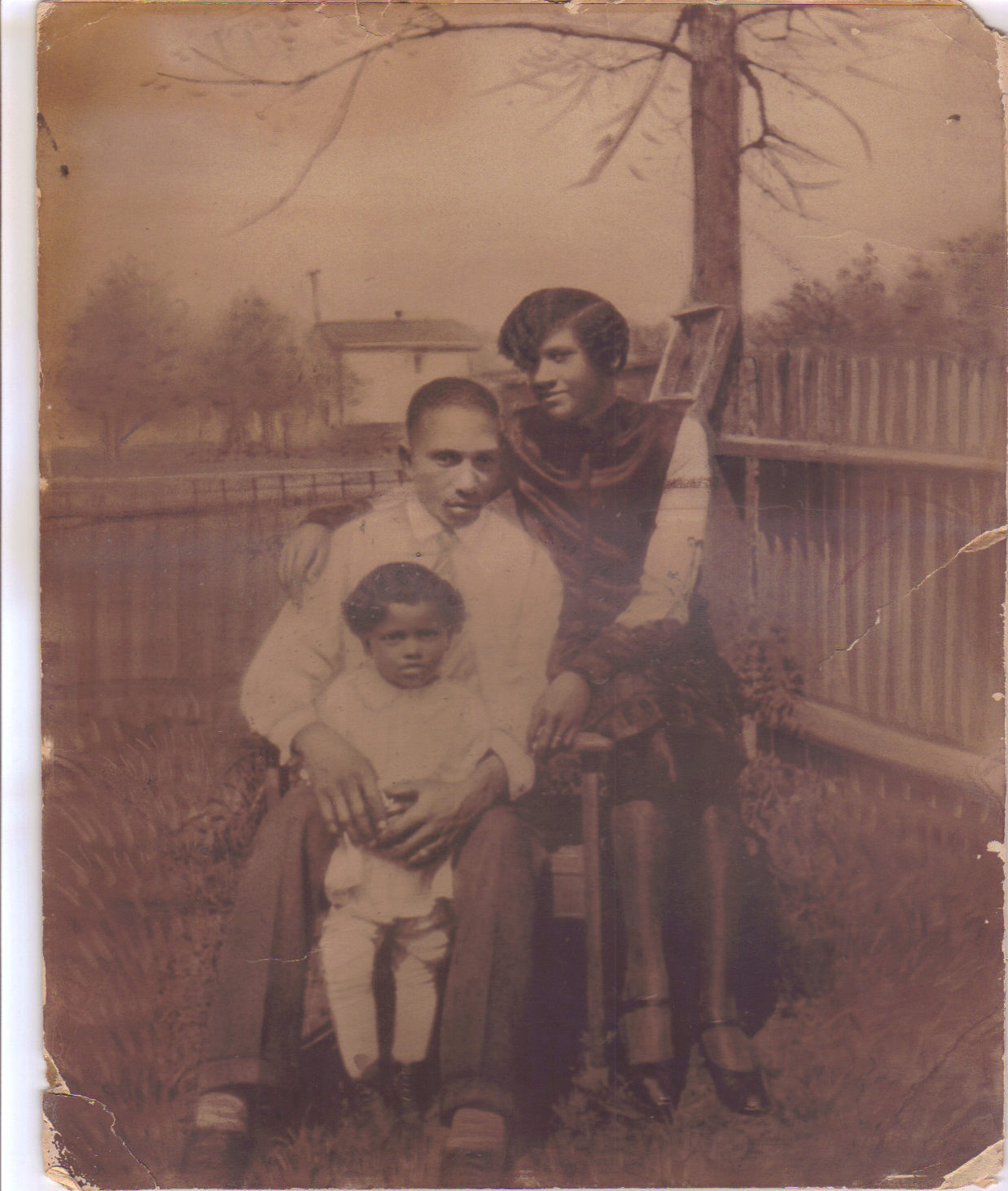
 

This photograph would have been taken in the mid-1920s in Louisville, Kentucky. In 1920, Black women comprised 18 % of the population and 93% of that number worked as laundresses. In spite of the high probability that if my grandmother worked outside of the home, she would work as a domestic in some form, my great-grandfather thought it was very important that she study hard and value formal education. My grandmother, as I noted in another post, graduated from high school when she was sixteen.
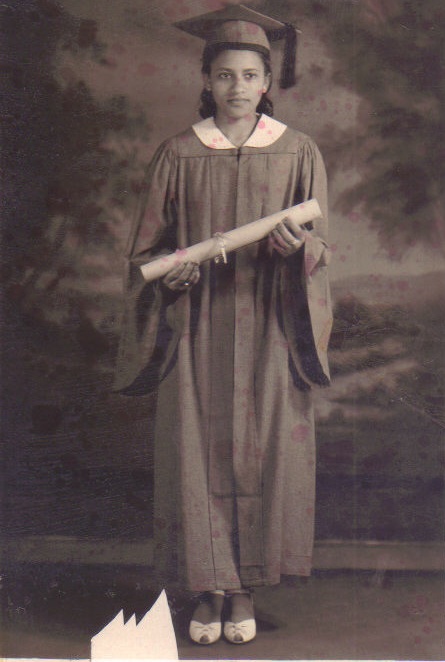
My grandmother did not speak like any of the black women in Stockett’s novel. Certainly some black women I knew have but the variety and the poetry of their speech is mostly missing from her novel.

How might the women in The Help have looked outside the frame of their labor? The characters attend church, live out their lives in their own homes, and ride the bus but did they take pictures of their family and friends? With them? On what occasions? What other hobbies did they have? Did they travel to visit relatives? Where did they go? What did they do while there? Edwidge Danticat offers a representation of the kind of looking that I am describing in her short story “New York Day Women.” In the story, Suzette, while out on her lunch break, spies her mother who is on her way to work as a nanny for a white family. Suzette sees her mother doing things she doesn’t recognize her as enjoying. She catches her mother briefly being at the center of her own life before observing her and other brown women at the center of the lives of white children.

“New York Day Women” in some ways reminds me of the many paintings of laundresses by both European and American artists. So I’m thinking about works by Jean-Baptiste Greuze, Edgar Degas, and Honore Daumier. This work by Robert Henri underscores the striking recognition that Suzette has of her mother in some ways:
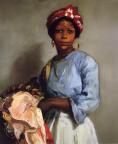
This woman seems caught unaware of being noticed. Suzette recognizes her mother anew and acknowledges her limited view into all aspects of her mother’s life. Henri’s painting casts arduous work in soft light. The load this woman carries, though unfurling, remains under her control. Henri intends for the viewer to see her. I suspect that he imagined a viewer who never really looked at the help; they imagined they already knew them; he offers them unexpected beauty.

Beverly McIver’s paintings of herself in blackface, performing her late mother’s former work as a maid disrupts the limits of perception by staging the mammy/maid paintings around an obvious resistance to nostalgia and sentimentalism.
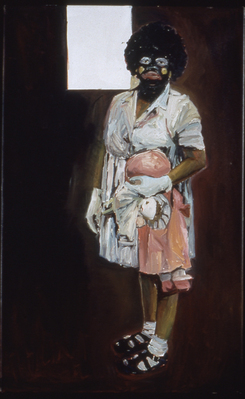
The artist knows we’re looking. Beauty here, seems unlikely. In order to have beauty as a part of this life, it has to be made or fashioned…and doesn’t that seem like it would take an extraordinary effort to make it so?

I do think that Stockett wants to honor the good lives that black maids made for their white charges. What she doesn’t seem to have a sense of is how good they made it for themselves and for their own families.
Kentucke II

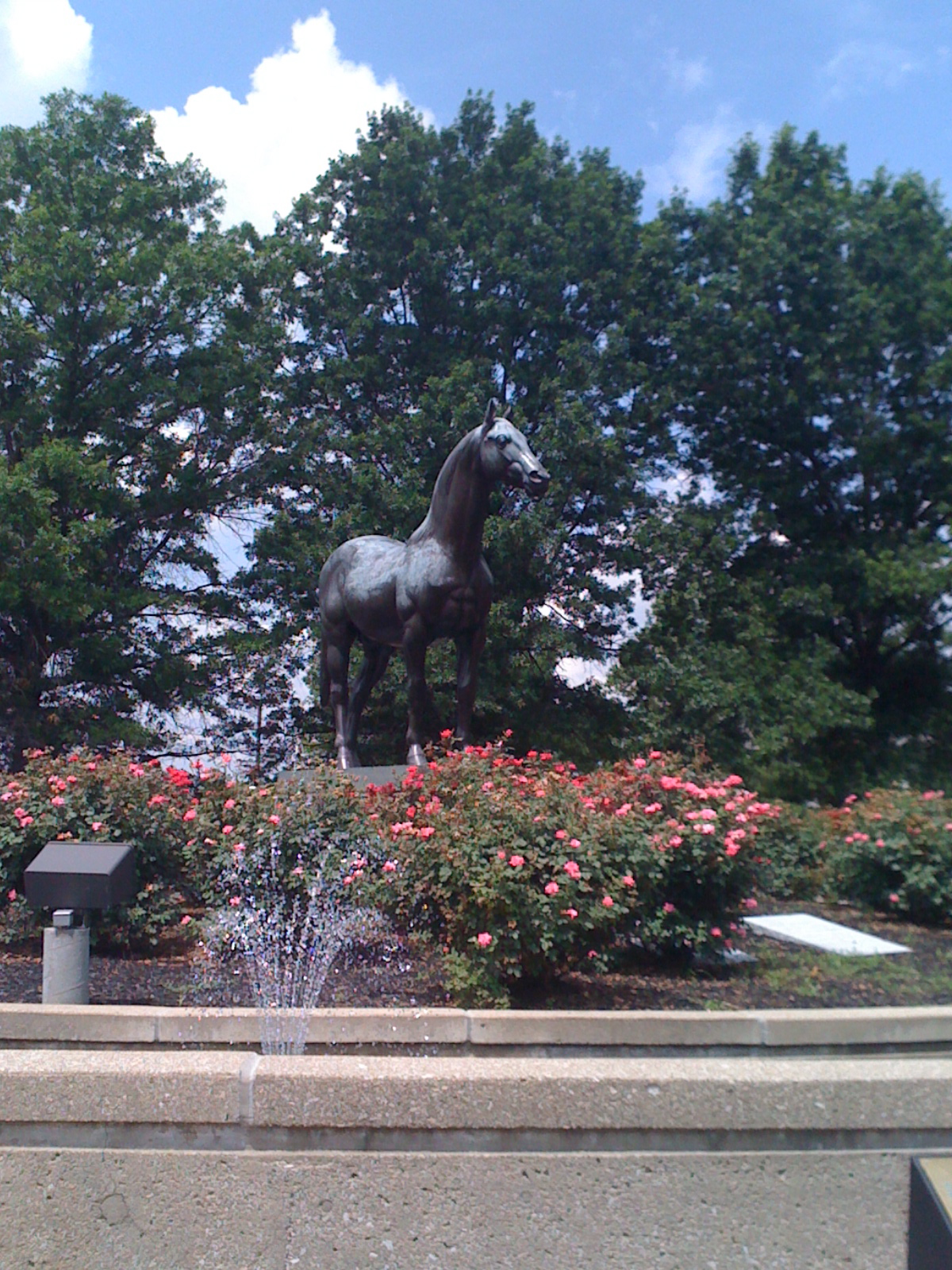
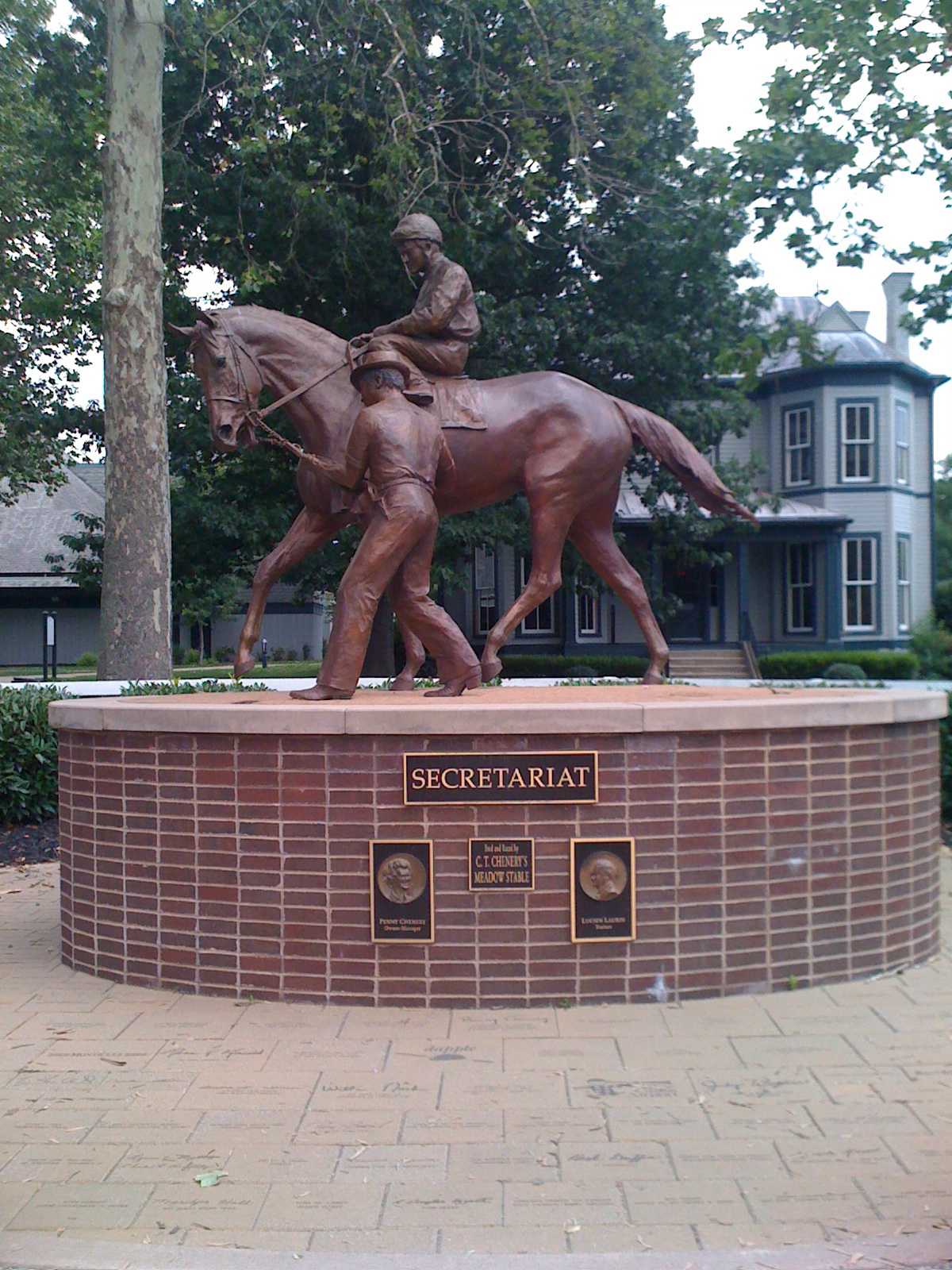
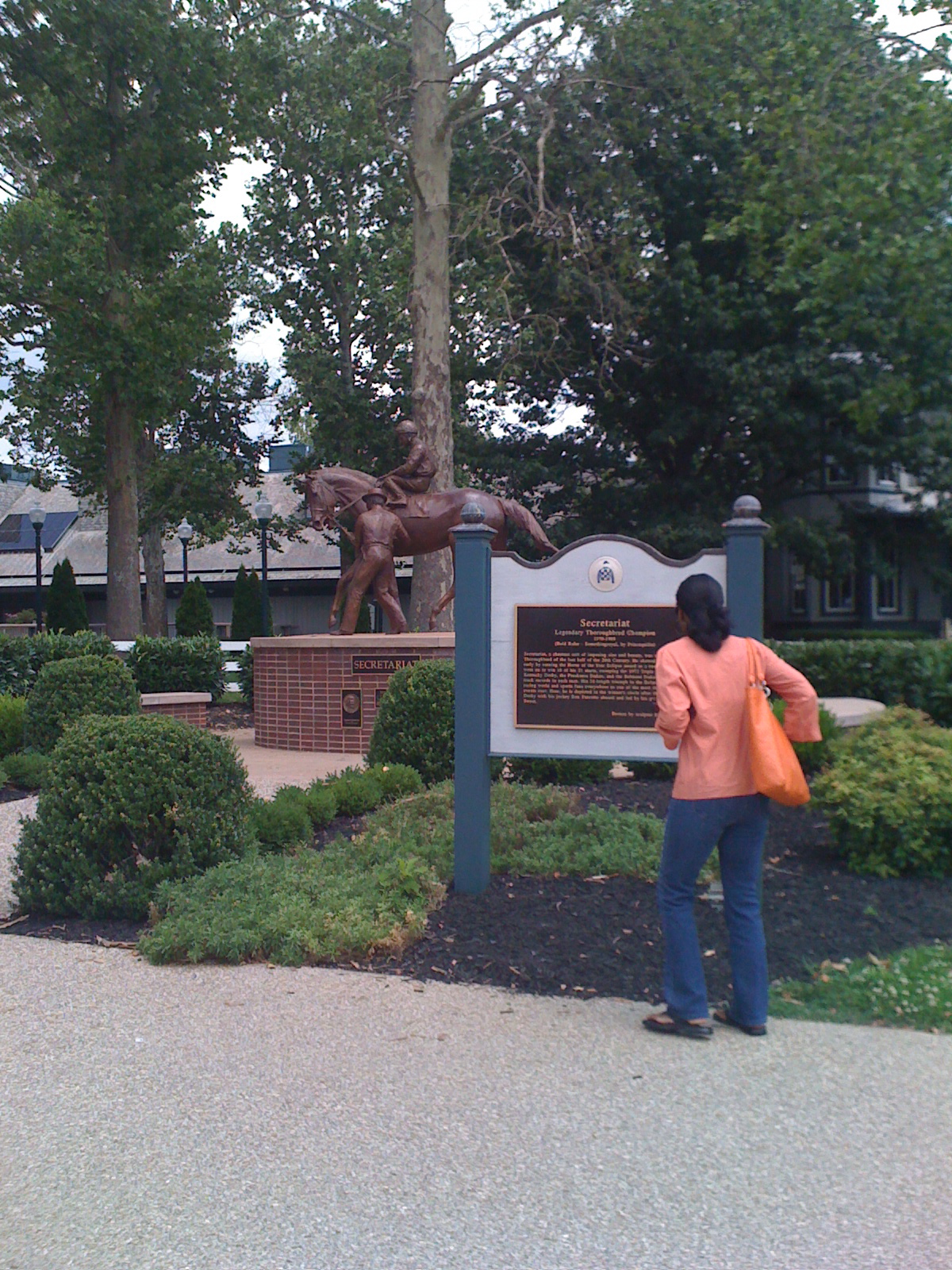
In my effort to begin placing myself into my family’s narrative of the history of black Kentucke, I visited a very good friend who lives in Lexington and we toured places previously of no particular interest. This time, we traveled the city as tourists might. So the Kentucky Horse Park was first on our agenda. There, we were able to visit the memorials erected to some of the greatest horses in Kentucky history. Secretariat greeted us first.

Secretariat became the first Thoroughbred in 25 years to win the triple crown. The sculpture at the KHP features his groom Eddie Sweat as well as Ron Turcotte, the jockey who rode him in the Kentucky Derby in 1973. Secretariat.com contends that the Disney film Secretariat about the famed horse dedicated much time and attention to getting an accurate portrait of Sweat, who was African American. In at least one place, I read that the film is exactly a waste of time because Sweat functions as the product of a limited racial imagination. I plan on making an effort to judge Sweat’s character in the film so stay tuned.

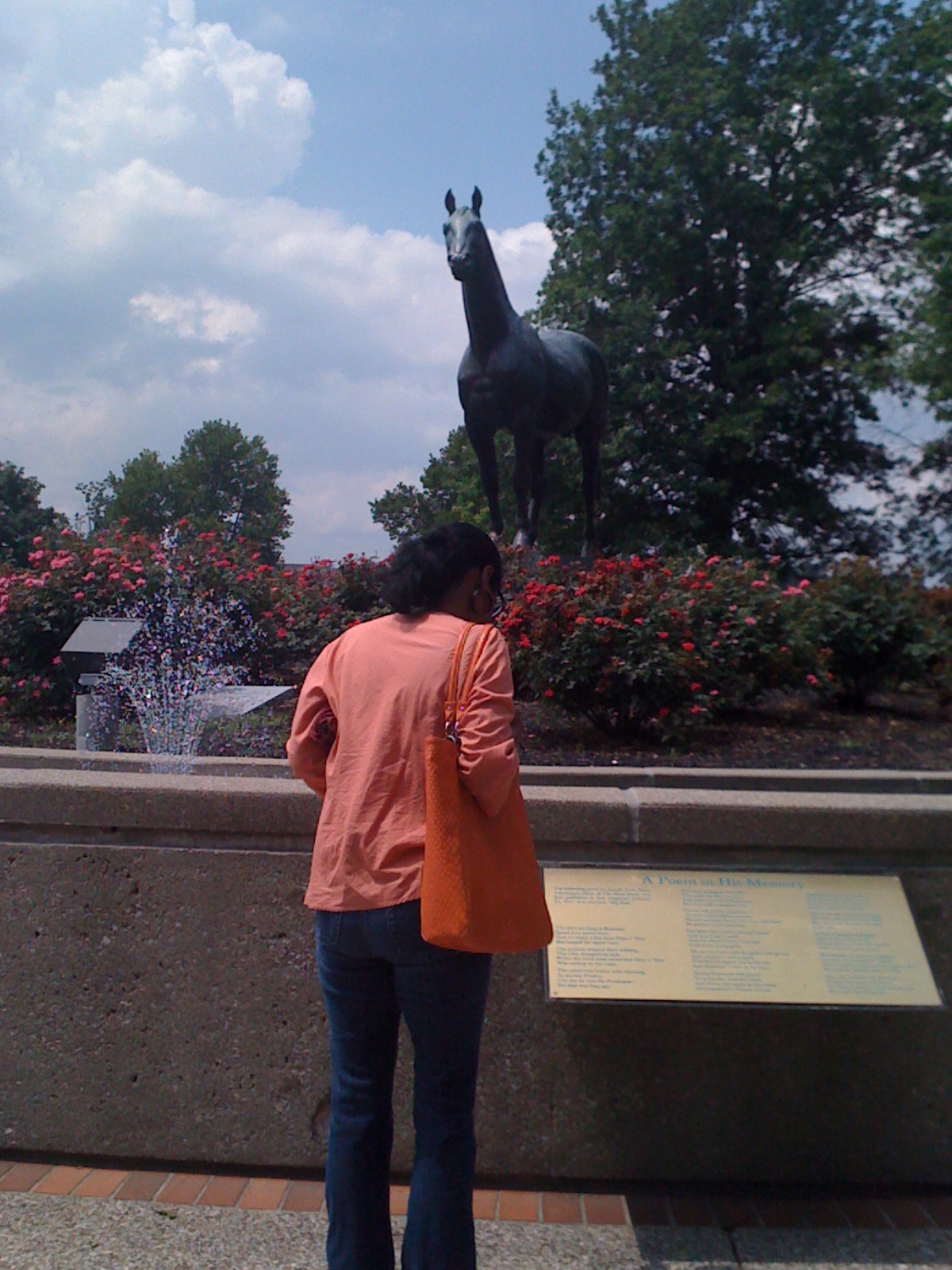
KHP is the final resting place for Man O’ War.

Competing within the context of the Great War, Man O’ War was a horse that excited the imagination during bleak times. Many thought of the horse as the greatest Thoroughbred of the 20th century. In the two years he competed, Man O’ War won 20 out of 21 races.

When I tell people outside of Kentucky, and outside of the horse racing world, that Man O’ War is actually buried here, they seem perplexed. I then have to explain what a tremendous tribute it is to the horses as well as to how much care it shows Kentuckians have for horses; though there have been recent reports on the cruelty shown race horses. There are even Thoroughbred cemeteries in the Bluegrass state. The most renowned of these are Calumet and Claiborne (where Seabiscuit grew up) farms. According to Lucy Zeh, author of Etched in Stone: Thoroughbred Memorials, there are “more than 400 Thoroughbred memorials” in Kentucky.

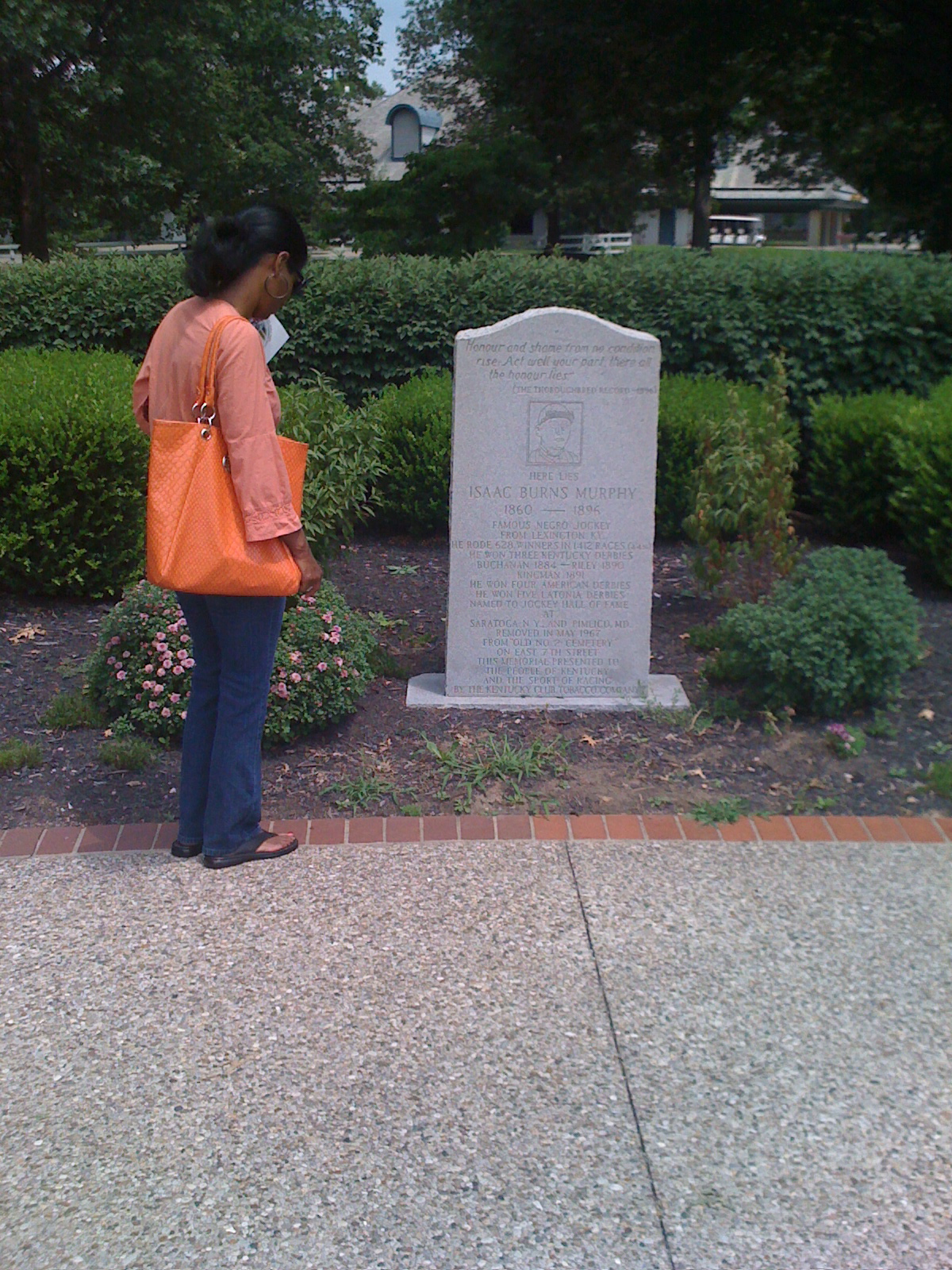
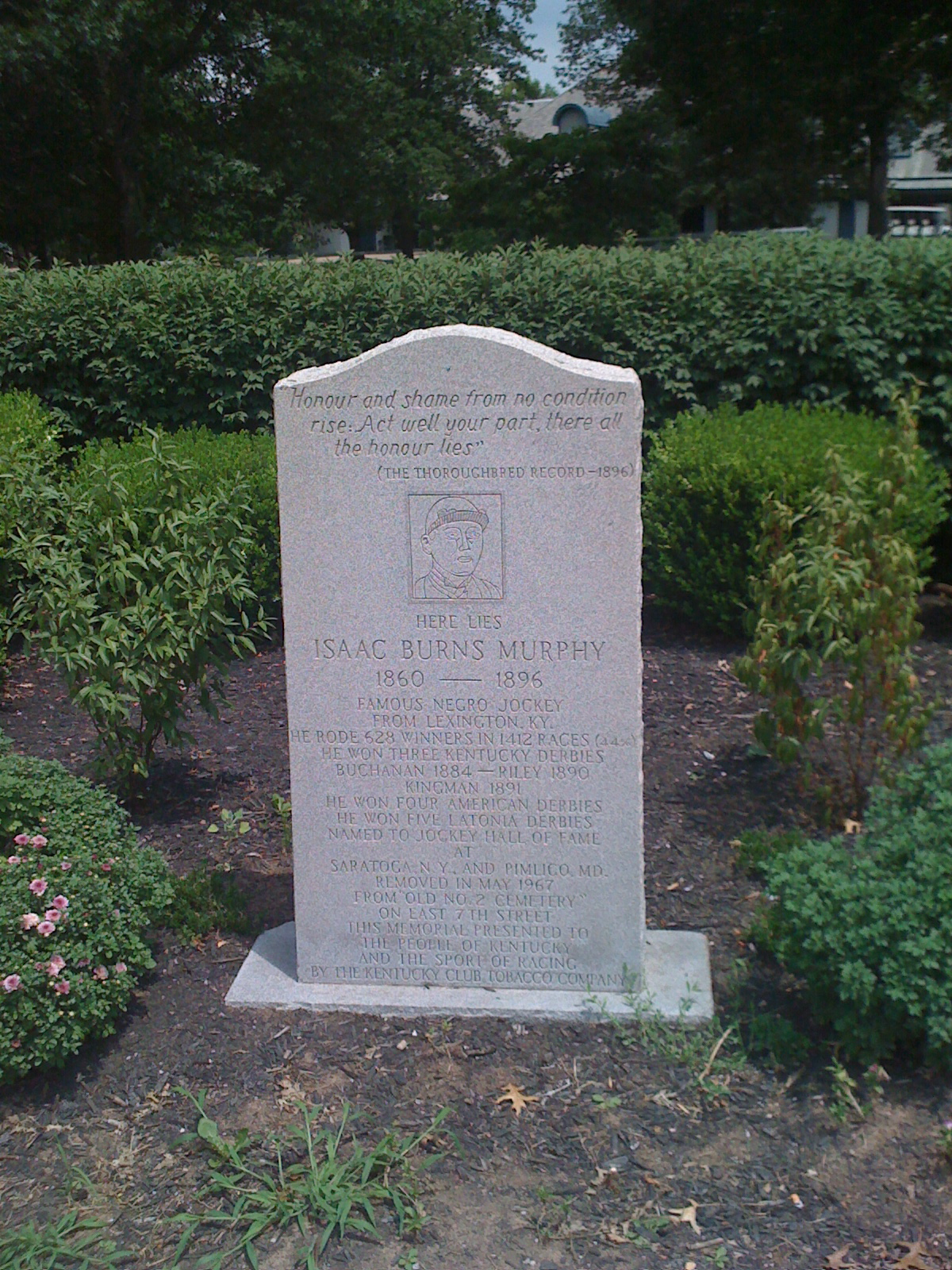
Ostensibly, laying Isaac Murphy’s body directly in sight of Man O’ War’s final resting place extends a high honor to this African American jockey born of the enslaved. History ranks Murphy amongst the greatest jockeys of all time. He won 44% of his mounts and was the first in history to win the Kentucky Derby three times. As a result, he was the first entered into the National Museum of Racing in the pivotal year of 1955.

Though Murphy was initially laid to rest in African Cemetery No. 2, his body was exhumed and moved to Man O’War Park before ultimately coming to rest in its current location. The exhumation proves most interesting because Murphy’s wife Lucy remains buried in an unmarked grave in the African cemetery.

Think about the significance of separating this husband and wife while reading Frank X Walker’s book of poems, I Dedicate This RideHow much of an honor do you find Murphy’s final resting place?

Kentucke

Yes, I know how Kentucky is spelled on a map but this spelling references a Frank X Walker poem in the book Affrilachia, a work I highly recommend. In my reading, the altered spelling references the difference black folk make to the state even though written out of the history and representation of the region; particularly, Appalachia. Walker coined the term Affrilachia after consulting a dictionary and learning that the term Appalachian specifically referenced white residents of the Appalachian region.

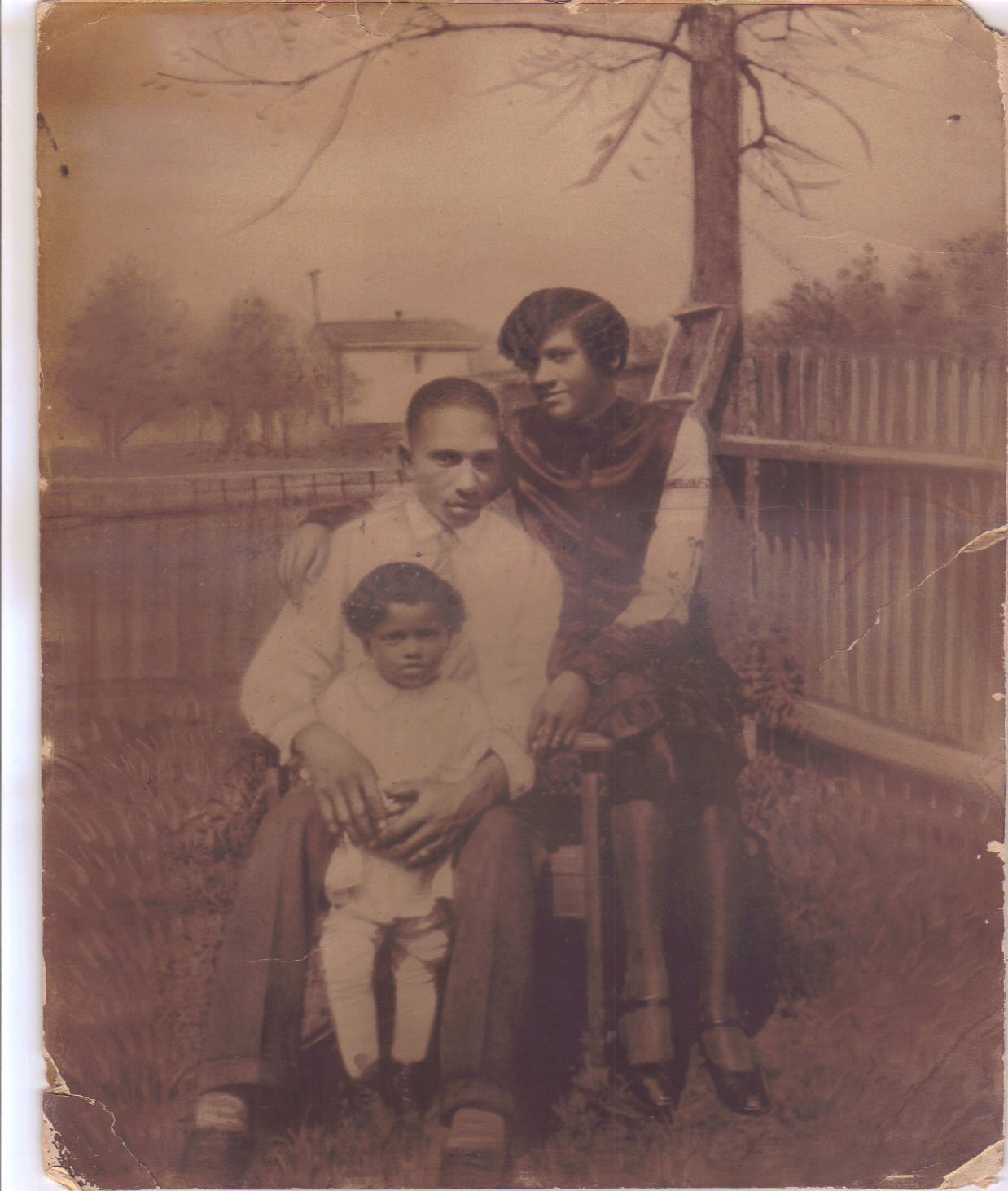
While I lived in Lexington I was underwhelmed by the experience of African American history; not so since I left. My son’s birth brought Kentucke history into greater relief as I set out to mark our family’s history in the state. My grandparents were born in Louisville in the 1920s. I was raised in my grandparent’s home surrounded by gorgeous pictures of their past. This is a photograph of my grandmother and her parents:

My grandmother’s birth mother, pictured here, died of a rare brain tumor shortly after this photograph was taken. My great-grandfather would later marry a wonderful woman who my grandmother would come to call “Ma Ma.”

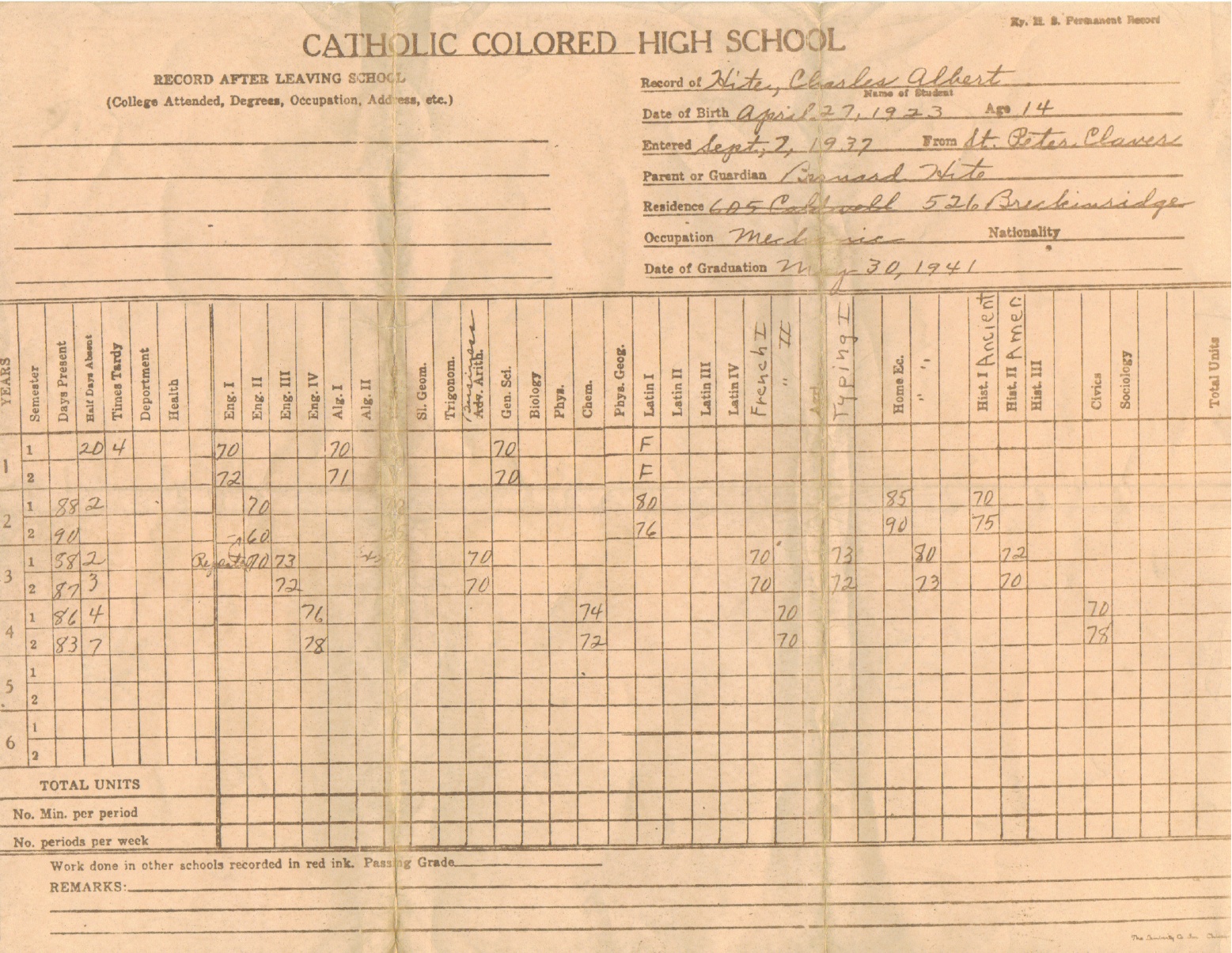
My grandmother and grandfather met while students at Catholic Colored High. I recently obtained a copy of my grandfather’s report card from his years there:

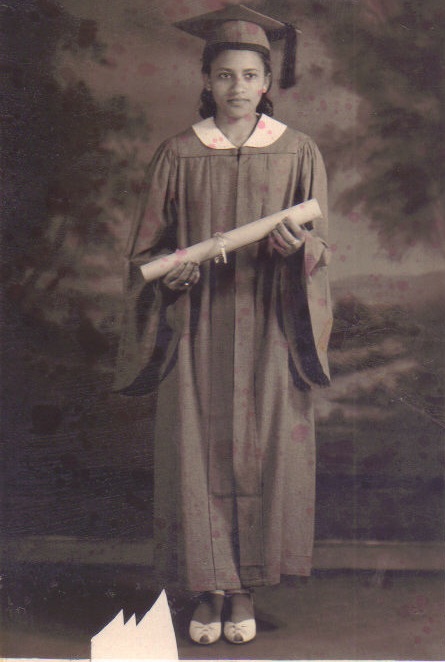
Though my grandfather wasn’t the greatest student, I thought he was a thoughtful man. I wanted to be just like him; think like him; value silence. My grandmother performed much better in school. She was sixteen when she graduated:

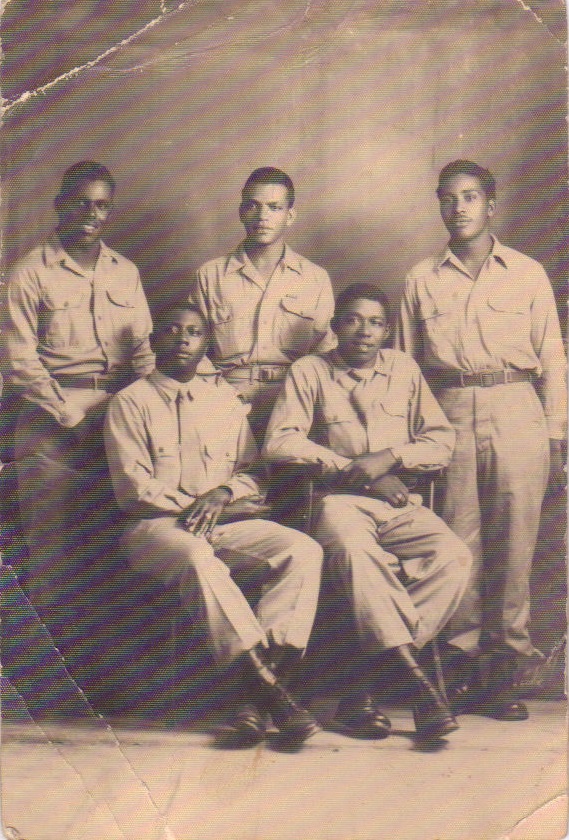
My grandfather served in World War II and he and my grandmother exchanged photographs while he was stationed in the Pacific:

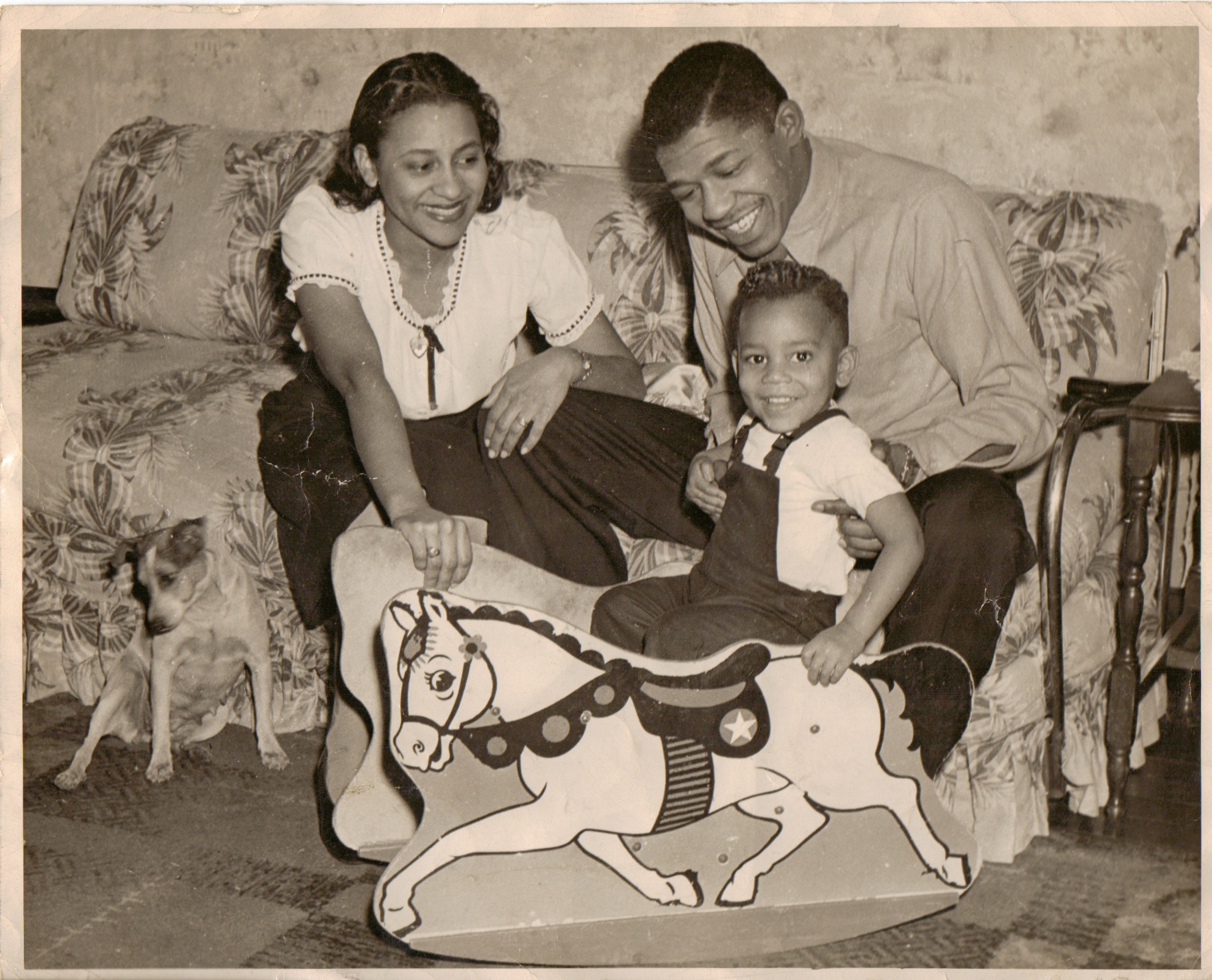
When he returned from the war, he and my grandmother would pose for a picture that would become a family classic:

Everyone in my immediately family loves this photograph and they used to fight over who should own it. My Aunt Sharon used to own the only copy we knew to exist but we recently learned that my Aunt Shirley, my grandmother’s sister, owned a copy.

When I grew-up, photographs like these covered our basement walls. One of the reasons why I think bell hooks’s “In Our Glory” is one of the top ten essays ever written is because it helps me understood why these images were so important. hooks writes:

Most Southern black folks grew up in a context where snapshots and the more stylized photographs taken by professional photographers were the easiest images to produce. Displaying these images in everyday life was as central as making them. The walls of images in Southern black homes were sites of resistance. They constituted private, black-owned and operated gallery space where images could be displayed, shown to friends and strangers. These walls were a space where, in the midst of segregation, the hardship of apartheid, dehumanization could be countered. Images could be critically considered, subjects positioned according to individual desire.

It took me a while to realize it, but my family’s walls were the first place for making Kentucke an important site for considering, observing, and appreciating black history.

Models Monday: On Free Land


IMG_1573
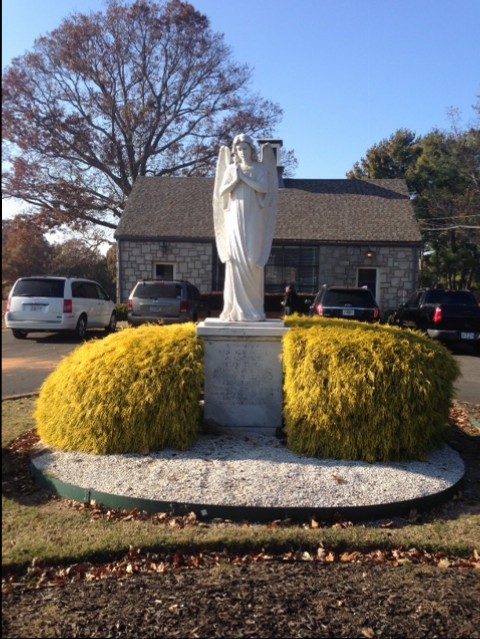
South-View Cemetery. November 15, 2014

This past weekend, I visited South-View Cemetery with a few friends. South-View was granted its charter on April 21, 1886 and so became the first for-profit cemetery for African Americans in the United States. Beneath the names of the six men who established this charter reads its significance: “To provide a respectable place for Christian burials.” In chartering South-View as an African American burial ground, black people could enter through the front gates, did not have to wade through swampy land, and accept the many forms of degradation that undermine attempts to commemorate black American lives.

I was originally drawn to South-View because it was the site of Martin Luther King Jr.’s original burial. I had been interested in the route his body took from Memphis, to Sisters Chapel on the campus of Spelman College, to Ebenezer Baptist Church, to Morehouse College, and finally to South-View. King’s body resided in South-View until early January in 1970 when Mrs. King had his body reinterred at was has become the Martin Luther King Jr., Center for Nonviolent Social Change.

I read a very interesting article in the Washington Post a few years back about an aging caretaker of a rural African-American cemetery in Loudoun County, Virginia. For more than fifty years, Vernon Peterson, 80, has taken care of Rock Hill cemetery where African Americans have buried their kin since 1889. Upon ending his service to the United States Army, Peterson returned home and found the cemetery in disrepair. He immediately began weeding around the graves and for $50 a year to meet expenses, he continues to maintain the cemetery.

I was struck by one of the photographs accompanying the article where Peterson is shown plotting the graves of every single person buried in the cemetery in a book to be given to his successor:

Tracy A. Woodward. The Washington Post.

The photographer has captured the eloquence of Mr. Peterson’s quiet work, the care he shows in making a record of lives. His hand unhurried, Peterson enters the names of many people he never knew, and some he did, between neatly drawn lines that strive for the order he endeavors to give the places where their bodies rest.

I am intrigued by Mr. Peterson’s use of time. I admire the discipline it takes to honor self-given tasks. School and work often impose deadlines that force action, without such pressures, some tasks may never be completed. Peterson, on the other hand, is his own master since he directs his own tasks. He’s a wonderful example of how to be free.

Menu Plan: 27 March — 2 April 2011

Sunday
  • Spinach and Swiss Cheese Quiche
  • Spanish Rice Nachos
  • Chicken Piccata, Mashed Potatoes and Peas

Monday

  • Pancakes, Yogurt, Bananas
  • Spanish Rice Nachos/Salad
  • Vegetable Soup and Grilled Cheese Sandwiches

Tuesday

  • Pancakes, Yogurt, Bananas
  • Spanish Rice Nachos/Salad
  • Leftovers

Wednesday

  • Pancakes, Yogurt, Bananas
  • PB and J
  • Pizza/Salad

Thursday

  • Pancakes, Yogurt, Bananas
  • PB & J
  • Leftovers

Friday

  • Grilled Cheese
  • Leftovers
  • Sloppy J and Fries

The Dinner Table

Sometimes I see advertisements that force me to really work at understanding the desires they seek to arouse. More pointedly, I find myself straining to make sense of what I’m supposed to want. The narratives of the ads aren’t always apparent. So while I understand that I’m supposed to want to wear the clothing that Kimora Lee Simmons and her daughters are wearing since Baby Phat makes that their business, I’m not sure why this image makes these goods attractive. While I really enjoy eating, there is no food here. There is nothing that makes my mouth water…but I guess all of my salivating is supposed to occur over all of the expensive stuff on display in the ostensibly sumptuous red room. I guess. But now I don’t understand why one’s children would be a part of the sale of those goods. Am I supposed to want her children? In what way?

John Ficara, Black Farmers in America. The University Press of Kentucky, 2006.

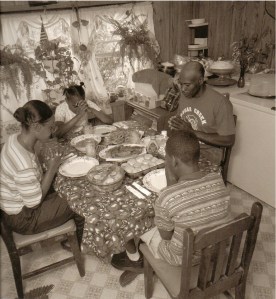
While not an advertisement, John Ficara’s photograph of a family meal in his book Black Farmers in America makes sense. Arranged around their kitchen table, Belinda, Jonathan, Roger, and Kendra Lamar bow their heads in prayer over what appears to be a delicious meal of rolls, onion rings, fried fish (or maybe chicken), beans (maybe pinto) and a green salad. While their glasses are empty I imagine they will soon be filled with the “house wine” of Putnam County, Georgia, sweet tea–as it is the choice spirit of the South in general. In the background, I spy the silhouette of what I believe to be a delicious white cake with butter cream icing. Have mercy. The direction of my desires are clear.

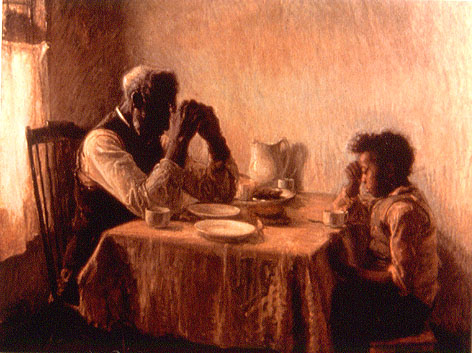
Reminiscent of Henry Ossawa Tanner’s painting “The Thankful Poor,” humility and reverence makes this an attractive scene.

"The Thankful Poor," Tanner.

This family expresses gratitude for their bounty. I can almost hear them giving thanks for the hands that lovingly prepared the food that will nourish their bodies; for their family who have all been brought together in love. The bounty here is intelligible.

I prefer this grace to the ostensible glamour of the other scene. As there are boundaries here, I can imagine an adult conversation. Such an exchange is predicated on instructing the children, and this begins with the prayer of gratitude. Despite Kimora Lee Simmons’s status as a business “mogul,” the photograph showing her daughter spread across the dinner table does not suggest that she is adequately in control of her home. Again, I am still unclear about why I should want to buy what Baby Phat is selling.

Meal Plan: 13 March-18 March 2011

Sunday:

  • Vanilla Yogurt Parfait with bananas and nuts and Grilled Cheese (B)
  • Sloppy Joe’s (L)
  • Turkey Stew and Salad (I made a recipe for Braised Turkey legs from Simply Recipes that I adapted and it was fantastic) (D)

Monday:

  • Vanilla Yogurt Parfait with bananas and nuts (B)
  • Sloppy Joe’s (L)
  • Hamburger Stroganoff (D)

Tuesday:

  • Yogurt, Grits, and Fruit for Miles (B)
  • Peanut Butter and Jelly for Miles (L)
  • Leftovers (D)

Wednesday:

  • Yogurt, Banana Bread (from the freezer), grits for Miles (B)
  • Peanut Butter and Jelly, fruit for Miles (L)
  • Hawaiian Chicken and Rice (D)

Thursday:

  • Yogurt, Banana Bread, grits for Miles (B)
  • Mac and Cheese, fruit for Miles (L)
  • Leftovers

Friday: Eat out

Saturday: Make the next Meal Plan

Duck and Goose: Knowing when to stop

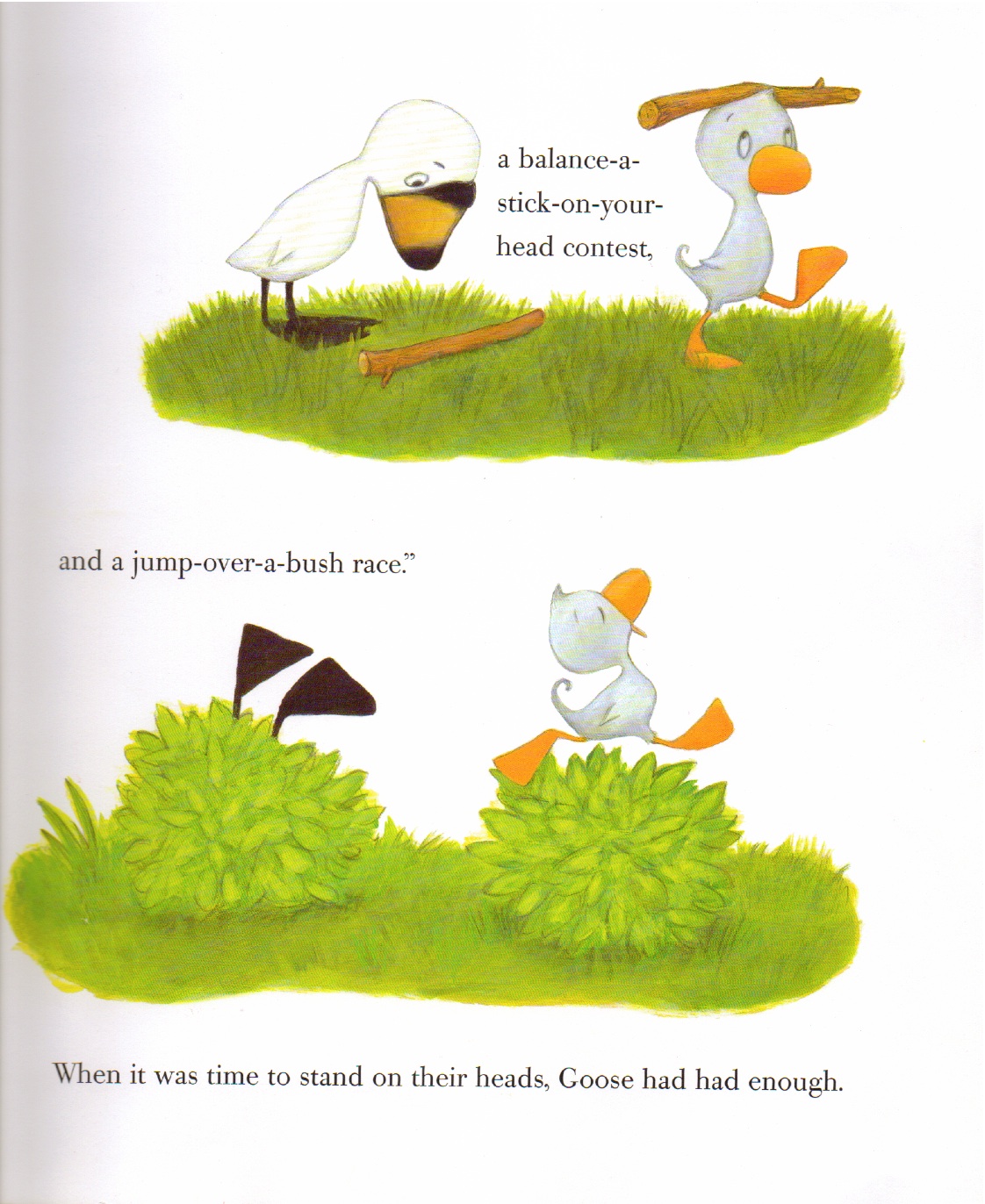
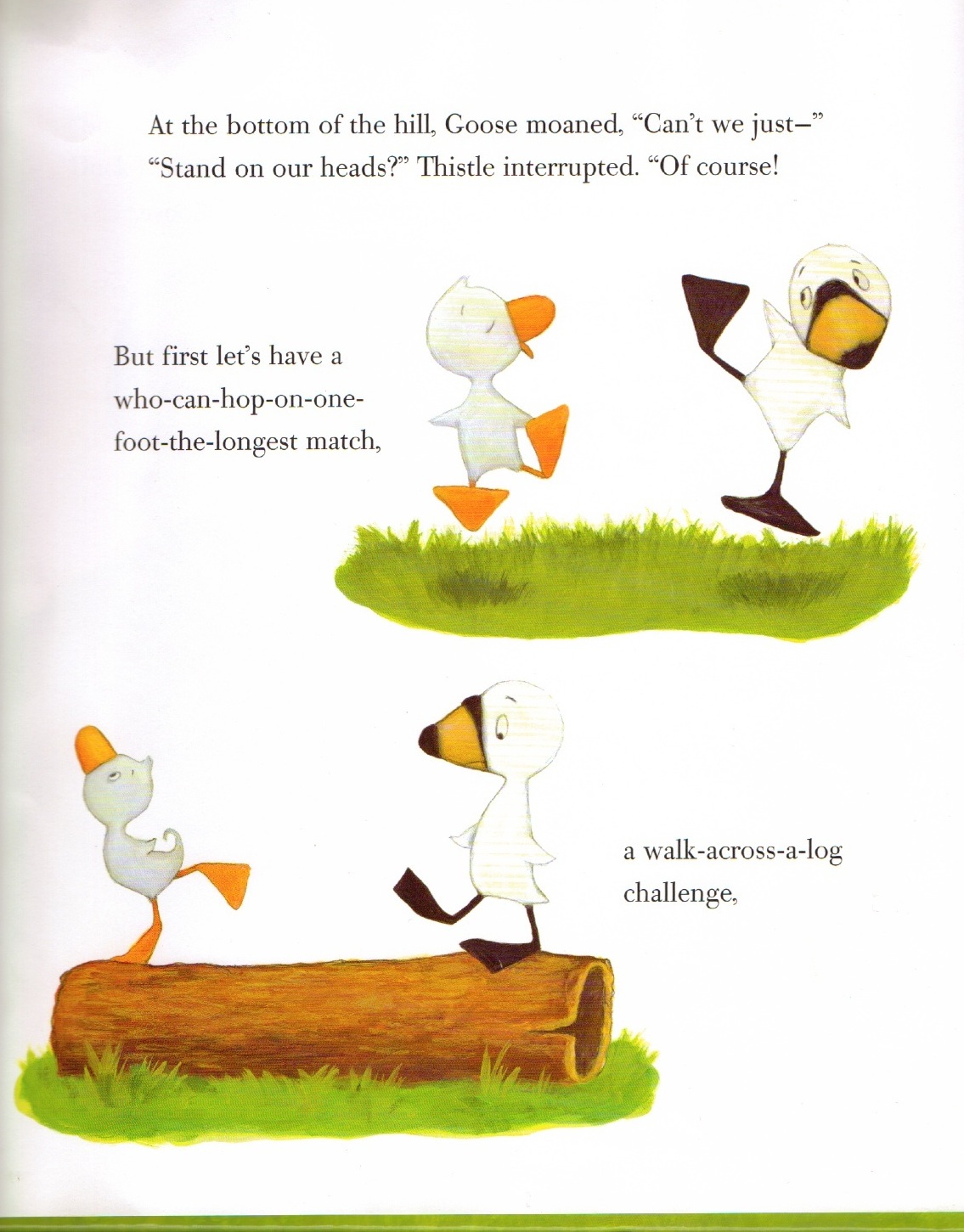
Usually, I end the evening with my son reading first, Duck and Goose followed by Duck, Duck, Goose both by Tad Hills. In the first book, Duck and Goose discover a ball that they mistake for an egg. In responding to what they take to be the egg’s needs, they develop an appreciation for one another that blossoms into a friendship. In Duck, Duck, Goose a new duck, Thistle, introduces competition into what had been a mostly cooperative relationship. My favorite part of the book occurs when Goose decides that he has had enough of Thistle’s contests.

Tad Hills. Duck, Duck, Goose. Schwartz and Wade, 2007.

I love that Goose has boundaries. Though he acts as a good sport and participates as much as he can in Thistle’s games, he ultimately decides to move on to something else. “I’d rather look for butterflies,” he decides.

I thought about this as I read an excerpt from Christina Haag’s memoir, Come to the Edge, published in Vanity Fair. Unlike VF’s description, I found nothing “magical” about the trip Haag and John F. Kennedy Jr. took to Jamaica. I judged his “fearlessness” to be reckless and their “romance” to be patriarchal. The example that proves the case is the story Haag relates of the time he took her kayaking in Jamaica after she had broken her foot. Before they encounter the reef that could have killed them or the “enormous swell” that might have, she describes her reluctance and offers his response:

” ‘It’s a reef–turn back, King,’ I heard myself saying in a voice much higher-pitched than my own. We paddled back out and convened. ‘You’re first mate and I’m captain, but we’re a team and I need you behind me,’ he said. ‘If we pull in and you say no for any reason–any reason at all–I’ll turn back.’ He kept his eyes on me and waited. There were bits of dried salt on his large brown shoulders. I wanted that desert-island fantasy, sand and all. I also wanted to feel powerful, as afraid as I was. And somewhere in the mix, I wanted to please him. ‘O.K. But you promise?’ ‘Don’t worry, I promise.’ ”

I had to read this several times before I felt certain I understood what happened. I was confused by the conversation following Haag telling Kennedy, who she affectionately called King, to “turn back.” She told him to “turn in” and he didn’t so how could they even be having the conversation they presumably had where Kennedy tells Haag that if she tells him to turn in for any reason, he will? Though I completely sympathize with Haag’s desire to want to please and found it admirable that she admits this, I did not regard this scenario as attractive. Kennedy seemed insensitive and self-absorbed. There is nothing magical or romantic about someone ignoring you and asking that you forsake your concerns for theirs; that’s just manipulative.

I guess that’s what I like about Goose, he knew when he had enough. Knowing when to stop, yeah, that’s attractive.

Preparing Meals

I am new to meal planning. I have been enjoying several simple and frugal living blogs, which all rave about it. I am finding it an incredibly responsible way to shop, cook, and eat.

My first week’s plan reflects a week when I had no outside commitments. Now that that has changed, my plan shows that I have obligations outside the home on Tuesdays and Thursdays. What I loved about other people’s meal plans was that they mostly cooked for several days and then had a leftover night. The brilliance of this plan was that one could then choose from several previous meals when selecting. This was something I had never considered before and my husband is not as much of a fan of leftovers as I am. In order to accommodate him, my ambition was simply to try to learn to cook smaller portions. Now, while I try to be mindful of cooking smaller portions, my plans usually involve enjoying leftovers for lunch and thinking about coming days while keeping variety through a series of fresh options. In light of my schedule, I cook fresh meals on Friday, Saturday, Sunday, and Monday. The other two are reserved for leftovers.


I am Enough

7e4478f8dd4f01af01121e1a414d29721I shared a heartbreaking story with a friend about someone I knew from graduate school who had been exploited, along with her daughter, through her child’s vulnerability. My friend then passed on a mantra that has now deeply impressed everyone I have shared it with: “The first thing I say to myself when I wake up in the morning is ‘I am enough,'” she said. “After that, I know that I can greet my daughter as she wakes up and let her know that whatever she has to confront, I am prepared to meet that too,” she confided. What a wonderful way to greet the day: With crucial information necessary for meeting the surprises that might be in store for us but also the daily challenges interlaced throughout those moments that challenge our feelings of sufficiency. I was flipping through several popular magazines last night and saw all of the shoes that they wanted me to buy, the parties that I was not invited to attend, the people who I should want to know but do not and I decided that “I am enough,” despite what they think is missing. Knowing that I am enough gives me the power to disagree with the glossiest of authorities.