G.O.A.T.

The Great of All Times
The Greatest of All Times

By the time I was aware of anything going on in my life and in the world, Muhammad Ali was ending his career and thus very far from his glory days. I have no idea how I became aware of him, saw him as the Greatest of All Times (G.O.A.T.) as he said of himself, and an avid fan. I read a great deal about him, mostly about his years as Cassius Clay, his joining the Nation of Islam and taking the name Muhammad Ali, his refusal to fight in Vietnam, and his first fight against George Foreman.

I’ve been thinking a great deal about Ali lately because I want to visit the Muhammad Ali Center in Louisville, Kentucky but doubt that there’s enough time this summer to go. Recently, I bought a poster with a photo of Ali with his answer to the question how he would like to be remembered:

I’d like to be remembered as a black man who won the heavyweight title; who was humorous; and who never looked down on those who looked up to him; a man who stood for freedom, justice, and equality; and I wouldn’t even mind if folks forgot how pretty I was.

I chose the poster primarily because I liked that he wanted to be remembered as someone “who never looked down on those who looked up to him.” For me, this sentiment testifies to my view of someone I regard as highly principled (except when it comes to women…with women, Ali was about as patriarchal as they come). I find it very hard to lack admiration for people who are willing to risk something important to them because of their principles (though this does not include those people who harass women at abortion clinics and kill doctors and nurses; their actions are less matters of principle and more about intolerance and intractable ideology masquerading as principle).

Given the respect and admiration that I have for Ali, I am not dismissive of his limitations. As I noted above, he was most certainly a womanizer. At the same time, when I read the Introduction to my favorite sports writer Gerald Early’s The Muhammad Ali Reader I was offended by it and thought it unnecessarily cruel regarding several aspects of his discussion of Ali. After diminishing the value of Ali’s refusal to serve in Vietnam and finding his rationale unconvincing, Early writes, “Ali, despite all the talk of his brilliance, was not a thoughtful man. He was not conversant with ideas. Indeed, he hadn’t a single idea in his head, really” (XI). According to Early, Ali’s lack of “brilliance” and thoughtfulness depends on very formal terms of education. For example, the first sentence in Part Two of the Introduction begins, “Muhammad Ali could barely read. He certainly never read books” (XV). While I am a strong advocate of reading, the texts that I include as legible extend beyond the printed word. Due to enslavement, scores of black Americans could not read letters, but they could certainly read their world; where they might find safety and shelter; who they might trust. In my lifetime, I knew people who lacked formal education but were expert observers of the doctors and nurses whose care they were under; they could read when they were being insulted; they could help their children with their homework by encouraging their curiosity and providing all the tools they needed to support and supplement their schooling. So while Early contends that Ali didn’t read books, I have read scholars whose writing, specifically about black folk, suggests they don’t think to much about what they have read, how they have read, and what they then say about black people. For example, one scholar writes this in the last paragraph of her examination of the Tuskegee Syphilis crimes:

There is widespread anger that the criminal courts never meted out punishment to those still alive who established and perpetuated it. That kind of judicial assessment is impossible to provide now, if it ever was possible.

Why might it never have been possible to render justice in the wake of crimes against those men and their families in the Tuskegee case? How could those complications have been more difficult than rendering justice in the aftermath of World War II? Somehow, the world figured that out. As far as I’m concerned this endowed history professor hasn’t read her history very well.

Early goes on to write that what “fascinated Ali, like many of the poorly educated, was the authority of books or their failure as authority” (XV). Seems to me that analytical minds would most certainly engage in the question of “the authority of books or their failure as authority.” In part, this investment is what was central to the “canon wars” in the 1980s and it’s certainly at the heart of debates concerning what should be taught in compulsory education.

While Early admits that with respect to Ali, no measure exists to identify “the range of his curiosity or his humanity,” this meager compliment in no way compensates for the preceding insults:

Ali scored a 16 on the Army intelligence tests, indicating that he had a low IQ. A man of his wit and quickness could not be that dumb, we protest. Yet I think the score was an honest reflection of Ali’s mental abilities. Ali was not literate, nor was he analytical. (XV)

In a single paragraph, Ali goes from being “barely” literate to illiterate and Early actually considers the results of the Army’s IQ tests reliable markers of anything meaningful? There are numerous accounts of men feigning mental and physical illness, performing poorly on IQ tests, and fleeing to Canada among other ways of escaping the draft. Leaving out these historical details or stacking the deck in favor of his own conclusion has greatly impacted my appreciation for Early’s work. Though I purchased The Muhammad Ali Reader when it was first published in 1998, I have yet to read beyond the Introduction because I don’t think I can trust the choices made regarding the essays Early selected.

Despite the many aspersions Early casts against Ali, I still think he “shook up the world” for the better.
Models Monday: Contentment

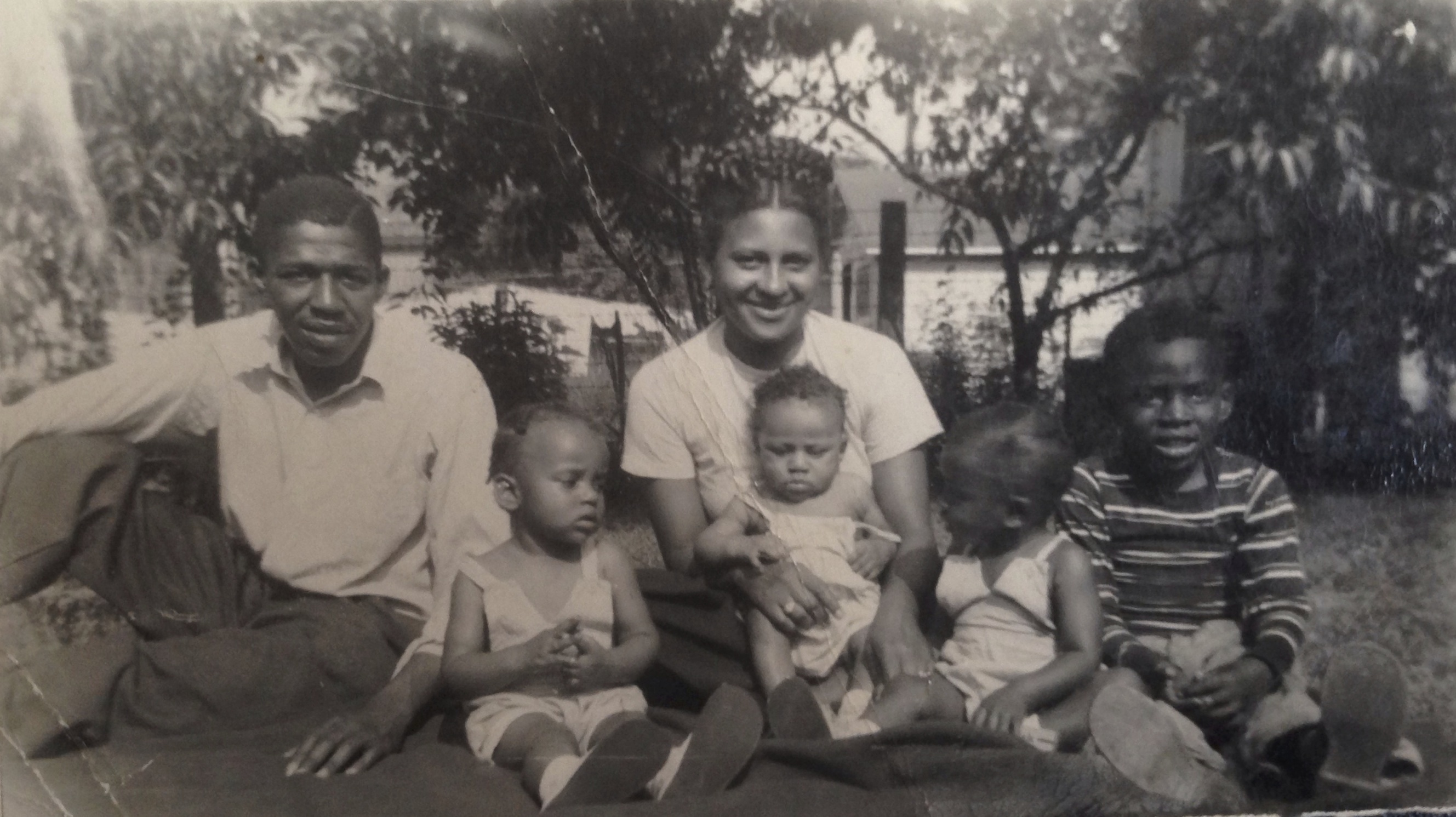
In addition to the many photos I took of Legos while I was at the Great Lakes Science Center in Cleveland last week, I also scanned about as many old photos from family albums that my Aunt Sharon maintains. I used a really good free app that my husband introduced me to called “genius scan” to reproduce all that I could in such a short time. This image is one of my favorite:

Family of 6

I’ve finally learned to recognize family photographs taken in Cleveland as opposed to those taken in Kentucky based on the homes in the background and the children in the photos. The houses in the background in the photograph above look like the one my Aunt remembers living in on 79th Street. Given that my Uncle Eric, the baby in the photograph sitting on my grandmother’s lap, is in the picture tells me that the family has relocated from Louisville to Cleveland because the twins, one on each side of my grandmother, were the last of my grandparents’ children to have been born in Kentucky.

Not only do I like the composition of the photograph, especially my grandmother’s centrality, but I like what I think it suggests about my grandparents’ generation that I find quite attractive. Both of my grandparents graduated from Catholic Colored High School in the late 1930s and my grandmother was quite bright, having graduated from high school at 16-years-old and also the recipient of a scholarship to Xavier University in Louisiana, though she did not choose to attend college. She chose to become a homemaker. For a black woman to have such a choice and to be able to exercise it at this point in history fascinates me. My grandfather wanted for her happiness, but I also think some scholars assume the reign of patriarchy when black men wanted their  wives to become homemakers, but I don’t think that’s always true. In Louisville, during the time my grandmother graduated from high school, I think I read that the percentage of black women in domestic service was around 98%. I understand why black men and black women would want to stay away from labor that made black women vulnerable to the licentiousness, physical violence, and poor pay that often accompanied such labor.

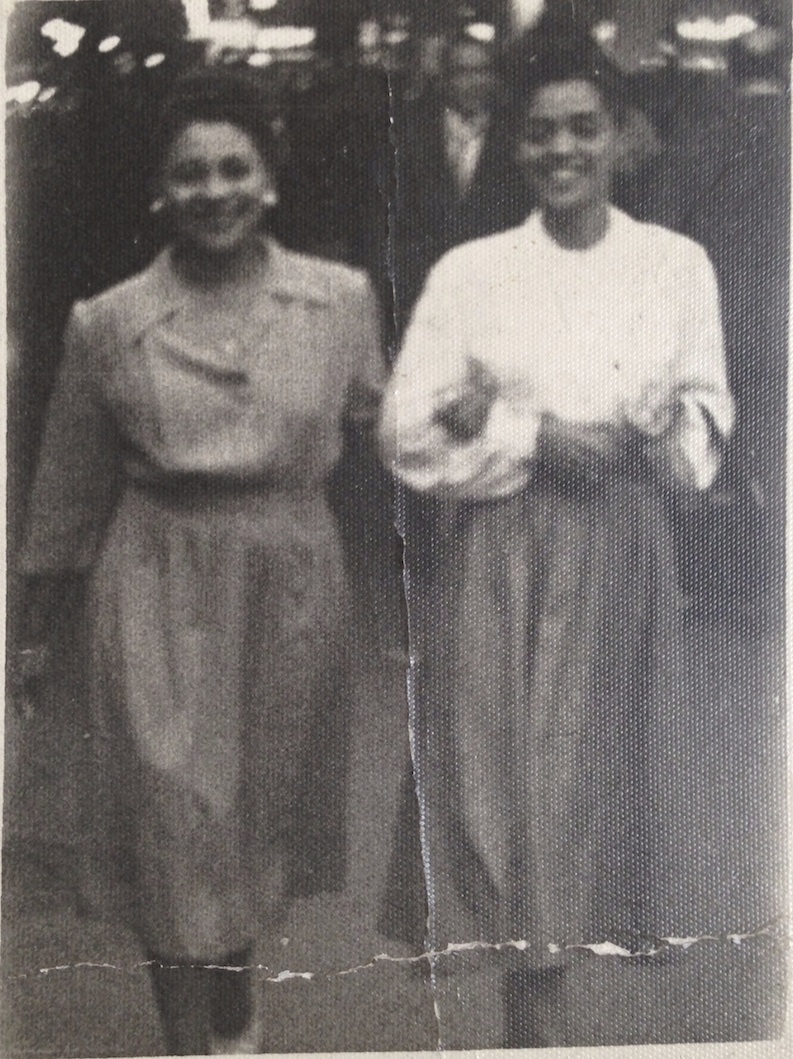
By contrast, my grandmother’s best friend Josephine, who was also a graduate of Catholic Colored High, did go on to college and later worked as a teacher. Like my grandmother and grandfather, Ms. Josephine married a classmate from their high school. Ms. Josephine went on to have children, like my grandma, but she also held a career outside the home. From what I could tell, both choices for both women seemed equally satisfying. I don’t ever remember meeting Ms. Josephine, but my grandmother wrote to her and spoke of her often and nothing negative

Grandma with her best friend Josephine.


was ever said about the choices they made. It seemed to me, then, that they were content with their choices, a choice the contemporary world doesn’t appear to hold out as an option.

My grandparents never longed for a bigger house, a luxury car, nicer clothes, better neighbors, luxurious or exotic vacations. They seemed to like the rhythms they created from the choices they made. If you were to tell someone today that you were happy with your life, I think you would be met with some skepticism: “Well, you say that now, but down the road, you will probably want to move up the ranks” or “I know that’s what you think now, but you’ll outgrow that house.” Today, if you decide that your life is good enough as it is, you’d be described as having low ambition. The one choice we seem capable of making is the one where you can accept that your life is not good enough as it is.

Now of course I don’t mean that issues of character and elements of one’s interior life should not be the objects/subjects of constant pruning, but for the strivers I spend a great deal of time around (it just comes with the territory of having to earn a living) such issues are never the topic of “upgrading” one’s life. Unfortunately, the few folk who are my dear friends who seek greater clarity in their lives, desire to become better listeners, want to have greater patience, and who aim to control their stress level are not the ones I interact with most frequently. The folk I spend most of my time around talk about wanting to make partner at a prestigious law firm today, though they’ve only recently graduated from college; they imagine that some quiet person in the office has her eyes on a better paying administrative post; they actually long to buy luxury goods; and worship people with money. Basically, I live in a world where most of the people talk about their ambitions the way that celebrities talk about building their “brands” or their “empires.”

I learned from observing my grandparents that time was the greatest wealth to pursue. Thus, I always wanted to be time rich so that I could control my movement through my days; I could linger over some things and skip over others. Time is a very precious resource and I’d just hate to waste it dissatisfied with my house, my car, my clothes, and my shoes. Longing is not living and my grandparents seemed content because they didn’t spend a lot of time fantasizing about the life they weren’t living or didn’t have. They found the place that was comfortable, felt like it was where they wanted to be, and they filled it up with the manifestation of the interior lives they so carefully pruned.

Models Monday: Going Home

I traveled home to Cleveland this weekend to celebrate my mother’s retirement (as she would say, “from a job she hated”) after 42 years of service. I drove so it took about 11 very long hours, but since being here, I’ve done some pretty fun things with my son. I took tons of pictures and these are a few of my favorite:


Entry to the Cleveland Public Library Reading Garden.
Maya Lin sculpture in the Reading Garden at the Cleveland Public Library.
One Tom Otterman's sculptures in the Reading Garden at the Cleveland Public Library.
One Tom Otterman’s sculptures in the Reading Garden at the Cleveland Public Library.


More Tom Otterman sculptures.
Reading Garden at the Cleveland Public Library.

My son and I also went to the Great Lakes Science Center. We had a really fun time. The Omnimax experience is very different from the Imax experience. Not only is the Omnimax screen six-stories-high, but there are times when you feel like the seats are rotating to capture a better point of view. Journey to the South Pacific was the film we chose to see.

In addition to the film, we visited several exhibits. My son’s favorite was the Lego Exhibit and play area:

securedownload (10)

securedownload (9)

securedownload (8)

Of course there were interactive science exhibits and many things to learn about the body, DNA, and the solar system but we spent most of our time building Lego cars. It was a fun time.

Models Monday: Telling a New Story

Chimamanda Ngozi Adichie being fly.

When I was young, I heard stories about the awful perils of the dreaded inner-city from my elementary school teachers. Their stories certainly made me afraid of that place. It wasn’t until my high school teachers told those  same stories of predation, poverty, laziness, and despair of inner-city residents that I finally realized they were describing where they thought I lived. I was incredulous. The “inner-city” they described was nothing like the “inner-city” I knew. My “inner-city” was actually a place where most of my neighbors left their doors unlocked and always welcomed your unannounced entry; where all of my neighbors gardened and generously shared the rewards of their harvest to as many people as they could; where people shared power tools and brought food to comfort families in mourning; where people held religious services in their backyards–just like my family held mass in ours. The complexity, the values, the belief in education as well as hard work were nowhere to be found in the homogenous, single stories my teachers told about the experiences, the values, or the qualities of the people I knew in the “inner-city” who apparently sprang from their limited imaginations.

I recommend viewing Chimamanda Ngozi Adichie’s TED Talk about the dangers of accepting a single narrative of people and of nations:

The similarities in the many powerful stories that Adichie shared and the one that I offered involve the absence of assuming responsibility for teaching folk about the fullness and richness of our lives. Revoking responsibility in this way is certainly another model for how we can all respond to the “danger of a single story.” You don’t have to waste a single minute of your time making lesson plans for how to correct another’s ignorance regarding your identity; it’s much better to spend time learning more about who you are and living out this understanding. Personally, I have very little patience for playing the native informant for all those liberal and racially well-intentioned friends, colleagues, neighbors, or strangers about my people, our hair, or our anything else.  A really good example of at least one response to an encounter with a single story of race, heritage, and culture is the one Adichie offered the young man who asked her about the brutality of the men in her country. Telling that young man about her take on American Psycho may not have taught him about the limitations of his presumptions, but it at least led to him leaving her alone– and sometimes, that’s good enough for me.

Models Monday: Because that’s what he would have done

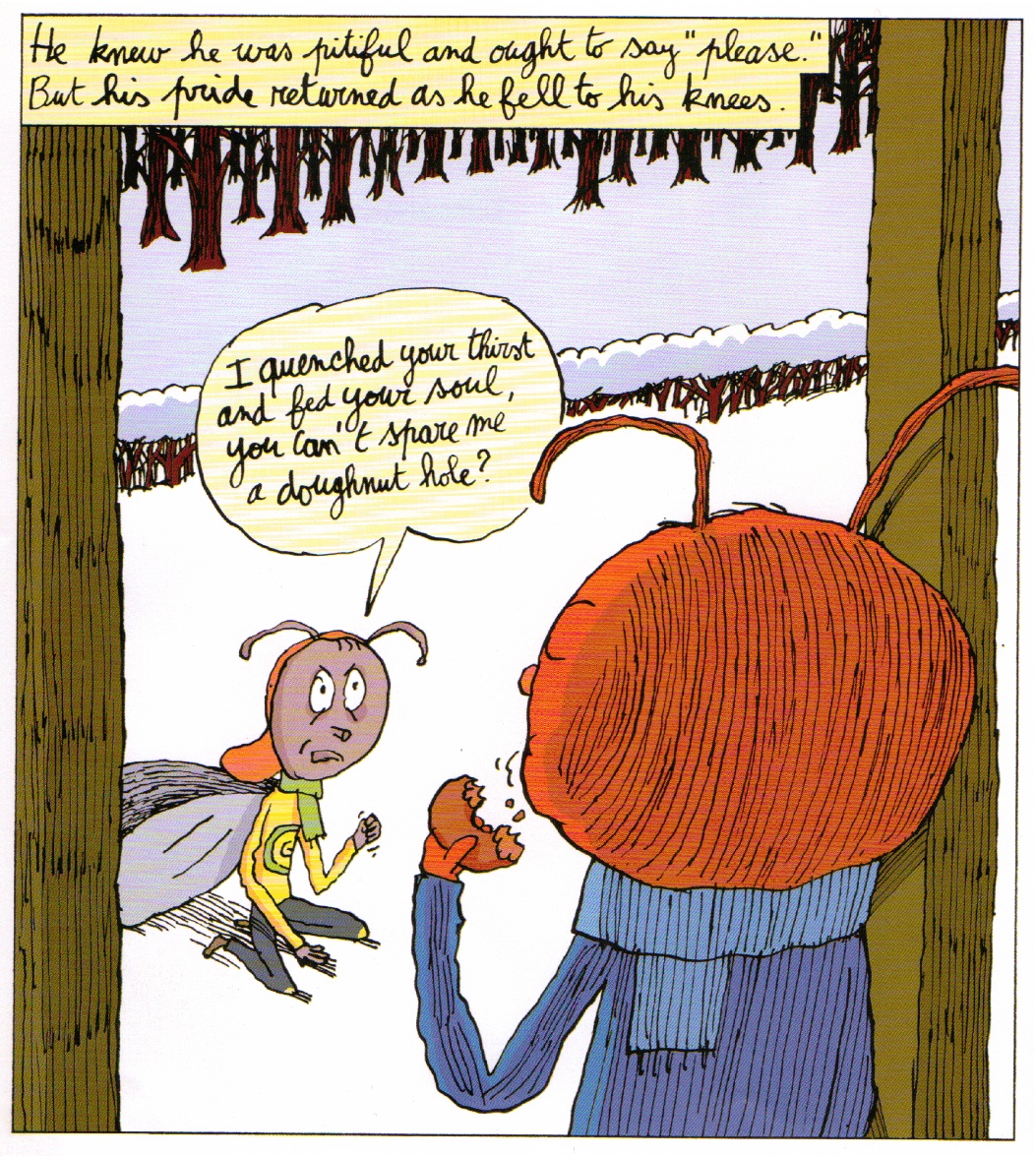
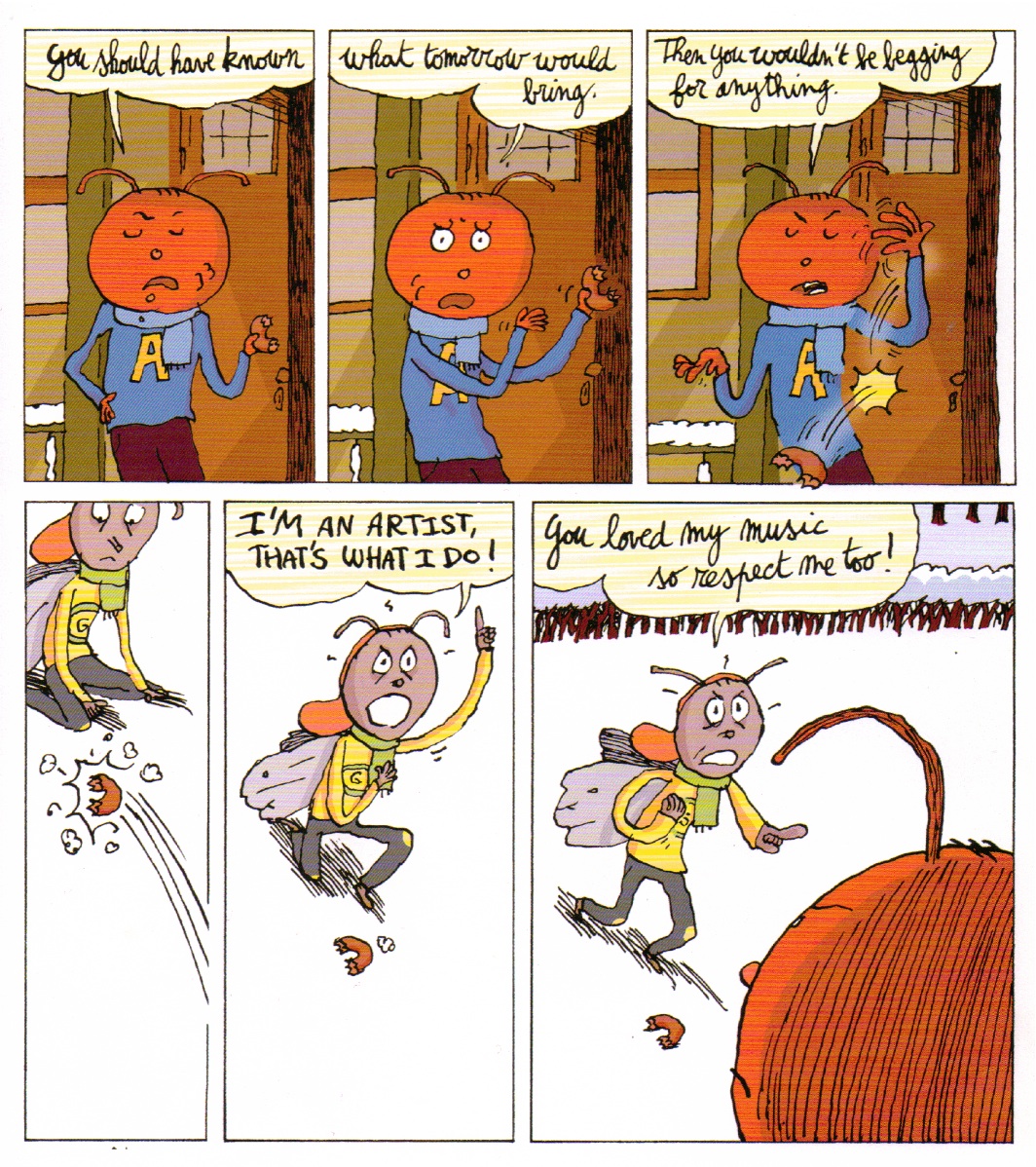
In Toni and Slade Morrison’s retelling of The Ant and the Grasshopper the reader is left with the dilemma of how you respond to the needs of those who have given you non-tangible gifts. The Grasshopper, Foxy G in their tale, is driven by his craft to create music. He doesn’t reject preparing for the winter because he is shiftless or defiant, he feels compelled to make art. The music he creates provides the background music for Ant, Kid A, who works diligently to gather provisions for his family. Once winter comes, Foxy G finds himself without provisions. Desperate, he seeks help from his friend:

“I’m cold kid, with nothing to eat. My wings are freezing and I’m dead on my feet. I’m not going to make it out here with no heat. So, say, my friend. Can I come in?” asks Foxy G. We see Kid A munching on his “doughnut” smugly regarding his friend:

“You’re cold? Hungry? No place to stay? Look at you, man. What, can I say? I planned ahead and stored up things. You wasted time on those funky wings.” Kid A was very self-righteous about his planning ahead and sacrificing for the future so that he didn’t experience the deprivations of his friend. Morrison tells us that “Foxy tried to smile but it didn’t work. The tears in his eyes made him feel like a joke.” While the focus of the division between the friends centers on art, the conflict between deprivation and surplus emerges for me as an even more general frustration.

Toni and Slade Morrison. Pictures by Pascal LeMaitre. Who’s Got Game? The Ant and the Grasshopper. Scribner, 2003.

With deep remorse, I have seen this scenario up-close. The music that Kid A could just  take, seemingly unaware of its tangible rewards, differs from what I saw. My friend Thomas, who recently passed away, gave people cars! He worked for Ford and he would co-sign for cars for “good” people who needed help but he also gave cars to people who were in need. At his funeral, people testified to how he knew that they struggled as single parents without vehicles and so he would show up at their homes with automobiles; nieces and nephews told of how he was responsible for them acquiring their first cars. Thomas, in fact, co-signed for my first car, a Ford Escort, that he also secured for me at an incredible discount. A few months before he passed, I visited him. My uncle had died and so I was in Cleveland in January to attend the funeral. I went next door to visit Thomas. His wife, Betty, was in the hospital and I had just missed his daughter who would be returning later to be with her father. As we sat and talked, I could almost feel how happy he was to have company; so I asked him about his visitors. “Do you get many visitors from your church,” I asked. I knew Thomas and Betty as deeply committed to their church and thought them much beloved so I figured he would have tons of guests. Thomas wanted to say yes, but then he said, “No, they don’t come by much. Or call.” Thomas had never been much of a talker, but he was on that gray, cold, snowy evening. He went on to catalogue the tithes that he paid, the carpet that he laid down and the air conditioning that he personally paid to have installed in the church but how in return, he had received scarcely a visitor or even a telephone call from either the leaders or the parishioners in the church. It was a painful discussion. Thomas had always been exceedingly generous.

I am among the many people who would have described him as financially comfortable. What was impressive about he and Betty’s money is that it was tempered by great humility. They lived in the same house for over thirty years; they gardened; they shopped locally; they used cash; they took their meals at home; they stayed home; they saved; they gave. They were simple, frugal people; quite remarkable. I wanted to voice that to him as he sadly recounted the ways that people became unavailable to visit with he and Betty.

When Thomas passed away this summer, his funeral became an extension of the righteous way people took from him. He and his sister died within hours of one another and so they were given a common funeral. The funeral wound up being a shameful tribute to Thomas. His daughter was led to believe that it would in fact be a service commemorating both her aunt and her father but it became an event that extolled his sister and only nodded to Thomas. In fact, I was the only one on the program scheduled to speak on his behalf. At one point, Tammie, went to the podium and told everyone how troubled she was at the tribute being paid to her father and asked that the service conclude as quickly as possible. It was heartbreaking. Betty died four days after Thomas and Tammie did a wonderful job organizing a service that paid equal tribute to both her mother and father.

Thinking about how entitled people feel to take from Thomas and not pay respect and tribute to him has deeply affected me. Sometimes I wonder if people think that giving is free for the one who dispenses; that somehow it doesn’t cost them anything or that it doesn’t come as a sacrifice, but what they give is necessarily extra. Like Thomas, I have given to people who I watched take with a sense of entitlement that I found shocking. And like Thomas, I didn’t stop giving all together, but I stopped giving to those people in the way that I once had.

It also seems to me that some people look upon giving as weakness. From this perspective, giving marks an urge to please. People seem to imagine that you are in fact giving to them because you want to be their friend. Giving is seen as pandering. It’s a troubling perspective.

I have an uncle whose generosity has also been taken for granted. In his case, people presumed that he did not care about anything so it was fine to take things from him without feeling any sense of obligation to him. As his body is beginning to fail him, he appears to be in the company of people with short memories.

Models Monday: Memorial Day

Norah Jones’s rendition of the Gene Scheer song “American Anthem” hits all the right notes and it frames my thoughts about this Memorial Day.

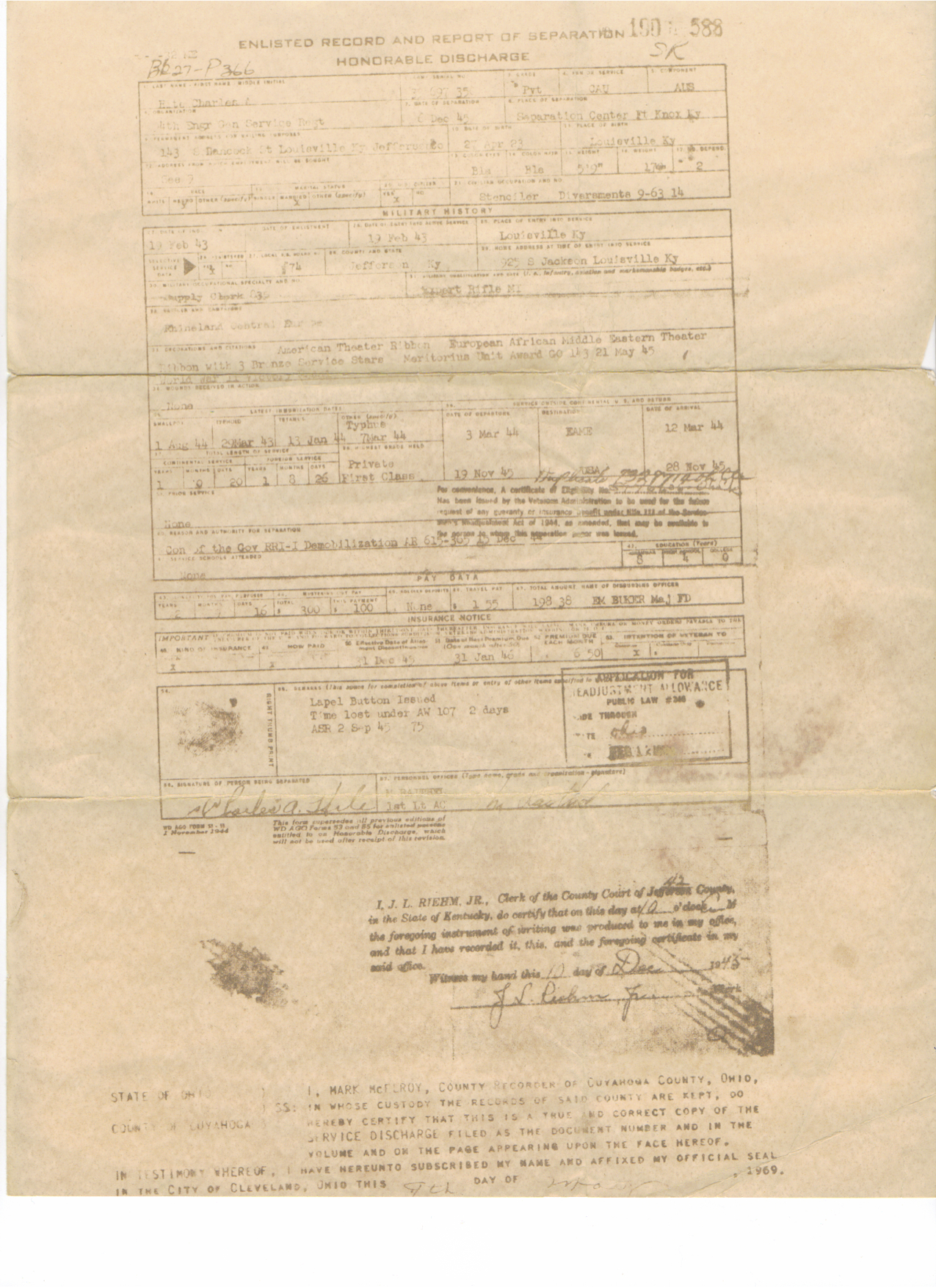
My grandfather, Charles Albert Hite, served in World War II and by all accounts he was none too happy about it. My Uncle Eric wrote about my grandfather’s views on serving in some of our correspondence. According to Uncle E’s memory, my grandfather “listened to FDR’s speech promising all them mamas that their boys would be safe from the draft, but if I can remember correctly,” notes my uncle, “he and Uncle Frank received their draft notices the next week.” What isn’t apparent from the Honorable Discharge report itself and my grandfather’s frustration with FDR involved his enlistment date on February 19, 1943: my grandparents were married only six days before he was drafted on February 13, 1943.

The Honorable Discharge report shows that my grandfather mastered the rifle, but according to my Uncle E, my grandfather had no interest in using his skills. “I can remember the Ole Man being angry at the Blacks back home who constantly went to the press about wanting the Blacks to have a bigger participation in the War effort,” he writes. According to my uncle, my grandfather “didn’t like that shit at all.” In fact, my uncle continues, “he was real cool with ‘digging ditches,’ and didn’t want nothing to do with the fighting.”

Today, as it is Memorial Day, I think about my grandfather’s service now through the lyrics of Jones’s resonant voice–even though those lyrics don’t quite fit his story. When I think of my grandfather, I wonder how he must have processed going into war with a new wife and and a baby on the way. I wonder how flimsy hope must have felt to him as he thought about making it back to them. My grandfather was fortunate since he did return to his wife and son. Today, I’m wondering about the soldiers he met who didn’t make it back. Did they have young wives and children who inspired their dreams of making it through the war? For my grandfather, Norah Jones’s bluesy, plaintive voice doesn’t quite strike at the core of what he might have been feeling–Louis Armstrong’s (What Did I Do to Be So) Black and Blue best captures the frustrations of a Black man from the Jim Crow South sent off to fight for a country that did not even protect him from Kentucky. When I imagine the friends that he might have lost, though, Norah Jones’s tender, raspy voice moves in deeply when I think of their mothers. I think of the soldiers telling what they might have believed but when Jones sings “America, America, I gave my best to you,” I imagine their mothers singing that part and I am deeply moved.

I know a lot of folk who celebrate Memorial Day with barbecues and picnics on Sunday. When I look around my neighborhood, there aren’t too many folks partying today, which seems appropriate. Today should really be a day for thinking about those mothers who gave us their “very best.”

Models Monday: Racial vs. Racist

Jane O’Toole, the woman who exposed Wolfeboro Police Commissioner Robert Copeland after hearing him call President Obama a nigguh, was even further appalled when Copeland wrote her a letter wherein he maintains his views about the President. O’Toole confessed to being shocked and appalled that Copeland made “an open admission of being racial.” Racial? I wonder why O’Toole described Copeland as being “racial” and not racist? What exactly does her choice of the adjective “racial” describe?

It’s as if nothing can be described as racist these days: Kill a black kid for walking home wearing a hooded sweatshirt in the rain–not racist; Kill a black kid for playing music that you don’t like and think is too loud–not racist; Imprison a black woman for firing a warning shot to prevent an abusive man from killing her–not racist; Kill a black girl who knocks on your door in the night after being wounded in a car accident–not racist.

I hope the Wolfeboro community sees fit to examine Copeland’s involvement in building and gathering evidence against suspected and convicted criminals under his watch. I’m convinced that being “racial” influenced how Copeland maintained law and order in Wolfeboro. Unfortunately, since this community only appears to think that Copeland said an embarrassing and bad word, it is highly unlikely that they will seek anything more than his resignation.

Given the apparent moratorium on racist activity or racist action being possible at this moment in U.S. history, silencing bad words apparently passes for justice. Unlike O’Toole, I find Copeland’s smugness, arrogance, defiance, disrespect, as well as his hateful description of “the current occupant of the Whitehouse [sic]” as all the evidence I need to determine that he’s racist. It wouldn’t be prudent to find comfort in Copeland’s age, as if he represents a dying breed. Substituting “racial” for “racist” ensures that racism will never die…

Models Monday: Jogging

runners-group-silhouette

Yesterday, a family friend asked me  about building endurance given her quest to run five miles. Given that she prefaced her remarks by referencing my track and field history, this became my starting point for addressing her question. I was around 8-years-old when I first joined a track team so I explained that my endurance resulted from continuous training. In order to build endurance, I suggested that commitment and dedication to practicing consistently were at least two requirements. My friend went on to tell me how she had walked five miles and now wants to run the distance. I told her that walking before running is a reasonable place to start, but going from walking five miles to running the distance will be littered with frustrations without a sensible strategy. To that end, I told her that if she wants to eventually run five miles, she should set her sights on running one mile first. It makes sense that a novice to the sport would set a five mile goal given that road races are commonly set at this distance, but there’s even a step before this. The standard distance for cross-country races is 3.1 miles. Recognizing these levels prompted me to I ask my friend a few questions: What timeline are you working on? Is there a road race you’re aiming to participate in? Can you combine walking and running until you can run the entire mile? In response, she told me that what she really wants to do is “to go for a jog.”

I guess when you live in the United States your entire life and are inundated with the uncontested assumption that dreaming is a civil right, it then makes sense to just wake up one morning and decide that whatever you say you want to exist should simply happen. Manifest. Be. My friend was dumbfounded by her inability to run five miles given that “that’s just what [she wanted] to do.” Being asked to present a plan for realizing this goal, led to her own discovery that she just wanted “to go for a jog.” If you have an end in mind, like running five miles, and you don’t have a reasonable plan for bringing this about, you’re still just running around aimlessly; running, as in my friends case, lacks purpose in such a scenario.

I’m happy it didn’t take very long in our discussion before my friend made her goals explicit because I didn’t have to waste too much time taking her seriously. Taking someone seriously takes time! If I had invested this time, I would have asked questions about speed; about improving; about races beyond 5k. As it stands, I don’t understand why my friend just can’t go for a jog if that’s what she wants to do. What’s stopping her? If it doesn’t matter how fast she goes or if she stops and walks during the five mile course, it’s not clear to me why she can’t just run or walk, fast or slow, today or tomorrow…what difference does it make? There are no requirements for one’s hobbies. If you want to jog five miles, jog five miles…good grief.


Models Monday: Consolation

As I’ve been reading The Art of Losing: Poems of Grief and Healing, a collection edited by Kevin Young, I’ve considered how this book might have worked as a dynamic text. Two songs that I keep playing in my head while thinking about scoring the book, if you will, are Don Henley’s “The Heart of the Matter” and Mike & the Mechanics’ “The Living Years.” Both songs confront different forms of loss. Henley’s song contemplates the end of a romantic relationship and the Mechanics’ song addresses regret upon the death of a loved one.

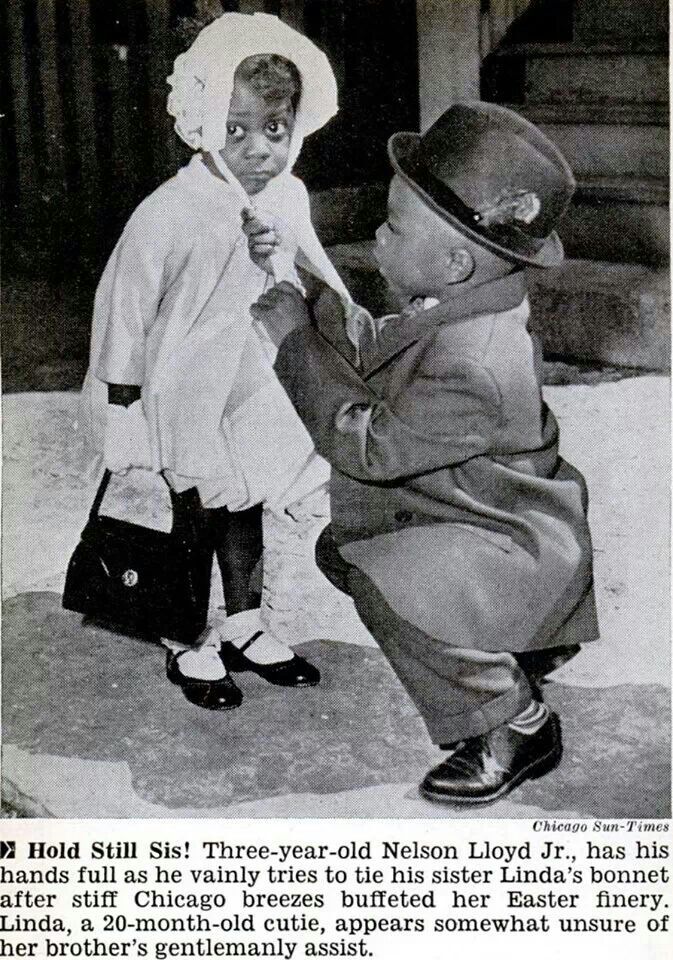
Henley asks a question in “The Heart of the Matter” that I find compelling and also apt in its description of history: “How can love survive in such a graceless age?” I’m hard pressed to name an age in U.S. history and culture that wasn’t “graceless;” the contemporary moment certainly fits this description. Rather than despair, as I am wont to do, these images offer some consolation that kindness and compassion are possible:

4f24965ad39b1f4765c4c08f74f8257d

b548d948de8f22967d6a0d718ea2d517

c59202fef882f1dc5c2a65bb5570c038

e0d88af955ceaaaea6e546acc33eb9f3

ef71547ee5d958aadc3d13cea6b12054