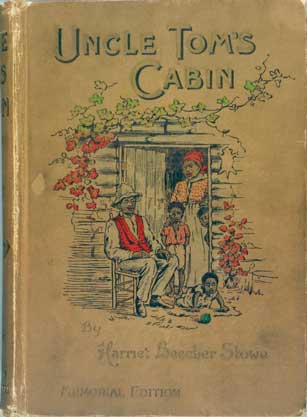
Models Monday: Today’s Uncle Tom

First-edition cover.
First-edition cover

In The Annotated Uncle Tom’s Cabin edited by Henry Louis Gates Jr. and Hollis Robbins, they reconsider Harriet Beecher Stowe’s effective use of sentimentality in virtually sanctifying constructions of Uncle Tom and George Harris, for example, as “perfect husbands.” According to Gates and Robbins, connecting slavery and domesticity, specifically marriage, was a chief insight from Stowe in this protest novel. Gates and Robbins admit that as early readers, they saw no relationship between these two institutions and so overlooked any abolitionist platform that might build on this novel. As seasoned readers however, Gates and Robbins assert that, “Stowe’s great claim was that men might embrace antislavery politics because their wives expected better of them.” Much of what follows in this introduction explores Stowe’s understanding of how women, particularly wives, could be greatly attracted to many of the near perfect husbands in the novel and want more from their own husbands. For Gates and Robbins, the unstated but very present sexual subtext of the novel helps explain its misinterpretation beyond its own era.

In the 1960s, for example, Uncle Tom became emblematic of the enemy within the black race who worked on behalf of white supremacy. Gates and Robbins write:

This was the era when–for the first time in our history–one could be read out of the race publicly for not being “black” enough. The term “Uncle Tom” became synonymous with self-loathing. For years after, everything connected with Uncle Tom’s Cabin recalled this nightmare, our very own version of the Inquisition, the time when blacks turned on other blacks as the enemy, as the principal targets of our revolutionary fervor. Clearing out the cabin suddenly became more urgent than dismantling the Big House.

While Gates and Robbins recognize that considerations for Uncle Tom’s apparent emasculation and sexually charged, physical ur-text of his character may have influenced black power castigation of such figures, Gates and Robbins hold deep appreciation for Stowe’s technique in protesting slavery. Unlike Gates and Robbins, I prefer the metaphor that derives from a limited appreciation for Stowe’s technique. Now I agree that throwing the term “Uncle Tom” around can have dangerous consequences, but at the same time it would be dangerous to dismiss someone who colludes with systems of domination and thus against the well-being of black folk. In my view, “Uncle Tom” is a very good metaphor for “the enemy” within. Samuel L. Jackson’s role in Django Unchained offers a very good example of the ugliness of being an “Uncle Tom.” Here’s a good example of Stephen selling out Django:

The contempt many viewers have for Stephen testifies to the brilliance of Jackson’s performance as an Uncle Tom. His collusion with that evil, cruel slaveholder Calvin Candy at the expense of Django and Broomhilda von Shaft conveys the ugliness, selfishness, brutal or lethal outcome, and general danger of failing to notice the Uncle Toms among you.

In real life, the best example of a contemporary Uncle Tom is Charles Barkley. Watch his minstrel routine here:

Charles Barkley will always be employed because his conservative views on racism and white supremacy support the media platforms where he serves as a mouthpiece justifying police brutality against black people (he also supported the play cop Zimmerman verdict). Barkley’s view of black people does not stem from his careful study of African American history and culture, an intense investigation of systems of domination, or even a close reading of the way he individually profits from demonizing black people. If he knew even a wee-bit of something about white supremacy as it intersects with other systems of domination, he would understand the relevance of slavery and Jim Crow as an ongoing narrative in the United States. Controlling black people’s movements, surveilling our communities, brutalizing and disciplining our bodies, denying us freedom, and murdering us with impunity NEVER ended. The police officers in Ferguson didn’t hang Mike Brown from a tree, but the four hours his dead body remained visible offered a spectacle very similar to one. Being from Alabama, Barkley, you would think, would know a little something about “Bull” Connor’s contempt for black people and his abuse of power in his efforts to maintain segregation in Birmingham. If Barkley knew just a little something about race in America, he would know that the collective power he claims denied black people given our glorification of idiocy and thuggery is the outcome of a system of domination designed to work this way. Though Barkley called those black folk in Ferguson “scumbags,” here’s how Martin Luther King, Jr. described the black folks involved in the Watts Uprising in 1965:

King told reporters that the Watts riots were ‘‘the beginning of a stirring of those people in our society who have been by passed by the progress of the past decade’’ (King, 20 August 1965). Struggles in the North, King believed, were really about ‘‘dignity and work,’’ rather than rights, which had been the main goal of black activism in the South (King, 20 August 1965).

Later that fall, King wrote an article for the Saturday Review in which he argued that Los Angeles could have anticipated rioting ‘‘when its officials tied up federal aid in political manipulation; when the rate of Negro unemployment soared above the depression levels of the 1930s; when the population density of Watts became the worst in the nation,’’ and when the state of California repealed a law that prevented discrimination in housing (King, ‘‘Beyond the Los Angeles Riots’’).

Now we all know that King did not endorse violence, but as he offers his perspective on Watts, he clearly understood why violence in that community erupted. For King, violence wasn’t the result of black American dereliction, violence stemmed from governmental and systemic neglect. Being from Alabama, I guess I shouldn’t expect Barkley to know anything about what King had to say. Alabama joined with other segregationist states (in other words, all of America) in HATING King. So when you’re thinking about the ghoulish, nightmarish mid-sixties vision of someone as an Uncle Tom, just picture Charles Barkley in a white hood; that should help you.
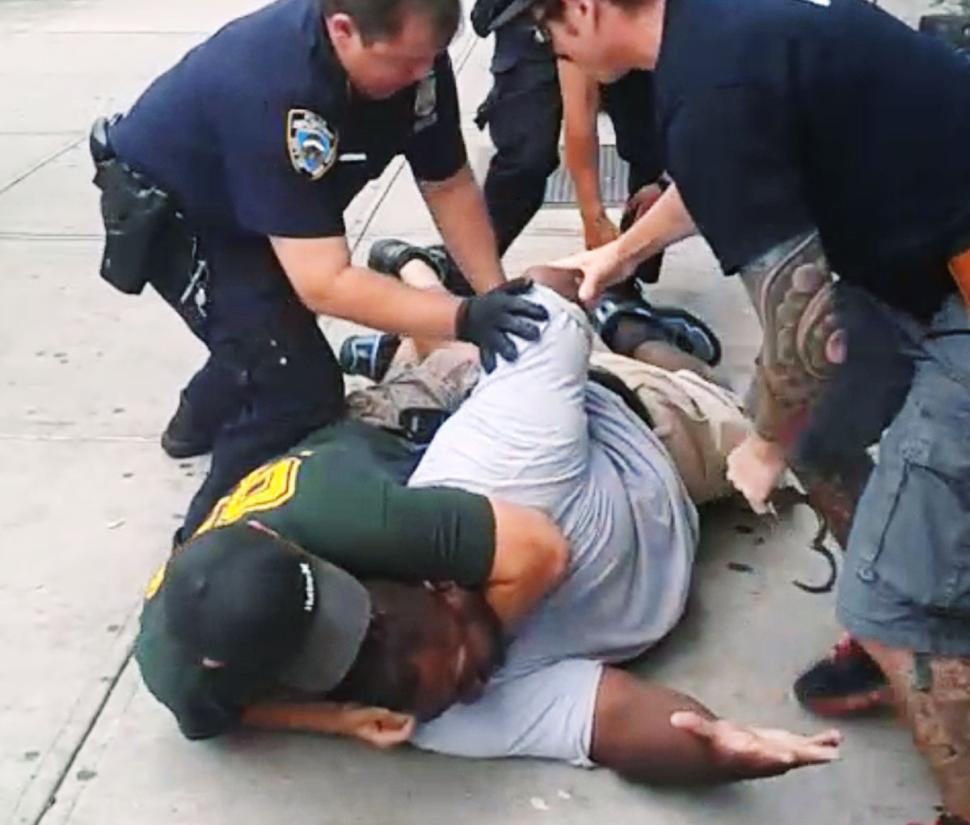
Officer Panteleo and the Afterlife of Wrestle-mania

Officer Pantaleo's "wrestling move" as it happened.
Officer Pantaleo’s “wrestling move” as it happened.

When 29 year-old Police Officer Daniel Pantaleo used a banned chokehold maneuver that would kill Eric Garner, it was all good ’cause the Officer perceived himself as using a “wrestling move.” Officer Pantaleo didn’t “mean” to kill Garner, he was just trying to arrest the man for the horrendous crime of selling individual cigarettes. As my son would say, “it was just an accident–it’s o.k.” In other words, Sh$t happens. Oops. My bad. Officer Pantaleo admitted that Mr. Garner told him that he “couldn’t breathe,” but Pantaleo’s lawyer had his back! Stuart London—lawyer/wrestling manager/hype-man–argued that the coroner’s conclusion that the chokehold and the compression to Mr. Garner’s chest caused his death was wrong because in saying he could not breathe, Mr. Garner had to be breathing; and it worked! The grand jury bought it. Who were these jurists? How could those people not reason that Mr. Garner was saying he could not breathe until he was not breathing? It’s like when an officer gets shot and says, “I’m hit! I’m hit!” The officer most certainly is alive when uttering those words, but if the bullets cause irreparable damage and the officer stops breathing, then (s)he is dead and whoever shot the officer would be charged with murder. Unlike a bullet, Officer Panteleo and his boys could’ve lightened-up on the man when he told them they were suffocating him, but Mr. Garner was still talking so they just kept at it. If the point wasn’t to kill Mr. Garner, why didn’t they just stop? I’m no medical doctor but I can reason that a suffocating man would be pretty easy to arrest at that point.

Officer Panteleo’s storyline borrows a script straight from the Hulk Hogan, Macho Man Randy Savage age when he claims that he didn’t immediately release Mr. Garner because he was protecting him. You see, he didn’t want “both he and Garner [to] go through that glass.” Still concerned for Mr. Garner’s well-being, Officer Pantaleo not only held on to maintain his balance, but also because, “he wanted to make sure that Mr. Garner was not injured by other officers rushing in, as well as to prevent Mr. Garner from possibly biting one of them.” Officer Panteleo was trying to make sure that everyone remained unharmed! I mean, if the unarmed, suffocating man who posed a considerable threat to the community due to his illegal cigarette selling was to be released from the officer’s grip, who knows what would’ve happened…

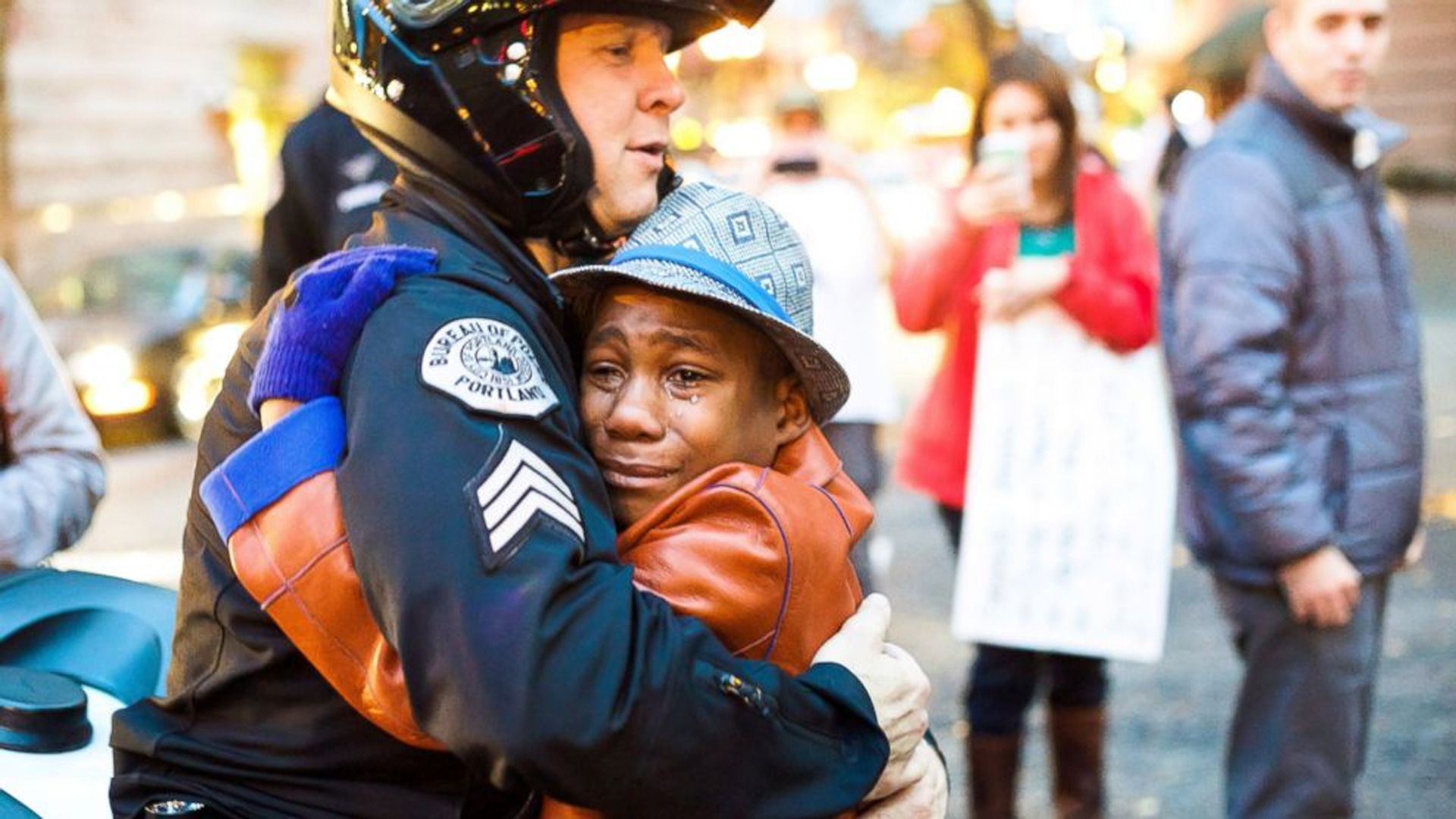
I want to tell the kid hugging the cop in this viral photograph, “stay away from cops passing out hugs.” If this child doesn’t heed some sorta caution, as he gets older, those hugs from cops become a little bit firmer…if he actually becomes a black man, this same cop will hug him to death.ferguson-free-hug-1

Malcolm X once used the figure of chocking to make a point concerning white supremacist violence and injustice:

…if you speak in an angry way about what has happened to our people and what is happening to our people, what does he call it? Emotionalism. Pick up on that. Here the man has got a rope around his neck and because he screams, you know, the cracker that’s putting the rope around his neck accuses him of being emotional. [Laughter] You’re supposed to have the rope around your neck and holler politely, you know. You’re supposed to watch your diction, not shout and wake other people up— this is how you’re supposed to holler. You’re supposed to be respectable and responsible when you holler against what they’re doing to you.

As former professional wrestler Rick Flair used to say, “WOOOOO!!!”

Models Monday: I Can Get Wit’ It

Here's what the description says for this image: This is an evaluation image and is Copyright Pamela Perry. Do not publish without acquiring a license. Image number: 0515-0911-1000-3544. http://www.acclaimimages.com/_gallery/_pages/0515-0911-1000-3544.html
Here’s what the description says for this image: This is an evaluation image and is Copyright Pamela Perry. Do not publish without acquiring a license. Image number: 0515-0911-1000-3544. http://www.acclaimimages.com/_gallery/_pages/0515-0911-1000-3544.html. Well, if I were Pamela Perry, I wouldn’t want anything to do with the bizarre Thanksgiving story this image tells. So if it’s blocked later–that’s fine ’cause this is all kinds of nonsense.

Since my son’s been in pre-school, Social Studies, I’ve learned, has nothing to do with time. I guess I sorta understand why given that young children, even when they can tell time, don’t appear to understand it. In my son’s case, I usually say that he speaks of time in biblical terms. Thus, he might say something like, “I want it to be my birthday for 40, 50 hundred minutes.” When children begin to glimpse time through the sun and the moon, summer can be hell because when you try to keep them on a consistent 8:00 bedtime schedule, they recognize that it’s still light outside…but back to Social Studies. For three years, Social Studies has meant lessons about community, culture, transportation, the Post-Office and other very rudimentary things about how a very generic society functions. So now that he’s in first grade, I was very curious about the Thanksgiving lesson he’d receive. When I was in school, the lesson involved Pilgrims, Native Americans, maze, and a feast. Here’s what my son says he learned:

The Pilgrims came over. They enslaved some people who taught them how to survive. The slaves taught the Pilgrims

to fish. They buried the fish in the ground and that produced the food they ate. The end.

Miles’s story had little bits of American history that I can get with. Some Europeans came to a place, committed violence through enslavement, and used the knowledge of those they enslaved to sustain themselves. I have no idea how the dead fish produced food, but he told me he couldn’t explain it, that’s just what he’d “thought [he] heard the teacher say.” I don’t know what those other kids learned but it sounds like Miles took a little bit of what he learned from his teacher–Thanksgiving and Pilgrims–sprinkled in with the stories I read to him that feature slaveholders and enslaved people, and rounded the story up with a little bit of the bible (that’s the only sense I can make of the fish).

Miles’s version works for me–especially in the aftermath of Darren Wilson’s free pass for killing a black unarmed child. When I saw this photograph

ferguson-free-hug-1

of a white police officer in Ferguson hugging this crying black child, I became sick to my stomach. Sentimentality is no substitute for justice. Next week, we’ll be reading about the same boy in this photograph being put into a chokehold by a police officer unfamiliar with the knowledge that black children were no longer demons for the men and women who take an oath to serve our communities. Thus, I like my son’s narrative because it paints a picture of the America that Malcolm X saw; one where these sentimental photographs of police officers hugging black people as the same BS that it is. It’s been almost fifty years since Malcolm was with us but his words reverberated in my ears over this Thanksgiving holiday. He spoke pure truth when he said, “We didn’t land on Plymouth Rock, the rock was landed on us.”

…I can get wit’ it

A New Look at the Work of “Demons”

This slideshow requires JavaScript.

Well, if you thought brutality looked like the welts on the back of an enslaved man named Peter, William Brown’s charred body, or Emmett Till’s battered face, then here’s a new set of images to add to your collection: Officer Darren Wilson’s Evidence Photos. Wilson’s face shows the marks of what a young man that he would describe as having the look of a demon does with his evil powers.

The testimony that Darren Wilson offers of his brush with death just drips with the racial grammar, including all its parts of speech, comprising the narrative of white American freedom and black American death:

Like I said, I was just so focused on getting the gun out of me. When I did get it up to this point, he is still holding onto it and I pulled the trigger and nothing happens, it just clicked. I pull it again, it just clicked again.

At this point I’m like why isn’t this working, this guy is going to kill me if he gets ahold of this gun. I pulled it a third time, it goes off. When it went off, it shot through my door panel and my window was down and glass flew out of my door panel. I think that kind of startled him and me at the same time.

According to The New York Times,[t]he gunshot startled Mr. Brown, Officer Wilson said. Officer Wilson said Mr. Brown stepped back. And then came forward. He had his hands up, but Officer Wilson did not see this as a sign of surrender – quite the opposite.” Here’s what Officer Wilson saw:

The only way I can describe it, it looks like a demon, that’s how angry he looked. He comes back towards me again with his hands up.

Despite being in a police truck, a Tahoe, presumably with gas and keys in the ignition, Officer Wilson becomes so entranced by the “demon” who comes toward him in a posture of surrender, with his hands up, Brown manages to punch Wilson–though he’s uncertain about that part–so he fires again. And again. After Michael “demon” Brown is shot several times at this point, Wilson claims Brown tried to flee and the Officer gets out of his truck and chased him. After telling Brown to get on the ground Officer Wilson states:

He turns, and when he looked at me, he made like a grunting, like aggravated sound and he starts, he turns and he’s coming back towards me. His first step is coming towards me, he kind of does like a stutter step to start running. When he does that, his left hand goes in a fist and goes to his side, his right one goes under his shirt in his waistband and he starts running at me.

Obviously, Wilson thinks Brown’s got a gun–which doesn’t explain why Brown would have gone for the officer’s–so Wilson, horrified by this scene, states:

At this point it looked like he was almost bulking up to run through the shots, like it was making him mad that I’m shooting at him. And the face that he had was looking straight through me, like I wasn’t even there, I wasn’t even anything in his way.

Having been ignored (which is actually the crime Brown commits: in the U.S. black people must always acknowledge their awareness of white authority and white supremacy), Wilson describes what happens next:

And when he gets about that 8 to 10 feet away, I look down, I remember looking at my sites and firing, all I see is his head and that’s what I shot. I don’t know how many, I know at least once because I saw the last one go into him. And then when it went into him, the demeanor on his face went blank, the aggression was gone, it was gone, I mean I knew he stopped, the threat was stopped.

Of course his final statement makes complete sense: killing someone does stop them from threatening you… I hope the folk over at Marvel are paying attention ’cause Wilson just invented the next villain for whatever summer blockbuster they’re planning.

Lord have mercy…

No Indictment, No Surprise

PPP-cover-11x22
By Kadir Nelson


Dear Black Children,

As cute and adorable as you are, cuddly in a way that Kadir Nelson expertly captures in nearly every image he draws, your beauty and our love for you will not save you. You may not understand this now, but you should know the truth. This truth comes from writer James Baldwin as he expressed it to the nephew he so dearly loved. So here it is: “You were born into a society which spelled out with brutal clarity, and in as many ways as possible, that you were a worthless human being.” The Fire Next Time, 1963 to November 24, 2014.

As Baldwin tells his nephew, the biggest mistake you can make in this life is to believe what a white supremacist society says about you…love yourself despite everything and everyone telling you not to. With Love, EMM

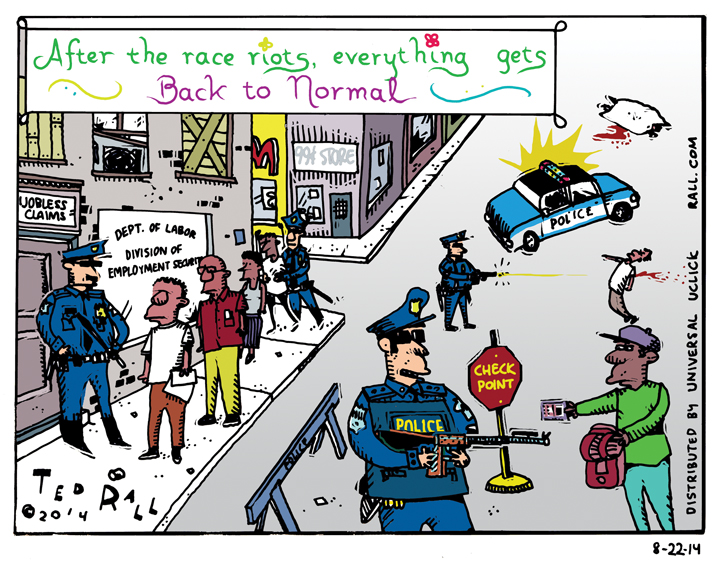
Back to Normal

In the United States, black people are the only ones who commit evil acts of violence. Killing workers at an abortion clinic, shooting children at an elementary school, a movie theater, or a parking lot, and dropping “precision” guided drones that rip apart unarmed children in the Middle East is apparently much better violence. Rejecting policies that would help feed the nation’s children, rejecting children seeking escape from certain death, the ambition to deny universal healthcare also counts as better violence.

Everyone with a microphone is telling black people not to commit violence as if black people are being indicted for shooting unarmed black boys. As M. E. Dyson made clear, “black people who kill black people go to jail.” Apparently, those bound to “protect and serve” can kill black people with impunity…oh yeah, we’ve made great progress since the days of “Bull” Connor…it’s mourning, as usual, in America.

Models Monday: Concrete, Definite, and Specific Language

This slideshow requires JavaScript.

The “Eyes on Ferguson” discussion below exemplifies concrete, definite, and specific language:

Mika Brzezinski and Joe Scarborough reveal what occurs when concrete, definite, and specific language is totally misunderstood:

http://http://youtu.be/cnt08qn0AVs

Michael E. Dyson elevated the conversation when he used the language of “white supremacy” and not “race.” He certainly didn’t “lower the level” of the discourse regarding systems of domination as Brzezinski suggests…it’s too bad how anti-intellectual U.S. society has become.

Walter Lee Younger’s Vision Realized

Raisin 2

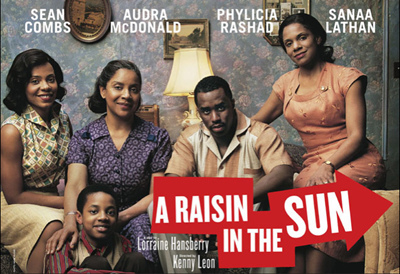
I’ve never seen Kenny Leon’s version of A Raisin in the Sun featuring Sean “Diddy” Combs as Walter Lee Younger. I was aware that many trained actors were disappointed in the casting given the rap mogul’s unproven talent for the stage. I don’t know if Diddy can act, but the casting was spot on!

In the play, Walter Lee wants to use the money from his father’s life insurance policy to open a liquor store. In spelling out his plan to his wife Ruth, Walter tries to make it clear that he’s got it all figured out:

Walter: “You see, this little liquor store we got in mind cost seventy-five thousand and we figured the initial investment on the place be ’bout thirty thousand, see.  That be ten thousand each. Course, there’s a couple of hundred you pay so’s you don’t spend your life just waiting for them clowns to let your license get approved–“

Ultimately, Mama Younger makes a $3500 down payment on a house in Clybourne Park, an all-white neighborhood. Mama asked Walter to put $3000 in college savings for his sister Beneatha, and the rest was to be Walter’s. Instead of honoring his mother’s request, Walter  gives the entire sum to one of his “business partners” who then takes the money and hits the bricks. Everyone is upset, but not broken. They decide to take their chances with their down payment on the house in Clybourne Park despite having no money to sustain their occupancy.

As I’ve been seeing images of Diddy promoting vodka and tequila, I can’t help but think of Walter Lee. I don’t know what it means yet, but Diddy has definitely realized Walter Lee’s dream.

This slideshow requires JavaScript.

Models Monday: On Free Land


IMG_1573
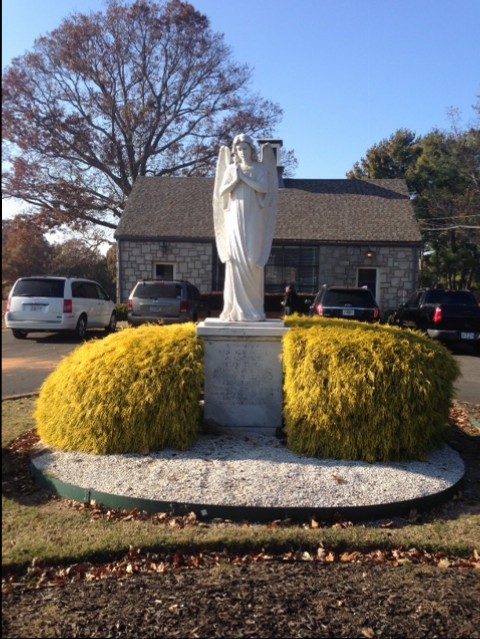
South-View Cemetery. November 15, 2014

This past weekend, I visited South-View Cemetery with a few friends. South-View was granted its charter on April 21, 1886 and so became the first for-profit cemetery for African Americans in the United States. Beneath the names of the six men who established this charter reads its statement of purpose: “To provide a respectable place for Christian burials.” In chartering South-View as an African American burial ground, black people could now enter through the front gates, follow the processional on dry land without swampy obstacles before them, and thus reject the many forms of degradation undermining attempts to dignify black American life and death.

I was originally drawn to South-View because it was the site of Martin Luther King Jr.’s original burial. I had been interested in the route his body took from Memphis, to Sisters Chapel on the campus of Spelman College, to Ebenezer Baptist Church, to Morehouse College, and finally to South-View. King’s body resided in South-View until early January of 1970 when Mrs. King had his body reinterred in a crypt on Auburn Avenue (this would eventually become the site for the Martin Luther King Jr., Center for Nonviolent Social Change).


This slideshow requires JavaScript.

D.L. Henderson, South-View Cemetery’s historian, correctly notes that King’s story isn’t the only one there. There are as many stories as there are bodies. Some of the more interesting ones for me were those of the victims of the 1906 Atlanta Riots, the space where the unmarked graves where seven of the victims of the Atlanta child murders lie, and the Vietnam veteran whose grave was once directly across from Martin Luther King, Jr. :

This slideshow requires JavaScript.

This visit reminded me of a very interesting article that I read in the Washington Post a few years back about an aging caretaker of a rural African-American cemetery in Loudoun County, Virginia. For more than fifty years, Vernon Peterson, 80, has taken care of Rock Hill cemetery where African Americans have buried their kin since 1889. Upon ending his service to the United States Army, Peterson returned home and found the cemetery in disrepair. He immediately began weeding around the graves and for $50 a year to meet expenses, he continues to maintain the cemetery.

I was struck by one of the photographs accompanying the article where Peterson is shown plotting the graves of every single person buried in the cemetery in a book to be given to his successor:

Tracy A. Woodward. The Washington Post.

The photographer has captured the eloquence of Mr. Peterson’s quiet work, the care he shows in making a record of lives. His hand unhurried, Peterson enters the names of many people he never knew, and some he did, between neatly drawn lines that strive for the order he endeavors to give the places where their bodies rest.

I am intrigued by Mr. Peterson’s use of time. I admire the discipline it takes to honor self-given tasks. School and work often impose deadlines that force action, without such pressures, some tasks may never be completed. Peterson, on the other hand, is his own master since he directs his own tasks. He’s a wonderful example of how to be free.

Models Monday: A Message for Republicans

GOP_Logo1.svg

Dear G.O.P.,

As you work towards your goal of “taking back our country,” I ask that you consider reading Robert Pogue Harrison’s book Gardens: An Essay on the Human Condition. Throughout the work, Harrison stresses the significance of care-taking as an essential aspect of being human and living a meaningful life. I’m sure you’re far too busy to read an entire book so if you can read one chapter, I suggest the one titled “Boccaccio’s Garden Stories” where Harrison reflects on The Decameron. Harrison’s explication offers a vision of a world that many of us would like to live in:

To be human means to be vulnerable to misfortune and disaster. It means periodically to find oneself in need of help, comfort, distraction, or edification. Our condition is for the most part an affair of the everyday, not of the heroic, and our minimal ethical responsibility to our neighbor, according to Boccaccio’s humanism, consists not in showing him or her the way to redemption but in helping him or her get through the day.

Please consider Harrison’s view of our responsibility to one another as you go about “taking back our country” and so setting out to repeal the Affordable Care Act, returning Central American children to a culture seemingly crueler than our own, preventing women from having control over their bodies and denying those same women equal pay as well as affordable and high quality child-care. Helping our neighbors get through the day could also be advanced if police officers and self-deputized citizens stopped killing black children because they “don’t belong here//don’t be long there, to cite Nina Simone. In general, our country might be best served if instead of emphasizing to us citizens taxpayers that we need to lower taxes and keep more of the money we earn, that you tell bankers on Wall Street and greedy politicians that “good is knowing when to stop.”

From a Concerned Taxpayer Citizen, EMM