“It is not my enemies who taunt me–I could bear that…It is you, my equal, my companion, my familiar friend…” (Ps 55:12-13)
“If someone asks,‘What are those wounds on your body? they will answer,’The wounds I was given at the house of my friends.'” (Zechariah 13:6)
I’ve been listening to Jon Krakauer’s latest book, Missoula: Rape and the Justice System in a College Town, on Audible. In his Author’s Note, Krakauer writes that, “Parts of the book may be difficult to read. Some of the events I describe are extremely disturbing.” I expected the ugly details regarding the savagery committed against the young women by rapists, but what has been even more horrifying is the calculated brutality and strategic ways these young men rendered young women–many of whom had been their longtime friends–vulnerable to their predation. The parents and other adults connected to these savage college males equally troubled my already troubled faith in humanity. Mothers, fathers, coaches, and teachers who in many cases knew both victim and perpetrator stood in defense of the “boys” whose innocence they fantasized even when the young men had confessed. To that end, Missoula reminds me of Bernard Lefkowitz’s upsetting book, Our Guys: The Glen Ridge Rape and the Secret Life of the Perfect Suburb.
It’s been years since I read Our Guys, but the disgust I first felt remains palpable. The “guys” were mediocre athletes (in my opinion) who were heralded and adored in their community. Most of these kids had been classmates since preschool, but on May 23, 1989 any pretense of camaraderie and moral obligation shed its thin skin when an estimated 13 boys were present while at least five boys sadistically raped an intellectually disabled peer. Knowing this girl for most of their lives, these boys knew how susceptible she was to their deceptions and they used this understanding to violate her and to bring deep hurt and sorrow to those who loved her.
Just like the adults in Krakauer’s Missoula, the adults in Glen Ridge were incredibly supportive of the integrity of their guys. I have known people throughout my life who have done some pretty awful things, but seldom has it been the case that an entire fantasy overdetermined the facts of what had been done. The person may not have been judged evil, but certainly their crime was acknowledged as being just that, a crime. I wasn’t taught to deny information, and as a result I have always had a very healthy suspicion of men. I would even go so far as to say that I think it’s healthy to be suspicious of all men; to be skeptical of their sense of integrity; and to be alert to how patriarchy informs their sense of entitlement, arrogance, and thus their self-righteousness in violating women, attempting to dominate women, and disrespecting women.
One of my favorite poems (“His Hands) by Natasha Trethewey describes a woman who has routinely suffered abuse from men in many facets of her life. When a seemingly good man comes into her life, she remembers everything she learned from those others. As a result, she allows herself to show affection towards this man and to find happiness when she’s in his company, but she does not provide him with full access to her anytime he decides he wants it. Thus, she never gives this man a key to her house. He knows the violence she has endured from other men and he wants to distinguish himself, and without a key he must because she controls whether or not he gets the chance.
Though I do not have a daughter, I care deeply about the vulnerabilities of girls and women. I am very conscious of raising my son with either the same or an even deeper appreciation for girls and women than even I hold. To that end, being a responsible parent to a boy means teaching him strategies of “making his hands soft” as the man in the poem does when he raps on his beloved’s door. Even if a girl or a young woman thinks he’s safe, I believe he is responsible for behaving in a way that acknowledges how unsafe the world is for women. Unlike the young men described in Missoula who used the pretense of friendship to make a young woman feel safe enough to sleep at the fraternity house with him or to come up to his apartment because he forgot something, I will do my best to teach my son that being responsible means that he should ensure her safe return to her dorm or to her apartment; that he not invite her into a fraternity house, a locker room, or a football dorm.
So many of these disgraceful arguments that blame women for their victimization depend on what she should’ve known or what she should’ve understood. This problematic paradigm ignores the responsibility that men also have to respect human dignity and the humanity of women. Responsible men are those who show integrity, decency, compassion, and concern. Seducing a young women into trusting you and then raping her doesn’t make you a man. Such behavior confuses being a bad ass, morally corrupt, entitled little boy and being a mature adult who makes sound, moral judgments. Men respect women’s boundaries and don’t mistake a penis for a key.
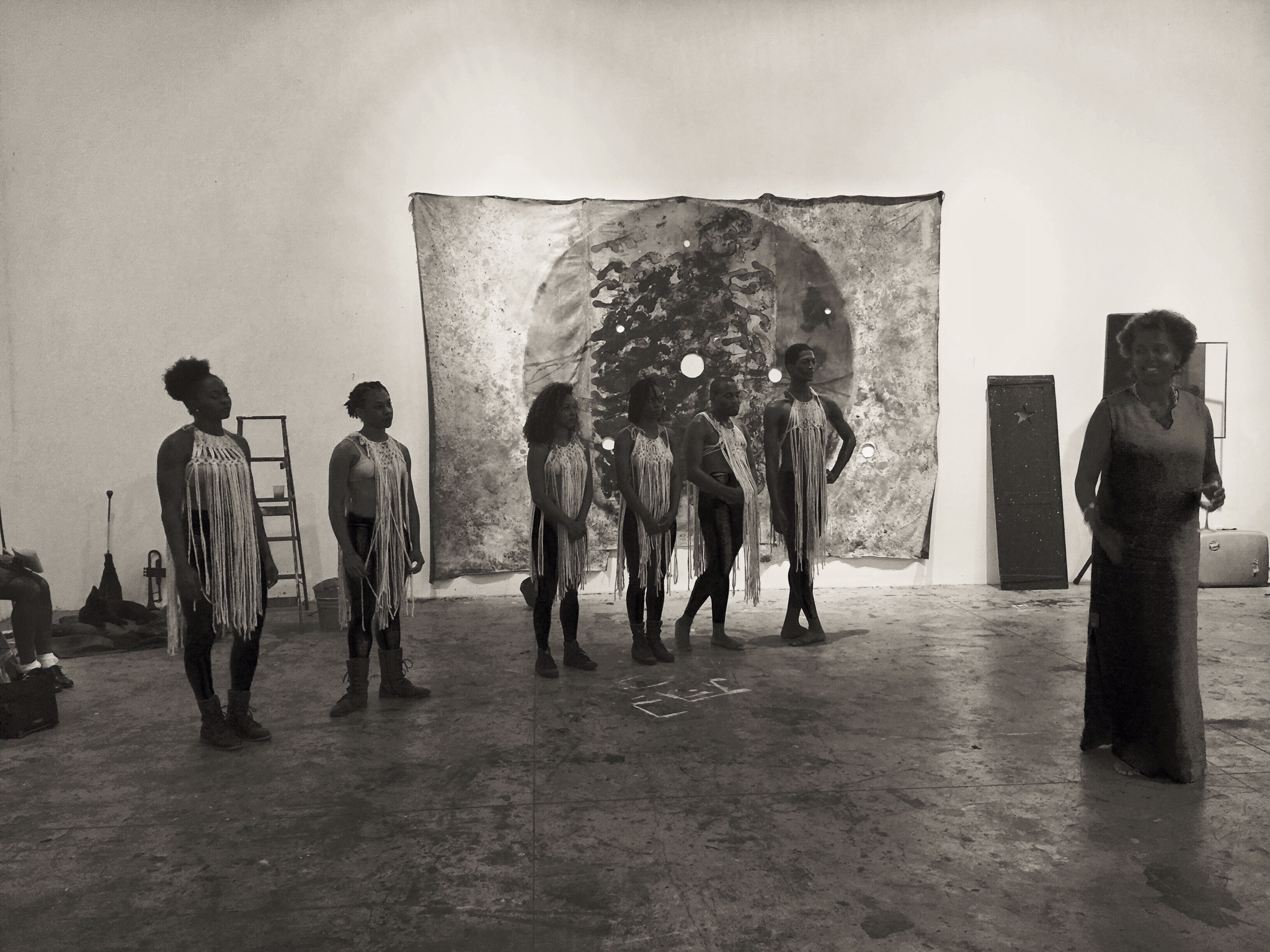
Members of T. Lang Dance after their performance in Radcliffe Bailey’s Studio. The woman standing before the dancers is artist Charmaine Minniefield. You can find more about a very interesting project she’s working on now by following this link.
In the introduction to this book, Williams writes:
“This is a book about slavery and family and loss and longing. It is a book about emotions, it is about love and loneliness and grief, about anger, and about fear, joy, hope, and despair. It is about the forced separation of thousands of African American families, about their grief, and about their determined hope to someday see each other again.” Like the narrative approach Toni Morrison took in writing Beloved that focused on the personal violence experienced as the everyday condition of a person living within an unrellentingly brutal system, T. Lang’s Post Up uses the unsurpassable weight of her father’s death to enact the emotions associated with questing for lost love.
Set against the backdrop of Radcliffe Bailey’s unfinished painting–featured behind the dancers as they performed in his home studio–the performance accentuated the improbability of finding someone you lost when the territory for searching appears to be the entire world. Bailey’s unfinished work as the backdrop for searching for lost loved ones captures the improbability of reunification so broad as to suggest the universe–the solar system itself as the exploratory terrain. In addition to the vastness of the search, the dancers articulated provocative and painful questions about the possibility of a somber joy upon reunification. Can there ever be certainty about the identity of the person you’ve recovered? How significant do the changes have to be for one to make a decision to dismiss the recovered person as merely a semblance, a shade of who you once knew; as someone else; not them? In other words, what makes who you were who I am seeing in this moment? What difference will change make for loving who you find?
The brilliant, talented choreographer reclining on the floor after watching her gifted, well-trained dancers perform. For video showing excerpts of Post Up, follow this link.
On one hand, what I found moving in this segment of Post Up is its insistance on defining love as a verb rather than a noun. For these newly empancipated folk, love was not as much about possession as it was about searching, questioning, and pursuing the person or people that you lost. On the other hand, I was also moved by Lang’s vision of love as a noun. As a “thing,” the only definitive name Lang gives “love” is mystery. So much of the beauty of this work stems from the simultaneity of the many recognizable truths and complicated facets of love.
My mother and I attended the same elementary school. I hated it, but she didn’t mind it. When she attended, mass and confession were a daily occurrence. When I attended, we only had service during holy days and I can only recall a singular confession.
My mother’s funny. She attends weekly mass, but she couldn’t tell you one word or even the theme of the priest’s homily. She can also tell you the names of visiting priests who, “talk way too long.” My memory is very, very different from hers. I still remember a homily Fr. Kraker gave when I was in elementary school.
I’ve written about this particular homily on this blog at least once (I would link to it but I don’t know what I’ve titled it). In the story, Fr. Kraker describes the difference between heaven and hell. In both locations, short-armed people are seated at a table with extra long utensils. In hell, the people are starving because they can’t feed themselves, but in heaven the people are well fed because they used the long utensils to feed the person seated across from them.
I thought about this story while putting dishes away and it reminded of a dinnertime experience that, in Catholic terms, had to be purgatory. Some time ago, our neighbors invited us over for dinner in an effort to acknowledge the many meals they have had at our home. Honestly, we didn’t really want to go because my neighbors aren’t very good cooks and their house isn’t very clean. We didn’t want to be rude so we accepted.
Now, when someone invites you over for dinner, don’t you think it reasonable to expect them to at the very least cook food? I know folk who don’t always feel like cooking so they have the meal catered. The latter option we never expected because my neighbors don’t have the money to cater a meal, so we anticipated eating what they prepared.
So at dinner time we walk next door and in the kitchen stands a woman we don’t know. Our neighbors invited us to sit and then introduced the stranger to us. We learned then that this woman would be preparing the meal–not because she was a chef but because the pots, pans, and bowls she used to prepare the food would feature among other items this woman was selling. I don’t remember the company, but I know it wasn’t Pampered Chef because I recognize their brand, and own some of their products. Our neighbors explained that they met this woman at someone else’s house and thought it would be great to host her. Somehow, they missed the part about this woman working as an agent for a company that sold cooking supplies. They seemed to think that she was a good cook and could offer you a chance at being a good cook if you bought the products she just happened to be selling. They were completely clueless when it came to recognizing that they were wasting this woman’s time so that we could have a free meal.
The meal was pretty awful. My husband and I don’t like chicken thighs and we didn’t like whatever the mystery sides were that she served along with the chicken. Dessert was some kind of chocolate cake made from ground vegetables in place of flour. We didn’t like any of it but we smiled and praised her anyway. My neighbors didn’t always like how certain dishes turned out and told her so! We were appalled that they would have the nerve to criticize this woman as though she were their paid chef.
After dinner, we looked through the catalog of kitchen items for sale because we really wanted to buy something from this woman as recompense for her trouble. Unfortunately, everything in the catalog was out of our price range. The least expensive item was an $80 mixing bowl. Well, I already have mixing bowls and thought purchasing an $80 “pity bowl” too extravagant given my budget. I’m sure we said something about going through the catalog more thoroughly and contacting her later, but mostly I remember wanting to get the hell out of there.
My mother was appalled when I told her about this dinner. Though she and I experience Mass differently, we share a vision of hospitality, respect, and consideration. I’m certain my mother would’ve bought the $80 bowl, given it to me, and then jumped on the phone to tell everyone she knew about my “triflin’ neighbors.” Me, I’d think about it for a while before sharing the tale of my meal in pergutory.
Some of The New York Times’s reporting on the case of Tamir Rice and its aftermath remain true. For instance, Samaria Rice did live in a shelter with her daughter Tajai, and while at the time the video was made they remained there, they moved to a small home during the Spring. According to what Rice’s attorney told ThePlain Dealer, “the outpouring of support, [enabled her] to find a safe, private domicile […]” As stated in the Times op-doc, Ms. Rice chose to leave the residence near Cudell Recreation Center, a location she aptly terms, “the killing field,” where Officer Timothy Loehmann shot and killed 12-year-old Tamir. The Rice family’s suffering continues to weigh heavily on them.
Once again, poverty significantly informs the disgrace the Rice family endures. Loehmann killed rice in November. The family held a memorial service at Mount Sinai Baptist Church for Tamir 10 days after his death on November 22, 2014. Lack of money has contributed to the family’s inability to bury Tamir. The Plain Dealer also reported that the Rice family attorney contends that Tamir’s body had remained uninterred “because the family did not know whether the Cuyahoga County Medical Examiner’s Office would need to re-examine” the boy’s body.
I remember reading that black families who experienced lynchings had varying responses to burying their dead. Some families made arrangements for dignified services that stood in stark contrast to the ghoulish manner of the murder. Others maintained the belief that those who committed the crime should be responsible for burying the body they lynched. The family of 14-year-old George Stinney Jr., the youngest person executed in the United States, were forced to leave town by those promising to lynch them if they stayed. After Stinney’s execution, his body was buried in an unmarked grave. According to Stinney’s sister, Amie Ruffner, the family’s rationale for leaving her brother’s grave unmarked had much to do with giving him a measure of peace: “If we had allowed a stone to be there, and someone would have found out where my brother was, they probably would have dug his grave up and thrown him to the wolves.” Stinney, who was finally exonerated 70-years later, now has a headstone:
This Memorial Day, I am nearly overwhelmed by the mean-spirited, cruel, bitter, and spiteful manner in which the U.S. continues to treat black children–especially those “living in poverty” (see: Red Nose post). Given the slow pace of an “investigation” that the Medical Examiner’s Office ruled a “HOMICIDE” and the Office’s recommendation that holding Tamir’s body was less costly than having to exhume it later, Tamir’s mother now has a bill for a future need that has become impossible. It’s hard for me to even imagine Samaria Rice ever living in peace…one can only pray.
Red Nose Day arrived stateside for the first time this year. The day dedicated to raising money for children and young people living in poverty began in the U.K. and Canada in 1988; makes sense given the mood of charitable concerts and records sold for the sake of starving children in Africa in the 1980s. The Live Aid concert held in the UK and simultaneously in the US, Australia, and Germany in 1985 to raise funds for Ethiopian famine relief offers one example. That same year, actually months before Live Aid, US musicians recorded the charitable single “We are the World,” which was in fact inspired by the 1984 Band Aid charity group comprised of British and Irish musicians whose song “Do They Know It’s Christmas” sought to raise funds for the Ethiopian famine. For years, the famine and drought in Ethiopia were attributed to poor farming practices in the Sahel region. This attribution of blame, in fact, was misplaced as scientists later learned that coal-burning factories in the US and Europe were most likely at fault.
Celebrities continue to offer their time and talents for the benefit of those suffering as a result of natural disasters, human cruelty, and general global recklessness. While I think these efforts are quite nice, I often wonder when we’re going to stop these momentary efforts and begin to think seriously about structural change. There is enough money and food in this world to feed, house, and clothe everyone in it. Instead of doing “something funny for money,” I’d rather spend time being honest about why ANY child should be living in poverty. WE HAVE ENOUGH (of everything) to provide for ALL CHILDREN. It is disgraceful that for many children the ability to eat stems from acts of charity; that adequate clothing results from “coats for kids” drives; that being equipped with school supplies depends on the good graces of grocery store shoppers willing to donate a dollar towards “back-to-school” items.
I consider such charity disgraceful because it shouldn’t be necessary in a wealthy world. I also find it disgraceful because we know for a fact that childhood poverty has absolutely nothing to do with the effort, work, or goodness of children. Children are born into families whose financial status, home life stability, work habits, mental and physical health was not of that child’s choosing; it was just the luck of the draw. If we know that a child’s status and standing in life has nothing to do with choice, why don’t we commit to taking care of children? Rather than doing “something funny for money,” why not do something thoughtful with how we distribute it? Children living in poverty underscore so much of what’s wrong with capitalism; it’s selfish, short-sighted and mean-spirited…and not one bit funny.
Banah Ghadbian gave the valedictory address at Spelman College’s 128th Commencement. Ghadbian and her mother were refugees from Syria who eventually made their way to Arkansas. In her speech, Ghadbian acknowledged the southern hospitality and the southern hostility that she and her mother predictably found there. Spelman became Ghadbian’s choice because she wanted to cultivate the freedom of speech that her mother nurtured in her daughter even while in a context of lethal suppression.
Without sentimentality and with great sincerity, Ghadbian thanked the grounds crew for beautifying the campus; the cafeteria workers who prepared meals; the security staff for making her feel protected; the faculty who helped discipline her mind and encourage her growth; the friends who helped her compose her address; and of course, she thanked her mother. Too, Ghadbian called attention to the needs of those still seeking refuge from war, those persecuted for exercising freedom of speech, and the conditions prompting young people to change lethal systems of domination.
Several weeks ago, I attended a conference where a distinguished Harvard Professor based his keynote address on a lithograph of immigrants coming to America through Ellis Island. Banah Ghadbian’s address underscores why “prestigious schools” and “distinguished scholars” are descriptions–titles, not Truths. Ghadbian’s lithograph captured the plight of those drowning in the Mediterranean Sea; those immigrants being met with the viciousness of US anti-immigration policies; and the frustration and defiance of those black folk who are refusing to allow their homeland to discard them as though they were the nation’s civic trash. It’s unfortunate that major media outlets in the US fixate so much on the “sage advice” that celebrities offer college graduates during this season. If I had a vote, Banah Ghadbian’s valedictory address would be featured on the front page of The New York Times.
On Friday, I went to Miles’s school for “Muffins with Mom” in advance of Mother’s Day. I expected to go in, have a muffin and orange juice with Miles and then leave. Instead, the school put together a really nice program. We were directed to our children’s classrooms where each teacher had prepared a specific program for us. Mrs. S began by playing this video:
Kid President is such an adorable little boy. I only recently learned that he suffers from osteogenesis imperfecta, which basically means that he has brittle bones. Though he’s only eleven-years-old, he has already had over seventy surgeries. In some of his videos, you’ll see him wearing a cast on an arm or a leg. He seeks to encourage kids and adults to have fun, to dance, and to enjoy life. The dancing and laughter from Miles and his classmates suggests that Kid President is an effective leader.
After watching several of his videos, I’ve learned that Kid President likes to ask people what kids and adults can do to change the world or he asks what they think the world needs more of. As should be the case, kindness and compassion rank among the most common responses. In addition to care, concern, empathy, and patience I would also add intelligence as something the world needs more of. One of my favorite passages from Martin Luther King’s sermon/essay, “Love in Action,” discusses the importance of intelligence:
“As the chief moral guardian of the community, the church must implore men to be good and well-intentioned. It must extoll the virtues of kind-heartedness and conscientiousness. But somewhere along the way it must remind men that goodness and conscientiousness without intelligence may be the brutal forces that will lead to shameful crucifixions. The church must never tire of reminding men that they have a moral responsibility to be intelligent.”
Continuing his reflections on the “blindness” that King attributes to those to whom Jesus referred to as he was dying on the cross, those who should be forgiven “for they know not what they do,” King asserts:
“Unlike physical blindness that is usually inflicted upon individuals as a result of natural forces outside their control, intellectual and moral blindness is a dilemma which man inflicts upon himself by tragic misuse of freedom and his failure to use his mind to its fullest capacity. There is plenty of information available if we consider it as serious a moral obligation to be intelligent as to be sincere. One day we will learn that the heart can never be totally right if the head is totally wrong. This is not to say that the head can be right if the heart is wrong. Only through the bringing together of head and heart–intelligence and goodness-can man rise to a fulfillment of his true essence.”
King’s understanding of “intelligence” extends beyond grades, test scores, and degrees. He eschews an elitist, narrow understanding of intelligence and gives a more nuanced portrait. King offers this:
“Neither is this to say that one must be a philosopher or a possessor of extensive academic training before he can achieve the good life. I know people of limited formal training who have amazing intelligence and foresight. The call for intelligence is a call for open-mindedness, sound judgement, and love for truth. It is a call for men to rise above the stagnation of close-mindedness and the paralysis of gullibility. No one need be a profound scholar to be open-minded. No one need be a keen academician to engage in an assiduous search for truth.”
Kid President’s body along with his questions put me in mind of King’s call for intelligence. Kid President’s fragile body is one that we’ll all come to inhabit if we’re lucky. Even healthy bodies are headed towards frailty, fragility, and fracture. Intelligence would surely help us build a world in anticipation of impending breaks and fissures. King reminds us that intelligence can help us become better caretakers of one another. If school facilitated such an understanding of intelligence, standardized tests might prefer these questions: “Are you still maintaining your integrity? (Job 2:9) “Do you not yet understand? (Matt 16:8)” “Why do you make trouble for the women? (Matt 26:10)” “Who is my neighbor? (Luke 10:29)” “Is there no balm in Gilead? Is there no physician there? Why then has the health of my poor people not been restored? (Jeremiah 8:22)”
I read the news throughout the day and I rarely watch it on television. Most recently, I’ve started reading traditional news sources while also reading posts on Twitter and Instagram. For all that mainstream, ostensibly respected news sources have alleged about the “thugs destroying their own communities,” I’ve been impressed by how trenchant the hooligan analysis has been. While some community “leaders” have given interviews with mainstream journalists and held their own as they were disrespected for their failure to denigrate protestors in Baltimore, social media users help to expose the anti-intellectual bias of even the most liberal journalists.
This slideshow requires JavaScript.
While these protesters are closer to being drop kicked to the curb than to being television news anchors, Pulitzer Prize winning journalists or esteemed cultural critics these social media commentators have done a solid job of exposing the limitations of the professionals.
Baltimore protester on the run, 2015. Photo by Devin Allen
Distinguishing police brutality by distinct historical periods seems a rather pointless enterprise; nonetheless, I want to.
As I look at a terrified young black woman desperately attempting to escape further danger from the police, I recognize an important distinction between escaping police brutality in 1960 and escaping it in 2015. In Baltimore, a young black man looking to escape understands that he needs a generous lead…so examining distinct moments of police brutality throughout U.S. history matters because it equips the citizen runner with a sense of when to make haste: justice in the face of police brutality amounts to knowing when to flee.










 In Reverie Blog