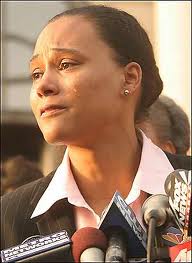
Marion Jones on the courthouse steps October 2007 in White Plains, N.Y.
“Why do we fall, sir? So that we might learn to pick ourselves up.” Alfred Pennyworth, Batman
This weekend, I watched 30 for 30: Marion Jones: Press Pause–this after viewing 9.79*, another 30 for 30 documentary about the track and field doping scandal involving Ben Johnson in the 1988 Seoul Games. Watching Press Pause was painful because the film spends so much time dealing with the moment captured in the image above when Jones first publicly admits to having made false statements to federal agents about using performance-enhancing drugs and to making false statements regarding a check fraud case. As much as some folk expressed ire towards Jones for lying and for so publicly claiming the fruits of gains that she had not honestly earned, I felt sadness for her in equal proportion. I was not happy to see Jones’s humiliation.
The film 9.79* suggests that Ben Johnson may have used performance-enhancing drugs for a steady portion of his career. In fact, at some point, most of the runners who lined-up to compete in the 100 m. dash final in Seoul tested positive for some banned substance. Perhaps much of my own sympathy for Jones stems from following her for much of her career and knowing that she has always been incredibly talented. Like Ron Rapoport, Jones’s biographer, I saw her drug use as so unnecessary. While I don’t know that she would have won five gold medals at the Sydney Games without doping, she certainly would have left decorated.
Viewers responses to Press Pause were quite scathing. People were upset with John Singleton, the film’s director, for appearing to give Jones a platform for providing a very biased account of her failings and that didn’t push her to be more forthcoming about other aspects of the case she might be hiding. What isn’t clear to me in cases such as these is when a person has suffered enough. The woman has had to suffer through prison–something Barry Bonds probably will not have to do, though he was convicted of obstructing justice–having to leave her young children and her husband for six months, and enduring the public humiliation of having to admit that she cheated and lied.
Despite her failings, I’m still rooting for Marion Jones. I think that people deserve the opportunity to pick themselves up after a fall. Jones appears to be refusing to allow herself to be defined by her shortcomings. Though she admits her limitations, she has not allowed them to ultimately determine how she will identify herself. She seems a perfectly good model for getting back up after taking a tumble, which happens to all of us at some time or another. It just can’t be that we always win, make the right choices, do what is best. And in those times, the champions might not be our best models, it might just be the losers who have something to offer.
I don’t know how these things are connected, but I’ve been holding them together in my mind for some time now. For some reason, I’ve been thinking about these lists we chronicle in popular culture at this time of year at the same time that I have been thinking about the stories that we need confirmed despite their veracity. So for example, I was thinking about or better yet, dreading, the television shows and magazines dedicated to which celebrities divorced or filed bankruptcy or were engaged in some scandal alongside my thoughts about the documentary film 51 Birch Street. Have you ever seen this film? If not, go directly to Netflix and add it to your que. The film is about a man who learns that the relationship that he believed that his parents had was an illusion after his father marries a woman who had been his secretary soon after his wife of 54 years dies. Doug Block, the filmmaker and son, had been close to his mother but found his father difficult to get close to. The viewer expects to like and respect the mother but one of the great surprises of the film is how much you like and respect the father. Doug learns that his parents’ marriage was rather loveless when he discovers the almost daily journals that his mother kept chronicling their marriage. I’m not going to give it all away, but one of Doug’s pressing concerns involves his father’s swift marriage. Were they having an affair, he wonders. In one very poignant moment between Doug and his father, Doug asks his father this very question. It reminded me of an episode of Kimora: Life in the Fab Lanethat I happened to catch when one of her daughters asked her if she was actually nude in a PETA advertising campaign she had seen printed somewhere.
Kimora Lee Simmons for PETA
The audience had been privy to the behind the scenes footage of the photography shoot and knew that Lee Simmons was actually in the nude so I was curious to see how she would respond to her daughter’s inquiry. She looked directly at her daughter and said, “No, Mommy was not naked.” The little girl let out a sigh of relief and moved on. I remember thinking it was a sweet moment because Lee Simmons knew that her little girl wanted her to say exactly what she did. That if she could have accepted the possibility of her mother’s public nudity, she wouldn’t have needed to ask the question. So when I heard Doug Block ask his father if he had had an affair, I thought his father must have heard a little boy asking the question.
Maybe I’m curious about my own need for sustaining fictions and whether or not I would recognize them if I asked them out loud. I wonder if there is something fundamental about the parent/child relationship with respect to these sustaining fictions. If, for example, we find the need for our husbands or our wives to support these fictions for us, are we asking our marriage to perform paternalistically. If we need our friends to perform this function, then are we asking our friends to perform paternalistically.
I still don’t know why I’ve been thinking about the year in review alongside sustaining fictionsbut in thinking about the two ideas now I am more intrigued by what a year’s end list of questions might look like. Maybe I don’t like the fiction of facts that we chronicle. I don’t like the suggestion that because we know the quantity of something or the state of something, that we also know the quality of it. Maybe I would more greatly appreciate a list of the mysteries of life that we have encountered and the ways we encountered them. Perhaps I’ll work on this list as a model for a more interesting chronicle of our times.
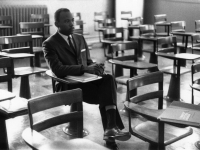
James Meredith photographed in a classroom at Ole Miss where students have cleared out in protest of his presence.
Today marks the 50th anniversary of James Meredith’s first day of class at the University of Mississippi. NPR’s “The Picture Show” has some of the photographs that Ed Meek recorded. NPR also has two wonderful discussions about Meredith and the violence that occurred on the campus over desegregation. Thus, in addition to checking out “The Picture Show,” I also recommend these stories:
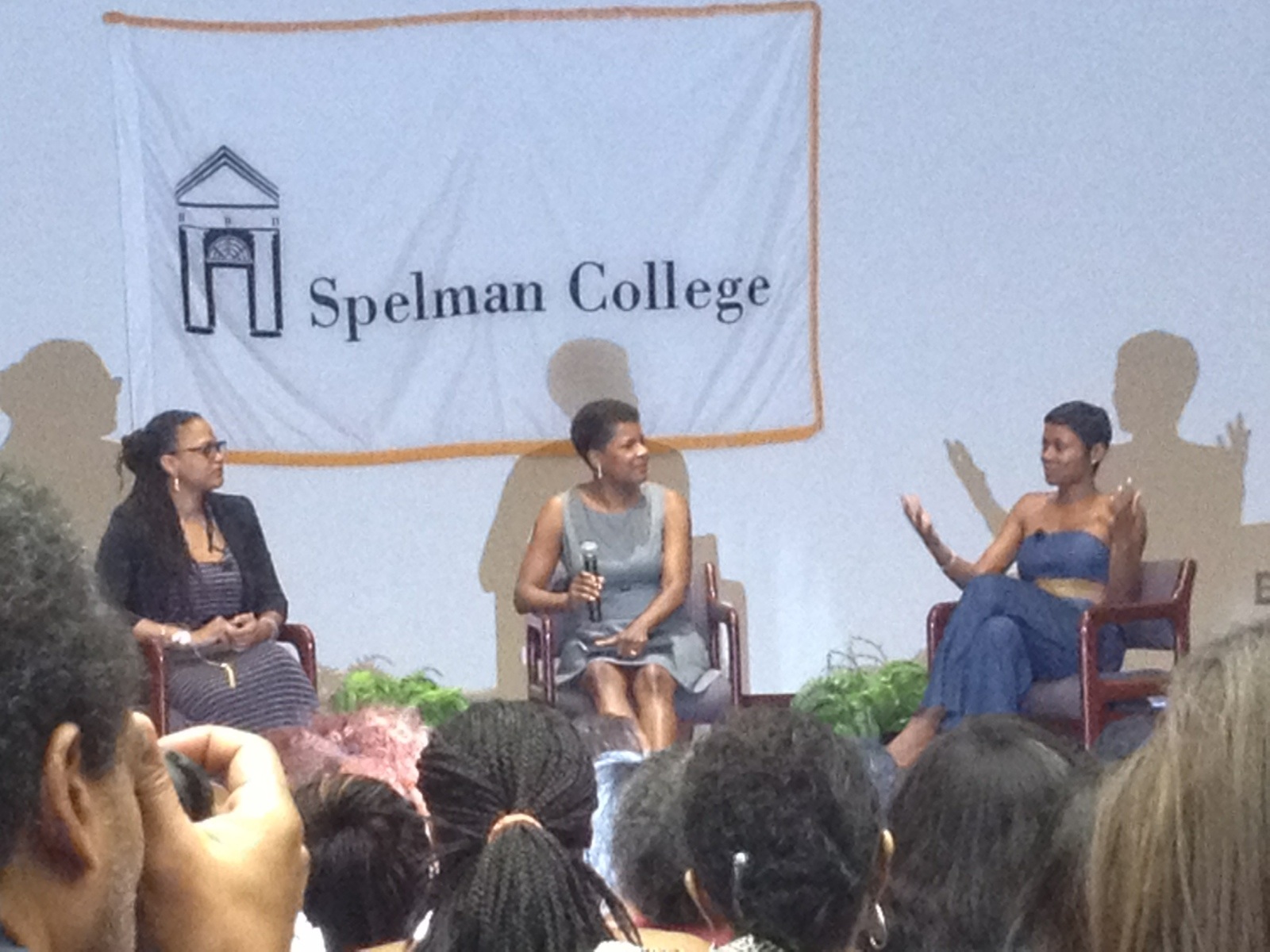
Filmmaker Ava DuVernay (left), author Tananarive Due (center), and actress Emayatzy Corinealdi (right) at Spelman College.
Last Thursday, I had the great pleasure of being in the audience at Spelman College where filmmaker Ava DuVernay screened three clips from her film Middle of Nowhere, which won her the Best Director’s nod at Sundance in January. The film personalizes mass incarceration through the lens of one couple’s experience. If you have not seen DuVernay’s first film, I Will Follow, I recommend it. This film centers on how a niece copes with the death of her beloved aunt Amanda and in doing so examines a taken for granted hierarchy embedded in how sympathy gets accorded in the aftermath of loss. Maye, played by Salli Richardson-Whitfield, literally finds herself displaced, being forced to move from the home she once shared with the aunt she cared for by her cousin Fran, Amanda’s daughter. As Amanda’s daughter, Fran legally assumes primacy for her mother’s affairs, but Maye was not only physically closer, she was emotionally tied to her aunt through a great regard for the integrity of how she wanted to die and a rich resource for recording her memory.
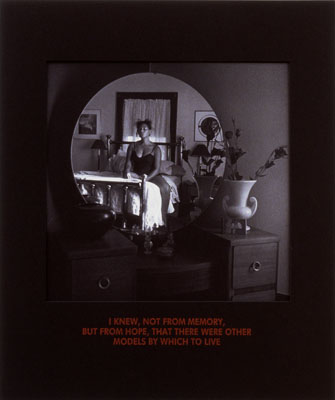
I Will Follow was the first film distributed through the African-American Film Festivals Releasing Movement (AFFRM). DuVernay founded the association as a way to distribute films outside of the predominant corporate model. AFFRM brings together premier black film organizations, including Urbanworld Film Festival, Imagenation, BronzeLens Film Festival, ReelBlack Film Series, and Langston Hughes African-American Film Festival to market and distribute films whose value may be found beyond Hollywood’s recognition. This collective recognizes the potential of what it means to have “other models by which to live.”
A friend asked me to be on a book panel to discuss Manning Marable’s book Malcolm X: A Life of Reinvention that a group of college honors students had been assigned to read over the summer and I accepted her invitation. Only after receiving the itinerary did I learn that the event would take place a little over an hour away in Macon. My husband and son accompanied me to the event and so that made it a nice drive.
The discussion took place at the historic Douglass Theatre. Since the name was spelled the same as the historic abolitionist’s I initially thought it a tribute to him. In fact, it honors the man who built it, Macon native Charles H. Douglass. Douglass built the theatre after making his money as the proprietor of a bicycle repair shop. We learned that some of the most talented black musicians to come from Macon performed on that stage. It was hard to imagine such an intimate venue framing the expansiveness of Otis Redding, Jimi Hendrix, and James Brown, but apparently, it did. I liked the venue very much.
As our panel organized my son had become antsy, wanting to talk to me from afar. Once my co-panelists began their presentations, my son had to be taken from the venue. As he calmed down, my husband and son would appear periodically throughout the various discussions. Afterwards, my husband shared with me that he had not seen so many people playing Angry Birds and texting at the same time as he saw from his vantage point at the back of the room. He found it extraordinarily disrespectful. “If these are the honor’s students, I would hate to see how the regular students behave,” he said. I agreed. I was put off by their arrogance and struck by how at odds it was from the humble posture that St. Augustine marks as a characteristic of learning. It was also at odds with the lesson Poppy offers his grandson Nate in Toni and Slade Morrison’s interpretation of one of Aesop’s fables and thus from an entire storytelling tradition on the value of paying attention.
In Who’s got Game? Poppy or the Snake, Nate, the favored grandson, tells his grandfather that he doesn’t want to leave his company and be forced to return to school. When Poppy presses him, the boy shares that he has a difficult time concentrating on the lesson because of the fun taking place around him. This leads Poppy to tell Nate a story about the time he accidentally ran over a snake who he then felt responsible for helping to heal. The snake eventually bites Poppy but Poppy had injected himself with a serum that protected him against the poisonous venom. “Oh, that’s what saved you!” Nate says. “Not entirely. Paying attention is what saved me,” Poppy concludes. Paying attention, Poppy told Nate earlier “was just another way of taking yourself seriously,” which was something my husband and I felt the honor’s crowd had not considered.
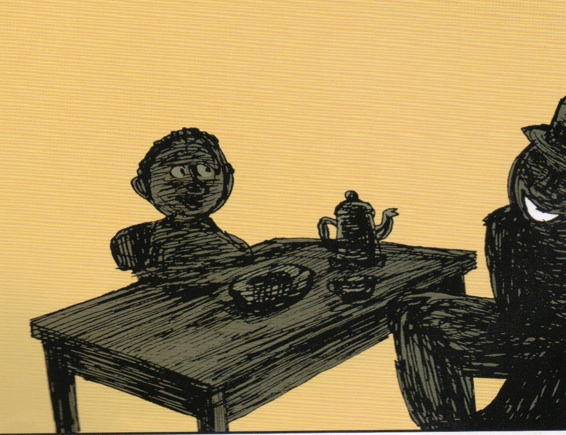
Who’s Got Game? Poppy or the Snake
Taking one’s self seriously wasn’t altogether overlooked by the students as I overheard many of them expressing to the Director the events on their schedules that they were concerned about getting back to Atlanta to attend. Clearly, they had a very different notion of taking one’s self seriously than we did. Taking one’s self seriously for them meant focusing on the calendars they had built for themselves. If they were not engaged in those appointments, they allowed themselves to become distracted from what was occurring before them. Taking one’s self seriously also seemed to be about expressing one’s aspirations for professional success. The students that I was on the panel with discussed their career ambitions and actually used their presentations to describe how they were using the history of Malcolm X’s life as documented in Marable’s historical account to inform their professional pursuits. Thus, many of their presentations combined book reports with speeches on what they wanted to be when they grew up. It wasn’t what I expected.
As much as I like my devices, being convinced by the value of paying attention keeps me from being seduced by them. As with Morrison’s story, I think my early education prepared me to be suspicious of the lure of distractions. Before Poppy schools Nate, Little Red Riding Hood’s mother warned her about being lured from the path on her way to visit her grandmother. The value of paying attention is an early lesson. When I tell my son to pay attention, I think I’m equipping him with a life sustaining piece of advice: paying attention could save your life. In playing Angry Birds and text messaging, those students were showing a very casual regard for themselves at the same time as they were claiming to take themselves seriously. Paying attention is a call to the present. It acknowledges the meaningfulness of the present as a necessary context for any future you plan on having. Playing Angry Birds and text messaging while others were presenting work where they imagined you as a present audience, if not an interested audience, was not only rude, it was reckless. We cannot allow our new devices to tempt us away from old lessons. Paying attention is old advice that matters in an age of new technology.
There’s an article in The New York Times about the first comprehensive retrospective of Carrie Mae Weems’s career opening at the Frist Center for the Visual Arts in Nashville on Friday. Given that Weems’s series Not Manet’s Type inspires this blog, I thought I would highlight the article and Weems’s work, featured on her website, today.
I watched the 2009 Academy Award nominated documentary film Trouble the Waterthis weekend and it was an enthralling feature. The film combines footage that Kim Roberts captures while she and her husband Scott are trapped inside their home in the 9th ward as Hurricane Katrina bears down on New Orleans. The film also chronicles the aftermath of these events. At one point in Kim’s film, she tells neighbors who are preparing to make their way out of the city that she would leave too if she “could afford the luxury.”
Poverty plays such a central role in the narrative that it easily becomes an effective character in the film. As a result of being poor, Kim and Scott cannot escape the storm; many of their neighbors get displaced; some of them die. Though the fact of death seems hard to trump, some of the most disturbing scenes in the film involve the U.S. military. Kim, Scott, and their neighbors sought higher ground at a U.S. Naval base not far from their homes after the Coast Guard recommended the location. Though the base has approximately 200 family housing units and over 500 evacuated rooms in the barracks, Kim and Scott’s group was refused. When Scott asked a guard if the women and children could be accommodated, he reports that a guard told him to “get off the property or they were going to start shooting.” One soldier disputes Scott’s report that soldiers loaded their M16s, another soldier appears to uphold Scott’s version of events. Refused shelter at the Naval base, Kim and Scott’s band moves on down the road to Frederick Douglass High School where no one is there to refuse them. In the scene’s aftermath, soldiers are featured outside of Douglass High School discussing their recollections of encountering the group. One soldier describes the scene as “a wreck” and another claims that he means “no offense to civilian people” but he claims from what he witnessed, civilians “have no concept of how to survive.” It seems to have escaped this soldier’s attention that this particular group has survived one of the deadliest hurricanes in the history of the United States. Despite the hostility directed at its own citizens, President Bush awarded the Navy officers a commendation for “defusing a potentially violent confrontation.”
Kim and Scott offer a representation of poverty that defies the government’s view of them. From the government’s perspective, poor people are generally violent and immoral. Where they clearly understood the poor as figured in Kim, Scott, and their group as pathological, the story that Kim tells through her camcorder offers a narrative of such authenticity that the one told through the film’s broader narrative has greater credibility and challenges the myth of the rapacious poor. Through Kim’s lens, the viewer sees she and Scott extend their home and space to neighbors who would have been alone otherwise; and though they have few resources, we see them sharing all of what they have with those they shelter. While the film can tolerate an understanding of these obviously poor people being generous and thoughtful, the government cannot. I thought about such intolerance as I read and thought about Little Free Libraries this weekend.
Last weekend, I went to the Decatur Book Festival and saw some of the Little Free Libraries being auctioned off there. These reflected the creativity of builders throughout the country who have taken up this project. Little Free Library is a national organization and the project involves communities creating tiny public libraries where community members are free to exchange books. When Little Free Libraries are officially established, their location gets placed in Google Maps and there is additional written documentation of the library’s history thereby blending old and new technologies.
As Little Free Libraries seek to use books to build community, they suggest that lacking an ethos of sharing and generosity involves all communities and not just poor ones. Frankly, the hostility often shown in doctors offices regarding magazines not being removed reflects the ethos in some elite communities over resources, particularly reading material, and a need for a greater spirit of generosity.
The starting bids for the Little Free Libraries at the Decatur festival began at $300. Though I didn’t sign-up, I like what they represent. As it stands, my version of exchange takes on the vernacular approach like that of Kim and Scott: I assist however I can. In considering their story, it raised issues for me about what “community” actually meant as neighborhoods installed their adorable little libraries. Did it only refer to people who lived on your block or had people intended a broader understanding of “community?” To that end, I wondered how comfortable Kim and Scott would feel “borrowing” books from a library on a block where they did not reside; I also wondered if they would be welcome to do so. In other words, issues of race and poverty, trust and suspicion definitely interact with this very engaging public service project.
Little Free Libraries highlight the rarity of the sharing of resources but a simultaneous desire of doing so. Even though they did not have very much to give away materially, what little they had, Kim and Scott shared it. The government’s view of poor people as exemplified through the handling of the aftermath of Hurricane Katrina rejects recognizing the poor as anything but pathological. I wonder if communities across the country offer a better model of recognizing the generous poor.
Searching for school supplies might be the one time when I enjoy shopping. I actually think that good school supplies can contribute to an improved attitude and inclination towards doing school work. Crayola 64s prove this point. Anyone who has ever received a box of Crayola 64s remembers what it was like to have these crayons and set out to use them right away because of the box’s built-in sharpener; new pens, notebooks, and other devices worked similarly. I wanted to use them to test the color of the ink or the precision point of the pen; the width of the paper’s spacing; the tension of the calculator’s buttons.
Here are a few school supply items that I am currently enjoying:
I bought these journals at Target. I pick-up little writing journals all the time. I think they’re good for just jotting down ideas. These are small enough to fit into your back pocket but not so small that they are hard to keep open while you write.
The red journal and the Kindle Fire offer nice contrast to the journals on the far right. I like the size of the journals on the farthest extremes for different reasons.
The covers make them attractive. I’ve visited each of these places so I’ve played with the idea of making them travel journals but then I’d have to keep up with that and instead of being able to just pick up a journal and jot down any idea, I would have to remember to separate them. So I decided they weren’t for specialty writing, just writing.
Zebra Sarasa Pens come in fun colors and only cost $1. I have only ever seen them in the check-out line at Staples but I think I’ve purchased every color.
I stumbled upon a great list of note taking app suggestions. From that list, I purchased Day One and I love it; especially now that they’ve added the photography feature. It’s a beautiful app that lets you jot down ideas and also provides a way of keeping a visual log of those thoughts. Since I can’t draw but enjoy images, I love that I can have a photography journal without the hassle of developing the pictures and organizing them in a book.
My relationship with my father was a hard thing for me to describe to people who only knew me as being estranged from him; so I usually didn’t talk about it. It was hard to explain how I knew that my father adored me, that he loved me as much as he was capable; I never, ever doubted his love. Ever. As I thought about it over the years, what I understood was that I could see and embrace my father’s love throughout my life because even before I had language to describe it, I had accepted that receiving my father’s love required recognition and acceptance for his limitations in demonstrating it; he could only be who he was. Thus, my father loved me through his demons.
I think my father would have benefited from psychological therapy or counseling. It was years before I associated his drug distribution and abuse as being related to his psychological and emotional demons but I think that my father probably suffered from mental illness that led to him self-medicating. As a child, I would have described my father as violently moody and I knew that it was best to stay out of his way when he was “going through it,” which was rather easy for me to do because, thankfully, he and my mother never married so I didn’t live with my father and there was no formal custody agreement. Though I saw my father regularly, I was never forced to, so if I didn’t want to chance a bad spell, it wasn’t required.
I was definitely afraid of my father. I was afraid of his temper and I tried to always stay on the good side of it. He never hit me but I knew him to hit women; he saved his verbal abuse for everyone else, and here, I had been his victim. The final straw came for my accepting his cycle of attack and apology came after my first year of college. My father learned that I had given up my track scholarship and he was livid. Now, my decision to do so only involved my father emotionally because he hadn’t committed anything to me financially or otherwise. During my entire freshman year, he had never called or written, he had never sent money or care packages, and he never visited. My quitting would involve my mother more in funding my college education but not my father. I wasn’t surprised when he called to tell me his thoughts about my decision, but the vitriol he spewed was more than I could bear. After telling me how disappointed in me he was after I had said for years that I was going to the Olympics (something that most people think you want as a runner so you just go along), how could I go and do something like this. “Man, fuck you,” he said. “If I die, I don’t even want you to come to my funeral.” I didn’t say anything. Though I would tell a more heroic story to my friends about how I immediately responded, “Fine, I’ll make other plans,” what I really did was silently cry on the other end of the telephone. I didn’t find empowerment until shortly after I hung up. I had been managing my father’s abuse for years but I decided that this was the last straw. When he came over to get money from me every time he knew I would be attending a formal dance, I figured out that he would ask for half of the total amount that I gave him. So when I knew he would come over high and needing a fix, I would give him a total amount whose half I wanted him to have versus the actual figure. “How much money you got,” he would ask. “Fifty,” I would say. “Give me twenty-five.” I would give him twenty-five and then really have seventy-five for myself because I might have actually had $100. I decided that this latest violence was something that I would have to handle on my own in much the same way and I decided that I didn’t want anything else to do with him. In order to make the break, I needed to get back the hardware-the trophies, medals, and plaques-that I had given him to keep. When I called him the next day, acting as though nothing happened, I asked him if he was going to be around so that I could collect these things. He confirmed that he would be and he also apologized for his crudeness the previous day. I accepted his apology and set-up a time to collect my things, did it, and never looked back.
I didn’t speak to my father again for another ten years or so. This seemed to be a decision that only people who had experienced abuse understood; everyone else was sentimental. People who had also suffered any form of abuse understood that when you acted to stop it, you were moving towards having peace in your life, and that that peace was worth more than living a cliche about relationships. I was never so angry as when people who had come into my life sideways, that is, through relationships that I had with mutual friends or acquaintances, and they would try to repair the breach in my relationship with my father. You know nothing of what I have had to endure and I don’t owe it to your fantasies to re-enter that relationship to take more abuse, I would think. Even as a much younger, vulnerable woman, I was never manipulated into repairing my relationship with my father for the sake of others. If my father was an unchanged man, then he was a threat to me and anyone in my life. I knew that and I wasn’t willing to deny it for anyone else’s sense of what I ought to do.
People who are estranged from others in their lives know that estrangement doesn’t necessarily involve bitterness. I was more at peace when I became estranged from my father than I had ever been in our relationship. Estrangement didn’t mean that I carried hatred, it meant that I had rejected violence; peace was what I carried in exchange, not bitterness. The experience of peace allowed me to forgive my father and to accept him into my life once I was convinced that he had changed in relevant ways. While my father still had significant flaws, he understood that his relationship with me was tenuous and he wanted to preserve it. We never discussed this tenuousness together, though he would talk about it, I only listened, I liked what I heard. My father had no authority in my life and I liked it that way. He couldn’t be trusted with authority in my life so I liked that the balance of power had shifted to me and I trusted how I would handle it.
In his discussions of our relationship and our past, my father spoke in terms of debt. “Do you know how much I owe her,” he told me he would say to people if or when they questioned some measure of generosity I’m sure he told them he was making towards me. I would have never exploited my father’s vulnerability in the way that he exploited mine, or any other way, but I certainly perceived his vulnerability to me as a result of his moral indebtedness. From my vantage point, my father really had done the best that he could or knew how to do. I saw him as a very broken man who tried to love through weakly held together pieces of himself. I could forgive my father because he couldn’t hurt me anymore. He was now safe to love up-close. I trusted that he wanted to be in relationship with me and was willing to forfeit any authority his status as my father granted him and follow my lead. Thus, I could forgive him because I trusted myself.
What I admired about the depth of my father’s understanding of the hurt that he had caused people was his willingness to stand and face the pain, endure possible rejection, and to keep apologizing for it as long as forever lasted. When my father would tell me of his experience in attempting to reconcile with his ex-wife and their two children, I noticed that he would get frustrated at times but he never became bitter or angry with them; he accepted the pain he caused. He didn’t ask them for anything.
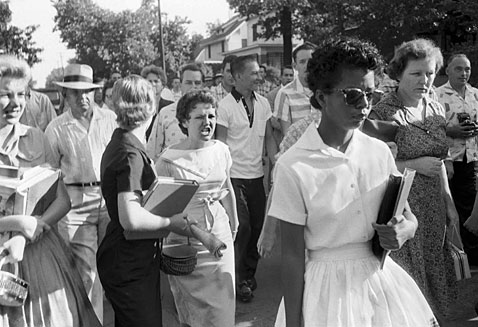
I recently finished reading Elizabeth and Hazel: Two Women of Little Rock, David Margolick’s very thorough account of the life behind Will Counts’s famous photograph of Elizabeth Eckford’s walk among a hate filled crowd as she makes her way to Little Rock Central High School (LRCHS) on September 4, 1957 and I thought about the lessons I learned from my father about forgiveness and reconciliation and I have wondered how they might apply to race. I certainly accepted that Hazel Bryan Massery, the white woman in the photograph whose contorted face came to figure the hatred of Southern whites towards integration, had changed in significant ways. Even though I don’t think that time makes change inevitable, I can accept that people who want to grow and change can do so. Massery had come to accept the limitations of the views about race that she had as a teenager and she had taken on alternative ideas about it. Had she stopped short of friendship and offered an apology to Eckford for her part in causing her pain, they might have been a model of what we might reasonably expect of racial healing from this traumatic time; instead, they offer a model for much of what goes wrong within the terms of racial understanding in the United States.
Will Counts photograph of Elizabeth Eckford and Hazel Bryan on September 4, 1957.
Ultimately, in wanting a friendship, Hazel wanted too much from forgiveness and thus Elizabeth. From Margolick’s account, nothing about Hazel suggested she wanted to capitalize financially from a relationship, as far as I was concerned, but in wanting friendship, she wanted something beyond absolution. Had friendship with Hazel been something that Elizabeth wanted and pursued and it matched Hazel’s desires, that would have been fine. Wanting Elizabeth to become a friend asked for too much because it sought to establish a relationship of mutual power and authority. Hazel had no right to ask Elizabeth to open her life to her authority. This was especially true in Elizabeth’s case because she was mentally and emotionally unstable. Doctors diagnosed Elizabeth with Post Traumatic Stress Disorder and she had been mentally, emotionally, and financially unstable for years in the wake of her experiences at LRCHS. In most of her relationships, Elizabeth was the recipient of another’s special care; she took more than she gave. Those in her community accepted this because they saw Elizabeth as someone who had sacrificed enough for their sake through her role in integrating LRCHS. Friendship or neighborliness was an everyday recognition of the meaningfulness of history. Given what she had suffered for their sake in the past, they owed it to Elizabeth to do what they could for her, but they decided that she had done enough for them.
Hazel Bryan Massery’s relationship to history was different. She wanted forgiveness to absolve her of her debts to history and for friendship to mark a future where she and Elizabeth were mutually obligated to one another; after all, weren’t friendships about mutual obligations? Being someone who suffered from PTSD meant that history claimed Elizabeth. There was no escaping the literal return of the past for Elizabeth through traumatic flashbacks or the terror she experienced from even seeing the photograph of her surrounded by that mob; her future was inextricably linked to the past. Hazel wanted more from her and this seemed like too much to ask. Too, it showed a profound ignorance of trauma. Margolick and Eckford described Massery’s views and understanding about race naive, I found them so limited as to be reckless. She seemed ignorant of the power of racism to cause traumatic wounds and so she trivialized them. Trivializing race meant that she didn’t know how to support or show concern for the dailiness of Eckford’s encounters with racial blows.
To Massery’s credit, she did not deny Eckford’s past experiences of racial assault; much unlike Ralph Brodie, former president of the student body at LRCHS. I found Brodie’s efforts to minimize the representations the Little Rock Nine offered of their horrific experiences at LRCHS reprehensible. His efforts to cast ninety-five percent of the student body at LRCHS as “good kids” and to place his version of events beyond the master narrative offered by the Little Rock Nine constitutes a racist act because he assumes that he has the authority to dictate what happened to those black students. In doing so, his effort suggests that they lack credibility. The credibility that they lack and the authority that he assumes in seeking to redeem the white students that he feels have historically been egregiously maligned reifies the kind of abuse the Little Rock Nine claim occurred during their time at LRCHS. I thought about Excaliber Gymnastics and the response from the CEO as well as a former gymnast that trained there when I read about Brodie. The CEO essentially called Gabrielle Douglas a liar and a former athlete at the gym thought he could better describe what happened to her in his own terms. Thus, according to Randy Stageburg, Douglas was “bullied” but she was not the victim of racism. The fact that Stageburg thinks that he has the authority to dictate what happened to Douglas presumes power that he does not have. The fact that Douglas did not report her victimization to him or others shows a lack of understanding regarding the humiliation and violence of racial terror and it presumes that those outside of Douglas determine the nature of reality but she can’t. Stageburg made Douglas responsible for naming something she may not have even been able to name at the time. Just like Brodie, Stageburg set himself up as a witness and judge who did not see and was not informed and yet feels that he gets to decide what happened. His ignorance regarding the mechanics of racial terror makes one wonder what kind of witness he could be when he’s blind to racial violence and hostility. In both cases, racism gets reified by the people disputing it.
I agreed with my father’s view of his responsibility to continue apologizing for the hurt that he caused for as long as forever lasted. I accepted my father’s final apology because he had become someone who would honor that by not continuing to commit violence against me. I didn’t owe my father anything beyond that and he seemed to agree. He never seemed to want me to make him completely innocent, he didn’t seem to think he was innocent, as though the past never happened. While Massery accepted the past, through pursuing friendship, she wanted her goodness recognized and she wanted a fresh start. Thus, she wanted a shot at innocence. Such an ambition fails to keep you aware of the ways that the hurt you caused may require forever.
My friend Julia and I were casually chatting on our way to a meeting when she shared with me the details of a trip she had taken with J.P., her son. I was taken aback by how beautiful her trip was in its thoughtfulness and its execution. Julia always does such thoughtful things with J.P. and I asked her if she would allow me to record her experience through an interview for my blog. She graciously agreed and we recorded our exchange through a series of emails.
Though summer vacation time has ended for those of us in the South, there is still time for others to use Julia’s excursion as a model for planning a trip before the school year begins. As for me, I plan to consider contemplating her trip in light of my desire to be deliberate in choosing to live creatively. Julia’s trip broadens the possibilities for extending our highest ideals to every aspect of our lives. I will also think about her time with her son as an example of the kind of contemplative experience that I find worth pursuing. As you will read, Julia sought out spaces for she and J.P. to reflect and to be quiet, to think about history and their relationship to it, to eat good, fresh food, to play and to rest.
What motivated your trip?
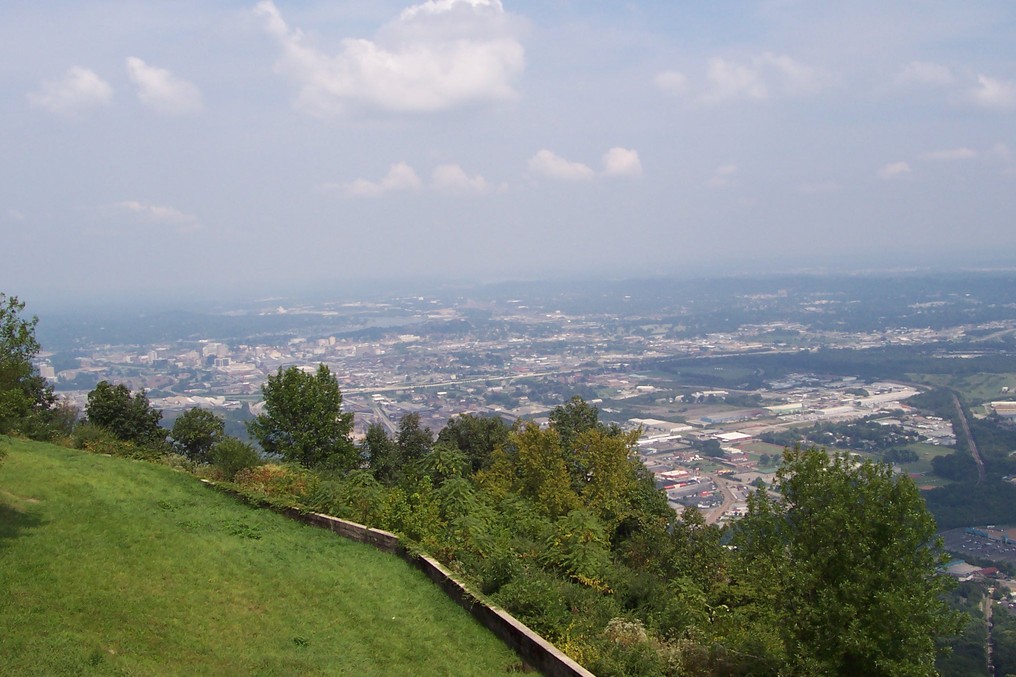
A number of things. As you know, I have been feeling somewhat antsy about this next transition in J.P.’s life and I wanted to make a memory with him before he moved on to middle school. This type of memory making before a transition is somewhat of a tradition in my larger family, so, with my husband out of town, I thought it the perfect opportunity to make a memory with J.P. by going up to Chattanooga. It is, as you put it “austerity time” and going off to somewhere local would not have been good enough. So, we went to Chattanooga where it was cheap and close. We went to see some of the things that he loves–animals and trains with a history and book excursion thrown in for me–even though it didn’t work out as well as I had hoped (Note: Here, Julia is referring to her disappointment in not being able to ride the Incline Railway and see the Civil War museum at the top of the mountain, which she discusses some later), but that is the nature of these things sometimes.
How did you think about fun?
I knew that Chattanooga Zoo was not large, but that they had some animals that he had never seen before–he was especially fascinated by the chimpanzees. He is a big fan of Jane Goodall’s work (Note: J.P. is a fan of Through a Windowas well as the film Chimpanzee) and so this was a good opportunity for him to see some of the things that she has discussed in some of the books that he likes to read. The train trip was a plus for both of us. He loves trains and the history that was narrated during the trip was great for both of us. This part of the trip, though, was a big reminder about how much the South is marketing its Confederate history as a tourist draw. Curiously, I did not find it bothersome, but just something to note. As this history was being discussed, remember, we are riding on the Jim Crow cars. All of this, for me, was a nudge from the universe that J.P. is going to have to confront his racial history in a much more direct way very shortly. I have always tried to impart to him that learning is fun, but the impact of the racial history will come down in a much more direct way, which may not be fun. I want to make sure that I am there to discuss it with him in a way that allows him to come away feeling pride and not victimization. He comes from survivors and he needs to know that story.
How did we decide on the location?
Chattanooga is close and cheap in these austere times! I would have tried to do it in one day, but it would not have had that vacation feel. Given that I knew I would get that $50 gas card back, the cost of staying at the Comfort Inn, which is my favorite hotel chain, made an overnight stay workable.
What did we listen to or watch during the voyage?
There has to be compromise at these times. He is into anime and he likes Bakugan (you may not know about this yet, but you will). It is noisy and does not make for good driving. I had checked out an audiobook from the library on my iPad–Three Cups of Tea. You probably remember all of the upheaval a few years ago about [Greg Mortenson having] fabricated his trips to Pakistan, but I was not familar with the text as I should have been (it was required reading at Kennesaw State University for the first-year students and he came to speak at the campus before the controversy), so I thought this was a good time to examine the controversy by listening to the book first. They made a version for younger readers and this was the audio version. Guess who did the voiceover of her own intro? Jane Goodall! Well of course he had to stop his anime and listen to what Jane had to say. We listened to the book for about an hour together and then I let him watch his anime. It gave us a good way to discuss giving and philanthropy, but for myself, I am still trying to put together how I feel about what this guy did. Do the ends justify the means?
Did I require any prepartory work for J.P.? How much of that work did I do for myself?
I had lots to think about in the run up to this in how to go somewhere as cheaply as possible, so yes, I have lots of run up work. I did not share this planning with him, because he gets too excited and he would harange me endlessly about the particulars. He may get to being able to share in this planning work someday, but not yet. I only required him to map the way and to see how closely the GPS got us there (J.P. completed this task on an iPad). This was the occasion that I found out about the battery power running down the phone and I had the GPS on all the way (I didn’t need it on at all on I75!) and my phone conked out as I was trying to find the hotel, so no GPS help. I had to do some aimless driving, including asking for directions from other Comfort Inns, to find the hotel!
Where did we go? What did we do?
We went to Chattanooga Zoo, left there and went to the Tennessee Valley Railroad for the train trip. That was enough to do in the first day. However, as I could see on the maps, the Comfort Inn that I chose was right down the street from McKay‘s books. I had no idea what that was. It is only the greatest chain of used bookstores in Tennessee! After we checked into the hotel, he got a swim and I got a rest, we went to McKay’s before we went to get dinner and had a ball there–so the unplanned stuff works out too! The next day we went to the Incline Railway, which was shut down due to the bad storms, and the Chattanooga Choo Choo to see the large model railroad display. We would have gone to the aquarium, but it is austerity times and my GA aquarium membership does not help there. I told him we would come back sometime, and we will. Our Fall breaks overlap this year–we may go to the Aquarium and the Incline Railway then (and go back to McKay’s!).
What did you eat?
It was about lunchtime when we got to the Railroad, and they had a little shop to eat in there. I thought we would eat snacks, but he wanted something more substantial. They had sandwich platters and we ate that, and it wasn’t to bad. For dinner, after McKay’s, we went to Fresh Market. I had noticed it in my aimless driving to find the hotel. We had a good time going in and picking out chicken, pasta salad and grilled veggies from the deli, good peaches (which have seemed so rare this summer) and a couple of raspberry pocket cookies from the bakery. We picked up some flavored waters and that was dinner! The cool thing about Comfort Inns is that they always have a fridge and a microwave in the room, so we could save things that we didn’t eat for the next day. Breakfast comes with the room and J.P. made sure to make his strawberry waffle in the iron–which is always fun. I stuck to Raisin Bran and fruit. We stopped at a Zaxby’s for lunch on the way home in Marietta. I was all for eating lunch at home, but you know how kids can be. (Julie’s reflections on dinner and my image of them eating in the hotel reminded me of a blog post I read some time ago where a woman and her daughter are on vacation in Paris and dine “picnic style” in their hotel room.)
Did you make a special effort to record the trip?
I went to use my brand new phone to take pictures of the trip, but I don’t know how to use it. None of the pictures are on my camera roll! Even the Jim Crow ones! Arrrgh! I need to get a camera…Of course, this e-mail to you, as well as J.P.’s using writing to create a record of the trip [are records] so that is good! I hope that he remembers it, even just a part of it.
Can you say more about J.P.’s writing record?
He wrote about his experiences on the laptop to practice his keyboarding skills. He writes in response to what he liked the best and why. He just keeps it in a folder on the laptop.




 In Reverie Blog