I will grant that James Brown sounds good when he sings “It’s a Man’s, Man’s, Man’s World,” but I hate the song…but people clearly dig it. Anytime you see clips of Brown performing it, you hear the crowd going wild. I don’t know if they like the music, which is nice, the lyrics, or some combination of them both, but folk appear passionate about the tune. I was in a discussion with several first-year college students recently who referenced Brown’s song to offer me commentary on how they viewed themselves with respect to men. “It’s a man’s world and I just want to be a lady in it,” one young woman confessed. “Yeah,” said another. “As long as I’m treated like a lady,” she offered, “it can be a man’s world. Because frankly,” she continued, “I just don’t want to do the things that men have to do.” The only chore she could think of that men do is to take out the trash. In my experience, being treated like a lady by a man typically occurs when your interactions with him are so infrequent that your competence cannot be depended upon; otherwise, women are treated as though they are capable. Given that competence-women’s competence, I’m not sure why one would concede to it being “a man’s world;” I’m not willing to concede that point.
The young women I talked to about this offered the example of men holding the door open for them as an example of how men make women feel like “ladies.” In my house, the doors stay open without my husband’s assistance so I’m not sure how being treated like a lady works out as a routine experience. I don’t know if I have the power to imagine what this would look like beyond episodic instances within the experience of one’s day. So I guess I have to admit that these students would not find my life attractive or that of any of the people whose lives I admire because I don’t know any women who get to chill all day. Chillin’ and being married, or chillin’ and being in relationship ,or chillin’ and having children just don’t go together. So I wish these sistahs luck because it’s going to be very hard finding a man who believes that “it’s a man’s world” while also maintaining that women don’t have to work in his kingdom.
I usually make what we consider a big breakfast on Sunday. This meal typically includes turkey bacon, scrambled eggs, waffles or pancakes or biscuits or hash browns, strawberries, and yogurt. I provided the recipe that I use for pancakes in a post some time ago so today I thought I would share my waffle recipe. Just like with the pancakes, most people have the staples to make homemade waffles in their cupboards or pantries, if you also have a waffle maker, then you’re ready to make these waffles.
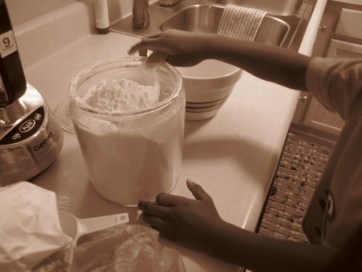
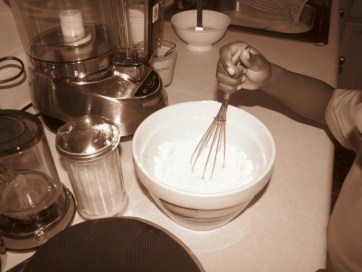
In a large bowl, whisk together the following DRY INGREDIENTS:
1 3/4 cups all-purpose flour
1/4 cup sugar
1 tablespoon baking powder
1/2 teaspoon salt
In a separate bowl, thoroughly mix the following WET INGREDIENTS:
3 eggs
3/4 cup of unsalted butter
1 1/2 cups of milk
1 teaspoon vanilla
Pour the wet ingredients into the bowl containing the dry ingredients. Mix until combined. Here’s the final product:
I usually have batter left-over and so I have started using it to make waffles for dinner on Monday night. Breakfast for dinner is easy to make, filling, and in this case, an interesting take on leftovers.
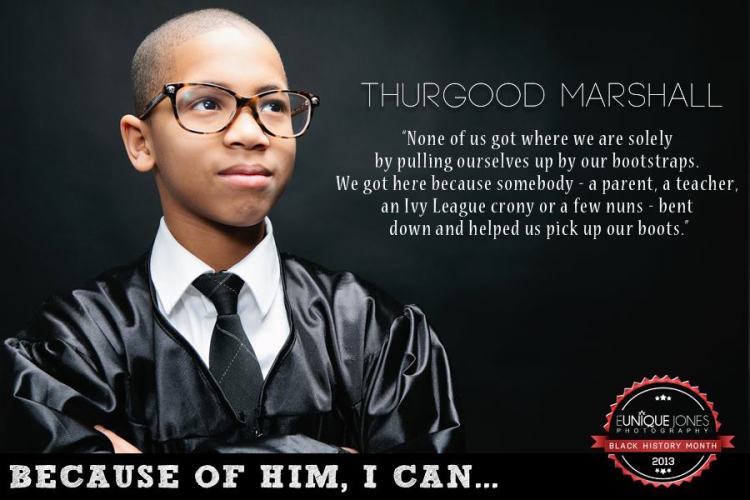
Tonight, my son will be performing as Thurgood Marshall in the Black History month celebration at his school. Gibson’s photograph of this potential Marshall holds extra charm for me in light of Miles’s connection to the former Supreme Court Justice.
Today is the last day of February, and so the last day of Black History month, but I hope it isn’t the last day for Eunique Jones Gibson to produce additional photographs for her enchanting photo series Because of Them, We Can... Each day during Black History month, Gibson released one photo per day on her website as well as through other social media outlets. The photos depict a black child posed to emulate in visage and in pursuit distinguished African Americans for their historical contributions. Gibson now sells posters and calendars on her site so that she can continue this engaging project; I of course bought a poster of mini Marshall.
Alpha Robertson’s reflections on controlling one’s personal feelings of anger and hatred come at the conclusion of Spike Lee’s Academy Award nominated documentary film 4 Little Girls. Robertson’s 14 year old daughter Carole was one of four black girls killed in the bombing of the 16th Street Baptist Church on September 15, 1963. Robertson tells Lee that holding on to anger and hatred “wasn’t going to do [her] any good,” but she acknowledged that she struggled with those feelings. Robertson’s obviously gentle, loving spirit makes watching her publicly negotiate what clearly remains an open wound painfully difficult to witness–and I’ve done so on numerous occasions; it’s an absorbing film.
I have thought about the scenes Lee devotes to Robertson and they strike me as masterful. She helps to set in relief the terrible ugliness of racism as the antithesis of love. It produced Carole’s absence and forced a gentle spirit, her mother–and by Mrs. Robertson’s account, her husband as well–to absorb a powerful blow. The shaky, unsteadiness of Robertson’s voice throughout her scenes in the film disrupts any comfort the viewer might take in imagining the salve of time.
I read in at least one place that when the bodies were recovered from the blast, they were so mangled that the girls could only be identified by their shoes. This might explain why in Christopher Paul Curtis’s young adult book The Watson’s Go to Birmingham–1963, Kenny finds his own sister’s shoe and worries that she has died in the blast as she was supposed to be in church that morning. In Lee’s film, Robertson recalls that Carole was wearing her first pair of little pumps, with a slight heel, when she attended church that morning. I imagine Carole’s delight.
Carole is clearly identifiable in the morgue photographs Lee includes in his film. Since he did not ask the families’ permission before including these photographs, one can only imagine how Robertson experienced these post-mortem images of her daughter as they flashed across the screen. How do those terrible photos sit with her recollection of her daughter’s “little heels?” Her daughter’s delight?
Alpha Robertson was 83 when she passed away in 2002. I think about her sometimes and I marvel.
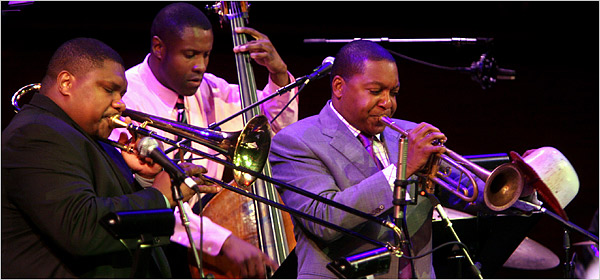
Wycliffe Gordon, Reginald Veal, and Wynton Marsalis performing In This House, On This Morning. Hroyuki for The New York Times
There is a moment in Bruce Broder’s delightfully engaging documentary film Chops (2007) when T.J., a very talented young trombonist, asks famed trumpeter Wynton Marsalis the difference between the sound of church in one’s horn playing and the sound of soulfulness. Marsalis offers a great response:
O.K., this is the difference between soulfulness and church. Soulfulness is something that everybody has. Soulfulness is the feeling that when I am around you, I don’t want to leave. That’s soulfulness. You walk into somebody’s house, man you want to sit down there forever […] And that’s a part of our music, the down home, the soulful, the warm, the inviting. Sometimes church is that, sometimes it [ain’t].
I can’t say that I’ve experienced enough church to have encountered the absence of soulfulness that may be found there, but I have known a few church going folk who reflected the lack of soulfulness Marsalis describes; whose homes were not inviting and warm. At the same time, I’ve known people whose church experience has been limited to attending funerals but my encounters with them are certainly soul satisfying, spiritual experiences. Maybe these encounters are ones that informed my long held belief that ministering to the needs of others, caring for the soul, could occur beyond the physical space of a church; which is not to say that church is irrelevant. Church matters–particularly in an increasingly secularizing culture that elevates materialism above all else. Church insists upon the relevance of nonmaterial, spiritual values as well as a higher spiritual power than celebrity. So church matters, but so does the potential for it to occur beyond its walls.
My grandfather performed ministerial work from our front porch during the summer and from our t.v. room in winter. He listened without judgment and offered encouragement to those whose lives seemed far, far from glory. I never talked to my grandfather about what music offered him, but I associate music with the healing he offered others; jazz especially. Not knowing that many church going folk once thought that the secular sounds of blues and jazz were “the devil’s music,” I didn’t consider the possible incongruity between ministry and music in my grandfather’s work. When I learned of Wynton Marsalis’s In This House, On This Morning, a twelve part composition structured in the form of African American church services, I thought first of my grandfather’s lay person’s soulfulness as well as other encounters with soulful church services that I experienced as a child. Here is a bit of Marsalis and his Septet rehearsing “Alter Call,” one of the movements from In This House:
Melissa Clark’s beans. Photo by Andrew Scrivani for The New YorkTimes.
I don’t agree with Melissa Clark’s suggestion that beans make good dinner party food, but I do recommend them. Clark makes pinto beans using a red wine reduction. You can watch her make her recipe by visiting this embedded link. I’ve tried pinto beans this way before and they are quite tasty so I recommend them…but, if you want to really make beans but you want to put in as little effort as possible, then I recommend throwing them into a crock pot. I don’t use any meat to flavor my beans. For one pound of beans I use about four cups of water and two cups of vegetable stock (if you’re not trying to avoid meat, then use chicken stock). For additional flavor, I add 1/4 teaspoon of thyme, 1/4 teaspoon of black pepper, 1 small diced onion, 1 bay leaf, and 1 teaspoon of salt (you can add more salt later but I recommend starting out with only 1 teaspoon). I set my crock pot on high for 4 hours and let it do all of the work. When my beans have about an hour left to cook, I peel and halve white potatoes and add them to the crock pot. Adding the potatoes thickens the liquid–the pot liquor–and provides added heartiness to your meal. At some point while my beans are cooking, I make cornbread and then that’s dinner. Easy. Inexpensive. Filling.
I have long been a reader of The New York Times’s “Sunday Routine” series. I read the accounts of Sundays by notable New Yorkers and think about the absence of routine from my own Sundays. The only thing consistently true about the way I experience Sunday is that there is very little that might be said to be routine about it. Even as a girl growing-up in a Catholic household, church was not a consistent part of my week because we might attend mass on Wednesday or Saturday; in fact, I liked that about Catholic worship. Most of my friends were Baptist and they seemed to be in church all day on Sunday and I didn’t like the idea of spending the entire day in church before having to return to school. For a while, I thought the same thing about attending church on Sunday in relationship to work on Monday. And even if Catholics experienced a shorter service, I didn’t like the idea of having a requirement to attend service one day before returning to highly structured and regimented environments like school and work. My thoughts about Sunday worship began to change the more I thought about the meaningfulness of Sunday worship for African Americans.
Historian Jacqueline Jones stressed the importance of Sunday for the formerly enslaved through their experience of work. According to Hannah Davidson, a woman formerly enslaved in Kentucky, “Work, work, work” characterized her day; except Sunday, as it was “the only time they [those enslaved] had to themselves.” The rhythm of “work, work, work” as a defining aspect of black life continued far beyond the period of enslavement. Sunday was an important day for worship and physical as well as spiritual recovery. Spiritual renewal was certainly important in an environment where terror reigned. Here I am thinking about lynching, rape, and mob violence that threatened and claimed black life from the late 19th century through much of the 20th. As James H. Cone notes in The Cross and The Lynching Tree, “On Sunday morning at church, black Christians spoke back in song, sermon, and prayer against the ‘faceless, merciless, apocalyptic vengefulness of the massed white mob,’ to show that trouble and sorrow would not determine our final meaning.” For African Americans, Sunday was a day of witness and meaning making.
In a post some time ago, I wrote a little bit about Sundays. At that time, I was interested in designating a part of each Sunday to sharpening my listening skills and thus thinking about how I could become more reflective. Since then, I’ve continued thinking about my relationship to the history of African American meaning making and Sunday’s role in that production. I’m interested in participating in that history by reflecting on moments where I find Sunday meaningfully appearing in African American texts; so I begin with “Come Sunday.”
Duke Ellington first recorded the song in 1944 but it wasn’t until 1958 that he collaborated with Mahalia Jackson to produce the version featured at the top of the page. The song speaks to the hope of Sunday in a deeply affecting way. It reflects African American faith in God’s capacity to renew the soul and spirit of rightfully exhausted folk. The mournfully optimistic song addresses itself in the perfect pitch to the weary faithful.
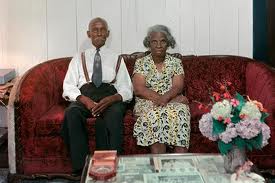
Mr. and Mrs. Albert Thornton of Mobile, AL., 1956. Gordon Parks.
Earlier this summer, I read Maurice Berger’s article in The New York Times about the discovery of a series of Gordon Parks photographs believed to have been lost. The photographs chronicled the daily life of an extended family in Mobile, Alabama in 1956. According to Berger, the found photographs expand upon themes established in that same series of 20 photographs published in Life magazine. Contrary to the documentary photographs from the civil rights period showing brutal inhumanity in black and white, Parks’s photographs reveal the dignity and humanity that black people procured for themselves as they made their lives as rich as they could, amidst demeaning circumstances, in full color and thus vibrancy. Berger contends that the full scope of Parks’s work captures the spirit and will of people committed to living fully in the face of grueling oppression.
The photograph above shows one of Parks’s photographs and confirms Berger’s contention; too, it reminds me of Zora Neale Hurston’s observations about black life–interestingly as she observed it in Mobile. Thus, in “Characteristics of Negro Expression,” she offers the following:
On the walls of the homes of the average Negro one always finds a glut of gaudy calendars, wall pockets and advertising lithographs. The sophisticated white man or Negro would tolerate none of these, even if they bore a likeness to the Mona Lisa. No commercial art for decoration. Neither the calendar nor the advertisement spoils the picture for this lowly man. He sees the beauty in spirit of the declaration of the Portland Cement Works or the butcher’s announcement. I saw in Mobile a room in which there was an over-stuffed mohair living-room suite, an imitation mahogany bed and chifferobe, a console victrola. The walls were gaily papered with Sunday supplements of the Mobile Register. There were seven calendars and three wall pockets. One of them was decorated with a lace doily. The mantel-shelf was covered with a scarf of deep home-made lace, looped up with a huge bow of pink crepe paper. Over the door was a huge lithograph showing the Treaty of Versailles being signed with a Waterman fountain pen.
It was grotesque, yes. But it indicated a desire for beauty.
The Thornton home looks nothing like the Mobile homes Hurston describes as “average Negro” abodes. These sitters strive towards respectability. Hurston’s observations put me in mind of the Parks photograph largely because they situate diversity in black life while at the same time acknowledging a common “desire for beauty.” I saw this desire not only in the bouquet of flowers placed on the coffee table and formal wear of Mr. and Mrs. Thornton but also in the neatness and order that so marked their uncluttered space.
I’ve been learning to take greater pride in my own efforts to maintain a well-ordered environment. Rather than as a chore to be done, I now think about how in sweeping the floor, vacuuming the carpet, washing the dishes, and cleaning the commode I am not merely doing what needs to be done but I am making a claim about the value of my space. I better understand now that in maintaining my environment, I am making an assertion regarding its value. Under Jim Crow segregation, Mr. and Mrs. Thornton were not supposed to think that they led lives of value. The photograph of them shows that they had another idea about that–they disagreed with their culture about the measure of their lives. For those of us who live anonymously in small homes without great material fortune, we have a similar fight to declare the meaningfulness of our lives.
I am keenly aware of how little regard I am supposed to have for myself as a result of the trappings of success that I lack. It would seem impossible not to know this. Popular voices in American culture assume a common starting point for measuring success and so much of what you read or view in the culture trumpets money and the loot it affords as the standard for judging human value. If you are at all critical, however, the absurdity of this standard through the lens of popular culture undermines itself. For example, I was reading an article on a celebrity news site about boxer Floyd Mayweather Jr.’s release from prison. Apparently, the night before his release, his current girlfriend had a birthday and Mayweather paid for the cake to look like an expensive bag, he bought her expensive jewelry, and perhaps he paid for everyone’s meal. I have to admit, I was confused about the gifts and can’t be sure if he also bought his girlfriend the purse that the cake was based on or if the cake itself was expensive and that’s what was supposed to be the fact to acknowledge; all I know for sure is that he spent a lot of money. The author of the piece did make clear that readers were supposed to be jealous because we weren’t similarly feted; but of course, this was completely absurd–at least to me. Floyd Mayweather was in prison for having attacked his ex-girlfriend while his children watched. Expensive goods do not replace this fact. His purchasing power does not eclipse the fact that his ex-girlfriend was not a worthy contender for the boxer leading authorities rank as the best pound for pound in the world. To me, the ex-girlfriend is lucky to have escaped with her life. Given that precedent, I do not envy his current girlfriend anything.
Maybe Floyd Mayweather, his current girlfriend, and the author of the article all have a “desire for beauty;” maybe we all do. The critical point is that we are living at a time when acquiring beauty is thought to be available only to those with money. The Mayweather example highlights the difference between acquiring beauty and spending a lot of money. The goods that Mayweather purchased for his current girlfriend, whatever they were, were certainly expensive but they actually may cost too much to be beautiful if they were given by an unchanged man. I can afford everything in my life and that’s what lends those things value. And when I am broke, without a dime to spend, I can always straighten, clean, wash, cook, or iron something that will then provide me with the beauty I desire. The Thorntons showcase the availability of beauty in the most oppressed circumstances to those invested enough to invent it.
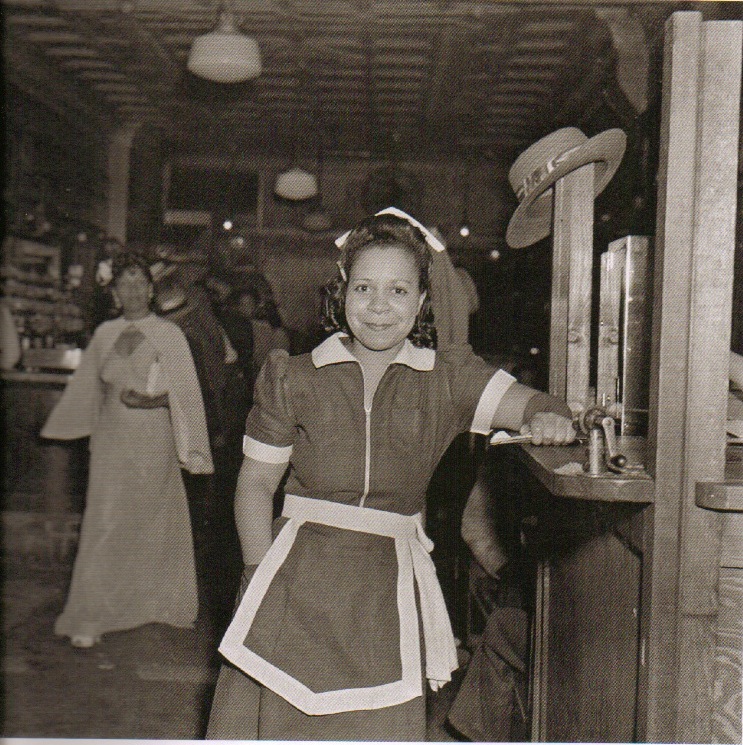
Waitress at the Crawford Grill, 1952. Charles “Teenie” Harris
The above photograph by Charles “Teenie” Harris was one of the many from his extensive collection that distinguished scholar Deborah Willis discussed at the Atlanta University Center Robert Woodruff library on January 31. The Carnegie Museum of Art houses the Harris archive and can be accessed on-line. If you’re not in the Atlanta area and won’t be able to experience the exhibit at the Woodruff library, then I highly recommend searching the on-line archive as another way to engage Harris’s work. Doing so is well worth your time.
One of the things that I like about Harris’s work is that it recognizes broadly articulated expressions of beauty in black life and culture. In the photograph above, Harris focuses on the waitress, who is certainly a beautiful woman, in a clean, crisp uniform–but a uniform nonetheless, taking time out from her work to smile for the camera. Harris’s choice of subject is interesting given the elegantly dressed woman in the background who is privileged enough to at least not be working in that moment and dressed so as to be camera ready; she even seems to admire the waitress.
The photograph of the waitress at the Crawford Grill reminds me of the photographs of my family that I enjoyed as a child. At the time, I didn’t understand that I was looking at working class people whose lives the larger culture discounted and thought devoid of beauty. I didn’t know then that their working class experiences were supposed to place them outside the frame of even my interest. I remember admiring the beauty and elegance of the sitters and wishing that I could possess such charm. The Harris photograph makes the issue of class a more overt concern than the way I understood it at the time and challenges the broader view that beauty can only be an elite affair.
My aunt attended an inaugural brunch four years ago in the home of a friend and she would repeat that experience this past Monday when President Obama was sworn in a second time. About thirty people attended the first brunch. While there weren’t as many people attending this most recent inaugural brunch, my aunt said everyone had a wonderful time. On the menu were waffles, eggs–any way you wanted them, bacon, sausage, fresh fruit, chicken salad, and mimosas. Apparently, there was no particular dress requirement, but I imagine everyone was pretty covered-up as Cleveland saw very low temperatures on inauguration day.
A good friend of my mother’s runs her own day care and she had an inauguration party for her kids. Ranging in age from three to nine, the children were required to wear red, white, or blue; they learned how to pronounce the word inauguration and learned its definition; they came to identify the members of the first family; they rehearsed the songs of their country as they heard them play out throughout the ceremony. On their menu were waffles, hot dogs, sloppy joes, chips, and brownies.
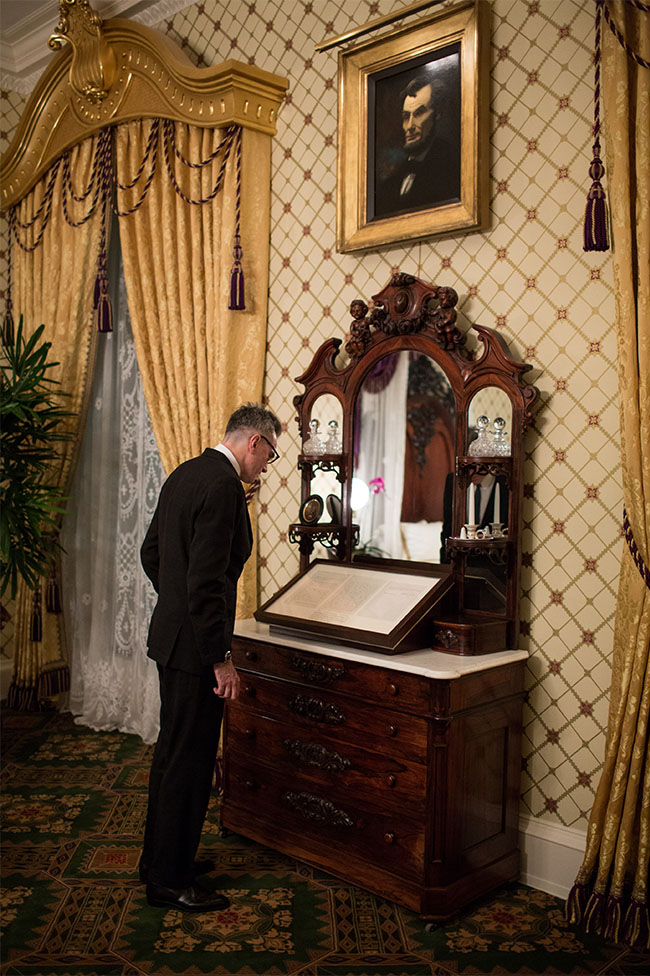
Daniel Day-Lewis in the Lincoln Bedroom in the private residence at the White House on November 15, 2012. Day-Lewis was so good at playing Lincoln that I completely forgot that he was acting. Pete Souza.
My husband and I caught an early morning showing of Lincoln the day of the inauguration.It seemed like an appropriate film to screen on such an historic day.
I didn’t hear much about these kinds of celebrations in the mainstream media, but I suspect that there were similar micro-galas and carefully chosen events to mark the King Holiday and President Obama’s inauguration hosted and planned by everyday folk throughout the land. Real life really does push past its representation in popular culture. As I impatiently waited to see Michelle Obama’s ball gown, I got so bored watching television tell the same stories of the day’s inaugural events as they imagined them to have only occurred on Pennsylvania Avenue. My aunt’s recap of her day discussing current events, generational change, family, and fashion was far more compelling than most of what I saw featured on television. The television narrative about those of us at home was that we spent it envying the people who scored tickets to the balls that we wished we could attend. My experience of inauguration 2013 both personally and through the stories of friends and family never even came close to envy. We enjoyed our own deliberate efforts to commemorate a very important day in our nation’s history.
I was surprised that many of the blogs that I read, specifically those focused on cooking and entertaining, didn’t share a special inauguration cupcake, cookie, or cake; usually those bloggers will create a scenario so that they can make something to share. Friends of mine who have Facebook pages said that people didn’t tend to post pictures of the events they may have hosted to celebrate the inauguration as much as they documented their reactions to what was playing out on television in relationship to the event. I hope we get to see more in the coming days about how people marked the day. Perhaps folk don’t recognize that there are people hungering for stories more interesting than the non-story of where Beyonce actually performed the singing of “The Star Spangled Banner.”
Unfortunately, one of the reasons why I believe people may not have posted their inauguration menus, recipes, and lesson plans may have been because they are still salty over President Obama’s victory so they tried to avoid anything having to do with the inauguration. I definitely think that this was the case at my son’s play school, which is located in a very conservative county. I received conflicting reports concerning whether or not the inauguration was marked at his school. My four-year-old son is not very reliable when it comes to giving reports but one of the little girls in his class, a slightly older girl, told my husband that they had an “inauguration party.” When I asked the teacher about that she told me that the school did not host any events leading up to the election and they did not encourage any activities recognizing the inauguration. My son’s teacher confirmed that she hosted an “inauguration party” in her classroom, but that actually became an act of resistance. I think that it is grossly irresponsible for a school to ignore an event as nationally and historically significant as the presidential inauguration. No matter who gets elected, the inauguration is an element of U.S. governmental procedure acknowledging voting rights as a fundamental democratic practice; it is also a non-partisan event–even John Boehner was there; Chief Justice Roberts, a George W. Bush nominee, officially swore in Obama on Sunday and Monday.
There are wonderful resources available at the Smithsonian’s website that could be used by educators in marking the inauguration. Given that the 2013 inauguration also fell on the King holiday, there are equally provocative resources at the Smithsonian’s website that would have served an educator well. What I know for sure is that young people are ill served when educators decide to allow partisanship to influence class content. Since I’m being very honest, I have to admit to being disappointed that some of my favorite food bloggers failed to provide inauguration brunch menu suggestions or inauguration themed sugar cookie recipes on their sites. Perhaps like me, they will be posting their experience of Inauguration 2013 later, once they’ve had an opportunity to process it all. I certainly hope that’s the case because it’s hard to believe in someone’s entertainment and home hosting expertise when they fall silent on the occasion of the nation’s greatest opportunity to celebrate the outcome of our democratic process.




 In Reverie Blog