Grilling out is a big deal in Cleveland, my hometown, because the freezing temperatures and the snow and ice storms limit your opportunities to get that grill fired up. Clevelanders see summertime, especially summertime holidays, as their one shot at grilling at the crib. When I was a kid, I hated grilling holidays because I never liked the menu my mother preferred. She liked ribs, coleslaw, deviled eggs, and plain potato chips. The only thing I could even tolerate eating was the filling bulging out of the deviled eggs, but because I understood that I couldn’t waste food, I wouldn’t eat them because I didn’t like the white part. There was usually fruit around the house so that’s what I typically ate on those occasions. So I know now that if I’m in Cleveland, I don’t hang out with my mother on grilling holiday; I go to my Aunt Janet and my Uncle B.B.’s house. On grilling holidays, they ALWAYS have the kind of grilled food I enjoy: hot dogs, hamburgers, baked beans, macaroni and cheese, green beans, and boneless, skinless chicken breasts. For dessert, they might have apple pie and ice cream. I eat all of that (though I would only eat turkey dogs or turkey burgers).
On the Fourth of July this year, I went to my Aunt and Uncle’s house and they PUT IT DOWN! The chicken they made was sooooo tender you could cut it with a plastic fork! So between my husband and I, we got a sense of how they did it. First, my husband saw my Uncle take the meat and put it on the grill. He didn’t seem to fool with it too much; he might’ve flipped it over every 10 minutes for about 30 minutes and then pulled it off his covered charcoal grill. He then saw my Uncle give the chicken to my Aunt who put it into a casserole dish filled with bar-b-que sauce and put it in the oven on a very low temperature.
I tried to convey to them how much pleasure I took from the meal, but my words seemed so inadequate compared to that glorious food. When I asked my Aunt how she got it to be so tender, she told me that she first tenderized it with a mallet. Next, she seasoned it and put the meat into a plastic bag and added a marinade. So the FIRST thing I did when I came back home to Atlanta was to buy myself a mallet (and I had Kohl’s cash and a coupon) ! Before, I had been using the underside of a small pot to flatten parts of the chicken or I would puncture it with a fork thinking it would allow for the marinade and spices to flavor the meat. Let me tell you, if you want the experience of eating chicken that is so tender you can cut it with a plastic fork, go out as soon as you can and get yourself a mallet.
Yesterday, while my husband readied the grill, I allowed my son to use the mallet to pulverize the meat. Next, I seasoned the chicken with salt, pepper, garlic powder, and paprika. After that, I put the meat into a plastic bag and I poured balsamic vinaigrette over the chicken until the meat was fully covered. I think the meat had a chance to marinate for about three hours. After that, my husband put the meat on the grill and let it cook between 30 and 45 minutes. When he took it off the grill, he used a casserole dish that had been sprayed with Pam and poured the bar-b-que sauce over the chicken just to cover it. He then put the meat into a 275 degree oven and we let it braise in that covered casserole dish for at least two hours. When we put a fork into that meat to test for doneness, it was so tender it was falling apart!
My Aunt and Uncle knew what they were doing! In following their example, we had the most delicious meal yesterday. If I was really into making money and selling stuff, I think we’ve got something to sell. But I’m straight with what I have so I prefer to give you this simple method for life changing food without cost. If you try it, let me know how it turns out for you. I’ll give you a picture of what ours looked like later. The picture’s not in my cloud and I can’t seem to get my phone to email the photo to my account. Technology. Try this grilling/braising method. You will not be disappointed.
I just came from seeing Fruitvale Station. The film offers a sensitive portrayal of the last day in 22-year-old Bay area resident Oscar Grant’s life. Having apprehended Grant and several other black and brown skinned passengers after a scuffle on a BART train, Police Officer Johannes Mehserle’s fatally shot Grant, claiming he mistook his own gun for his taser. Contrary to Kyla Smith’s troubling review of Fruitvale Station, I thought Ryan Coogler’s debut film was quite well done. Smith essentially charges Coogler with being manipulative by making Grant appear warmer and gentler than his criminal past suggests. This troubling assessment ignores Coogler’s obvious efforts to create a black male character whose likely and unsurprising end was not matched by a depiction of his assumed depravity. Grant, who Michael B. Jones masterfully plays, has flaws and the film engages them. While Smith acknowledges Coogler’s attempt to complicate Grant through an engagement with his former incarceration, former infidelity, and his failure to take full responsibility for himself, which accounts for him being unemployed, Smith contends that the film “tries to fit a halo on its subject, seemingly to play up the audiences sympathies.” As evidence, Smith points to every detail of Grant’s petty criminal past expunged from the film’s record. Let’s say that these additional details were added to the script, would Smith expect audiences to conclude that Officer Mehserle was justified in slaying an unarmed man? Smith flatly denies any affirmative conclusion drawn from this question, but he does question the integrity of pleading for justice on Grant’s behalf if doing so depends on the charge that Officer Mehserle’s actions demonstrate racism. In Smith’s estimation, even if Mehserle were racist, it would be irrational for him to carry out his agenda “in front of dozens of people.” Racism, however, doesn’t depend on reason or logic, it works through power, history, custom, and tradition. Sure, there have been efforts to rationalize and justify white supremacy but such attempts are never valid. Officer Mehserle had a much greater understanding of the nation’s low and contemptuous regard for black American life than Smith admits. Officer Mehserle understood that killing a black man wouldn’t cost him very much–and it didn’t: Mehserle spent 11 months of a two year prison sentence for his crime. And like him, George Zimmerman is chillin’…right alongside the four officers acquitted for killing Amadou Diallo and Officer Michael Carey who killed Sean Bell on the morning of his wedding.
Fruitvale Station pays homage to Oscar Grant. The film shows him as a father, a brother, a son, a partner, a friend. The film also reminds me of Hank Willis Thomas’s tribute to his 27-year-old cousin Songha Willis who was shot on February 2, 2000 in the parking lot of a Philadelphia nightclub. InPitch Blackness, Thomas uses family photographs of Songha in an effort to restore his humanity and with it, the weight and significance of his loss. Rather than allow his cousin to remain a statistic reflecting an expected outcome for black American males, Willis Thomas sought to resurrect the meaningfulness of his cousin’s life through the many photographs of him with people who loved and cared for him. This video features Willis Thomas discussing his work and
how art helped him process his sadness and grief in the wake of his cousin’s murder.
Fruitvale Station shows great sensitivity to the importance of offering audiences an example of black American humanity. Smith’s critique of the film highlights the carelessness with which black American life is often read. From this point of view, Oscar Grant was too good to be true. According to Smith, Coogler’s Oscar Grant has too much humanity and so is a lie; he isn’t thugged out enough. His is an unmerciful view.
You should check out the film, it will piss you off for all the right reasons.
I’m offended by that because first of all, and this is going to sound arrogant, but my presence is charity. Just who I am. Just like Obama’s is. Obama provides hope. Whether he does anything, the hope that he provides for a nation, and outside of America is enough. Just being who he is. You’re the first black president. If he speaks on any issue or anything he should be left alone…I felt Belafonte he just went about it wrong. Like the way he did it in the media, and then he big’d up Bruce Springsteen or somebody. And it was like, “whoa,” you just sent the wrong message all the way around…Bruce Springsteen is a great guy. You’re this Civil Rights activist and you just big’d up the white guy against me in the white media. And I’m not saying that in a racial way. I’m just saying what it is. The fact of what it was. And that was just the wrong way to go about it. Jay Z
In light of Jay Z’s recent admission concerning the offense he took to Harry Belafonte’s critique of Beyonce and Jigga’s sense of social responsibility, I decided to repost my original response and to include new ideas in light of current remarks.
I. Harry Belafonte’s Critical Reading of Jay Z and Beyonce
Only Halle, who had watched her movements closely for the last four years, knew that to get in and out of bed she had to lift her thigh with both hands, which was why he spoke to Mr. Garner about buying her out of there so she could sit down for a change. Sweet boy. The one person who did something hard for her: gave her his work, his life and now his children, whose voices she could just make out as she stood in the garden wondering what was the dark and coming thing behind the scent of disapproval.
I thought about the text above, taken from Beloved, as I read Harry Belafonte’s critique of Beyonce and Jay-Z for failing to accept social responsibility. Those two, at least as conveyed through Beyonce’s camp, had no idea what Belafonte meant by his critique. The fact that Beyonce has performed at charity benefits and given money to worthy causes does not speak to the substance of Belafonte’s criticism. He didn’t say that she and her husband wouldn’t do what came easy to them, Belafonte was suggesting that they have not done what might be hard–like allow their images to suffer. Bruce Springsteen, the celebrity Belafonte endorsed, has shown a willingness to critically examine his cultural terrain, as “American Skin (41 shots)” certainly did. This song was inspired by the tragic police shooting of unarmed, Guinean immigrant Amadou Diallo by police officers in 1999. Though Springsteen insists that the song is anti-tragedy and not anti-police, this did not prevent the Police Benevolent Association from discouraging its members from supporting Springsteen’s concerts with their labor as he performed the song in venues across the United States. Springsteen has since dedicated the song to Trayvon Martin. I may be wrong, but I haven’t known Beyonce or Jay-Z to have taken such chances.
In a previous post, I wrote about the limitations of the nearly hour long performance of “Niggas in Paris.” While Jay-Z and Kanye commanded the stage with their hit song while actually performing in Paris, they never sought to make a relevant connection to the lives of those who are actually experiencing being treated like “niggas” in Paris. The women in the video below being dragged, pregnant and with their babies on their backs, know a little something about dehumanization and yet no connection gets made
between them and what it means to be a “nigga in Paris.” Why not? I suspect it’s because being socially responsible in this way would have cost too much. It would have meant that people might have been uncomfortable; that they may not have purchased more concert tickets; sponsors may not have offered more endorsement contracts.
I read an article in The New York Times about the huge return that Jay-Z nets on a relatively small investment in the Nets franchise. I found it incredibly troubling that Jay used his influence–or at least he allowed his image to be used to promote the idea that a new basketball arena would create jobs. Of course it will create low-skill, low-wage jobs but it won’t lead to the creation of work that will generate a middle-class lifestyle; minimum wage does not do that. Perhaps Jay-Z understands this about the kind of work that the arena will produce but he didn’t make his understanding clear to those who trust and believe in him. Doing so would have certainly influenced whether or not he was considered an appropriate choice to be a stakeholder with the franchise. As the Times article notes, Jay-Z benefits financially from his relationship with the Nets but Belafonte’s point asks us to consider whether Jay’s personal gain satisfies the terms of social responsibility.
When Baby Suggs in Morrison’s Beloved considers the sacrifices that have been made for her, she finds few people who have made difficult choices in her honor; in fact, only one person “did something hard for her.” Not only has this measure helped me to be clear about who has shown me love and who I’ve shown it to in my personal life, it has also helped me to evaluate social responsibility. When Harry Belafonte made his critique of Beyonce and Jay-Z’s philanthropy, he had Baby Suggs’s metric in mind.
II. Jay Z and Social Responsibility
In his most recent remarks, cited at the top of this post, Jay Z illustrates that he still doesn’t understand the substance of the critique Harry Belafonte leveled against him. Jay Z claims that by virtue of showing up, he performs charity work. In using the word “charity,” he shows how little understanding he has. Belafonte and concerned artists of his own era did not see themselves as providing or offering “charity;” instead, their cultural work served a socially transformative agenda. To that end, Belafonte was a member of the Association of Artists for Freedom, which set out its purpose through five points: 1.) To be a cultural adjunct, and not in competition with, the existing organizations fighting for civil and human rights in our country; 2.) To achieve a meaningful unity of all artists who are concerned with the great American moral and cultural crisis; 3.) To conceive and sponsor and encourage cultural and artistic activities in the Negro communities in particular, and in the entire American community as well; 4.) To help make art a part of the ordinary life of all people; 5.) In the main, our activities will be neither political, nor legislative, but cultural (qtd. in Keith Gilyard’s book John Oliver Killens: A Life of Black Literary Activism). This organization was formed in the wake of the bombing of the 16th Street Baptist Church in Birmingham, Alabama that claimed the lives of Addie Mae Collins (14), Denise McNair (11), Carole Robertson (14), and Cynthia Wesley (14); as well as in the aftermath of the police killing of Johnnie Robinson (16) and white civilians killing Virgil Ware (13). How can Jay Z render his presence equivalent to this culturally relevant, rich, thoughtful engagement linking art to social change? Does he really think that his presence adequately serves as an abbreviation for the kind of careful planning and involvement put forward by the Association of Artists for Freedom?
Artists who assumed social responsibility during the 1960s voiced their opposition to injustice at the risk of losing their very lives. In Jay Z’s case, expressing support for an opinion widely shared does not require much or cost much. Jay Z and Beyonce should have participated in the New York rally opposing stand your ground laws in the wake of the Zimmerman verdict. To quote Spider-Man’s Uncle Ben, “with great power, comes great responsibility.” If Jigga’s mere presence makes a powerful statement, then the least he can do is show up. But just showing up doesn’t exemplify “great responsibility.” Certainly, he and his wife did something, but it was cheap; it didn’t cost them very much. This seems very problematic for a man who generally seems stunned by all the shit he can buy.
Jay claims that Belafonte didn’t show him proper respect when voicing his criticism–-especially because Belafonte held up Bruce Springsteen, a white man, as a model of an artist who assumes social responsibility. Seems to me that Jay Z missed the point that Belafonte doesn’t think highly of him as a civically engaged person, which makes sense given his own activist work. There is nothing about Jay Z that represents a threat to an oppressive social order. His claim that he inspires others through his rags to riches story supports an American myth that relates material goods and achievements to individual effort; the myth of meritocracy. So instead of pointing to his wealth as a sign of possibility, Belafonte’s criticism, I think, makes one wonder why Jigga chooses to focus on possibility in terms of its potentially positive outcomes. It is certainly possible for black folk to go from the projects to the penthouse in America, but it is highly unlikely. And the structures that enable such a rise help to predict this improbability. Children from these communities are likely to attend poorly performing schools, to confront an unmerciful yet hyper-vigilant criminal justice system, to find employment unsatisfying and low paying. Nothing about Jay Z’s rise to fortune and fame challenges these realities. His rhetoric about competition, respect, and achievement don’t do anything to change the structural forces that maintain networks and systems of domination and oppression. In fact, when he challenged Belafonte’s critique, he actually said that his feelings of betrayal weren’t racial though they highlighted the fact that Belafonte offered a white man as a model over a black man. To that end, Jay even undermines his own vision of the current state of race relations. If race loyalty isn’t an issue why did he make it one? Given that he made it an issue, what is its status? In other words, what do you need race loyalty for? How does his response to this question highlight the character and life of racism at this historical moment?
Harry Belafonte’s critique of Jay Z and Beyonce helps to expose their shallow understanding of capitalism and democracy. Sure, they can point to all the work they’ve done to create a market and to enchant consumers, but they don’t do anything that empowers or inspires citizens to create social change. I will not deny that they have given money for “charity,” which is important, but have they examined how this money responds to the need for social change? Their work seems to be more focused on encouraging ballin’ in a way that is very consistent with mainstream views. I’m sure Jay Z wouldn’t think so, but I find his views to be very conservative.
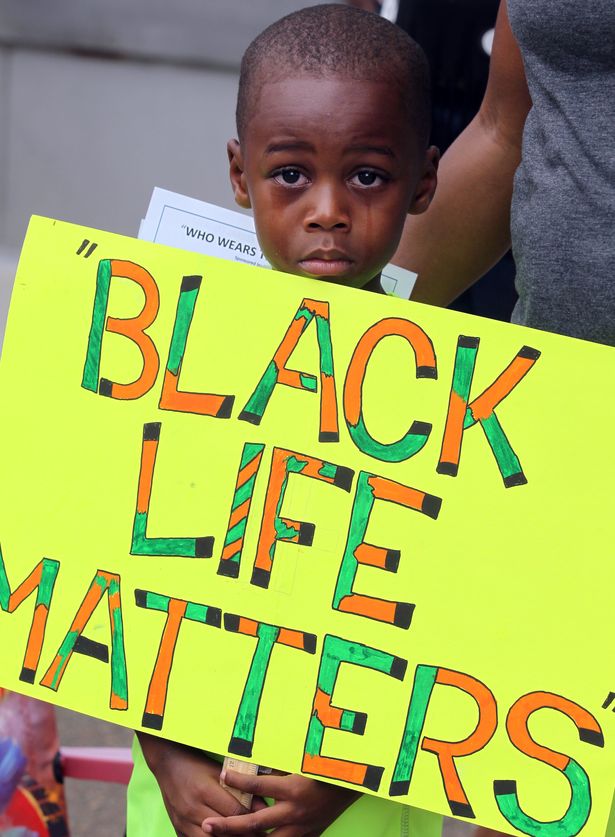
Phil Skinner photograph of an unidentified black boy participating in the Atlanta protest rally condemning the Zimmerman trial verdict.
Phil Skinner’s photograph of an unidentified black boy with a tear streaked face holding a sign that reads “BLACK LIFE MATTERS,” is poignant because it can lead to an easy conclusion that the child is crying because justice was denied Trayvon Martin given the “not guilty” verdict rendered in favor of George Zimmerman. Of course, we have no idea why this child has been crying. He could be upset because his sister ran off with his favorite toy or that his father punished him for saying a bad word moments before the picture was taken. Nonetheless, Skinner’s photograph provides us with an opportunity to take seriously the possibility that this child’s tears prove that black boys learn early how lowly regarded they are as American citizens. Do they know because of the number of students crowded into their classrooms? Do they know because they are hungry? Do they know that they are not safe? Do they know because someone told them they were worthless?
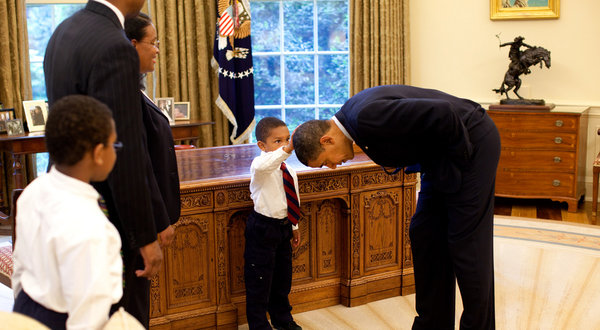
Considering what black children are told about their worth reminds me of the Pete Souza photograph of President Obama bowing before 5-year-old Jacob Philadelphia so as to give the boy an opportunity to feel his hair.
I’ve written about this photograph on twooccasions. In one post, I wrote this about the Souza photograph:
In part, the potency of the Obama/Philadelphia photograph lies in the suggestion that legal authority may lean in close so as to address an imbalance of power that has routinely harmed black children. While holding the highest office in the land, President Obama leans in to a child; it’s a portrait of servant leadership that holds promise for young black boys.
I think it’s interesting that young Jacob asked the president “if your hair felt like mine” and not simply what his hair felt like. Jacob appears to wonder about himself in relationship to the President’s body. In feeling the president’s hair, his touch confirmed his nearness to power rather than his distance from it. The president himself didn’t seem to think that he was a specimen or an object of racial curiosity.
Philadelphia’s mother addresses one aspect of her son’s fascination with President Obama’s hair when she offers that he consistently asks his barber for a haircut like the President’s. What this history doesn’t tell us is why young Jacob wants hair to signal his relationship to the President. Has his hair been presented to him as a problem? Has he suffered as a result of his hair texture? Did Obama identify with Philadelphia’s youthful curiosity? Was there a black man in a position of authority whose hair he wanted to feel?
Through remarks President Obama made in the wake of the Zimmerman trial verdict, he paraphrased the first statement he ever made about the slaying where he puts forth the notion that if he had a son, he would’ve looked like Trayvon Martin. In his most recent statement, he noted that Trayvon Martin could have been his son. In capturing the full essence of this claim, Obama restates this position and contends that “Trayvon Martin could have been me 35 years ago.” Though the President discussed the inconveniences of being black in America, he didn’t say much about the deadly consequences of being black in America. The justification the court gave Zimmerman to kill an unarmed black child highlights racism’s lethal force: Claims of racism are more than mere complaints, they are accusations of murder. The little boys in the Skinner and Souza photographs suggest that black children come of age knowing how lowly they are regarded in American life. Their tears and their touch tells us what black boys know. If our goal for justice includes saving black boys, one step towards aiding them involves seeing them as credible witnesses. Pay attention to black boys’ tears and to what they seek to touch. Doing so might tell you how to identify and how to make use of what they are learning about race in America.
I wish people would stop donning hoodies as a sign of protest. There was a time when I found this gesture meaningful in the way it symbolized the trivialities in American culture that can be used to justify racial terror against black people. We are in a different moment now and so we need a meaningful response beyond symbolism. The verdict favoring George Zimmerman requires an oppositional stance that uses symbolism to initiate material, concrete change. Wearing a hoodie to church or donning one to reflect your social media profile no longer counts as activism; again, we’re beyond that now. Wearing a hoodie can no longer count as this generations’ sit-in or freedom ride; it’s not enough.
Continuing to rock hoodies as protest reflects a very thin reading of American history. Trayvon Martin could have worn a military uniform with ribbons and medals all over it and George Zimmerman still would have killed him. Black men in military uniforms weren’t saved because of their attire after serving their country during World War II. Trayvon Martin could have worn the sharpest three-piece suit you’ve ever seen and George Zimmerman still would have killed him. Addie-Mae Collins, Denise McNair, Carole Robertson, and Cynthia Wesley weren’t saved because of their genteel garments as they readied themselves for worship at their home church on September 15, 1963. Trayvon Martin could have worn anything and George Zimmerman still would have killed him. I don’t know what Yusef Hawkins was wearing, just like I don’t know what Amadou Diallo was wearing, but no matter their attire,white people killed both of them. As a student of American history, George Zimmerman killed Trayvon Martin because he understood that killing a black child wouldn’t cost him very much. Moreover, emphasizing Trayvon Martin’s choice of clothing suggests his complicity in Zimmerman’s crime. Trayvon Martin was in no way responsible for George Zimmerman’s actions.
If you are a black person in America, your choice of clothing will not save you from racial terrorism. This idea that putting on a lab coat, a judge’s robe, a top hat and tails, a priest’s collar, or a nun’s habit makes you safe defies American racial history. Armor for black folk in America involves literacy, not clothing receipts. Calls for literacy in this case means that black folk in America should know how to read their world as it is while still being aware of an ideal world. I read a very interesting story in Jonathan Rieder’s book The Word of the Lord is Upon Me: The Righteous Performance of Martin Luther King, Jr. Rieder offers this narrative in order to substantiate his claim that King authentically experienced fellowship with ministers outside the baptist faith; especially with those who could identify with black suffering and those who preached against injustice. Citing secondary sources as well as interviews he conducted with Rabbi Jacob Rothschild’s family, Rieder tells a story about an invitation King accepted on he and his wife’s behalf to attend dinner at the Rothschild’s home. Here’s the story:
The Kings arrived late, Janice Rothschild remembered. As far as the hosts were concerned, there was no need for explanation. Still, she continued, ‘Martin apologized anyhow and explained that they had been delayed trying to find our house.’ It seems the Kings were forced to knock on doors to get directions. ‘As Martin told us this, he quickly added, ‘But we were careful not to embarrass you with your neighbors. I let Coretta go to the door so they’d think we were just coming to serve a party.’ Janice added, ‘I still get a lump in my throat when I think of it. (281)
From there, Rieder moves on without explicating the Kings’ actions or Mrs. Rothschild’s lump. For me, this account provides great insight into King’s understanding of race in America. Though King accepted the Rothschild’s invitation, he did not interpret their offer as anything more than that. King did not assume that he and Mrs. King had suddenly been invited into a world of racial tolerance. Instead of discounting all that he knew and understood about race, King drew upon this knowledge in order to safely reach his goal of dining in the Rothschild’s home. Once there, King set out to allay Mrs. Rothschild’s fears that his actions would reflect badly upon her. Thus, King’s analysis of race helped to script or to craft the plot of his compassion. Given this interpretation, I’m not sure what to make of the lump in Mrs. Rothschild’s throat. Does it signal shame for what King understood about fears she thought were secret? Is it a sign of her witness to King’s goodness? Does it represent her desire to change the past so as to be as invested in King’s feelings as he was with hers?
King’s actions in this instance provide a model for confronting a truth about race that James Baldwin offered his nephew in 1963: “You were born into a society which spelled out with brutal clarity, and in as many ways as possible, that you were a worthless human being.”Neither Baldwin nor King suggest using this reading of the world as the basis for a lesson plan designed to disprove widely held ideas about blackness. In King’s case, he uses what he understands about race to author a response that would allow him to achieve his goals. It would have been interesting for Rieder to have probed what those might have been. What did King find so worthwhile about accepting an invitation whose subtext demanded a deferential posture? Without knowing King’s goals beyond dining with the Rothschilds in their home and supporting the racial narrative they may well have been enacting, King’s actions suggest he was not diminished by presumptions regarding his identity. His grace and compassion exemplify such an insight. Rather than surrender the power to name himself, King pronounced that he held sole authority in this regard. Therefore, King’s authority is instructive because it teaches us that being free requires knowledge of the past and an effective strategy for using that knowledge to survive. Freedom requires conceptualizing new terms for defining worthwhile experiences and rejecting the ones coming from a culture that considers you worthless. Assuming the integrity of those terms has lethal consequences for black people in America. To that end, freedom depends on one’s ability to craft meaningful terms for living a good life that others are bound to respect. Freedom requires naming, not rocking a hoodie.
In the introduction to her book Posing Beauty: African American Images from the 1890s to the Present, Deborah Willis cites Ben Arogundade who provocatively frames the subject of the moral and political implications of beauty:
“in literary terms, black beauty remains a cause without a portfolio…Who can really talk of the folly of beauty when there are still so many other battles to be won? But beauty is also a battle. And the right to be beautiful and to be acknowledged as such whoever you are, wherever you are from is not so much a folly as a human-rights issue. In writing the history of the black experience did we forget something important? Did we forget about beauty?”
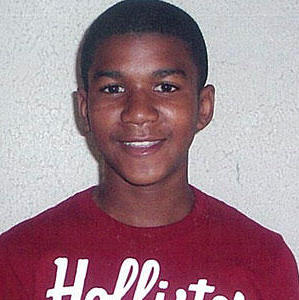
In the first post I ever wrote about the slaying of Trayvon Martin, I made a discussion of beauty a central element in my reflection. As the case against Zimmerman continued to mount, challenges emerged against the original images that were introduced to compel interest in seeking an indictment against the shooter. Thus, the photos of Martin smiling sweetly
in a red and white Hollister t-shirt or trying to look tough in his football uniform
were countered with photographs suggesting that the “real” Trayvon Martin was a thug. Photographs of Martin sporting a grill
were offered as evidence that he was your typical ugly,black, low-life gangsta menacing and threatening the safety of innocent people. As far as I was concerned, the publishing of those “thug life” images of Martin ensured that the prosecution was not going to secure a guilty verdict against Zimmerman. The logic undergirding my claim regarding the verdict stems from my familiarity with the significance of Mrs. Rosa Parks’s refusal to give up her seat to a white man on December 1, 1955 in Montgomery. As Martin Luther King, Jr. would say about Parks, she was “not a disturbing factor,” this perception enabled activists to strategically cast her as a quiet, demure, simple woman whose character was beyond reproach. In other words, nothing in her record or her reputation could be used to undermine claims regarding her dignity and integrity. The “thug life” images of Trayvon Martin did just that. Those photographs denied the possibility of Martin’s innocence.
Beautiful black boys do not exist as plausible characters in the national narrative of U.S. civil society. I’m sure that folk won’t like my claim, but I would love to have someone counter me. I would be most interested in the evidence you would offer to support your claim that America values black boys; thinks they are beautiful; lovable. What data would you use? You couldn’t cite data culled from the Department of Education or from Criminal Justice sources; you couldn’t point to housing, employment, or medical records. You could claim that President Obama’s elections prove that Americans now reside in a post-racial society. Now I am no Nate Silver but I doubt that even he could use one number or even two to show evidence of anything or to make a meaningful prediction. Obama’s election victories were cultural surprises not reasonable assumptions. Thus, Obama’s presidency does not prove a change in racial attitudes as much as it is an interesting abnormality in an otherwise predictably racist society.
The verdict in Zimmerman’s trial calls attention to the consequences of ugliness. Ugly people are disposable and outside of calls for justice. Thus, wedding ugliness to blackness as shown in the Zimmerman trial reveals the truth of Willis and Arogundade’s assertion that beauty is a “human-rights issue.” There is no cost, no penalty for exterminating ugliness.
If you have a black son, black daughter, black neighbor, black mother, black father, black friend or know anyone who cares about black people, know this: James Baldwin was right when in 1963 he told his nephew that he was “born into a society which spelled out with brutal clarity, and in as many ways as possible, that [he was] a worthless human being.” In light of this truth, loving black people, parenting black people, teaching black people requires that you create an awareness of the callous regard awaiting them and that you help them in developing strategies of disavowal. To that end, direct them to the charge that Toni Morrison offers through the character Baby Suggs as she preaches to those black people who come to hear her in the Clearing:
“Here,” she said, “in this here place, we flesh; flesh that weeps, laughs; flesh that dances on bare feet in grass. Love it. Love it hard. Yonder they do not love your flesh. They despise it. They don’t love your eyes; they just as soon pick em out. No more do they love the skin on your back. Yonder they flay it. And O my people they do not love your hands. Those they only use, tie, bind, chop off and leave empty. Love your hands! Love them. Raise them up and kiss them. Touch others with them, pat them together, stroke them on your face ’cause they don’t love that either. You got to love it, you! And no, they ain’t in love with your mouth. Yonder, out there, they will see it broken and break it again. What you say out of it they will not heed. What you scream from it they do not hear. What you put into it to nourish your body they will snatch away and give you leavens instead. No, they don’t love your mouth. You got to love it. This is flesh I’m talking about here. Flesh that needs to be loved. Feet that need to rest and to dance; backs that need support; shoulders that need arms, strong arms I’m telling you. And O my people, out yonder, hear me, they do not love your neck unnoosed and straight. So love your neck; put a hand on it, grace it, stroke it and hold it up. And all your inside parts that they’d just as soon slop for hogs, you got to love them. The dark, dark liver–love it, love it, and the beat and beating heart, love that too. More than eyes or feet. More than lungs that have yet to draw free air. More than your life holding womb and you life-giving private parts, hear me now, love your heart. For this is the prize.”
Thus, the work of loving black folk requires creating a “Here” in some Clearing, some safe space where they can be extolled. Delighting in the worthiness of blackness serves as an act of reclamation from the unmerciful clutches of racism. As I’ve written before, the one positive thing that I can take away from the tragedy of Trayvon Martin’s brutal slaying is that he fought for his life; he thought his life was valuable. That means his parents can join the pantheon of black parents who created a space for their sons and daughters to know of their significance despite American culture’s claims to the contrary. American society’s failure to thoroughly appreciate black beauty and dignity has lethal consequences. If black love continues to mean teaching black children to think that their lives have significance, they might continue fighting back like Trayvon Martin did. And it is my hope that in continuing to fight, one day, those children will win.
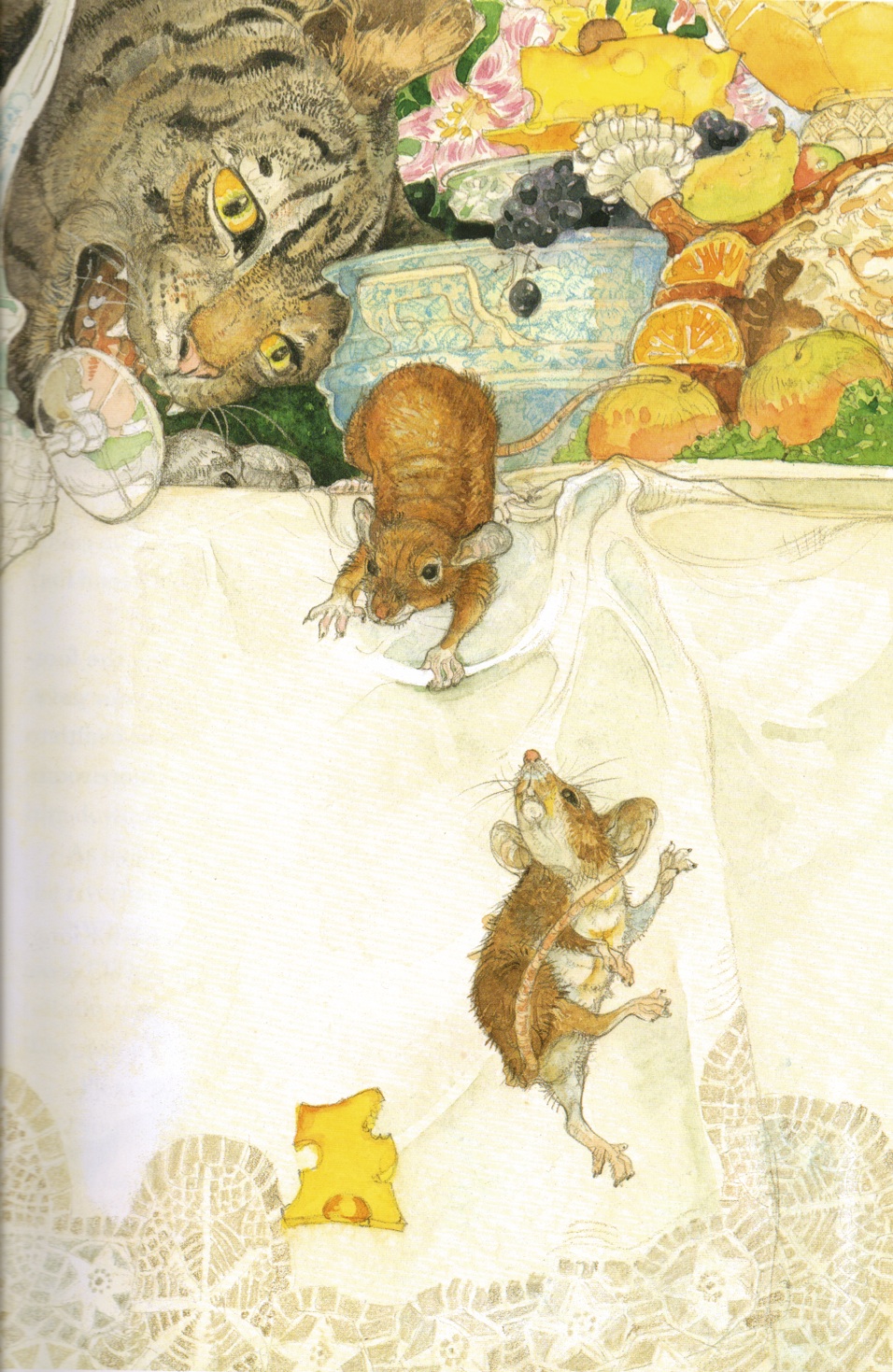
Jerry Pinkney, “The Town Mouse and the Country Mouse,” Aesop’s Fables.
For some time now I’ve been ruminating on Aesop’s fable “The Town Mouse and the Country Mouse.” On the surface, the story tells of two mice-one from a rural environment and one from an urban environment-who interact with one another inside the home territories of the other over a meal. In Jerry Pinkney’s version of the tale, the City Mouse wants to show the Country Mouse how much better the food is in the city so they journey there. As they prepare to dine, a cat interrupts them and nearly makes them dinner. The City Mouse then tells the Country Mouse of their great fortune in not having to encounter the dog who has a history of interrupting mealtime. With that, the Country Mouse decides to head back home. According to Pinkney’s version, the moral of the story is this: “Poverty in safety is better than riches in peril.” I understand how one could derive this meaning from the tale, but a more pressing element of the story emerges in my reading about what it means to be a good guest or the recipient of hospitality.
In Pinkney’s version of the fable, the Country Mouse works deliberately and with great care to gather food to share with her cousin who she has invited for dinner. Though the City Mouse tries to appreciate the meal, she simply finds it too meagre and so she invites her cousin to take leave of the country and travel home with her to the city in order to enjoy a more bountiful feast. When they arrive in the city at a grand mansion featuring a table where the remains of a banquet await, I was struck by the Town Mouse’s exclamation: “Look at all the good things here!” This was striking in light of the diligence that went into preparing the country meal as we are told that the Country Mouse “worked all day to prepare the dinner, gathering a few peas, a stalk of barley, a crust of bread, and cold water in a green leaf to drink.” Unlike the banquet remains that sat available for easy scavenging, the country meal required careful, skillful work; why should such thoughtful, deliberate, careful, and skillful work get translated into poverty? I don’t understand why performing such labor makes one poor. Instead of being honored by being the recipient of such great care, the Town Mouse rejects these gifts of hospitality for a bounty that actually resulted from another’s waste.
When I reflect on my childhood, it seems like the entire experience was designed to teach me what it meant to be the recipient of another’s care. It seems that my earliest lessons were in learning to show gratitude for the food that was made for me, the cleanliness of my environment, and the plans that were made on my behalf; these were all things that I needed to be grateful for. I was taught to believe that I owned nothing; everything that I even thought to claim was at best borrowed and could be taken away at any moment. My grandfather made it clear that while I could lay claim to having a “home,” the “house” belonged to my grandmother and to him; “my room” was actually a space where I slept but where my mother could enter at any time and determine its condition. For me then, being a guest in someone else’s home was very much like being in my own in that I was residing in a space that did not belong to me and so I needed to honor those who were providing me with it. I was taught that my physical labor as well as the verbal acknowledgement of my appreciation were forms of payment that I could use in showing gratitude to my hosts. These were valuable lessons. As a child, then, I was being introduced to the work of asking myself to discover the contributions that I could make to my environment and to my community despite my not having money, credentials, authority, or possessions.
I was talking to my neighbor about her nephew who stays with them off and on during the summer and she tells me that he treats her “like the maid,” or as she says, “like his idea of what it would be like to have a maid since his family has never had the means to hire domestic help.” So her nephew occasionally fails to make-up the bed and when he does, it looks nothing like the neat and tidy bed that she prepared for him or that approximates what the other made-up beds look like in the house. He never acknowledges the work she put into preparing a meal with any kind remarks about the food; he only sometimes thanks her for cooking. When he washes dishes, he only washes the ones that he uses. As I listened to her describe all of the things that her nephew failed to acknowledge, I saw him as the Town Mouse who expected bounty to await him and who overlooked the bounty that was gathered on his behalf.
It is still worthwhile to keep in mind the work that is done for our sake; to see this work as our bounty. This work commits us to repayment. Dismissing the Country Mouse’s work as a sign of poverty removes it from the terms of responsibility and thus from acknowledging debt. Constructing poverty in this typical way assumes that the poor can’t be owed anything as they are without anything of worth or value that they would have or could have contributed. What Aesop’s fable shows us is that while Country mouse did not have money, she did have talents and skills that allowed her to extend hospitality. The lessons of my childhood taught me a similar lesson: I was without money, status, and power but I had my labor and my talents to offer as thanks. In my reading of the fable and its larger significance, Town Mouse had a responsibility to pay tribute to Country Mouse for her deliberate, thoughtful, and skillful work, but she did not honor her responsibility. In not doing so, Town Mouse failed at being a good guest and this failing marks her impoverishment despite her ability to find food in mansions.
With great interest, I have followed news reports concerning Paula Deen’s problematic deposition testimony she provided as part of a racial discrimination suit against the celebrity chef and her brother, Bubba Hiers. Mainstream news outlets strongly emphasize the moment in the deposition when Deen admits to using the word “nigga” and her suggestion that in doing so, she was reflecting an era when white Southerners routinely and publicly found it an acceptable term. Connected to this admission, Deen further maintains that she tolerated jokes whose terms reflected a derogatory and demeaning portrayal of marginalized folk. Fewer mainstream news outlets provide additional commentary on Deen’s very problematic admission that she would love for her brother to experience “a southern style plantation wedding.” In recalling a dining experience where “middle-aged black men” in white jackets and bow-ties worked as servers “that probably made a very, very good living,” Deen advanced the notion that the dress and professionalism of these men recalled the antebellum era in a sentimental way. Deen’s acknowledgements offer much to explore in terms of finding “other models by which to live.”
To begin, if like Deen you believe that the enslaved were “professionals,” allow me to counter this notion. Being a professional suggests at least the possibility for experiencing respect in light of an acknowledgement of one’s expertise. Such respect facilitates a person’s experience of dignity and integrity. Enslavement should be defined against an expectation for respect as well as against an experience of dignity and integrity. An enslaved person could no more be a professional than could a hammer or a wrench. The carpenter is the professional who wields the tools but the tools cannot be the professionals. During the antebellum period that Deen casts as ideal, those marked as professionals were those who procured, sold, distributed, and managed the enslaved who were regarded as property; tools. While the categorial imperative from a Kantian position cautions against treating people as a means to an end, this is precisely how the enslaved were defined; again, as tools–a “means.”
One very good way of challenging romantic interpretations of slavery like Deen’s requires disabusing one’s self of the belief that Margaret Mitchell’s Gone with the Wind serves as the definitive text for understanding and representing slavery in the United States. Though loved by millions, Gone with the Wind does not capture the violence and brutality of slavery as an institution and so does not encourage a reading of the validity of resistance for those who were enslaved. Mitchell’s work imagines violence and brutality inflicted upon chivalrous white men and genteel white women who offered the enslaved kindness, affection, sustenance, and protection. Violence becomes a force claimed by Yankees who had little respect for the “southern way of life.” I certainly think that people should read the book and watch the film Gone with the Wind. Gone with the Wind is an important text for making sense of Deen like visions of black servants happily serving white people. If you want to understand American racial history, however, you will need to read more books–and this recommendation includes fiction. To that end, if you are going to read Gone with the Wind, you should read it alongside Toni Morrison’s Beloved. Unlike Gone with the Wind enthusiasts who strive to recreate “Tara,” the fictional plantation in the novel, through how they go about assigning names to streets and sub-divisions, readers of Beloved aren’t generally left with the impression that the Garner’s “Sweet Home” plantation should inspire an excavation of blueprints that might shape an authentic replication of this place on contemporary maps; to plot as a point in Google Maps. In Beloved, the repetition and intrusive force of remembering plantations directly opposes sentimentality and nostalgia. For Morrison then, Slavery marks a catastrophe, not an ideal.
Deen’s vision of the antebellum period with “professional” black men in jackets and bow-ties also recalls the famous stair dance routine featuring Bill “Bojangles” Robinson and Shirley Temple in The Little Colonel.
Such representations, I think, bring into focus the under-examined pathologies stemming from how race gets imagined as valuable information (drawing from Toni Morrison’s Playing in the Dark). Though I am not a psychiatrist, creating impressions of forced servitude through a portrait of delight, for me, hints at psychosis. Normalizing the imagined pleasures of enslavement seems abnormal. Thus, conversations regarding forgiving Paula Deen and believing her claims that she rejects racism make no sense to me. What does forgiving her have to do with the exposure of her formerly concealed psychosis? Forgiveness, as I understand it, would not address Deen’s delusions of race and servitude.
Forgiveness does not seem to me to be the lens through which to address Deen’s problematic understanding and conceptualization of race. For me, Deen offers a contemporary example of the continued relevancy of Martin Luther King, Jr.’s claim that America is a sick society. Forgiveness, as it is being framed through cultural discourse, does not meaningfully consider the ways that absolution might replicate the transgressions it aims to address. In this case, forgiveness appears to mean demonstrating continued support for Paula Deen by buying what she’s selling; literally. Forgiveness then, works like this: I offer Paula Deen financial support by continuing to eat at her restaurants and continuing to purchase her products. Is self-satisfaction with my ability to demonstrate compassion through consumption my reward? If yes, then this is a thin construction of forgiveness. If financial profit defines the terms of forgiveness, how is that altering the suffering generated by Deen’s delusions of race? How does forgiving her extend to others in a meaningful way? King’s notion of forgiveness involved a program for rendering social justice, buying a Paula Deen soup ladle doesn’t seem to carry the same cultural and moral benefits as crafting a civic agenda would. Buying Deen’s products certainly allows for her continued flourishing, but if you’re one of her employees and you’re a black person, be prepared to accept your labor for whites as payment enough. In the world that she imagines, the model of slavery and the satisfaction of slaveholders defines “a very, very good living.” If forgiveness means accepting Deen’s use of racial slurs as a mistake and accepting the validity of her claims that she’s not racist while at the same time claiming the southern plantation environment as an ideal, I don’t see how forgiveness is civically beneficial. Deen’s admissions offer excerpts of a broader ideological interpretation of the world that accepts white supremacy and thus the marginalization and denigration of all others. I don’t see how ignoring this fact, “looking away” as “Dixie,” the Confederate anthem would have it, addresses the wounds of racial trauma. I am more interested in addressing lethal forms of domination in civic terms more than I am interested in the expression of fond feelings for a person who maintains their innocence despite obvious evidence to the contrary…I’m not buying it; literally.
I imagine Martin Luther King shaking his head at how far we’ve overcome.
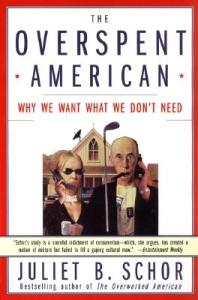
I’m not totally averse to an expanded understanding of what it means to keep up with the Jones’s. Though this used to be a caution against competing with our peers over material possessions, it might have some under-acknowledged benefits. I have been easily swayed by arguments like the one I first read by Juliet B. Schor in her work The Overspent American: Why We Want What We Don’t Need. Schor contends that when we were at pains to try to match our neighbors in material gains, we were at least better off financially than when we started trying to keep up with the Hiltons and the Diddys. Our neighbors typically share our financial portfolio, unlike the people we try to emulate who are on television because of their multi-million dollar lifestyles, and so it becomes less costly for us when we try to keep up with the folk next door.
I also think keeping up with the Jones’s might have gotten a bad rap because of our attenuated focus on its association with material possessions. But trying to keep up with people who plan healthy meals for their family, who are organized, or who have beautiful gardens is not a bad idea. The documentary film A Man Named Pearl offers a wonderful example of this. The film focuses on the beautiful topiary gardens of Pearl Fryar. Fryar’s own yard offers a visual feast for visitors from his home state of South Carolina as well as for interested observers around the globe. Interestingly, he has inspired his neighbors to create their own topiary gardens. Their work is also on display in the film and they offer testimony concerning Fryar’s influence on them and their efforts to keep up with him. Fryar enjoys helping his neighbors to develop their topiary and they in turn welcome his support. In this instance, keeping up is cooperative rather than competitive.
If you’ve got a neighbor who conducts themselves with integrity, try to keep up. If you’ve got a neighbor who is thoughtful and creative, try to keep up. If you’ve got a neighbor who is generous, try to keep up. Keeping up with the laudable virtues and talents of our neighbors is much more worthwhile than keeping up with the Kardashians.
I have talked with friends about the contests and games staged for children these days and the verdict seems to be that children are routinely shielded from loss and encouraged to believe that everyone wins. Loss is cloaked with badges, ribbons, and medals for showing “spirit” and simply participating. It was a much harsher climate for people who “also ran” when I was a child. You either won or you didn’t. I don’t want to dismiss the value of recognizing the importance of all of the participants because I do think their contributions are important. When I competed, I never dismissed my teammates who never placed. In fact, I was almost awe struck by people who were committed to the team and to coming to practice but who never had any hope of winning or even coming close to it. Thus, I identified with Bill Clinton’s fascination with his daughter Chelsea’s commitment to dance in much the same way. In a review of Taylor Branch’s biography of Clinton, Robert Franklin, esq. writes this about the former President:
Any father can be proud of his daughter, but Branch’s account suggests something more: that Bill looks up to Chelsea and finds the self he never managed to become. She was a source of hope when he was bitter, of perspective when he was self-pitying. Clinton liked doing what he was good at but marvels over Chelsea’s devotion to ballet, how her feet bled after practice, how she worked hard at it because she loved it regardless of how good she was at it. “I’ve always admired that,” Clinton says. “I’ve wondered whether I could ever stick with something for its own sake.”
I am sympathetic to Clinton’s reflections because I have often looked at devoted people who continue to participate without hope of glory and thought the same thing: Could I continue to do this for its own sake?
When it came to sports, the answer was a resounding “no, I could not continue doing this for its own sake.” There was no other model by which to play sports as far as I was concerned. I knew that if you did not win, you did not matter and I could not accept the consolation prizes.
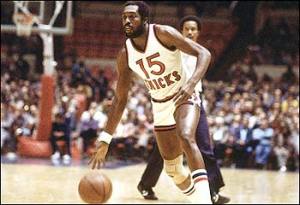
The real Vernon Earl “The Pearl” Monroe in action.
When I saw Spike Lee’s film He Got Game, I thought he captured an authentic experience of athletic competition that resonates with what I take to be a realization that many competitors face: the truth. The moment in the film occurs when Jesus Shuttlesworth confronts his father Jake about naming him after Christ and learns that his name was actually inspired by black people in North Philly calling Earl Monroe Jesus because he was “the truth.” I have only seen this movie once when it first came out back in 1998 and I never forgot that line. I remember it because I knew what it meant to encounter “the truth” as an athlete. The only equivalent that I can think of for non-athletes is of hearing Bobby Brown being asked about he and his wife being talented singers. In responding to the question about then wife Whitney Houston, Brown said, “naw, I can sing, but my wife, she can sang.” Sangin’ is for real jack. There are people who are so good that it just takes your breath away. And you know with every fiber of your being that no matter how hard you workout and remain committed, those people are competing on a level that you cannot attain. For me, it was an experience that made me rethink my goals for that arena. For a long time, I could pass for being among the really good ones but eventually, I knew the time was quickly coming to pass when I would have to move on. Unlike Chelsea Clinton, I decided that I would need to find a place where my hard work and dedication might contribute more to the history of what was taking place.
I left athletics with a profound understanding about the dynamics of functioning in a competitive environment. It was clear that there was always a tension between wanting the team to be better and fearing being displaced by “the truth.” People were always moving about under a heavy mantel of insecurity. Relief from this insecurity was generally temporary–it held until the next contest or the next season when the battle for supremacy would recur. When I entered other spaces where people wanted to talk about them in terms of competitiveness, I had a very solid vantage point from which to judge. In most cases, what people called competitive I could tolerate because they seemed to be imposing terms onto a space where they were superfluous. Competitiveness in the athletic arena is required. In those other spaces, I could opt out of whatever the competition was for and invent my own system of meaning that had value.
I prefer to cooperate rather than to compete. I enjoy getting along with people for the sake of a common goal rather than trying to fight with them in a terrain where everything valuable is scarce. I learned to monitor my own feeling that succeeding required a construction of scarcity. For example, when I consider conversations now among peers about college admissions, I pay attention to heightened concerns about enrolling in particular schools. While I think it’s fine to rank your top choices, I grow concerned when I hear people talk about their world ending when they are not accepted into what I call brand name schools. There are plenty of colleges and they accept students by the thousands. I am not convinced that being denied admission into your favorite brand is the end of the world. A well-known school can certainly provide the structure and the demand for excellence that should prompt one to excel but if you are interested in excellence, you can make that your goal in whatever program you enter. Too, the brand name should not take away your desire to create a system of meaning for yourself.
I also learned from my time as a competitive athlete that I preferred to surround myself with my betters rather than to exclude them because I felt threatened by them in some way. I think that my intellectual and spiritual growth depends on being surrounded by people who offer a model for being intellectually and spiritually strong. I am far from being the smartest person that I know; or the most patient, or compassionate, or thoughtful. I have a great admiration for the people in my life. They all bring something to the table. They offer skills and habits of being that I want to emulate and that help to ensure my humility. In athletics, a better athlete may replace you, but in life outside of athletics, someone with better skills can enhance you. I’m not so sure that this message is being conveyed in our efforts to ensure young people’s self-esteem. My feeling is that the way we’re encouraging self-esteem in young people teaches them to believe that they shouldn’t recognize their betters. It’s as if we’re encouraging them to think that in most cases, they are just as good at everything as everyone else–but that’s simply not true. Take my son and my next door neighbor’s daughter, who was born on the same day, as an example. Now, I think my son is a sharp little dude, but if I’m honest, my kid is not going to win an elocution contest today. His L’s sound like W’s so he says things like, “Why are you waughing at me.” While I think he sounds just as cute as could be, he wouldn’t be the first choice if CBS came looking for people to do voiceover work on 60 Minutes. My neighbor’s little girl, though, might have a shot at the gig. Her speech is perfectly free of tongue frustrations. She is the superior elocutionist at this point. Fortunately for all of us, we understand that there can be more than one child who can clearly articulate themselves. I’m happy to have someone in my son’s peer group who is close by so that we can take measure of his progress. She’s also one of three children in her household and she goes to daycare. I like it when my son plays with her because then he can develop his social skills by spending time with someone who is clearly so good at it. Instead of feeling threatened by our neighbor’s daughter and her facility, we are grateful to have her in our lives.
I think that it is a very good idea to have people around you who are better than you at any number of things. As one of my dear friends likes to point out, they will make you a better version of yourself.


 In Reverie Blog