One day after the southern style Atlanta cold kept teachers and educators inside, I dressed my son in corduroy pants, turtleneck, sweater, his thickest winter coat (Ezra Jack Keats Snowy Day Peter style), hat and gloves while the car warmed for at least 15 minutes before we set out for school. All this for about three minutes worth of time between our house and the car and then from the car into his school. Given all the clothes I wrapped around my son, it was heartbreaking seeing middle-school aged children wearing either sweatshirts, or sweaters, or just plain t-shirts waiting for the school bus. It was especially heartbreaking to see so soon after Christmas. Does Santa not bring coats to middle-school children in the South for Christmas?
My thoughts didn’t immediately turn to Santa when I saw these freezing children, I thought of their parents. Honestly, I cursed them for buying video games, non-essential things, instead of coats as Christmas presents for their children. Given the thinking and the writing that I’ve been doing about black boys in American culture, I uncritically associated the parents of those inadequately dressed children with some of the parental cruelties I witnessed in some of the trials that so many black boys had to experience alone. For example, Antron McCray was one of the wrongly accused and convicted teens in the Central Park jogger case. Bobby McCray, Antron’s father, convinced him to
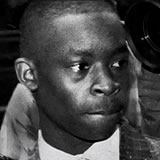
Antron McCray was a juvenile when he was convicted in the Central Park jogger case.
confess despite Antron’s denial of guilt. His father believed it best to tell the police what they wanted to hear so that he could go home. By the time the trial began, Bobby McCray could not tolerate the harsh, venomous anger directed at his son, so he abandoned his family. Antron idolized his father and never forgave him–even after his father and mother reconciled. Eventually, Antron’s father succumbed to illness and it was only at the funeral that Antron regretted not forgiving the man who had been the coach of all of his Little League teams and an overall superhero to him before the wrongful conviction.
Recently, I started listening to Thomas Cahill’s book, A Saint on Death Row: The Story of Dominique Green and the tragedy made of his life breaks your heart from his birth to his
execution. Green was physically abused by his mother, raped by a priest while attending Catholic school, raped by guards at the juvenile detention centers where his mother suggested he be kept. Eventually, his mother, who was diagnosed as mentally ill, was allowed to testify at his trial of her son’s probable guilt concerning the crime. The psychologist who was supposed to testify on Green’s behalf, maintained that black people were more likely than others to commit violence.
Despite Green’s many betrayals, the murder victim’s family contested his execution and Archbishop Desmond Tutu called him, “a remarkable advertisement for God.” Although these examples offer only a faint glimmer of hope for such abandoned and neglected children, it is a flicker that suggests the possibility of warmth when it’s cold outside.
Fan’s sign reads: “Thanks for 15 years of pain and misery.”
To this perfect message, I would only need to add 20+ years to this man’s “pain and misery” to capture my tireless commitment to this team. You definitely know you’re from Cleveland when instead of a win, you’ll accept a close loss as a slight victory.
If I’m not watching sports on television or something sports related, the only network that I watch is the Investigation Discovery (ID) network. The network does not in any way acknowledge race as a relevant category of analysis regarding its programming, but I would say that 95% of the stories feature crimes committed by white people against white people. When black men or boys are involved in an episode, the words “savage” and “thug” work there way into the language used in describing the crime. The network would most likely describe the crimes featured in their programs as “crimes of passion” stemming from adultery or jealousy; a fair number occur because of money: one spouse doesn’t want their ex to have any or because one spouse wants to benefit from the insurance policy they’ve taken out on the other one; and then, of course, there’s always some serial killer on the loose or there’s some maniac who wants to know what it feels like to murder someone.
Since these shows seldom feature black folk as victims or villains, not a word gets said about degeneracy, senseless violence, poor parenting, ignorance, or bad neighborhoods. In almost every episode, you hear all this stuff about how “they seemed like the perfect couple,” “we lived in a community where things like this just don’t happen,” “she was beautiful and didn’t deserve this (I guess if she were ugly there’d be no problem with her being raped and murdered).” Another really fascinating aspect of these shows is that the police officers and the detectives actually do investigative work! They dust for fingerprints, secure DNA evidence, look for clues, interview friends, family, and suspects. If you’ve read my previous posts on black boysin American culture, then you are well aware of the fact that none of this work goes into determining whether a black male is suspected of killing, raping, or recklessly eyeballing a white woman. When black boys are suspected of committing a crime, detective work involves getting in your squad car, spotting a random black boy, and deciding that he did it; that’s it, end of story. They will only fingerprint and take a DNA sample from the decided upon black criminal to add to his booking file. Then, a jury that has watched the ID network (before that Perry Mason, Matlock, and Murder She Wrote) and has seen the detective work featured in its programming assume that this black suspect must be guilty because those charged with serving and protecting our communities are always on the case…and so it is. These juries, however, should read more from W.E.B. DuBois. In the January 1913 issue of Crisis magazine, his discussion of race and crime reflects traces of the bloodlust we see in contemporary judgements:
Far too many, North and South, would preserve one foolish white woman if it costs the degradation of ten innocent colored girls, and who would greet the death of every black man in the world with a sigh of infinite relief.
I recently watched The Trials of Darryl Hunt on Netflix and the circumstances that I have been describing reflect what happened to him. Darryl Hunt spent nearly 20 years in a North Carolina penitentiary for raping and then stabbing to death a white journalist, Deborah Sykes, in 1984. Hunt had the great misfortune of being friends with a man named Sammy Mitchell.
Sammy Mitchell was the name given by an alleged witness in a 911 call reporting the crime against Sykes. Mitchell claimed he knew nothing about the call so the police decided to question his friend, 18-year-old Darryl Hunt, who then agreed to it and the rest follows the narrative of black boys and accusations of guilt–oh you did it: GUILTY!
Unlike the other cases I discussed in Parts 1 and 2, the police were never able to coerce Hunt into signing a false statement. For 18.5 years, he always maintained his innocence. Too, this is the only case, in the documentaries I’ve discussed, where the attorneys involved cited history as the most significant factor in the injustices Hunt suffered. One of his lawyers even says that Hunt wasn’t physically lynched but that he certainly was a victim of a “judicial lynching.”
Here are a few things that I’ve reflected on after watching The Trials of Darryl Hunt that will be helpful in raising my black son:
1.) Fairness is a fiction whenever you’re involved so you need to develop some coping skills to help manage this.
2.) Martin Luther King, Jr. was fond of quoting Amos 5:24: “But let justice roll down like waters and righteousness like an ever-flowing stream.” There has yet to be a torrential down pouring of justice in your case so expect a drought and pray for rain.
A sightation is a term I coined to refer to a visual reference, an optical echo that re-stages some primary, illustrated source. Angela Y. Davis has been one of the most eloquent critics of contemporary sightations of historical images that empty them of political content by substituting a distorted replication that represses radical resistance against systems of domination. In her case, Davis describes how contemporary representations of her lead many young people to associate the oppositional challenge she asserted against the United States as a police state for a hairstyle, an afro. Such historical oblivion erases the terror that Davis confronted during the time she was one of the FBI’s most wanted, as well as the terror greeting those black women with afros who were mistakenly identified as Davis.
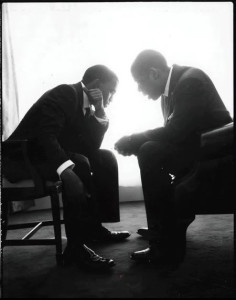
Popular American culture continues to make these troubling sightations. Take this one of Jay Z and Kanye West, for example:
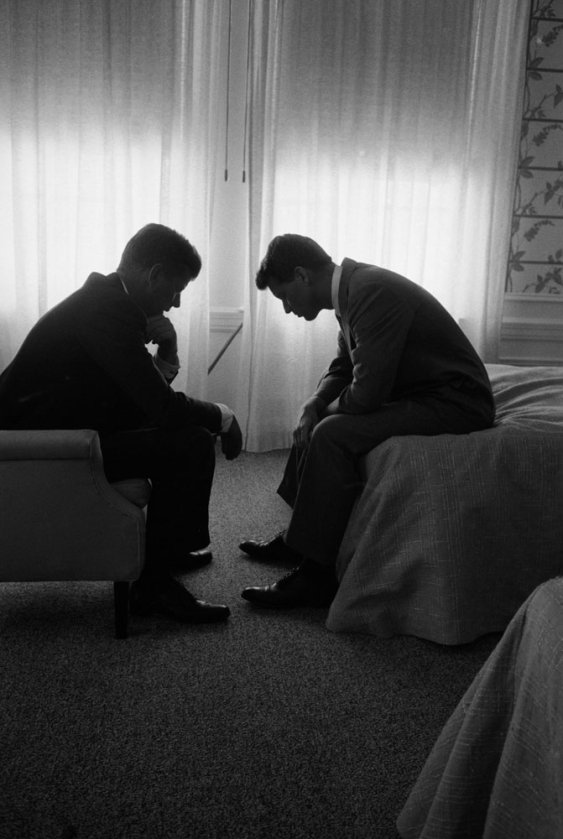
I see this as a clear sightation of this 1960 photograph of John F.Kennedy and his brother Robert F. Kennedy:
1960 | In a Los Angeles hotel suite, John F. Kennedy confers with his brother and campaign manager Bobby during the Democratic National Convention, at which JFK was picked as the 1960 party nominee. Originally published in the July 25, 1960, issue of LIFE. Read more: John F. Kennedy – TIME – News, pictures, quotes, archive http://topics.time.com/john-f.-kennedy/pictures/#ixzz2pIbtflM2
Perhaps Jay Z and Kanye West’s sightation of the 1960 photo seeks to call attention to their brotherhood, affluence, and power, but it fails to capture the turbulence that will mark their legacies. To me, the image of the Kennedy brothers as triumphant, which the original backdrop of JFK becoming the Democratic party nominee suggests, obscures the tragedies of their shocking assassinations in 1963 and 1968. Seems to me that before the contemporary brotherhood associates their Throne with the Kennedy legacy, they should more carefully read the history of their anguished fate.
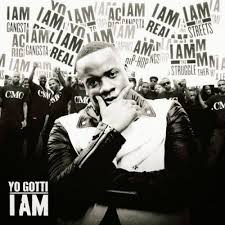
A few days ago, I stumbled across another disturbing sightation. This photograph of Memphis rapper, Yo Gotti, situates him into a historical narrative that completely misses the point of the original :
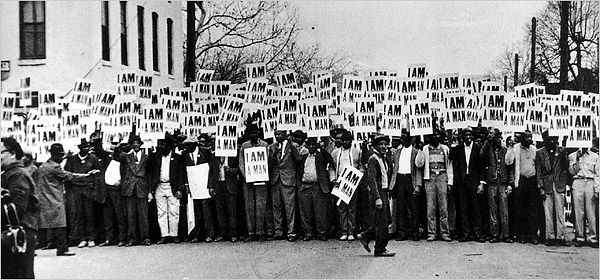
Not a single one of the placards in this rendering say anything about being a man; quite unlike the original:
Ernest Withers
The Withers photograph of the Memphis Sanitation Worker’s Strike in 1968 has certainly become iconic. It depicts those workers whose demands Martin Luther King, Jr. endorsed and whose spirits he sought to buoy as they faced the intransigence of city officials. King’s assassination at the Loraine Motel in Memphis also haunts this image. The strikers’ declaration of manhood highlighted their desire for adequate wages so that they could provide for themselves and for their families. Their declaration contained their need for better, safer working conditions. Their declaration also voiced their desire for independence from having perpetual adolescence thrust upon them due to the absence of a living wage that virtually guaranteed their dependence on government aid.
While I understand that the young people in the Gotti sightation may use the term gangsta to signify their toughness and their ability to make their way through a merciless and hostile terrain, it is oftentimes a weak social critique because it acts more as a complaint instead of an analysis of democracy and citizenship for black Americans. Too, hip hop cultures’ reading of gangster culture as portrayed in Coppola’s most famous and masterful trilogy, often cited as a great influence on rappers and their musical personas, misses the point of the films. Though The Godfather trilogy is beautifully told and beautifully executed as cinema, the overall story is tragic. The Don didn’t want Michael to be a gangster. Michael was supposed to attend college and marry a white, anglo saxon, protestant woman; they are supposed to have children and live in safety thereby living out the American dream. The Don is heartbroken when he learns of Michael’s involvement in the family’s retaliation for the assassination attempt against him. Early in part II, Michael reiterates his promise to Kay that he will leave gangsterism behind so that they can live safely as Americans through legitimate business practices. In the final film, Michael clearly says, “Just when I thought I was out, they pull me back in!” Michael didn’t want to be a gangster, an outlaw, he wanted to be an American.
Hank Willis Thomas offers a very striking meditation on the legacy of black American claims to manhood:
Thomas ends with a declaration regarding black humanity as he closes with, “so be it,” by divine right. I find it striking that not a single one of those placards in Yo Gotti’s sightation say anything about being a man and so self-sufficient and released from thug stereotypes reified through the criminal justice system. Gangsters reify American history and culture as the Hobbesian characterization of a state of nature wherein life is “solitary, poor, nasty, brutish, and short.” In “I’ve Been to the Mountaintop,” the last speech Dr. King gave on April 3, 1968, the day before his assassination in Memphis, he offers a rejection of martyrdom: “Like anybody, I would like to live a long life. Longevity has its place.” Gangsterism advances brevity, a figurative boyhood and so stands in direct opposition to “I Am a Man.” The ostensible glamour of gangsterism, its sightation, is shortsighted.
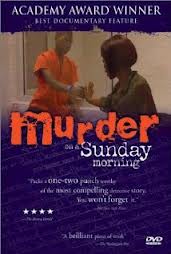
Gentle, quiet, well-mannered black boys are unrecognizable actors in American history; instead, these children are most always fiendish brutes in the cultural imagination and reified as such in daily life. The attempted crucifixion of Brenton Butler exemplifies this unfortunate truth. On Sunday morning, May 7, 2000, a white woman was shot in the face by a black male assailant who ran off with her purse. The Jacksonville Police Department set out looking for a tall, skinny, black male wearing dark shorts and a fisherman’s cap. 15-year-old Butler, on his way to apply for a job at Blockbuster video was asked if he would come to the police station to answer a few questions, to which he agreed. Before reaching the station, police asked Mary Ann Stephens’s now widowed and traumatized husband, James Stephens, if he recognized the young man in the backseat of the police car as the shooter and he confirmed that it was. The documentary film, Murder on a Sunday Morning, follows the public defenders’ efforts to prove Butler’s innocence.
I rented this from iTunes but you can view the entire film on YouTube–though I cannot verify its quality.
This poor child was beaten by at least one detective and compelled to sign a false confession by another. Once the police decided on Butler’s criminality, they gave up performing any real detective work. They did not attempt to verify Butler’s story by asking his parents or neighbors about his whereabouts; they never went to Blockbuster to verify Butler’s claim of applying for a job there; they never took fingerprints from the purse once it was discovered in a dumpster. All the police did was find this church going, bespectacled, quiet, disciplined black child and turned him into the black brute of American historical fantasy.
This case highlights the importance of teaching my son these lessons:
2.) It will be good to teach my son to recognize the exceptionally talented alto saxophonist, Julian “Cannonball” Adderley, as a surprising sonic emergence in Florida’s music history in light of the fact that it was not until 2007 that its state’s song was changed from the minstrel song, “The Swanee River.”
3.) I will remind him to be careful about work and play in Florida. Searching for work in the morning may leave you handcuffed in prison for six months and leaving home for tea and a snack at half-time might get you killed at night.
Though it is usually unwise to make broad, sweeping generalizations, I’m going to risk being foolhardy in making this claim about black boys in American history: It is impossible to mark a single decade in American history where your entry point into it remains unblemished by some gross injustice carried out against black boys; the Central Park Five marked mine. I don’t quite remember understanding the race and gender narratives involved, but the key terms that stood out for me were: wilding and Central Park jogger. In the years following the 1989 story of five black teenagers who where charged with raping a white jogger in Central Park, I read articles and bought books about the case. Earlier today, I finally watched the Ken Burns documentary about the miscarriage of justice against these boys most clearly demonstrated after Matias Reyes’s confession.
According to journalists interviewed in the film, neither the police nor the former district attorney for the case, could admit to their mistakes–or what I prefer to think of as their lies and their abuse of power. The documentary recalls the venom shamelessly directed at the accused without recognizing that the politicians calling for blood and the prominent citizens, like Donald Trump, who were calling for the return of the death penalty recalled the lynch mobs that formed whenever black boys or black men were accused of raping a white woman. While I found the film interesting in some ways, it was trite in its focus on this case as representing a discreet moment in American history. The story of the Central Park Five is the story of the Scottsboro boys (1931-1937), George Stinney (1944), The Groveland Boys (1949), Emmett Till (1955), James Hanover Thompson and David Simpson (1958), Bobby Hutton (1968), Jonathan and George Jackson (1970/1971). The tragedy of their stories make for engrossing, compelling drama, but what about the story of those who cried “crucify him?” To that end, The Central Park Five might have been more interesting if those same people who shamelessly called for blood and the death penalty were asked to reflect on how they understood themselves in relationship to this story in light of the truth. What is that story like? How does it sound?
In light of this history, here are some of the ground rules that I have established for contributing to my son’s view of himself as a free human being:
1.) When I can control it, I will not allow him to speak to figures of authority without my presence; thus, no police officers and no guidance counselors. These two forces have been detrimental to black boys (and girls, for that matter) flourishing. As long as my son is enrolled in compulsory education, I will make a note in his file that no guidance counselor is allowed to speak to him without one of his parent’s present. If he is ever taken to a police station for the very likely crimes of collecting the mail from our mailbox, using his key to enter our home, or buying clothes from any place other than Goodwill, I will teach him to say, “I would like to speak to my attorney.” I will prepare him to recognize all the tricks they will use to compel him to deny his own truth, be on his own side. I will teach him that they will tell him that calling for an attorney will only make him look more guilty; how they will tell him that if he’s innocent, there’s no need for an attorney.
2.) Just as I will tell my son to know his own name, his identity, I pledge to also know it. To most people, black boys are thugs and that includes the sweet boy that I know I have raised. If ever I recognize that my son is being represented to me as some vicious stereotype of black male identity, I will immediately plan for his escape from that environment.
3.) If my son tells me that someone in a position of authority is cruel to him, I will believe him and takeover. If he is in school, I will tell him to ask to visit the Principal’s Office so that he can call his parents.
4.) I will not allow my son to believe that some notion of “institutional prestige” is worth his life. Enrolling at The Dalton School, Harvard, or Yale, working at Salomon Brothers or at the Cleveland Clinic, and living along the contours of Central Park is not worth his dignity, integrity, sanity, or health.
5.) I will teach him that as far as he’s concerned, there is no right place or right time already made for him. Thus, I will encourage his creativity and his development of a rich interior life, for without this skill or this careful cultivation he might be without sanctuary.
One of my oldest and dearest friends sent me the photo above with the message, “Caroling and crepes at the Westside Market! What could be better?” It’s a good question.
While I can’t say that I miss Cleveland’s bone chilling cold, it’s a beautiful place to experience Christmas. There’s rarely snow in the South at Christmas time, as a former resident of The Land, I have fond memories of snow on Christmas morning, brunch with my family, opening presents with my cousins. Christmas’s at my house now are greatly informed by those fond memories. So today I’ll be making cornbread for the dressing I will bake tomorrow, boiling sweet potatoes for the ease of pealing them before roasting them in butter, vanilla, and brown sugar early the next day, and making gingerbread people with my son to leave as a token of our appreciation to Santa for his hard work.
Even though snow and cold weather make for slushy, messy traveling, they also provide the conditions that make you want to get closer to people, experience their warmth, and luxuriate in the coziness that you have made in defiance of the frosty elements. It’s more difficult to replicate the warmth of human connections when it’s sunny and near 50 degrees outside. So too, against these bright, warm, shiny days we must stop ourselves from granting the sun omnipotence to create the warmth that Northern winters urge humans to make themselves–together.
I used to dread going to many of my feminist theory or feminist themed classes; especially the graduate ones. While the course content could have been interesting, the classes were often filled with women, many of whom were well beyond their twenties, who asked questions like these: Can you enjoy baking cookies for your family and still be a feminist? Can you want to be married and still be a feminist? Can you wear makeup and be a feminist? Having to endure these simple worries and flighty concerns about living in the world with an oppositional conscience was indescribably painful. This foolishness has followed me beyond the classroom to conferences where women make comments like this one: “As I heard you speak about women hiding from the spotlight instead of claiming their authority and revealing their credentials, I decided to put my speaker’s badge on and to stop hiding [THUNDEROUS APPLAUSE].” Again, I was miserable.
For me, being a feminist means having an oppositional consciousness that enables you to understand how systems of power operate and to then utilize that understanding to confront normalizing ideologies concerning one’s identity so as to resist those systems in order to insist on having freedom and dignity as a human being. Currently, popular, media conversations regarding Beyonce’s latest album remind me of those foolish graduate school discussions. Whether or not Beyonce is really a feminist or if she actually teaches us something about being feminist is just so much nonsense to me. First off, in order to learn more about feminism that spoke to her own developing consciousness regarding empowerment, Beyonce does not claim to have read any books that might have helped her; too, she does not claim to have drawn on her experiences traveling abroad to shape her views; nor did she even claim the fine art, that so clearly influences her aesthetic, as influencing her understanding of feminism. Instead of drawing on her own life experiences as primary sources to define feminism, she conducted a YouTube search. Now, I’m not hatin’ on her for any of this; at least she wasn’t on YouTube trying to figure out how to build a bomb to murder people at church, a movie theater, a school, or a hospital. What I don’t understand is how you can have the resources to read, travel, experience art in its many forms and yet lack the ability to read your world and to create “other models by which to live.” Why wouldn’t it be prudent to actually use your experience of the actual world to inform your relationship to feminism and supplement those experiences with other sources?
I have known people who were so poorly educated that they never learned to read. But these same people were committed to living with dignity and integrity; too, they could tell you what made for a good life on their own terms. I don’t think any of these folk called themselves feminists but they lived out their understanding of how systems of domination operated in direct opposition to their desire to be free. To that end, I don’t think people, even public personalities, are required to explain what may look like inconsistency or account for what may appear to be at odds with one’s ideological stance. Depending on the situation, your ideological viewpoint may not accord with what circumstances demand. There are numerous accounts of black people who saw nonviolence as an effective tool for systemic change, but who also carried guns or accepted the protection of folk who toted guns–even Martin Luther King, Jr. accepted the protection of armed black folk in Birmingham in the aftermath of the bombing of the 16th Street Baptist Church.
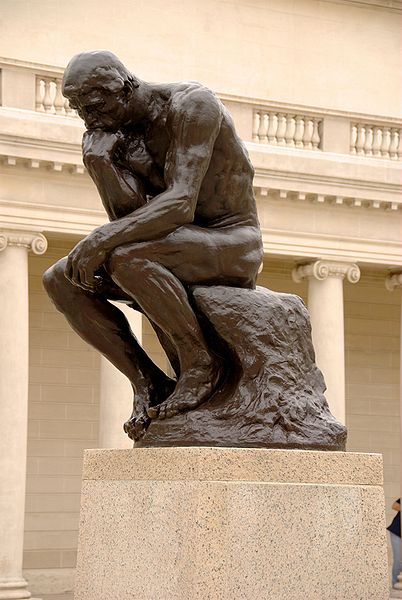
When I was growing-up, people used to say, “sometimes you gotta do what you gotta do.” This pronouncement acknowledges flux and change in life thereby suggesting that ideological positions cannot serve as an answer for all things, at all times, and in all situations. If you have to give yourself a name that describes your political stance, Rodin offers a good one “The Thinker.”
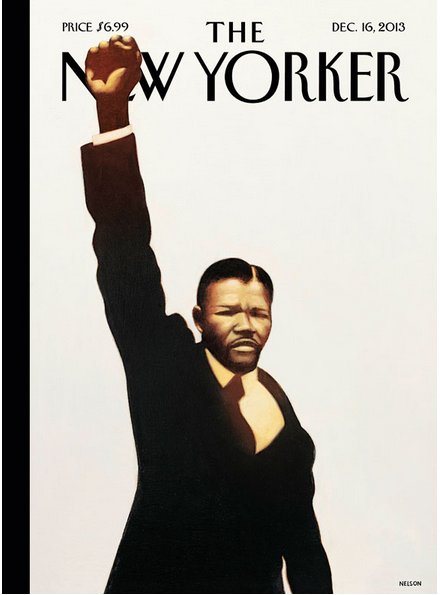
I never thought that I would be spending so much time thinking about Nelson Mandela and whales, but I have been. In paying attention to the many commemorative magazine covers honoring him, what appeared more profound than his passing was the documentation of a black man with a raised fist living as long as he did [A view similar to the one Rosa Parks offered through her remarks upon the death of Robert F. Williams, and reported by Timothy Tyson, in contending that she was “delighted…to find herself at the funeral of a black leader who had died peacefully in his bed”].
Black men who raise their fists like this, in a suit and tie–not a football, basketball, or baseball uniform after a championship game–are not supposed to live to be 95. In the United States, unarmed black teens can’t carry Skittles and iced-tea in their hands and make it past 17; and just forget about unarmed black men experiencing their mid-twenties as they lie face down on a rapid transit platform making it home to their four-year-old daughters; and no Lord, don’t even consider an unarmed black man getting married and celebrating his three-year-old’s birthday in two weeks or experiencing the personality of his five-year-old child after being shot four times in the neck and torso. It’s hard as hell to become a 25-year-0ld black man in these United States. In this country, any white person who declares themselves dedicated to “the daily practice” of making it possible for a community to “live safely,” is free to kill black boys and black men long before they could dream about living to be 95-years-old! Trayvon Martin never saw the other side of 17; and for Oscar Grant and Sean Bell turning 23 and 24, respectively, wasn’t even an option.
South Africa’s apartheid government certainly meant to kill Nelson Mandela. Held captive on an island, forced into performing hard labor in a quarry, and permitted meager access to visitors for 18 years at Robben Island, 6 years at Pollsmoor Prison, and rounding out his final years at Victor Verster Prison, Nelson Mandela was supposed to die long before now.
As Marvin Gaye has said, “No, no baby, this ain’t livin’//No, no, no”
In reaching the age of 95, Mandela experienced the longevity that Martin Luther King Jr. didn’t even expect. I have been more surprised by the fact that Mandela lived as long as he did, than I am by the fact that he died. Captives aren’t supposed to flourish.
The Whale
“If only you had paid attention to my commands, your peace would have been like a river, your well-being like the waves of the sea” (Isaiah 48:18). If we pay attention now, Lord, can we still have “peace flowing like a river?” Would that then compel us to set “the captives free?”
Peace is unlikely in captivity, but money flows from it “like a mighty stream.” For centuries, the desire for money has despicably trumped the desire for peace. This must be true because captivity has been and continues to be a habit of history–from sea to shining sea.
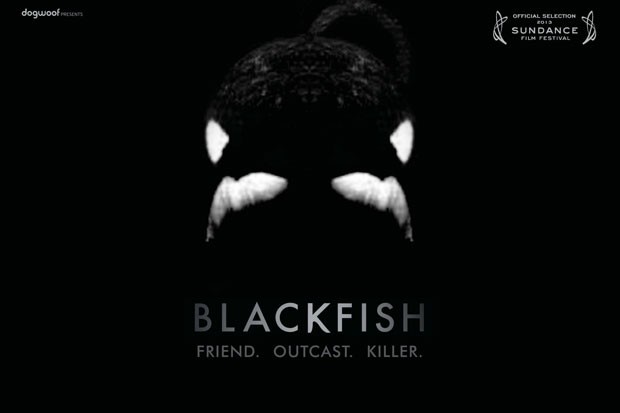
I don’t know how you can view a film like Blackfish and not connect it to this world’s routine theme of captivity. If you haven’t seen this film, I highly recommend it. I first learned of it through a review where the director, Gabriela Cowperthwaite, cites Tim Zimmerman’s article “The Killer in the Pool” as her greatest influence. After watching Cowperthwaite’s film, it serves as the perfect visual accompaniment to Zimmerman’s article.
Follow this link to the official trailer for the film.
Though some have criticized this film for being a biased, unbalanced, and thus self-serving visual screed against SeaWorld, I don’t really understand why that even matters. There is no way that SeaWorld can deny that they put an animal that can weigh as much as 22,000 pounds, grow as long as 32 feet, and travel up to 100 miles a day, into the equivalent of a kiddie pool. This nonsense about “rescuing” and “rehabilitating” animals in the wild has long been a ridiculous claim to me. If whales get sick and die, that’s what happens to living things; that’s that circle of life stuff. Instead of “rehabilitating” animals, humans need training in minimizing their waste and polluting the environment.
Human rescue missions into the animal kingdom make me very suspicious. I lived in an apartment complex when I was in college that was very close to campus. I saw this girl, who also lived in the building, carrying a squirrel in her backpack; so I asked her about it. She told me that she “saved” this squirrel when it fell off a wire and its mother did nothing to help it. It wasn’t clear to me how she knew that the larger squirrel was the smaller one’s mother or how her intervention coincided with what the squirrel needed to learn on its own about city living. Domesticating wild animals echoes justifications of human captivity wherein “civilized” people declared that their intervention into the affairs of presumed “savages” equalled salvation. Rescue efforts coupled with captivity and domestication have never facilitated peace, but they have produced lots of money.
Recognizing enslavement as the urtext of SeaWorld’s tale of Shamu emerges prominently in the way pods, or whale families, are disrupted when their babies are captured. Orcas form pods that may be as small as five whales or as great as 50 whales. They speak their own languages and form very close bonds. Once a baby Orca is captured and then released back into the wild, it is very, very difficult for those whales to ever find their pods and in the rare and unlikely chance that they do find them, reintegration becomes difficult if not impossible; basically, it’s the Orca version of Help Me to Find My People: The African American Search for Family Lost in Slavery.
Mandela and the Whale
Mandela overcame captivity, which is extraordinary, but captured Orcas tell the most likely tale of captivity: brutality, trauma, and death. SeaWorld has seen profits exceeding $500 million, but “what shall it profit a man, if he shall gain the whole world, and lose his own soul?” (Mark 8:36)






 In Reverie Blog