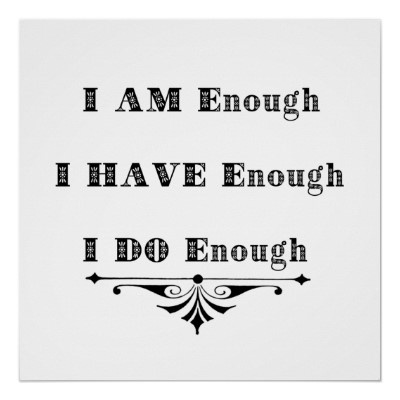
I shared a heartbreaking story with a friend about someone I knew from graduate school who had been exploited, along with her daughter, through her child’s vulnerability. My friend then passed on a mantra that has now deeply impressed everyone I have shared it with: “The first thing I say to myself when I wake up in the morning is ‘I am enough,'” she said. “After that, I know that I can greet my daughter as she wakes up and let her know that whatever she has to confront, I am prepared to meet that too,” she confided. What a wonderful way to greet the day: With crucial information necessary for meeting the surprises that might be in store for us but also the daily challenges interlaced throughout those moments that challenge our feelings of sufficiency. I was flipping through several popular magazines last night and saw all of the shoes that they wanted me to buy, the parties that I was not invited to attend, the people who I should want to know but do not and I decided that “I am enough,” despite what they think is missing. Knowing that I am enough gives me the power to disagree with the glossiest of authorities.
I remember a time when “healthy food” was prescribed for patients whose blood pressure was too high; whose diet needed to consist of more fiber. To my mind, healthy food was clinical, sterile, bland food on a menu medical doctors made. Cooks, however, made food that “was sayin somethin!” It was food that grew in gardens behind houses in plots as deep as a neighbor’s backyard. These gardens also grew inside brick beds lining chain link fences. It was food that produced an abundance and so was shared between neighbors, family, and friends. It was food that would be rinsed in deep utility sinks in basements–not because one needed special tools or solutions to remove pesticides, but because it provided the space that made rinsing and cutting easier.
Those were different times. They were days that included walking to the grocery store with one’s own personal grocery cart and pulling that same cart home afterwards. Those were also the days when people rode bikes to visit friends or pushed lawn mowers to cut the lawn at one’s own home; where we worked shovels to clear driveways and walkways. Those were days when children were not told to exercise because they were walking, pulling, riding, and working on real-life tasks. Gyms were sites where P.E. classes were held and basketball games contested. No one purchased a membership to a gym (unless, I suppose, when someone bought season tickets to basketball games).
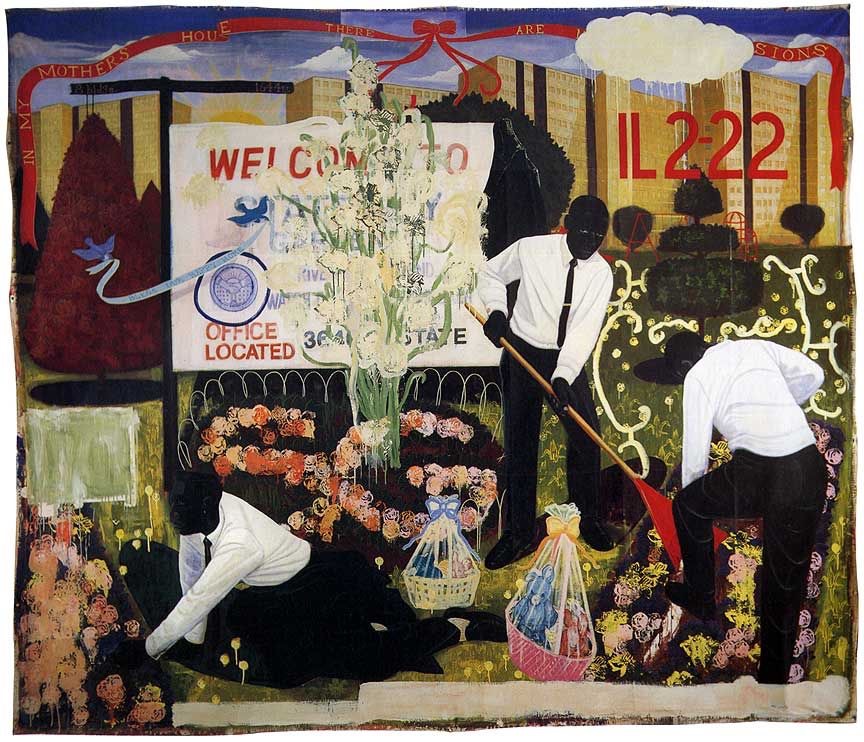
Many Mansions (1994), Kerry James Marshall.
Once upon a time when food was good, tomatoes could be eaten like apples because they were just that sweet. Once upon a time when food was good, peppers were hot, mint was fragrant, and (collard) greens were so robust one had to take a break from eating in order to pray for the great fortune of having that bite. Once upon a time when food was good, people stopped eatin that mess the doctor prescribed since he thought Jello was dessert and that bananas should be broken in half and eaten on separate mornings no matter how small the fruit. Once upon a time, the only thing we called “fresh” was (maybe) milk because calling those vegetables that grew right outdoors “fresh” would have been redundant.
…the U.S. has got to be the only place where good food had to be made healthy.
For a while now, I’ve marked the significance of April 4, the day Martin Luther King, Jr. was assassinated, as one that calls for serious reflection. This year has been different in how I feel about the loss; this time, mourning accompanied contemplation. Easter, I’m sure, has everything to do with this difference. In 1968, April 4 occurred on Thursday and not Sunday–Easter Sunday was observed on April 14 in 1968–this year, Easter preparation coincided with the King assassination.
I have started gathering images that inspire novel ways of considering the assassination of King. Below is a glimpse of what our dates would look like if our calendar mirrored the events immediately preceding, then following King’s violent death:
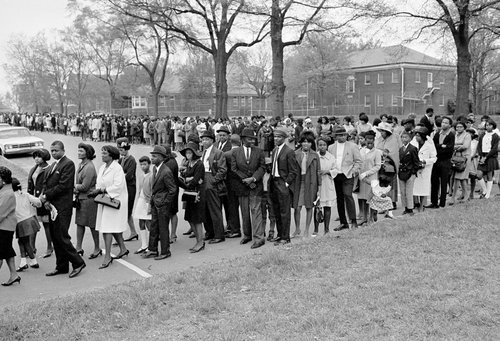
Saturday: April 6, 1968
Mourners standing in line outside Sisters Chapel at Spelman College to pay last respects to Martin Luther King, Jr.
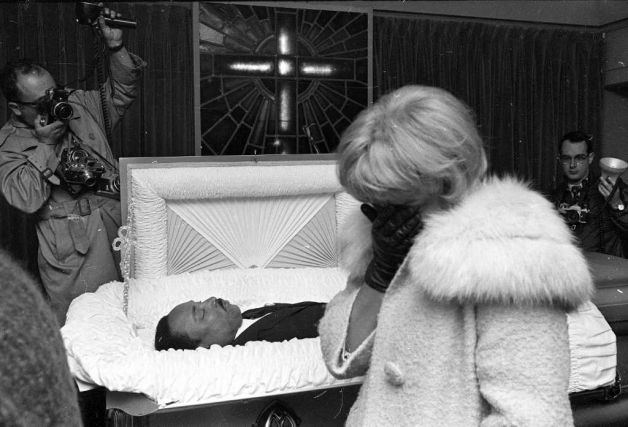
Friday: April 5, 1968
MLK’s body enroute to Atlanta.
Mourner viewing MLK’s body at R.S. Lewis Funeral Home. Mr. Lewis prepared King’s body so well that his face and neck were seemingly restored to their previous state before the shooting.
Thursday: April 4, 1968
Martin Luther King, Jr. was shot with a single bullet at 6:05 p.m.
Ostensibly, this is a fully restored hearse that carried MLK’s body from the Lorraine Motel to St. Joseph.
Remington 70-60; Gamemaster .30-06 rifle said to be the weapon used to kill King.
King pronounced dead at 7:05 p.m.
Wednesday: April 3, 1968
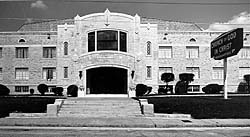
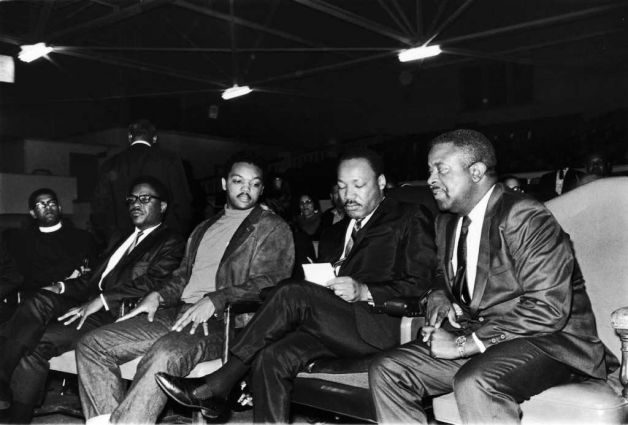
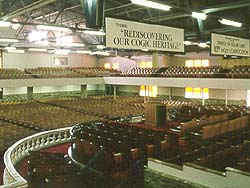
Exterior view of the Mason Temple.Reverends Jesse Jackson and Ralph Abernathy on opposite sides of MLK, who appears to be making notes for the speech that he will be delivering. This final speech is widely known today as King’s “Mountaintop” speech.
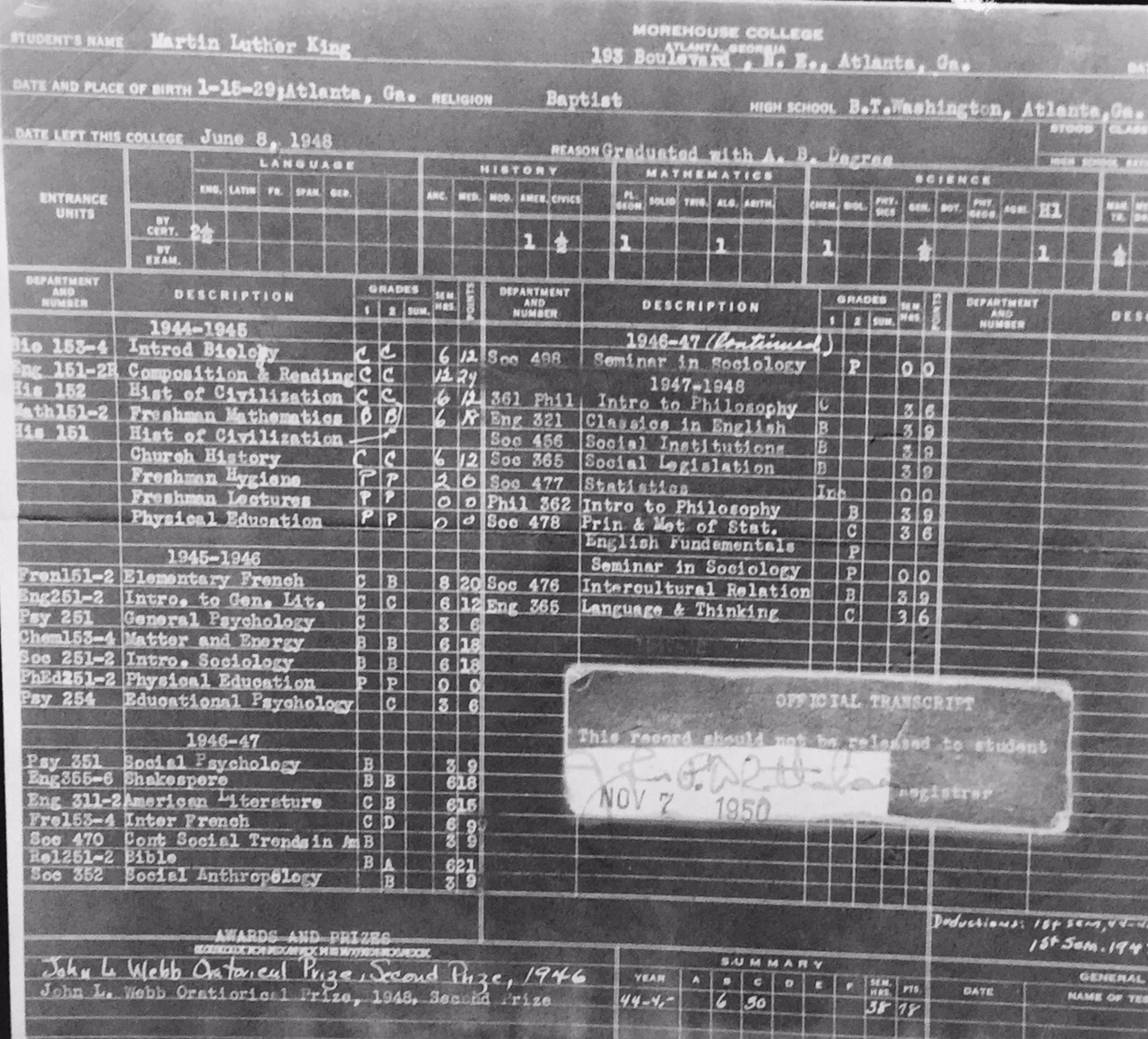
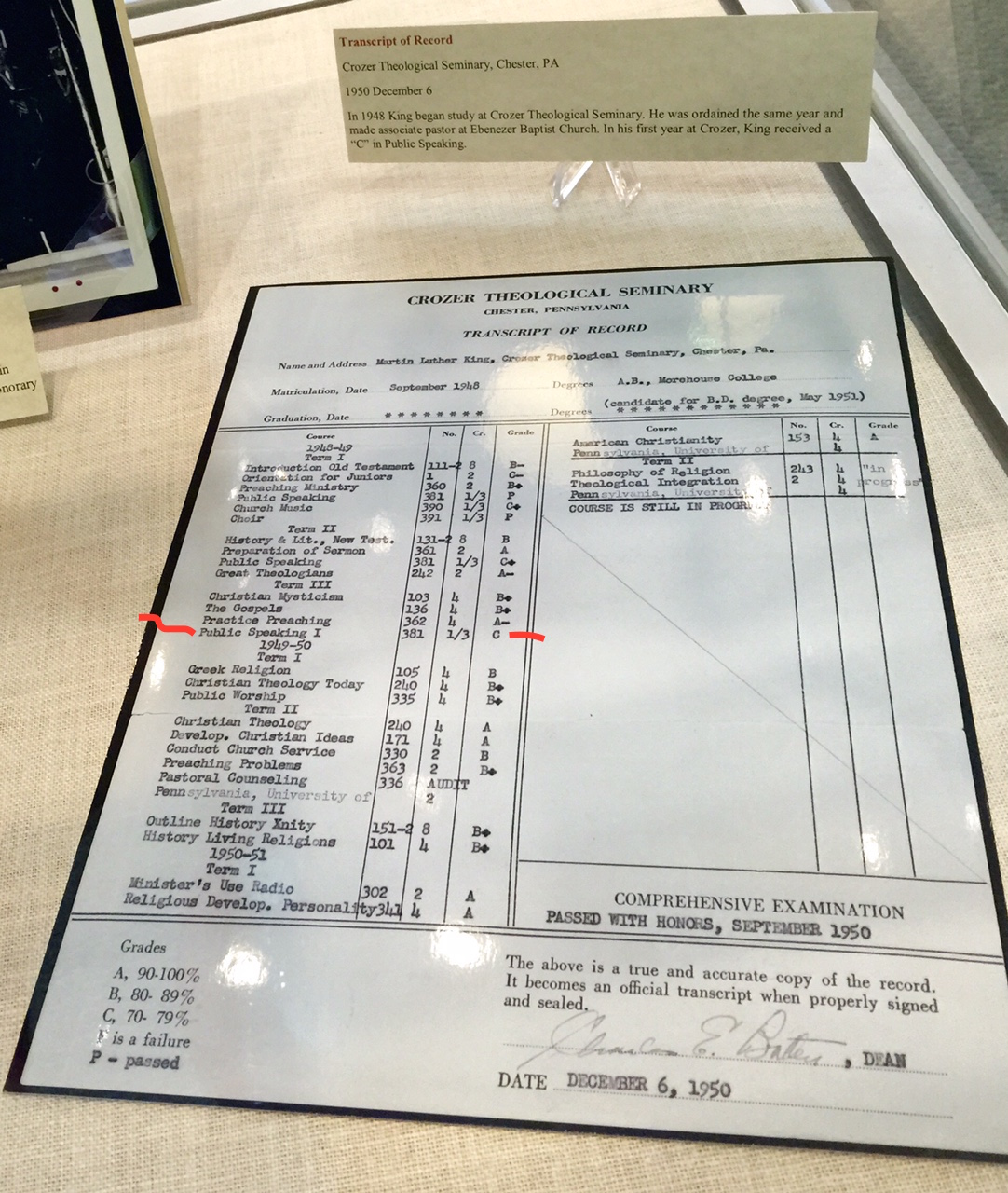
Martin Luther King, Jr.’s transcript from Morehouse College. Clark Atlanta University Archives.Martin Luther King, Jr.’s transcript from Crozer Theological Seminary.
The next time someone tells you that they were an “A” student in college, you might consider asking them if they knew that Martin Luther King, Jr. was a “C” student in college and that he earned a “C” in public speaking while attending seminary. King’s goals were bigger than being an “A” student; he set his sights on being a graduate. As his Morehouse transcript reveals, earning a 2.48 was enough to ensure graduation. Beyond that, King would prove that “A” work does not always confirm one’s brilliance nor does a “C” confirm one’s mediocrity. Brilliance and genius just might exceed institutional measures of assessment.
Behind the Myth of Benevolence (2014), Titus Kaphar
In past years, I never thought much about Women’s History because, unlike Black History Month, it did not come with sufficient indictments. Black History Month calls attention to interlocking systems of domination that cast black Americans as this nation’s civic trash. Even though the celebratory aspects of Black History Month are far too often cartoonish, this sanitized version of history itself becomes a subject of interrogation. Women’s History Month hasn’t gotten to a point beyond “I am woman hear me roar.” I often find it dishonest in its embrace of “women” without consideration for the divisiveness of race and class. Recent photos and discussions of Gloria Steinem offer examples.
On March 4, 2015, The Huffington Post ran Cavan Sieczkowski article “Gloria Steinem Wears a Clit Ring Like a Boss.” Sieczkowski calls Steinem a “feminist icon and all-around legend” before sharing a story and a photo of Steinem wearing the “Clitoring” posted on Instragram. Among the reasons that Sieczkowski finds this extraordinary is that Steinem once made this assessment of how women’s bodies are discussed:
“I didn’t hear words that were accurate, much less prideful,” she famously said. “For example, I never once heard the word ‘clitoris.’ It would be years before I learned that females possessed the only organ in the human body with no function [other] than to feel pleasure. (If such an organ were unique to the male body, can you imagine how much we would hear about it—and what it would be used to justify?)”
So Beyonce can’t call herself a feminist because she’s hypersexual, sensual, or whatever, but Steinem wears a clit ring and feminists everywhere should stand up and salute?! The fact that Steinem and her fans think these rings and pendants–that cost $130 and $540 respectively–ignores women of color who have historically longed for sexual privacy rather than public scrutiny and who fought for their right to possess their bodies, as well as their sexual lives should celebrate the ornamentation of our actual exposure? Doesn’t work for me.
I find Gloria Steinem’s critique of patriarchy trapped within the purview of her white female body. Forget the “simultaneity” of oppression or “interlocking” systems of oppression, for Steinem, inequality and injustice are solely informed by gender. I remain incredibly appalled by her 2008 op-ed piece in the Times where she completely ignores how race and gender interlock and in doing so, Steinem grants Barack Obama more currency than Quentin Tarantino ascribed to Django. In claiming gender discrimination against Clinton, Steinem writes:
Black men were given the vote a half century before women of any race were allowed to mark a ballot, and generally have ascended to positions of power, from the military to the boardroom, before women (with the possible exception of obedient family members in the latter).
If only Steinem could name one black person, ONE, who has been given anything in this country but pain and folly, I might clench my teeth a little less forcefully than I am now given her suggestion that there is a public wage of blackness (see Du Bois). With the passing of the 15th Amendment, all U.S. citizens were granted the right to vote but it wasn’t until 1965 when black people didn’t necessarily have to die casting a ballot (now we die for trying to go home from the store during halftime, asking for help after a car crash, sleeping on the sofa while police officers and a camera crew come to arrest our fathers). With a currency rate about as valuable as Monopoly money, black (wo)men certainly held token positions of civic authority but their tears have never led to the macabre scenes of vigilante justice for whistling offenses…and those tears certainly didn’t win one particular black man sufficient votes to win New Hampshire.
For me, Women’s History Month has had the feel of Steinem’s highly problematic argument concerning Hillary Clinton’s entitlement to, at least, the presidential nomination. Recently, I’ve started creating my own vision of Women’s History Month that looks less reactionary than I once envisioned. Titus Kaphar’s art, the painting depicted above being only one example of an incredible body of work, reflects the possibility for the kind of creative, trenchant, and interesting interrogation of gender that I find more fulfilling than seeing Steinem wear “a clit ring like a boss.”
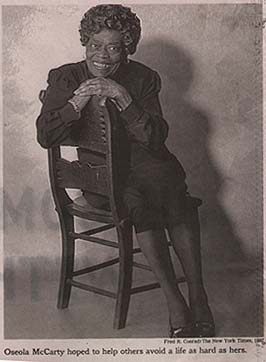
I remember when Oseola McCarty donated $150,000 of the $280,000 she saved throughout her years working as a washerwoman to the University of Southern Mississippi. Offering “another model by which to live,” McCarty cultivated a philosophy of life that eschewed constant consumption; instead, she chose living simply and in acknowledgement of the needs of others. According to McCarty,
“It’s not the ones that make big money, but the ones who know how to save who get ahead. You got to leave it alone long enough for it to increase.”‘
As living and dying with integrity in the United States gets increasingly impossible given low wages and a dull economy, Oseola McCarty inspires those of us who aren’t making “big money” imagine ways of living well. Contemplating these possibilities proves far more relevant and interesting than entering a shallow debate concerning whether or not we should “lean in.”

 I shared a heartbreaking story with a friend about someone I knew from graduate school who had been exploited, along with her daughter, through her child’s vulnerability. My friend then passed on a mantra that has now deeply impressed everyone I have shared it with: “The first thing I say to myself when I wake up in the morning is ‘I am enough,'” she said. “After that, I know that I can greet my daughter as she wakes up and let her know that whatever she has to confront, I am prepared to meet that too,” she confided. What a wonderful way to greet the day: With crucial information necessary for meeting the surprises that might be in store for us but also the daily challenges interlaced throughout those moments that challenge our feelings of sufficiency. I was flipping through several popular magazines last night and saw all of the shoes that they wanted me to buy, the parties that I was not invited to attend, the people who I should want to know but do not and I decided that “I am enough,” despite what they think is missing. Knowing that I am enough gives me the power to disagree with the glossiest of authorities.







 In Reverie Blog