Track and Transformation

Being athletic served as a powerful defense against children who were mean to me. My athletic accomplishments and successes made them reluctant to criticize me for fear that they would be labeled jealous, and certainly they were too slow to take me on so they left me alone. From as early as I could remember, I was the fastest girl in my school, and until about sixth grade, I could beat most boys in a foot race. I was always the first person chosen for any athletic contest.

My athletic competence was surprising given how painfully shy I was (I suspect that I was expected to perform as meekly as I behaved). When I visited my aunt and her children in California one summer, I spent most days inside for fear of going outside and having to engage the other children. When I did, they thought that I was the one to choose last for their games. In a round of foot racing, I destroyed the competition and I can recall my cousin’s confusion. “You didn’t think I could run, did you,” I asked her. Though she acted as though she had not heard me, she decided never to race me again. In fact, she knew how her playmates perceived me and decided to allow their version of me to persist so that she could dominate them in their games by keeping my talents to herself.

Though I could run fast and excelled in any sport I ever tried, I never liked the contests. I never identified with the outcome of athletic success. It never lived up to my expectations. One of my coaches was greatly skilled at crafting narratives of success that made you want to have a starring role in his tales. I wanted to be among those champions who had excelled through hard work and limited resources to defy expectations and establish myself in the record books. In fact, I had a vague familiarity with my future teammates because I had read about them in the newspaper each week. They were an improbable lot. A group of high achieving runners at a small, all-girls, Catholic school with no running track to speak of. They set state records, won state titles, and were academic standouts. I wanted to be like them.

Eventually, I would be. I won state titles, established state records, was widely recruited and finally settled on an athletic scholarship to the University of Kentucky. One of my former teammates and very good friends was the person who called me to tell me that I had been accepted into the University of Michigan. I had visited her for one of my recruiting visits and though I enjoyed spending time with her, she seemed miserable. Plus, Michigan did not seem to respect women athletes as much as I thought was necessary. I recall being shown the basketball and football training facilities and then being told that while other teams could request to use them, most often they were denied. Though I would be offered a scholarship, I was always concerned about the cost of attending. Somewhere in me, I knew that I was not going to complete college on an athletic scholarship. As far as I was concerned, Michigan cost too much.

Kentucky was affordable. And it needed to be because I gave up my scholarship at the end of my first year. I could no longer compel myself to care enough about performing well to work as hard as I needed to in order to be successful. Winning itself, wasn’t compelling enough–it was out of reach for me though, even if it had been.

What I realized sometime later is that I believed in the promise of meaning that winning offered. Though I could not have articulated this when I was younger, I definitely thought that winning would make the meaning of life less vague. I thought it would give it certainty and clarity. Thus, I thought winning would be a transformative experience. But when I won, nothing changed.
Because that’s what he would have done

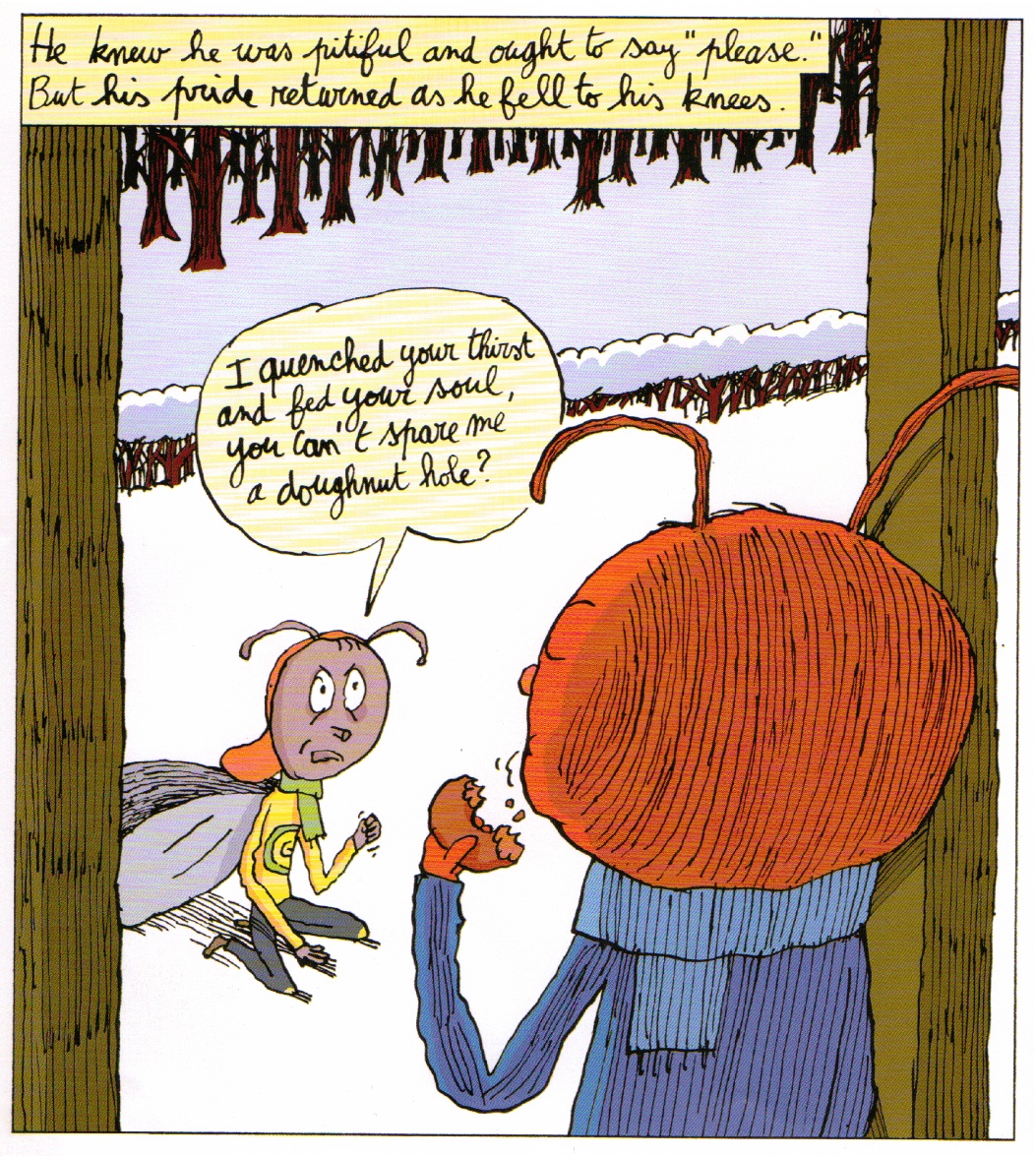
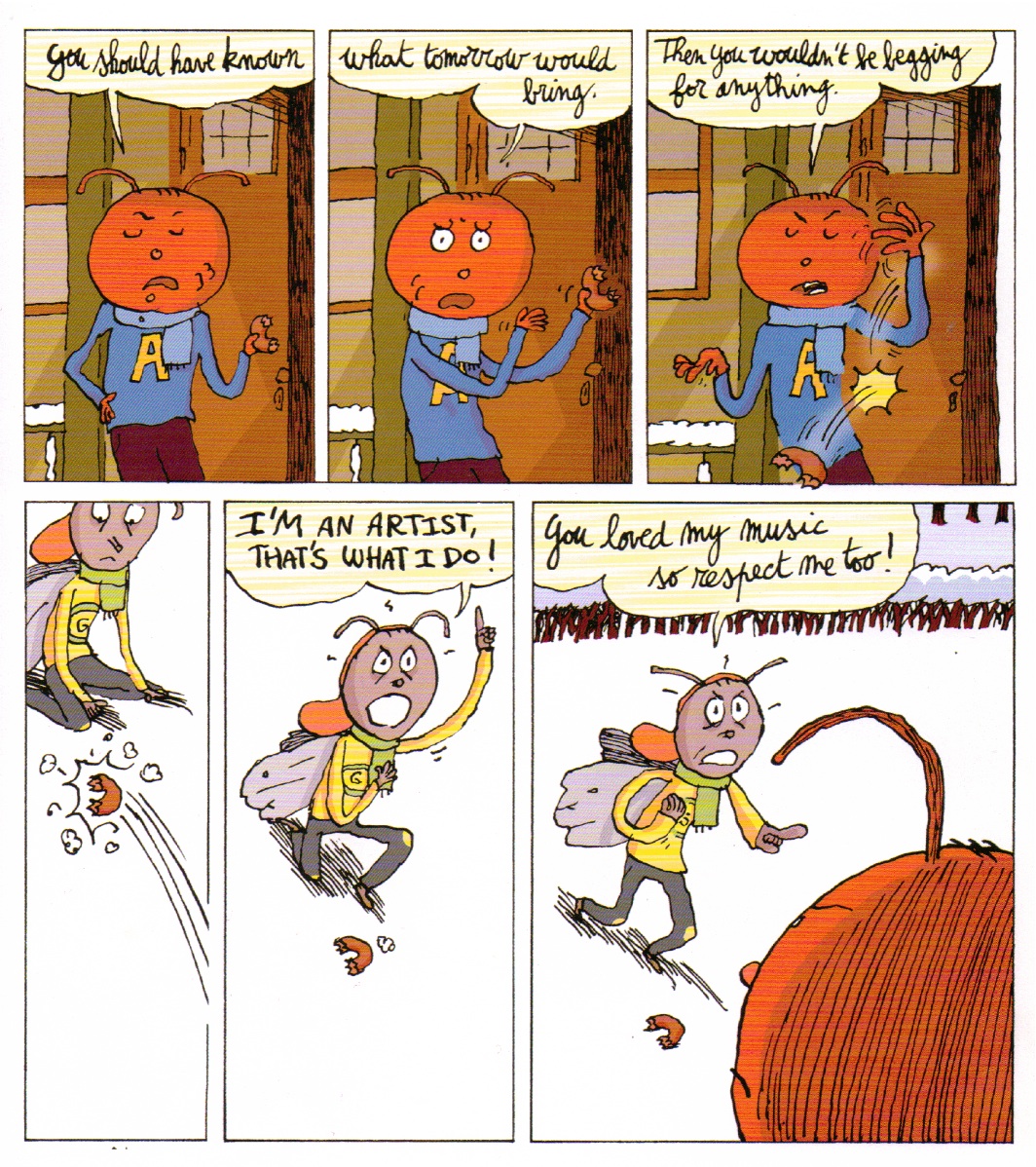
In Toni and Slade Morrison’s retelling of The Ant and the Grasshopper the reader is left with the dilemma of how you respond to the needs of those who have given you non-tangible gifts. The Grasshopper, Foxy G in their tale, is driven by his craft to create music. He doesn’t reject preparing for the winter because he is shiftless or defiant, he feels compelled to make art. The music he creates provides the background music for Ant, Kid A, who works diligently to gather provisions for his family. Once winter comes, Foxy G finds himself without provisions. Desperate, he seeks help from his friend:

“I’m cold kid, with nothing to eat. My wings are freezing and I’m dead on my feet. I’m not going to make it out here with no heat. So, say, my friend. Can I come in?” asks Foxy G. We see Kid A munching on his “doughnut” smugly regarding his friend:

“You’re cold? Hungry? No place to stay? Look at you, man. What, can I say? I planned ahead and stored up things. You wasted time on those funky wings.” Kid A was very self-righteous about his planning ahead and sacrificing for the future so that he didn’t experience the deprivations of his friend. Morrison tells us that “Foxy tried to smile but it didn’t work. The tears in his eyes made him feel like a joke.” While the focus of the division between the friends centers on art, the conflict between deprivation and surplus emerges for me as an even more general frustration.

Toni and Slade Morrison. Pictures by Pascal LeMaitre. Who’s Got Game? The Ant and the Grasshopper. Scribner, 2003.

With deep remorse, I have seen this scenario up-close. The music that Kid A could just  take, seemingly unaware of its tangible rewards, differs from what I saw. My friend Thomas, who recently passed away, gave people cars! He worked for Ford and he would co-sign for cars for “good” people who needed help but he also gave cars to people who were in need. At his funeral, people testified to how he knew that they struggled as single parents without vehicles and so he would show up at their homes with automobiles; nieces and nephews told of how he was responsible for them acquiring their first cars. Thomas, in fact, co-signed for my first car, a Ford Escort, that he also secured for me at an incredible discount. A few months before he passed, I visited him. My uncle had died and so I was in Cleveland in January to attend the funeral. I went next door to visit Thomas. His wife, Betty, was in the hospital and I had just missed his daughter who would be returning later to be with her father. As we sat and talked, I could almost feel how happy he was to have company; so I asked him about his visitors. “Do you get many visitors from your church,” I asked. I knew Thomas and Betty as deeply committed to their church and thought them much beloved so I figured he would have tons of guests. Thomas wanted to say yes, but then he said, “No, they don’t come by much. Or call.” Thomas had never been much of a talker, but he was on that gray, cold, snowy evening. He went on to catalogue the tithes that he paid, the carpet that he laid down and the air conditioning that he personally paid to have installed in the church but how in return, he had received scarcely a visitor or even a telephone call from either the leaders or the parishioners in the church. It was a painful discussion. Thomas had always been exceedingly generous.

I am among the many people who would have described him as financially comfortable. What was impressive about he and Betty’s money is that it was tempered by great humility. They lived in the same house for over thirty years; they gardened; they shopped locally; they used cash; they took their meals at home; they stayed home; they saved; they gave. They were simple, frugal people; quite remarkable. I wanted to voice that to him as he sadly recounted the ways that people became unavailable to visit with he and Betty.

When Thomas passed away this summer, his funeral became an extension of the righteous way people took from him. He and his sister died within hours of one another and so they were given a common funeral. The funeral wound up being a shameful tribute to Thomas. His daughter was led to believe that it would in fact be a service commemorating both her aunt and her father but it became an event that extolled his sister and only nodded to Thomas. In fact, I was the only one on the program scheduled to speak on his behalf. At one point, Tammie, went to the podium and told everyone how troubled she was at the tribute being paid to her father and asked that the service conclude as quickly as possible. It was heartbreaking. Betty died four days after Thomas and Tammie did a wonderful job organizing a service that paid equal tribute to both her mother and father.

Thinking about how entitled people feel to take from Thomas and not pay respect and tribute to him has deeply affected me. Sometimes I wonder if people think that giving is free for the one who dispenses; that somehow it doesn’t cost them anything or that it doesn’t come as a sacrifice, but what they give is necessarily extra. Like Thomas, I have given to people who I watched take with a sense of entitlement that I found shocking. And like Thomas, I didn’t stop giving all together, but I stopped giving to those people in the way that I once had.

It also seems to me that some people look upon giving as weakness. From this perspective, giving marks an urge to please. People seem to imagine that you are in fact giving to them because you want to be their friend. Giving is seen as pandering. It’s a troubling perspective.

I have an uncle whose generosity has also been taken for granted. In his case, people presumed that he did not care about anything so it was fine to take things from him without feeling any sense of obligation to him. As his body is beginning to fail him, he appears to be in the company of people with short memories.

Of This, You can Be Proud

Ma Mildred, the woman who was like a grandmother to me, would boast that she had the cleanest trash on the block. She boiled chicken bones so as to remove the stench that might draw stray dogs and she wrapped them up before tossing them into her pristine, white plastic garbage pail, which had once been my diaper pail. Her trash sat in the hall way directly outside the back door to her home. “I don’t think the garbage men notice your well-kept trash, Granny,” I recall my mother mocking. “You don’t know if they do or not,” Ma Mildred chuckled in response. “It does matter that they don’t have to put my trash together to pick it up, Baby. It is ready,” Ma Mildred popped back to silence my mother.

As the country prepares itself to debate the next round of Oscar winners, as we eagerly watch playoff games in anticipation of the next Super Bowl champs, memories of Ma Mildred’s trash reminds me that we can be proud of the routines in our lives. We can take pride in cleaning our mirrors everyday after work; we can be proud of washing a daily load of laundry. We can all feel a since of accomplishment when we take seriously the importance of our obligations.

Orange Sherbet

I never liked ice cream. My uncles used to ask me when I was young, “what kind of kid are you? How can you not like ice cream?” But I didn’t. I did, however, like sherbet. I still do.

The other day, I was feeding my son orange sherbet and I was overtaken by a memory of Ma Mildred, a dear woman who was like a grandmother to me, eating orange sherbet with me before bed. It was such a delicious way to end the evening. I used to take mine in an light colored orange mug. I don’t remember her choice. But we would eat and talk, then I would dress for bed and she would wash, dry, and put away the dishes.

My grandfather used to also take his dessert before bed instead of directly after dinner. I think I prefer my dessert this way as well. I am usually too full immediately following dinner so a bedtime snack is nice. Sometimes my grandparents enjoyed butter pecan ice cream or my grandfather would have a piece of the precious black walnut candy that he would stash in his dresser. Even though he had “hidden” it, he would always offer some. It wasn’t always black walnut, but it was always chocolate.

Chocolate is now the treat that I give my son for his potty training successes but orange sherbet is the bedtime treat. We don’t yet have a light orange mug for him, but he doesn’t complain.

Walls

I want to decorate my walls with photographs. Instead of pining over the decorated walls that I grew-up admiring, I decided to concretize the joy that I once knew in looking. My dining room already has a framed photograph of my son hanging and I’m thinking of adding others that I have had printed at Shutterfly.

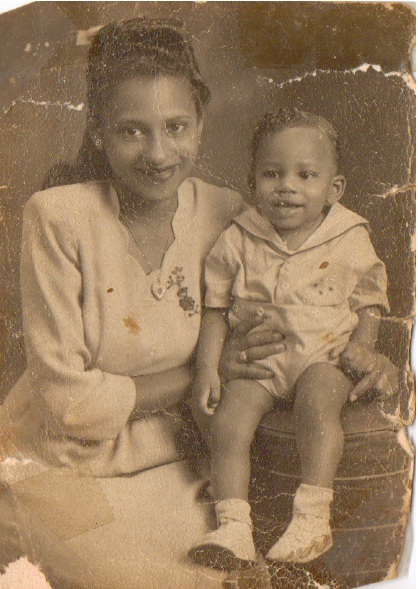
This is one that I definitely want to include of my grandmother and her oldest son, my uncle Charles. The photographs of my grandmother and my uncle are interesting for me because I now realize that when I look at them, I’m looking at Kentucky and not Cleveland. My family did not make the move to the midwest until after World War II ended and after my twin Aunts, Sharon and Sheila, were born. When I talk to my son about these pictures as he gets older, that is something that I want to stress: place.

I haven’t yet figured out why it was so striking to me to realize that many of the photographs that I thought I saw weren’t fully perceived. There were details that I merely skipped over unaware. I do realize that one of the reasons why I kept going back to look at the photographs on those walls though was that looking was no simple, glancing act. I understood that there was a reason to keep looking and reflecting. This is something that I want to pass on to my son.

Miles is just beginning to learn to read the story in pictures. I am so taken by how willing he is to go beyond the words of his picture books and just invent a rudimentary scenario from the images. What I realize about family photographs is that that is the kind of work that they require–at least initially. The photographs on the walls of our homes are not typically underscored by captions. Although I think captions have their purpose, in this case, I continue to be entranced by the call to keep looking for the missed details.

Taking Pictures

From what I remember, my grandmother was our family archivist and this was the camera she used. My uncle Eric remembered my grandfather attempting to act as the family photographer, but whose efforts at arranging the family in time-consuming poses never produced an actual photograph; while my grandmother’s photos, taken with her “cheap camera” always turned out wonderful images.

It wasn’t until recently that I realized that my grandmother was a picture taker. I usually thought of her as the beautiful woman being photographed–and indeed, I thought my grandmother was a striking, naturally beautiful woman. She didn’t wear make-up, her hair was not dyed or processed, she wore very modest clothing and still, I thought she was compelling to look at. It took time for me to see beyond the woman who was so easy on the camera’s lens to be the one composing a record of her family’s daily life. I look at those photographs in order to see how she attempted to frame her family and what she desired to preserve.

Some of what might have fueled my grandmother’s desire to take pictures may have been inherited. There are pictures of my grandmother with her father and birth mother at a very early age.

Chores: Interview

1. Is doing housework ever a matter of inspiration for you? In other words, are there ever times when you find youself in need of inspiration for completing household chores?

2. What housework do you do daily? Weekly? Occassionally? How do you determine this schedule?

3. Why is it important to organize yourself and your home in the way that you have? How do you think your approach could help others?

4. Were you always inclined towards being neat and organized?

5. Do you have a  least favorite chore?

Comment on these chores:

a. Ironing (When do you do it? What do you iron?) :

b. Laundry (How often? What products do you use? Where do you shop for them?):

c. Cooking?

d. Dish Washing? Why?

e. General Cleaning?

The No. 1 Ladies Detective Agency

Initially, I decided to read Alexander McCall Smith’s series, The No. 1 Ladies Detective Agency, because I saw an episode of the HBO series and had enjoyed it.I now read the series because I like feeling like I am a part of the lives of the characters. I find myself wanting to know what is going on with them; mostly because they represent the dignified, quiet, simple lives of real people whom I admire. Smith seems interested in plumbing the lives of careful people, people who are not reckless. Mma Ramotswe is the most interesting in this sense because she is often given the task of discovering unsettling information about people. The question is often raised through her: what does it mean to repair a life? For Mr. J.L.B. Matekoni, Mma Ramotswe’s husband, the answer seems to be simple: fix cars. For his wife, the answer never is. So when the answer may itself lead to disrepair, Mma Ramotswe finds that it is the responsibility of the messenger to be careful.

The central characters in these works have quite admirable traits. I want to live among them. There is so much discussion of honor, truth, honesty, modesty, listening, and thoughtfulness. Initially struck by this woman of traditional build, Smith moved past fantasizing about her body to imagining a thoughtful woman throughout the novels. Mma Ramotswe thinks and Smith provides wonderful descriptions of what that looks like. Her interior life is filled with thoughts of her late father Obed Ramotswe; her husband, and through him, the inner workings of mens’ interiority; her assistant, Mma Makutsi; the orphans who now live with her. What enables her to have such a rich interior life is the quiet afforded her in her home on Zebra Drive that resulted from her father’s passing away and the inheritance she gained.

I really enjoy these books!