In light of former federal judge and director of the F.B.I. Louis J. Freeh’s investigation into the Penn State scandal and the release of the findings, I decided to re-post my thoughts on the matter. I’ll be curious to read your reaction to my piece given these findings.
Fatherhood and fathering serve as strong themes in the narrative strand of the scandal surrounding former Penn State University football coach Jerry Sandusky’s trial where he stands accused of 52 counts of sexually abusing ten boys. Luke Dittrich writes a brilliant article about fatherhood and this scandal in the June/July 2012 issue of Esquire. Dittrich’s article, “In the Ruins of a Blue and White Empire,” approaches the Sandusky scandal through the lens of two of the central sons involved in this story: Jay Paterno, Joe Paterno’s son, and Victim #1, a fatherless boy.
Jay Paterno and Victim #1 couldn’t be more different. Jay paterno has had many doors opened to him because of who his father was. Victim #1 has only entered into a chamber of horrors as a result of the father he didn’t have. Interestingly though, Jay Paterno appears to cast himself and his father as victims. Their victimization comes as a result of accusations that Joe Paterno, the legendary coach, helped Sandusky commit his crimes by not doing more to stop him. From my reading of Dittrich’s article, Jay seems to think that his father’s legacy should remain untarnished and that he be considered blameless in these horrible events. He’s not alone in his beliefs. Victim #1 has been unfairly targeted for bringing shame upon Paterno’s legacy. People blame him for forcing them to see their idol as a man.
I always loved my father; most of the time I liked him; occasionally I feared him; and sometimes I was disappointed by him. I never idolized him. I was always hyperaware of my father’s limitations. I came closest to idolizing my grandfather. My relationship with my father prepared me to be a cautious admirer of any potential idol. Having a father who would call and say he was going to do something with you and never show and promise gifts that he would never give helped to keep me clear-eyed about a man’s limitations. But if I ever forgot, my mother and my grandmother always reminded me to keep guard against blind worship.
Before I knew my grandfather, he had been an alcoholic and my mother never seemed to forgive him for it. She was always a little bit cool towards him and he seemed to accept that from her. My grandmother didn’t seem quite so impressed by my grandfather either. I would watch my mother and my grandmother ignore my grandpa’s teasing; not go to him for advice like everyone else seemed to; want him to “hush up Charlie, and just be quiet.” One time, my grandfather was on the porch regaling us with stories of his horn playing days when he was a boy in Louisville, Kentucky. My grandmother must have crept to the door as he was telling his tale and called me inside when she had had enough. “I want to tell you something,” she might have said as a way to begin. “Your grandfather played the sorriest horn you ever wanted to hear,” she said without a doubt. I remember wondering why she had done that. Why not let me believe my grandfather could have been as good as Charlie Parker? For years since I’ve thought about that moment and I decided that my grandmother wanted me to know that men, even the ones we deeply love, have limitations.
Former assistant coach Mike McQueary taking the stand for the prosecution yesterday at the Sandusky trial and his role in this case has consistently framed for me the position of actual men versus idols. McQueary saw Sandusky showering with one of the boys and his reporting of the events to Paterno set off a string of events that eventually led to Paterno’s firing and now Sandusky’s trial. Instead of rushing in to save the boy from what he thought was an assault, McQueary caused some commotion to alert Sandusky to his presence before leaving the locker room. After composing himself, McQueary called his father for counsel and his father advised him to tell Coach Paterno. For me, McQueary’s actions firmly place him in the world where men reside. Men have limitations. They too can come undone by the horrible things they encounter in the world. The disappointment that many seem to find in McQueary’s failure to be a better hero for the poor child being assaulted stems from a failure to accept experience in human terms. Human beings have limits–even the one’s we try and turn into idols.
Trapped between an idol and a monster, Victim #1 has caught hell from adults and students alike in the small town Pennsylvania community that identifies him. As you consider the fact that the Paterno family received a call from the President of the United States on the day of Joe Paterno’s funeral and that a large number of people want to rename major streets after the Coach, you wonder how Victim #1 understands his own value. According to Dittrich, Victim #1 penned an essay about heroes where he wrote , “I’m glad I’m a hero. I save myself all the time.” His outlook holds promise. At least he thinks of himself as someone worth saving.
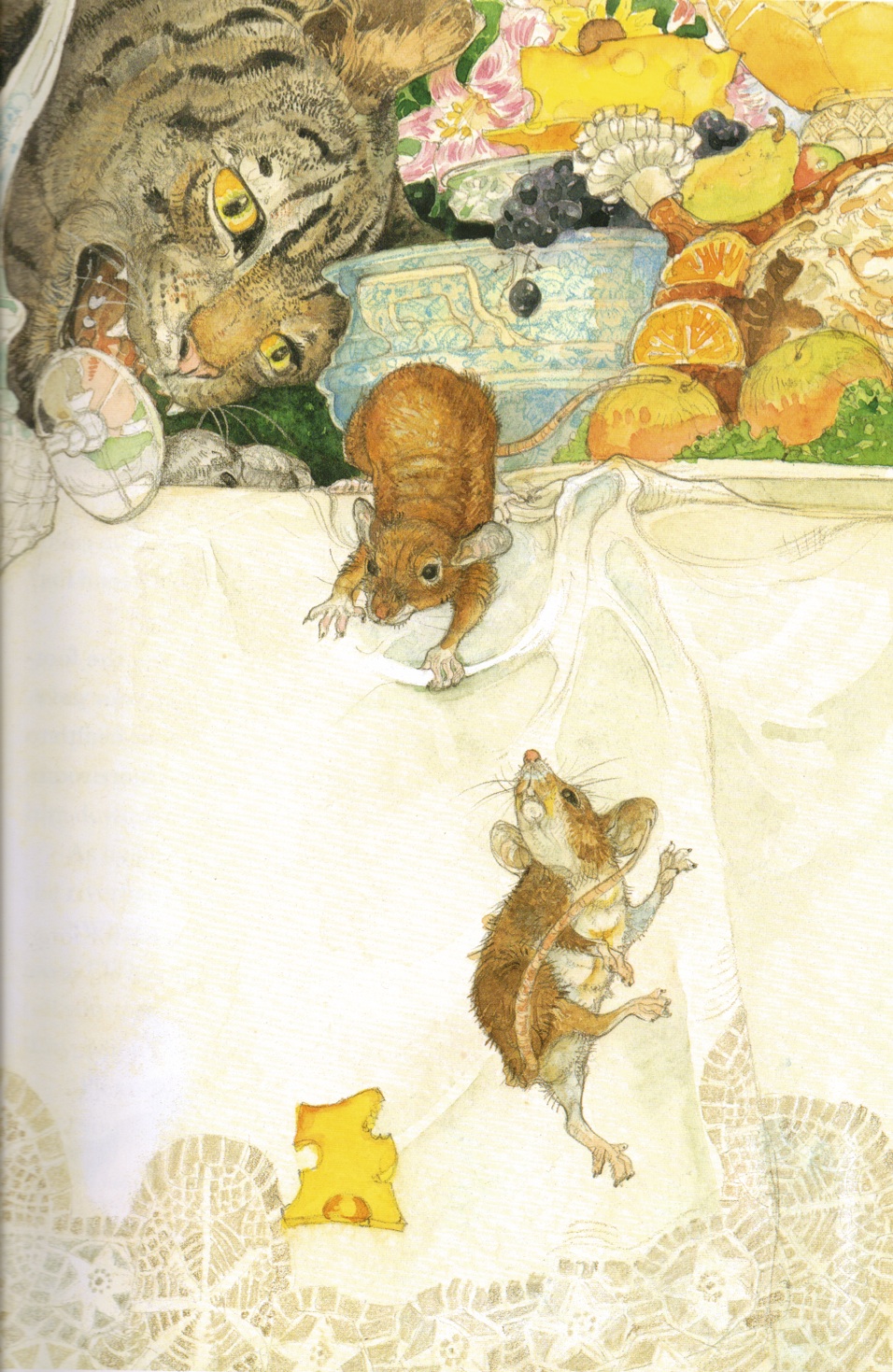
Jerry Pinkney, “The Town Mouse and the Country Mouse,” Aesop’s Fables.
For some time now I’ve been ruminating on Aesop’s fable “The Town Mouse and the Country Mouse.” On the surface, the story tells of two mice-one from a rural environment and one from an urban environment-who interact with one another inside the home territories of the other over a meal. In Jerry Pinkney’s version of the tale, the City Mouse wants to show the Country Mouse how much better the food is in the city so they journey there. As they prepare to dine, a cat interrupts them and nearly makes them dinner. The City Mouse then tells the Country Mouse of their great fortune in not having to encounter the dog who has a history of interrupting mealtime. With that, the Country Mouse decides to head back home. According to Pinkney’s version, the moral of the story is this: “Poverty in safety is better than riches in peril.” I understand how one could derive this meaning from the tale, but a more pressing element of the story emerges in my reading about what it means to be a good guest or the recipient of hospitality.
In Pinkney’s version of the fable, the Country Mouse works deliberately and with great care to gather food to share with her cousin who she has invited for dinner. Though the City Mouse tries to appreciate the meal, she simply finds it too meagre and so she invites her cousin to take leave of the country and travel home with her to the city in order to enjoy a more bountiful feast. When they arrive in the city at a grand mansion featuring a table where the remains of a banquet await, I was struck by the Town Mouse’s exclamation: “Look at all the good things here!” This was striking in light of the diligence that went into preparing the country meal as we are told that the Country Mouse “worked all day to prepare the dinner, gathering a few peas, a stalk of barley, a crust of bread, and cold water in a green leaf to drink.” Unlike the banquet remains that sat available for easy scavenging, the country meal required careful, skillful work; why should such thoughtful, deliberate, careful, and skillful work get translated into poverty? I don’t understand why performing such labor makes one poor. Instead of being honored by being the recipient of such great care, the Town Mouse rejects these gifts of hospitality for a bounty that actually resulted from another’s waste.
When I reflect on my childhood, it seems like the entire experience was designed to teach me what it meant to be the recipient of another’s care. It seems that my earliest lessons were in learning to show gratitude for the food that was made for me, the cleanliness of my environment, and the plans that were made on my behalf; these were all things that I needed to be grateful for. I was taught to believe that I owned nothing; everything that I even thought to claim was at best borrowed and could be taken away at any moment. My grandfather made it clear that while I could lay claim to having a “home,” the “house” belonged to my grandmother and to him; “my room” was actually a space where I slept but where my mother could enter at any time and determine its condition. For me then, being a guest in someone else’s home was very much like being in my own in that I was residing in a space that did not belong to me and so I needed to honor those who were providing me with it. I was taught that my physical labor as well as the verbal acknowledgement of my appreciation were forms of payment that I could use in showing gratitude to my hosts. These were valuable lessons. As a child, then, I was being introduced to the work of asking myself to discover the contributions that I could make to my environment and to my community despite my not having money, credentials, authority, or possessions.
I was talking to my neighbor about her nephew who stays with them off and on during the summer and she tells me that he treats her “like the maid,” or as she says, “like his idea of what it would be like to have a maid since his family has never had the means to hire domestic help.” So her nephew occasionally fails to make-up the bed and when he does, it looks nothing like the neat and tidy bed that she prepared for him or that approximates what the other made-up beds look like in the house. He never acknowledges the work she put into preparing a meal with any kind remarks about the food; he only sometimes thanks her for cooking. When he washes dishes, he only washes the ones that he uses. As I listened to her describe all of the things that her nephew failed to acknowledge, I saw him as the Town Mouse who expected bounty to await him and who overlooked the bounty that was gathered on his behalf.
It is still worthwhile to keep in mind the work that is done for our sake; to see this work as our bounty. This work commits us to repayment. Dismissing the Country Mouse’s work as a sign of poverty removes it from the terms of responsibility and thus from acknowledging debt. Constructing poverty in this typical way assumes that the poor can’t be owed anything as they are without anything of worth or value that they would have or could have contributed. What Aesop’s fable shows us is that while Country mouse did not have money, she did have talents and skills that allowed her to extend hospitality. The lessons of my childhood taught me a similar lesson: I was without money, status, and power but I had my labor and my talents to offer as thanks. In my reading of the fable and its larger significance, Town Mouse had a responsibility to pay tribute to Country Mouse for her deliberate, thoughtful, and skillful work, but she did not honor her responsibility. In not doing so, Town Mouse failed at being a good guest and this failing marks her impoverishment despite her ability to find food in mansions.
For my Models Monday post last week I wrote about the strategies I have been developing in response to what I consider the bullying practices of the business side of medicine. You might recall the resentment I described feeling when a clerk from the hospital where I was scheduled for an MRI called on Friday to pre-register me for an appointment the following Tuesday and told me about the $479 debt that I would have after having the test. The clerk then pushed me towards answering how I would accept “responsibility” for this anticipated bill. My understanding of the fact that this was a business practice led me to seek out another practice whose policies regarding billing were more flexible and better served me. Yesterday, I went to the appointment for the MRI at the place where I arranged to have it. Do you know how much I paid upfront?N-O-T-H-I-N-G. NOTHING. Not a single dime! I went from being told that I had a “responsibility” to pay $479 by one practice to having it all covered by the insurance company at another.
As I have continued thinking about this, I have decided that all manner of unlikely things benefitted me but they all begin with having “other models” for engaging in and with the world. In my case, not having $479 to spend on an MRI on June 26 was one of the chief motivators in deciding that I needed to go elsewhere, but I never told anyone this because I understood that information was largely what this battle was over. The clerk wanted to know how I would take “responsibility,” she never asked if I had the money. The bullying side of this works because it assumes that you are vulnerable because of the anxiety of illness and you will do anything to get the money to pay to discover the cause of your medical condition. Thus, if I didn’t have the money, I would do anything to get it and I would have told her as much. Too, people are supposed to be ashamed of not having enough money or not being able to pay their debts so it empowers someone else to tell you what to do and how to act. So I didn’t give away any information about myself and what I had; instead, I used what the clerk gave me–a number, the value she seemed to think important, $479. What that clerk told me was that the hospital wanted $479 and they thought that they could get it from me and they were willing to make me think I owed it to them in order to get it. At that point, it didn’t quite matter if the money was sitting in my account because it was all hypothetical anyway–remember, no tests had been performed so there was no actual bill. So since this was all hypothetical, I decided to imagine that I did have the money on hand. Once I did so, I decided that it was precious, that it was mine, and that I got to decide whether, how, and when it would be exchanged. Imagining that I had that money empowered me to act on my own behalf towards where it would go and how it should be paid out. What was interesting, though, was that once I did that the general response to me was one of anger and frustration.
The clerk at my doctor’s office was unhappy with my decision to alter the original plans that had been established for the MRI. She learned of the change after the new place called asking for Orders. The doctor’s office then called me to ask what had happened. The clerk was clearly angry with me. She told me that $479 was probably my deductible and so that is what I owed. It most likely was, I told her, but I decided that I should have some measure of control over how I pay it, I explained. Given that the first place was inflexible over their billing policy, I continued, I sought out a place that had a more flexible one. The clerk wasn’t too impressed by my rationale. What mattered most to her, it seemed, was that my decision meant that the doctor would have to revise my Orders. She told me this twice. I think she expected me to apologize. Though I think I have very good manners, I decided not to apologize as a matter of principle. No one felt that I deserved an apology as they negotiated my debt and constructed a vision of my moral order. Too, I felt, once again, that I was being bullied. At the same time, I did consider the possibility that what I had done might have been unfair to the clerk at my doctor’s office because it ended up increasing her workload. I thought about my responsibility to her and whether or not I owed her an apology for making her work overtime when she might already be receiving inadequate wages. Given my refusal to apologize when she was clearly trying to make me, I also wondered whether or not I was using a flawed business model in determining my own model for responding and this limiting how I might live in the world? These are very valuable concerns and by way of answering them, I have decided that while “I’m sorry” is the phrase that much of my concern turns on, “thank you” will be the one that I go with. To that end, I don’t plan on mentioning any of this when I visit my doctor on Friday but if he mentions it to me or if the clerk does, I will say, “thank you so much for revising those Orders because it paid off for me.”
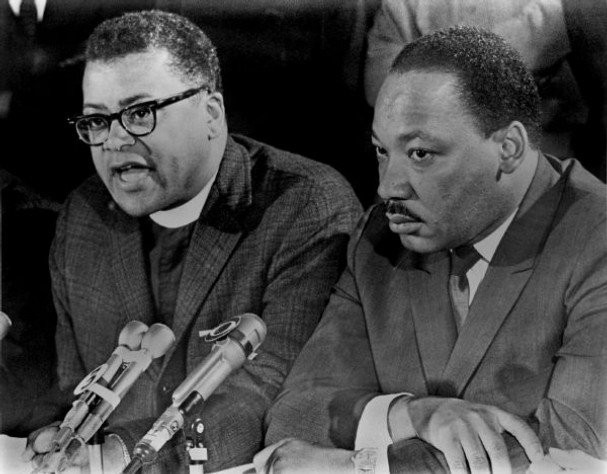
James Lawson (left) with Martin Luther King, Jr. on March 28, 1968 at a press conference supporting the sanitation workers’ strike. JACK E. CANTRELL / COURTESY OF SPECIAL COLLECTIONS, THE UNIVERSITY OF MEMPHIS LIBRARIES. See The Commercial Appeal as my original source.
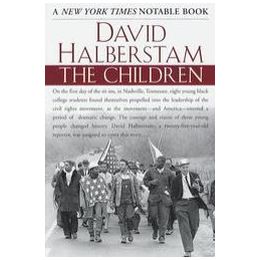
I finished reading David Halberstam’s wonderful book, The Children, late Saturday night. As I read, I recorded recurring terms used in discussing the principle subjects involved in the Nashville sit-ins when they first entered the Movement in the 1960s. My list includes the following terms: commitment, conscious, inner, worthy, serious, intellectual, serious intellectual, mutual, respect, mutual respect, noble, purpose, noble purpose. These terms appeared in discussions about a person’s motivations for joining the Movement or the reasons they found participation in the Movement fulfilling. Most of the early activists were deeply religious and the philosophy and principles of nonviolence as Jim Lawson taught them in his training workshops were rooted in religion and spiritual practices reflecting their own faith commitments. What I find striking about the terms, as they once marked the activists’ ambitions, has to do with the life of the terms once Halberstam begins writing about the activists after they helped to create revolutionary social changes.
Success and employment appear inextricably linked in terms of how adult lives appear intelligible. On one hand, this makes sense because of the time that adults spend working and thus the relationship to the kind of private life that work might allow one to create for themselves and their loved ones. On the other hand, wedding success and employment in this way limits insight into the meaningful inner or interior lives that people create for themselves despite their employment. In the environment that I grew-up in, people didn’t ask other folk where they worked or what they did to earn money. Of course, if the person brought up where they worked or how they earned money it was discussed but I NEVER knew anyone who would directly ask someone what they did for a living or where they worked. I was raised to believe that this was a rude question because it might put someone who was unemployed in an awkward position and you did not want to make a person feel uncomfortable so you didn’t ask. As I matured, I learned that work could have little to do with a person’s choice or level of ambition. As a matter of history, people could be conscripted into labor and service beyond their desire for other kinds of employment. In my community, it was also the case that a lot of people hustled for a living, thus making money any way they could above ground or below. The illegitimacy of such labor could have been embarrassing to discuss before people who took home an “honest day’s pay” from the Water Department, at Ford, at the Telephone company, or through Domestic service. Peoples’ feelings and their ability to participate in the life of our community was stressed over the terms of their labor. Though I recognize that there are multiple reasons for asking someone where they work, I am still startled when I am asked what I do for a living in social situations–especially because the question and the response don’t typically add anything meaningful to the conversation; perhaps it adds to how someone chooses to imagine your life and what it’s like but then it seems as though discovering the answer would actually be what limits the imagination. Knowing where someone works does not mean that you have insight into that person’s relationship to those substantial, though nonmaterial, terms that those young activists used to mark meaningfulness in their lives in the 1960s. Thus, in using those terms, one can be serious, conscious, and noble while employed in any number of jobs or professions. I certainly thought that my grandfather was a serious intellectual despite never having attended college. In fact, he read more, focused his intellectual energy more, and disciplined his mind more than many college students I know who don’t always understand these habits as fundamental to their work as students.
The story that Halberstam tells about Hank Thomas highlights some of the limitations that occur when considerations of money and employment inform the meaning of success. Thomas participated in the Nashville sit-ins while officially enrolled as a student at Howard University in Washington, D.C. Thomas later served in Vietnam before becoming a millionaire through his ownership of McDonald’s restaurants. Thomas’s story underscores some of the tensions surrounding his as a conventionally understood “success” story. To this point, Halberstam writes:
One of the things which bothered Hank Thomas was the way many of his old colleagues in the Movement treated entrepreneurial capitalism, putting it down, as if to be successful financially in this country was to betray the goals of the Movement. Financial success–living well with dignity and having many of the good things that so many white people had–was, as far as he was concerned, just as much a part of the Movement as ending voter discrimination. But, he believed, it was hard to make blacks see that, as if they felt that somehow their own personal success might seem to be a betrayal of other, less successful blacks. That was crazy, he thought: For too long in this country, blacks had supplied the labor but had not gotten the benefit of their labor. Now that the opportunities to benefit from their own labor were opening up, it was a mistake to hold up a kind of reverse prejudice against those who worked hard and were successful. (697)
Such sentiments were conveyed to me almost verbatim in response to a post I wrote about being “broke and still blessed” when an anonymous commenter accused me of criticizing black financial success but not black poverty. According to my critic, no criticism is leveled “against the outhouse we lived in,” though it is leveled against “the penthouse God has blessed us with.” In response to this aspect of the commenters ideas, I wrote: “I believe that God blesses us when we live in the “outhouse,” the small house, the dirty house, and the poor house. Faith in God, to me, means that you believe in God’s glory and can see it (though you might need help) in the most trying of circumstances. According to my faith, then, it can’t be that to be poor is to be in a godless position. Conditions of poverty have more to do with capitalism, race, and power than with God’s will. What do you think? Why is it the case that being able to prosper in material terms makes someone more of a symbol of being blessed than someone who has grown kinder, more circumspect, more patient? I would suggest that those people are just as valuable in symbolizing God’s glory as the ones that American culture turns into symbols of proof. My father did not die a wealthy man but because he was so much better as a man, I thought he ended his life well. I thought the arc of his entire life made his a story worth telling to crowds of people wanting to improve the quality of their experiences.”
Perhaps even qualifying “success” as “financial success” fails in avoiding critiques of having attenuated the possibilities of the meaning of success for it is certainly the case that one can imagine how one might live well and with dignity despite having a great deal of money. Race, particularly as Thomas understands it given the historical context in relationship to “the goods that so many white people had” directly informed the Movement with respect to black people “living well and with dignity.” Segregation and the codes of Jim Crow staged roles and performances of black subservience. These roles ostensibly placed black people outside of dignity and thus the possibility of living well. Poverty, oftentimes extreme poverty, was assumed to have guaranteed black exclusion from this same possibility. The goals of the Movement certainly sought to improve the economic conditions of those living in extreme poverty because it does inform the extent to which one can live well and influence their experience of dignity. At the same time, what many of these activists understood is that in the face of lack, oftentimes extreme lack, those same poor people had managed to create an alternative system of value and meaning wherein they did live well and with dignity. That is to say, for those black people living under the harsh terms of segregation, living well and with dignity was not exclusively defined as having “the goods that so many white people had.” Those terms would have made it impossible for those people to ever have experienced lives of value. Instead, one example of living well and with dignity meant having a home with at least one adult at home to provide meals for the family. Such was the case with Jim Lawson’s mother Philane who I wrote about in a previous post. Living well for the Lawson family was not based on being able to hire someone to perform domestic chores within one’s household, but on being able to do that work for the sake of one’s own family. Too, Mrs. Lawson also taught her son the meaning of dignity. She had explained to him upon learning that he slapped a child who called him “nigger,” that his actions had done him no good:
We all love you, Jimmy, and God loves you, and we all believe in you and how good and intelligent you are. We have a good life and you are going to have a good life. I know this, Jimmy. With all that love, what harm does that stupid insult do? It’s nothing, Jimmy, it’s empty. Just ignorant words from an ignorant child who is gone from your life the moment it was said. That child is gone. You will never see him again. You do not even know his name. (31)
Having something, being wealthy, if you will, meant being the recipient of love. It also meant being intelligent. Violence in that moment estranged young Lawson from dignity because he had ignored another’s obvious impoverishment in an effort to dominate that person though there was a glaringly apparent power imbalance: Jim Lawson was loved and intelligent, therefore rich; the child who called out “nigger” was loud and stupid, thus the signs of his rearing and being loved were absent, therefore, he was poor.
The Lawson case illustrates the ways that financial terms might be reworked to highlight the expanded ways that words might be redeployed to reflect alternative values. Hank Thomas’s effort to discuss “financial success” and thus distinguish it from other meanings of success becomes conflated with those same definitions. He introduces nothing new.
As much as I loved reading The Children, I wondered how different the book would have read if the aftermath of the activists’ lives would have been read through the key terms that defined their work as activists instead of through ones that define the world of work. Thus, I wondered how the final portion of the book would have read if it were told through the story of their interior lives. If a success story were written through a narration of the interior lives of The Children of the Movement, it might have considered questions like these: What did they think about when it is quiet? What did they find noble as they matured? How would they define the core of their inner lives? Did it change as they matured? What is the relationship between their faith and their inner life? What qualities did they notice themselves admiring in their friends? What about themselves did they want to change? What did they like about themselves that they wanted to enhance? What makes life worthwhile?
Responding to questions like these not only expands how we understand the terms of success, it also gives more of us a crack at it.
I have sarcoidosis, a disease that causes immune system cells to cluster to form lumps in various organs in the body, and it has been active for a little over three years. I’ve gone in and out of remission but currently I’m in an active phase. I have a wonderful rheumatologist who began treating the sarcoid rather aggressively because it no longer merely resides in my lungs but has found its way into my liver. So to give you a sense of what aggressive means, the prednisone that I take for it has been reduced from 60 to 40 milligrams over the last month.
Over the past three years, I have been under the care of a variety of doctors for various problems that have arisen as a result of this illness. As a result, I have gained some experience as a patient, but almost more importantly given today’s standard of care, I have experience as a customer of medicine and I would like to share how I am processing what I have learned–especially when it comes to paying medical bills.
One of the things that troubled me recently was a pre-registration call I received on Friday for an MRI of my brain that was scheduled for this coming Tuesday. I resented it when the woman who handled the call ended it by asking me how I would be addressing the $479 dollar “responsibility” that I would have after my insurance paid its portion of the test. It wasn’t quite in the moment that I understood that she had limited the notion of being “responsible” to an economic construction–that came later–but I knew that I did not like her question. I trusted myself to resolve what disturbed me about her construction another time so I responded quite practically at first. Thus, with the practical understanding that I was not going to pay $479 on Tuesday, I told the clerk that I would be canceling that appointment because I had an MRI administered at another facility and they did not require any money at the time of service so I would be contacting that facility. She then sent me to a scheduler who canceled the appointment. Approximately 30 minutes later, someone else from that hospital called with the same question about my debt and how I would be taking “responsibility” for it to which I responded, “by canceling my appointment and going with another facility.” “So you did cancel?” he asked. “I most certainly did,” I told him.
By the time I confirmed the canceled appointment, I had figured out that I didn’t like being forced to accept the terms that someone else had established for what it meant for me to be “responsible.” There are more ways of understanding being “responsible” than through a discussion of resolving one’s debts. While I think it is “responsible” to pay one’s debts, it is also the case that being responsible involves being reliable and making rational decisions. When the hospital clerk called my house, she wasn’t interested in talking to me as a reliable, rational person, she was only interested in talking to me as someone with debt. It felt hostile to have someone call my home and force me, as a responsible person, to answer questions about an anticipated debt. Thus, I felt as if that woman, through the authority of the hospital, was trying to bully me.
I think that hospitals rely on having an aura of mysteriousness regarding the power of healing, the seemingly high quality and expense of the technologies currently available, and the dynamics of bringing those things together to help a single individual as a force operating in the cultural imagination to bully and exploit people. Instead of making itself appear less imposing, those working the business side of medicine (and sometimes even bit players) try to use the seeming impenetrability of their bureaucracy to intimidate you into acting in accordance with their practice. For example, if you have an MRI performed, theoretically, you can’t make the appointment yourself. This is something that gets done mysteriously through phone calls between people who make more phone calls and give authorizations and pass along codes that you apparently don’t have access to. You are supposed to provide your dates and times of availability and then someone calls you with an appointment. Thus, this all confirms how passive you’re supposed to be in this process. The business side of medicine tries to turn your balance, your bill, into the most significant moral aspect of the interaction but it seems immoral to me to exploit a person’s ignorance of a bureaucratic process. Morality at the doctor’s office gets conveyed mostly in terms of the bill.
I notice this as I have a PPO, which I chose because I was willing to pay for the choice to select my own doctors. I pay 10% of the cost until I have met my deductible. Most times, I’m billed after the service. But more and more, I’m being asked to pay what the medical practice doesn’t find insurance companies typically paying. So you get provided with notices and forms from the medical practice about your “obligations” and “responsibilities” regarding your bill before the first appointment is scheduled. I read these forms as impending bills being cast in moral terms. When I was new to the game, I was moved by it. I agreed that I owed it to the doctor to take care of my “responsibility” given that they had provided me with their expertise. I have since moved away from this position and one of the reasons for this involves my awareness of how my bureaucratic ignorance gets exploited–especially as someone who is a professional outsider, but also as an unique customer, an unwell person needing relief. No one tries to clear up any mis-understanding that I might have about the policies of one medical office being a standard practice for them all. Thus, the first time that I had a endoscopy performed, the hospital where my doctor worked required that I pay a portion of the bill up-front. The second time I had this procedure done with a different doctor, that hospital billed me. Had I known that there was a different way of handling the business of paying for the procedure, that might have influenced my decision to take on the first pulmonologist as my doctor.
As a unique, patient customer, rarely does it seem that my position as an unwell person figure into anyone’s construction of morality. Thus, payment functions as the prism through which to engage the subject of morality but not my vulnerability as a sick person in need of care. That is to say, the relationship between illness, vulnerability, sound judgement, and payment seemingly are not a part of the negotiation of how the business of medical care should be morally approached with ill people. Thus, the $356 that my GI doctor asked for up-front was not a necessary condition for the bronchoscopy she performed; that was about business, not medicine. Interestingly enough, as a business decision, it worked for her but I overpaid by $26, which I learned when at the follow-up exam, there appeared to be a credit at the bottom of a form that the administrative assistant gave me to sign. When I inquired about it, she told me that she would research it and have someone contact me. About two months later, I received a check for $26. No one gave me that kind of grace period for paying the $356. So what I have learned to do is to create my own system for dealing with medical bills.
First, I always want to know about any up-front costs that I am expected to pay. If I don’t like the terms or the figures, I will call my insurance company and ask them to help me save money. So in the case of the MRI of my brain, CIGNA put me in touch with Medical Solutions who gave me the authorization code and the telephone number for the facility where I had gone before. When I contacted that facility, I told them that I was not willing to pay them $479 for the exam up-front. I explained that I would prefer to be billed if there was a fee but barring that I would accept a payment plan that could begin when I arrived for the test. Those terms were accepted and so I have an appointment scheduled for July 2.
In instances when I am billed, I never pay the bill according to when the bill states, which typically lists “upon receipt.” I don’t typically pay it “upon receipt” because it usually doesn’t arrive at the precise moment when I have worked out my monthly budget. Just like a hospital has billing, so does my household. Recently, I received a phone call from a doctor’s office about a bill that I had not paid. I explained to that woman that the bill had arrived very late in light of when I had been seen, but nonetheless, I would pay it after I made my new budget. Thus, I told her that she could expect to receive a check for half of the billed amount at the end of June and the other half at the end of July. She thanked me and that ended the call.
Honestly, I usually don’t begin making arrangements to make any of these payments until someone calls me because I’ve learned that insurance companies don’t always pay as quickly as you may be billed. Once you have paid a bill, however, you will wait months to get reimbursed and when you call about it, they will tell you, just as sweetly, about how their billing office only processes checks on various days and who has to approve the transaction, and whose office you might call to get a sense for when to expect the approval. Thus, I feel very little urgency about paying a bill merely because it arrived. I recently received a $40 bill from an opthamologist that fell according to my budget. About a week later, they returned the check because my insurance company had covered the cost even though the practice had not expected them to cover it.
One final thing that I’ll say about this involves prescription drugs, and one of my dearest friends pointed this out to me: ask your doctor for samples. When doctors tell you to “try” something, that could be an expensive gamble for you. I had a pulmonologist once who wanted me to “try” a sinus medication that cost me $63 because there was no generic form of it. The medicine didn’t work. Oftentimes, what they want you to “try” is experimental. So fine, let them experiment within reason but they need to do that with the samples that the pharmaceutical representative left. I go through this all the time with inhalers. Some of those don’t have generics and they can be very expensive. What I’ve learned to do is to say to the doctor that I will need samples until I at least learn how much this is going to cost me. I now use an inhaler that works. My pulmonologist knows that I’m all about the samples so he gave me an entire bag full and told me that “we have tons of these things in the closet” while writing out a new prescription for me.
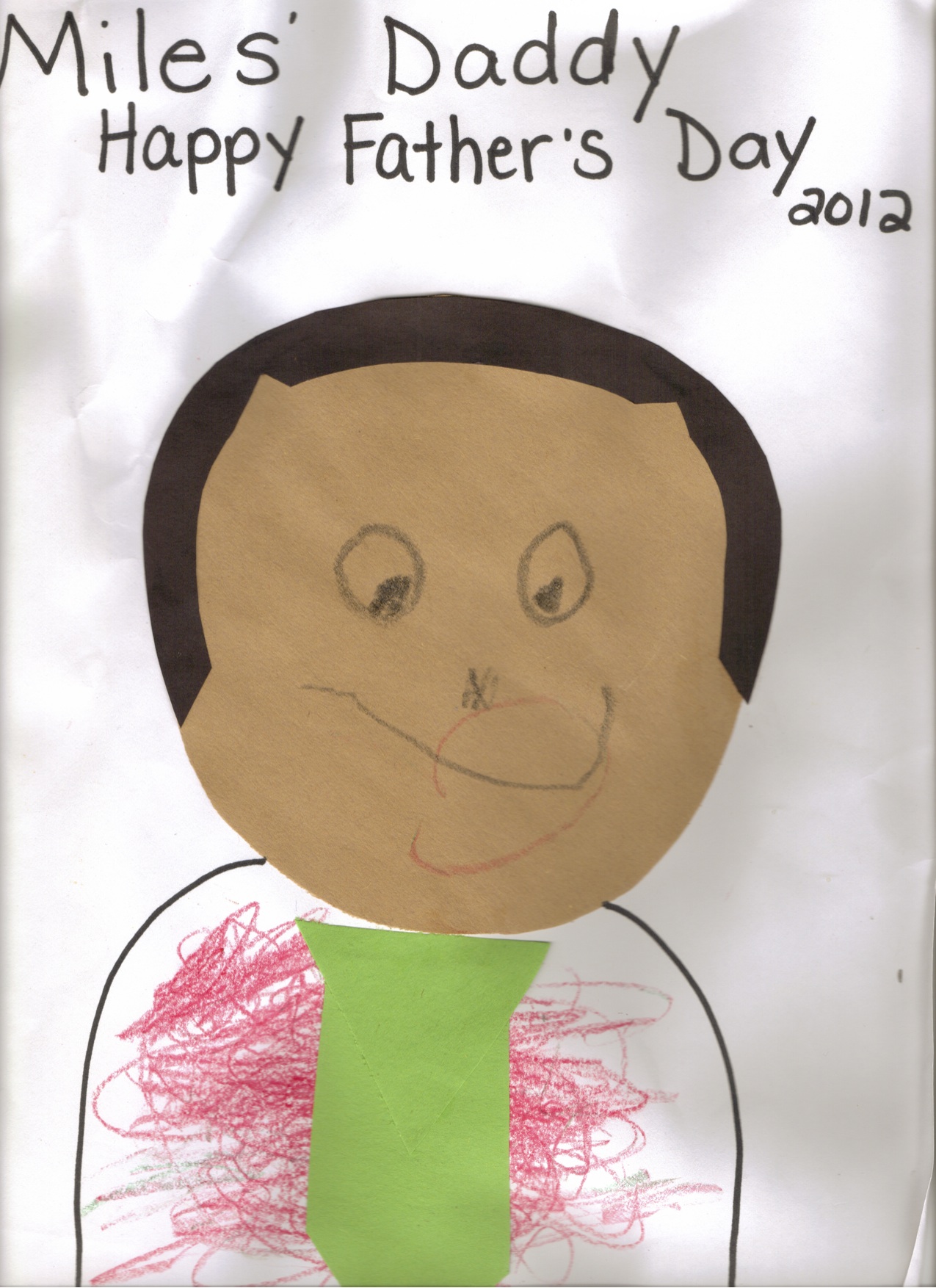
What was most striking to me about the portrait that my son made in Play School as a Father’s Day gift for my husband was the green tie. Miles’s teacher had asked us to bring in a small picture of my husband that would be used for making a separate gift, and in that picture, he wore a tie. Did they make ties for all the fathers as it is a traditional Father’s Day accessory or were they intentionally trying to make the portrait representative? Whatever their intentions, we thought they did a fabulous job! Even the hairline was accurate. A few things, though, came to mind regarding that bright green tie as a marker of formality and its relationship to notions of appropriate dress. First, when I was a child, my grandfather used to rail against young people’s desire for “sneakers” instead of church shoes as desirable purchases. “When I was a boy,” he would say, “I never woulda asked my Mama for no sneakers.” To laughs, he would continue on, “man, are you crazy. Naw, no way. No sneakers, Jack!” I didn’t quite get the joke then because tennis shoes were practical as far as I was concerned. I was an athlete so I needed “sneakers.” As I continued to think about it years on, I realized that it was precisely because they were practical that my grandfather wouldn’t have wanted them–he would have been put to work in practical shoes. He had decided that as a young black boy coming-of-age in the Jim Crow South that he had more than enough work to do requiring shoes thought practical for him. I always believed that my grandfather wanted a life of the mind and as much as he could give that to himself, he did. Thus, “sneakers” did not suit the intellectual life he desired. Sneakers were more suited to a life of physical labor and he would not have chosen that for himself.
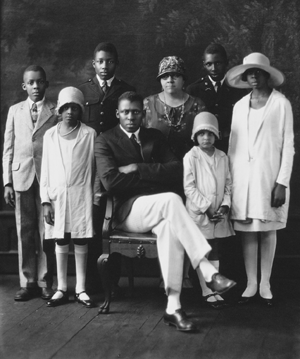
Thinking about my grandfather in this way led me to another portrait. This one by famed Tuskegee photographer, Prentice Herman Polk:
Mr. and Mrs. T.M. Campbell and Children, ca. 1932. You can find a full listing of the subjects in the photograph by following this link to the Paul R. Jones Collection, Atlanta, Ga.
Thomas Monroe Campbell stands out in this family portrait. It’s only later that I really pay attention to the rest of the family. He dominates the portrait with his defiant, almost confrontational, gaze. Then you notice that everyone except Anna Marie Ayers Campbell, looks at the camera, which is something that I have noticed in many formal portraits of middle and upper-class women. What was it like for Mrs. Campbell tucked inside her half of this frame? Even as this Easter portrait is beautifully balanced and composed–one adult to each group of three children; two dark uniform suits across the back with boys of equal height; three across the middle of about the same height; the hats, the ties, the white dresses, jackets, pants, and socks–you can’t help but notice that this portrait has a center, a black male center and he offers no apologies for where he sits. T.M. Campbell embraces his distinction.
T.M. Campbell did live a life of public distinction. He was the first African American extension agent for the United States Department of Agriculture (USDA) to work with rural black farmers in advanced farming and land-management methods. The Jesup Agricultural Wagon that carried seeds, fertilizers, and the tools of modern farming practices was first begun by George Washington Carver, Campbell’s teacher and mentor. With Carver’s support and Tuskegee Institute President Booker T. Washington’s endorsement, Campbell took over the school’s Moveable School of Agriculture. Campbell achieved great success in his work and created opportunities for other black extension agents. Though presented with many opportunities to enter other fields, he declined opportunities to work outside of his extension work serving poor, rural, black folk.
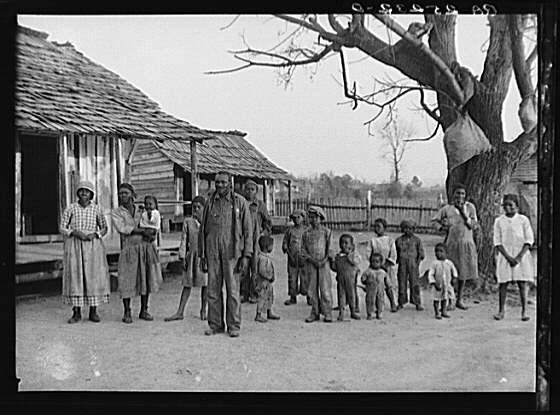
Polk’s photograph of the Campbell family, particularly Mr. Campbell’s depiction, challenges our image of black southern men, especially during the 1930s. This Arthur Rothstein image suits that construction:
Arthur Rothstein photograph from Gees Bend, Alabama 1937.
This documentary photograph of a sharecropping family also features a black man set apart from the others but his distinction is due to his location on the line and not the suggestion of his command or authority. The desperation that one might imagine in the Rothstein photograph is nowhere present in the Polk photograph of the Campbell family. Interestingly, Mr. Campbell’s posture and his engagement with the camera resembles one of Polk’s more famous photographs:
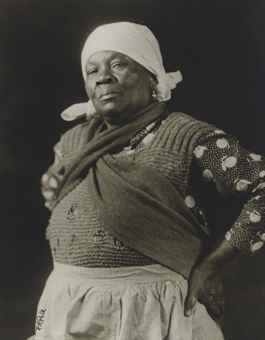
P.H. Polk, “The Boss,” 1932.
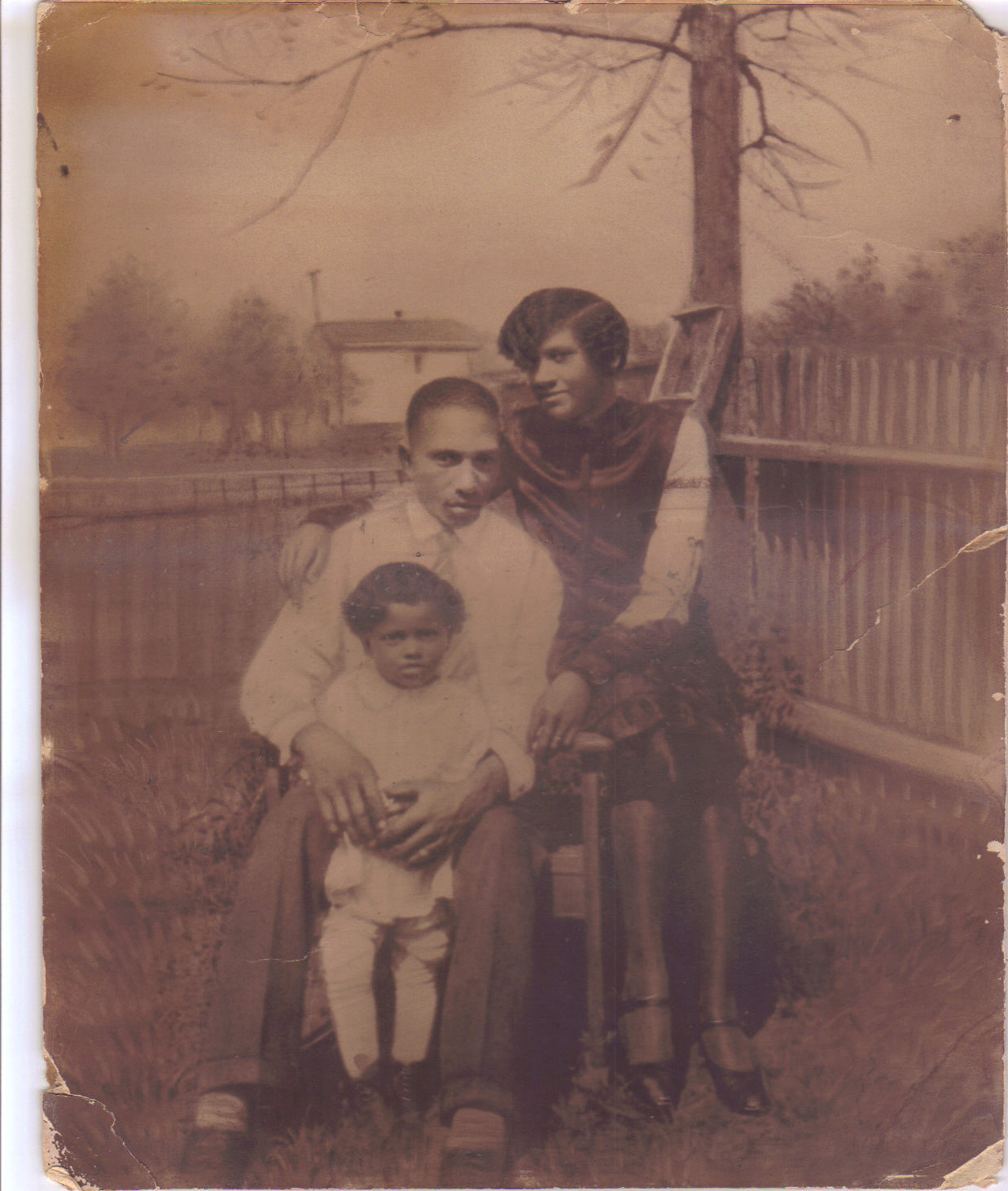
The subject of Mr. Polk’s photograph, “The Boss,” had been visiting a farmers’ conference on Tuskegee’s campus when he saw her. Seeing power and command in her, Mr. Polk thought this “woman can boss anybody…” so he asked her to put her hands on her hips but the look is all hers. Mr. Campbell appears to be a “boss” as well. He and the subject of “the boss” confront the camera in unexpected ways–especially as they speak through conventions of dress and portraiture. Despite the habiliments of domestic labor and their suggestion of subservience, “The Boss” participates in being photographed but on terms she seems to have decided for herself; the same can be said for Mr. Campbell. He has agreed to dress formally for the occasion of the family’s yearly Easter portrait but he will comport himself as he pleases. I think that this photograph of my great-grandparents and my grandmother performs similarly:
Like Mr. Campbell, my great-grandfather, Charles Lewis, sits and is dressed formally, but what strikes me about him is that he’s actually the parent touching the child. The touching in this family portrait appears thematic. No one here gets estranged from intimacy.
Even as black men in the 1920s and 1930s dressed for formal portraits, they still broke through convention with original voices, thus uniquely asserting themselves into tradition and altering expected utterances. I wonder what place formality holds for us now in our contemporary self-portraits? What role does fatherhood play in our efforts to define formality? Does fatherhood have a central role in crafting contemporary family portraits?
Generationally speaking, the photos that I have of young families in my own home don’t feature young men wearing ties. Even when there is clear color coordination in contemporary photographs between the men, women, and children in my growing little collection, young men do not wear ties. I noticed this recently at funerals too. While it wasn’t something that offended me, I noticed that young men and their children were not dressed in what I would have considered formal attire at my father’s funeral or my uncle’s. I think I noticed because my father was a suit-wearing man. He took pride in having clothes to meet the expectations for whatever occasion was being marked. Too, my uncle and I had had a conversation not long before he passed about a young man who my uncle felt was far too casually dressed for court. “Can you believe he actually wore that to court today?” he asked me rhetorically as the young man was approaching from a distance. “I can’t even imagine what the judge thought when he saw that fool,” he said laughing. I remember thinking at the time that he and that young man certainly had very different definitions of what it meant to be cool. For my uncle, it certainly meant having a wardrobe that marked life’s key moments.
The relationship between black men, formality, and death, especially funerals, occurs in Spike Lee’s film 4 Little Girls. This eloquent memorial film pays tribute to the four little girls killed in the bombing of the 16th Street Baptist Church on September 15, 1963. In one scene, Freeman A. Hrabowski, III recalls his experience of preparing to attend the mass funeral for three of the girls. His school’s principal, George Bell, pulled him aside and while taking his tie off, said to young Freeman, “son, you wear dark ties to funerals.” While placing the tie around Freeman’s neck, he explained to the young man that he was representing the school through his attendance. Dress conveyed meaning beyond personal expression. Dress had the power to convey seriousness of purpose and could carry a group message of love, support, sympathy, and solidarity. Too, dress suggested that a child had been taught. That someone had prepared a young person to participate in public rites and ceremonies. Thus, a child’s attire carried an adult’s imprint.
There was a time when my observations about formality wouldn’t have been about class and education but now they appear to be. The example of my father and my uncle marks such an earlier period. Things appear to be changing. Young men who attend college, even for a time, will take photographs wearing ties, but otherwise, this does not appear to be the case. I was recently in a conversation with a woman and her colleagues who were in the Math Department at Morehouse College. The woman’s colleagues were teasing her for wearing a Spelman College shirt after being presented with it as a gift from the College following a speaking engagement. “Well, of course I wear it!” she said. “They actually had me in mind when they presented it. Morehouse only ever gives out ties. What am I supposed to do with a tie?” They laughed. Historically Black Colleges and Universities continue to create occasions for formal dress. For that matter, single-sex private high schools do the same. I recently received a newsletter from my high school that featured some of the girls in the formal uniform, which requires a blazer. In these contexts, spirited debate certainly follows the mandate for compulsory self-expression. What troubles me is that there are some people clearly being left out of the debate; it’s as if they don’t know that one is taking place. In the case of my father’s funeral, being sharp for going to a club shared the same aesthetic as attending a mourning ceremony. I wonder what this does for your sense of life’s fullness. It’s hard to imagine that life would seem more than mere monotony with every event being some slightly altered version of itself.
I had never considered the role that fatherhood played in how formality might get defined until I looked at my son’s portrait of his father and saw that green tie. I will be interested in seeing how this theme continues to play itself out as we’re raising him in this new media age. I wonder if his father’s ties will impact the Facebook photos he will one day post or even what new arguments he will bring to the table, presumably, against formality.
My father was the one who first told me that David Halberstam was killed in a car accident. I don’t remember what we were talking about or which of Halberstam’s books I was reading at the time but when I referenced him, I clearly remember my father asking, “oh, the guy who died the other day?” “Really,” I asked. “Yeah,” he said, “I’m pretty sure he was killed in a car crash.” I searched for the story immediately after getting off the phone with my father and he had been correct. I remember being incredibly saddened by that news as well as struck by how diligently my father read. It was a habit he was very proud of.
As I’ve been reading Halberstam’s The Children I’ve been thinking a lot of my father, not so much because of the subject matter, but because he seems to fit with my impressions of Halberstam now. I think of them together, and this is a beautiful work to regard them over. If you are someone who takes an interest in considering portraits of peoples’ inner-lives and imagining the content of quiet, internal narratives that convey or lead to original ways of living in the world, then this book offers much to enjoy.
I’m far from finished but one of my favorite stories to consider thus far has been about James Lawson’s mother, Philane. Mrs. Lawson was born in Jamaica as Philane Cover. She married James Lawson, Sr. and together they created a large family of nine children. Though James Sr. was the minister, it was Philane who impressed her oldest son Jim with a deep and lasting impression of nonviolence. Halberstam writes beautifully and movingly of the impression Philane made on young Lawson:
Her love, her optimism about human nature, and her belief that there had to be a better way than responding to hatred with hatred of your own–a hatred which she feared might end up devouring the hater–formed his home every bit as much, he later decided, as did his father’s strength and hard work. She was a strong, careful, loving woman who knew how to maximize the limited amount of money a black minster in the North made in the thirties and forties. They got their home from the church, and there was a church salary, probably no more than $1,000 a year. The black women of that generation, he believed, were brilliant at many things, none less than making-do, raising families virtually outside the cash economy. On a tiny salary Jim Lawson’s parents raised their nine children, sent five to college in an austere American economy, and did it so well that no one ever felt poor. Philane was a skilled cook, a magical repackager of food, so that nothing was ever wasted. She was a talented seamstress. By ritual every December each Lawson child was allowed one new suit of clothes for Christmas […]
They grew a lot of their own food, and they always seemed to eat well. They had a big backyard and that allowed them not only to grow vegetables, but to keep chickens as well. It was a family where everyone shared in the chores and everyone accepted responsibility for getting the work done […]
Jim’s mother, in addition to her other household chores, worked regularly in her home doing alterations for a local dress shop, and there were frequent offers for her to come and work full-time in the downtown store. It was only when the youngest children were in high school that she took such a job. Even in the late fifties, with her family largely grown and her holding the full-time job, she still ran a wonderful home. The first time Dorothy Wood came to Massillon to meet her husband’s family, the thing she remembered both then and every other time she visited was that on Saturday, at 4:00 a.m., the wonderful smell of baking bread would fill the house because Philane Lawson had gotten up early and started cooking so that her family would have the best of homemade foods all weekend, full-time downtown job or no. She was, her daughter-in-law decided, a woman full of human richness and a woman who took her own codes seriously […]
As Jim Lawson came to manhood he had a sense of how hard his mother’s life had been. It had been difficult for her as a girl–a life with little opportunity–but she had set out to create against all odds a better life; she had come to this country on her own and married and raised a large and loving family. Most important, she had managed to pass on not merely strength but compassion and a capacity to love to all of her children. She had strengthened them without hardening them. That, her son thought, was truly miraculous.
Halberstam’s understanding of Dorothy Wood’s impressions of her mother-in-law as someone “full of human richness” strikes at the very core of the meaningful portrait he paints of Philane Lawson. Wealth here gets defined through the human ability to generate and extend a capacity for regarding another with careful acknowledgement and concern. The ability to generate such wealth is astonishing in light of the fact that the world of Jim Crow segregation with its thorough contempt of blackness, which permeated all of America, North and South, would have defined riches against a black person’s ability to have it. The America of Philane Lawson’s time forced black people into the most menial jobs and thus the lowest economic positions and housing options that it could fashion. It was a nation that left black people to enter the most ill-equipped schools and to be cared for in the most neglected corners and basements of medical facilities. It was a country that used its creativity, its energy, its laws and its customs to showcase its disdain for black people, and this is no exaggeration.
Even as the country began making strides towards integration, it was clear that it knew very little of what it meant to be hospitable towards black people. Halberstam offers an example of the limits of hospitality as the nation considered integration after the Brown v. Board of Education decision of 1954 as it appeared at Vanderbilt University. He writes:
When Vanderbilt had made its first tentative steps toward integration in its law, divinity, and graduate schools, there had been built-in restrictions. The black students were not to dine in the student cafeteria, they were not to play intramural athletics, they were not to buy tickets that allowed them to sit in the Vanderbilt gym for athletic games, and they were most assuredly not to live in an otherwise white dorm. If at all possible, they were not to use the toilets, which had been white-only until then. Nor were they, if the administration had any choice in the matter, to feel particularly welcome. In 1959 one of the school’s deans had received a letter of application from a would-be black Ph.D. candidate. The dean wrote back to warn the young man of the “annoying, embarrassing, or very distasteful” experiences he would probably face as a Vanderbilt graduate student. He would not be able to live on campus, so he would have to find housing in a black residential area. He would, the dean warned, be refused service in restaurants and motels, and he would run into other forms of rejection at the hands of white Nashvillians. Otherwise, it was presumed, he would be quite welcome to come.
This is so absurd it’s hard to even know where to begin. In effect, black students could come to Vanderbilt but they would be made to feel like they did not belong there. Too, black students should accept this treatment as a part of their admission and they were to adjust their emotional lives so as to feel suitably pained by their treatment. It was not enough to be treated poorly, black students needed to actually feel unwelcome, which of course, wouldn’t have been much of a stretch since they actually were unwelcome.
If the disdain for blackness represented in the Vanderbilt dean’s letter was supposed to extend to black spaces, Philane Lawson’s work for her family suggests definite limits to how far Jim Crow was allowed to permeate black life. Philane Lawson’s actions towards her family suggests that she had not used the broader culture as a model for determining the quality of the experiences her family should enjoy. That Mrs. Lawson could value herself and the people that the nation had decided were unworthy of anything it regarded as valuable was an achievement. Mrs. Lawson defined her humanity as wealth. She disagreed with the nation’s contempt for blackness and so she baked bread for her family at 4 a.m. on Saturday; she re-imagined how her family’s food would be served; she planned and saved for how her family would be clothed. Her example offers a model of wealth in human terms.
Fatherhood and fathering serve as strong themes in the narrative strand of the scandal surrounding former Penn State University football coach Jerry Sandusky’s trial where he stands accused of 52 counts of sexually abusing ten boys. Luke Dittrich writes a brilliant article about fatherhood and this scandal in the June/July 2012 issue of Esquire. Dittrich’s article, “In the Ruins of a Blue and White Empire,” approaches the Sandusky scandal through the lens of two of the central sons involved in this story: Jay Paterno, Joe Paterno’s son, and Victim #1, a fatherless boy.
Jay Paterno and Victim #1 couldn’t be more different. Jay paterno has had many doors opened to him because of who his father was. Victim #1 has only entered into a chamber of horrors as a result of the father he didn’t have. Interestingly though, Jay Paterno appears to cast himself and his father as victims. Their victimization comes as a result of accusations that Joe Paterno, the legendary coach, helped Sandusky commit his crimes by not doing more to stop him. From my reading of Dittrich’s article, Jay seems to think that his father’s legacy should remain untarnished and that he be considered blameless in these horrible events. He’s not alone in his beliefs. Victim #1 has been unfairly targeted for bringing shame upon Paterno’s legacy. People blame him for forcing them to see their idol as a man.
I always loved my father; most of the time I liked him; occasionally I feared him; and sometimes I was disappointed by him. I never idolized him. I was always hyperaware of my father’s limitations. I came closest to idolizing my grandfather. My relationship with my father prepared me to be a cautious admirer of any potential idol. Having a father who would call and say he was going to do something with you and never show and promise gifts that he would never give helped to keep me clear-eyed about a man’s limitations. But if I ever forgot, my mother and my grandmother always reminded me to keep guard against blind worship.
Before I knew my grandfather, he had been an alcoholic and my mother never seemed to forgive him for it. She was always a little bit cool towards him and he seemed to accept that from her. My grandmother didn’t seem quite so impressed by my grandfather either. I would watch my mother and my grandmother ignore my grandpa’s teasing; not go to him for advice like everyone else seemed to; want him to “hush up Charlie, and just be quiet.” One time, my grandfather was on the porch regaling us with stories of his horn playing days when he was a boy in Louisville, Kentucky. My grandmother must have crept to the door as he was telling his tale and called me inside when she had had enough. “I want to tell you something,” she might have said as a way to begin. “Your grandfather played the sorriest horn you ever wanted to hear,” she said without a doubt. I remember wondering why she had done that. Why not let me believe my grandfather could have been as good as Charlie Parker? For years since I’ve thought about that moment and I decided that my grandmother wanted me to know that men, even the ones we deeply love, have limitations.
Former assistant coach Mike McQueary taking the stand for the prosecution yesterday at the Sandusky trial and his role in this case has consistently framed for me the position of actual men versus idols. McQueary saw Sandusky showering with one of the boys and his reporting of the events to Paterno set off a string of events that eventually led to Paterno’s firing and now Sandusky’s trial. Instead of rushing in to save the boy from what he thought was an assault, McQueary caused some commotion to alert Sandusky to his presence before leaving the locker room. After composing himself, McQueary called his father for counsel and his father advised him to tell Coach Paterno. For me, McQueary’s actions firmly place him in the world where men reside. Men have limitations. They too can come undone by the horrible things they encounter in the world. The disappointment that many seem to find in McQueary’s failure to be a better hero for the poor child being assaulted stems from a failure to accept experience in human terms. Human beings have limits–even the one’s we try and turn into idols.
Trapped between an idol and a monster, Victim #1 has caught hell from adults and students alike in the small town Pennsylvania community that identifies him. As you consider the fact that the Paterno family received a call from the President of the United States on the day of Joe Paterno’s funeral and that a large number of people want to rename major streets after the Coach, you wonder how Victim #1 understands his own value. According to Dittrich, Victim #1 penned an essay about heroes where he wrote , “I’m glad I’m a hero. I save myself all the time.” His outlook holds promise. At least he thinks of himself as someone worth saving.
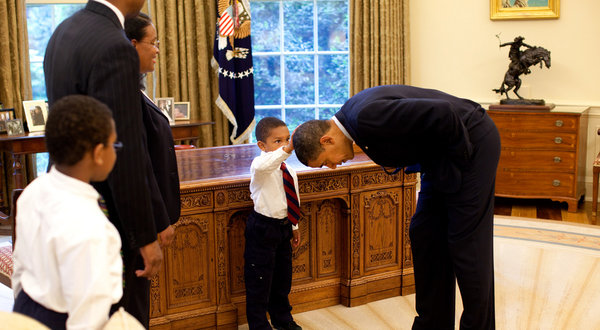
Jacob Philadelphia, the little boy who touches a bowing President Obama’s hair, is such an interesting child. He and his family were interviewed on Lawrence O’Donnell’s The Last Word and he pretty much stuck to his story about Obama’s hair: it felt the same as his own. The new detail regarding his fascination with President Obama’s hair is that when his mother takes him to the barber, he consistently asks for a haircut like the President’s.
Interestingly, “The Obama” cut is actually a style listed on Hyde Park Hair Salon’s price list given its popularity. Zariff, the President’s barber and thus, First Barber, describes the style to Essence magazine in this way:
The Obama cut is a custom cut. It came about in 2004 when Mr. Obama came into the shop and said he was speaking at the Democratic National Convention that evening. So I had to make him look sharp. Before that he was wearing his hair longer and a little curlier. I took it down to a short cut, tapered on the sides, back and neck. I wanted it to look more natural.
Mr. Obama’s haircut received slightly negative attention in May when reports began circulating that Zariff was trekking from Chicago to Washington, D.C. every two weeks to give him his now famous cut. The ostensible scandal involved whether or not taxpayers were paying Zariff’s expenses; the carbon footprint being created by these trips; and the general notion of extravagance surrounding a seemingly mundane event. Neither Zariff nor the White House addressed the specifics of their arrangement; though Zariff confirmed that Mr. Obama pays $21 for his haircut just “like everyone else.”
“Barber-gate” aside, I think it’s interesting that “The Obama” is a popular request at Hyde Park Hair Salon. I think it’s interesting because it reflects an aesthetic investment and set of conventions usually unseen in popular culture about black men. The clean, neat cut that characterizes “The Obama” was familiar to me as an aesthetic pursued by men who found eloquence in a conventional life. I was reminded of the possibility of black men desiring conventional lives when I considered Obama’s hair and the popularity of the style in conjunction with one of the books that impacted him as a kid, Toni Morrison’s Song of Solomon.
Obama’s investment in Song of Solomon makes sense in light of how he identifies his quest for self-identity in Dreams from My Father. When he was fifteen, the President writes that he was engaged in a “fitful interior struggle,” as he was “trying to raise [himself] to be a black man in America, and beyond the given of my appearance, no one around me seemed to know exactly what that meant.” Reading the classics of African American literature provided young Obama with material from which to draw on in his efforts at racial self-fashioning. It is clear why Song of Solomon, with its interest in black male questing for identity, would have appealed to him. One scene from the novel resonates powerfully with Obama’s quest, especially as it occurs in a space long associated with black men’s tales of coming-of-age, the barbershop.
Railroad Tommy and Hospital Tommy, the proprietors of a barbershop, provide Guitar and Milkman with the frank talk about black male experience that young Obama, who was about the same age as Guitar and Milkman when he experienced his “fitful interior struggle,” might have yearned to hear. In one powerful scene, the barbers learn that Guitar is frustrated because Feather would not allow he and Milkman to stay in his bar and have a beer. The “lecture” that follows from Railroad Tommy details a host of disappointments the young Guitar can expect as a black man in America:
“You think that’s something? Not having a beer? Well, let me ask you something. You ever stood stock still in the galley of the Baltimore and Ohio dining car in the middle of the night when the kitchen closed down and everything’s neat and ready for the next day? And the engine’s highballing down the track and three of your buddies is waiting for you with a brand-new deck of cards?”
Guitar shook his head. “No, I never…”
“That’s right, you never. And you never going to. That’s one more thrill you not going to have, let alone a bottle of beer.”
Guitar smiled. “Mr. Tommy,” he began, but Tommy cut him off.
“You ever pull fourteen days straight and come home to a sweet woman, clean sheets, and a fifth of Wild Turkey? Eh?” He looked at Milkman. “Did you?”
Milkman smiled and said, “No, sir.”
“No? Well, don’t look forward to it, cause you not going to have that either.
Hospital Tommy drew a pinfeather toothpick from under his smock. “Don’t tease the boy, Tommy.”
“Who’s teasing? I’m telling him the truth. He ain’t going to have it. Neither one of ’em going to have it. And I’ll tell you something else you not going to have. You not going to have no private coach with four red velvet chairs that swivel around in one place whenever you want ’em to. No. And you not going to have your own special toilet and your own special-made eight-foot bed either. And a valet and a cook and a secretary to travel with you and do everything you say. Everything: get the right temperature in your hot-water bottle and make sure the smoking tobacco in the silver humidor is fresh each and every day. That’s something else you not going to have. You ever have five thousand dollars of cold cash money in your pocket and walk into a bank and tell the bank man you want such and such a house on such and such a street and he sell it to you right then? Well, you won’t ever have it. And you not going to have a governor’s mansion, or eight thousand acres of timber to sell. And you not going to have no ship under your command to sail on, no train to run, and you can join the 332nd if you want to and shoot down a thousand German planes all by yourself and land in Hitler’s backyard and whip him with your own hands, but you never going to have four stars on your shirt front, or even three. And you not going to have no breakfast tray brought in to you early in the morning with a red rose on it and two warm croissants and a cup of hot chocolate. Nope. Never. And no pheasant buried in coconut leaves for twenty days and stuffed with wild rice and cooked over a wood fire so tender and delicate it make you cry. And no Rothschild ’29 or even Beaujolais to go with it.”
A few men passing by stopped to listen to Tommy’s lecture. “What’s going on?” they asked Hospital Tommy.
“Feather refused them a beer,” he said. The men laughed.
“And no baked Alaska!” Railroad Tommy went on. “None! You never going to have that.”
“No basked Alaska?”Guitar opened his eyes wide with horror and grabbed his throat. “You breaking my heart!”
“Well, now. That’s something you will have–a broken heart.” Railroad Tommy’s eyes softened, but the merriment in them died suddenly. “And folly. A whole lot of folly. You can count on it.”
“Mr. Tommy, suh,” Guitar sang in mock humility, “we just wanted a bottle of beer is all.”
“Yeah,” said Tommy. “Yeah, well, welcome aboard.”
Railroad Tommy’s list of disappointments reads like the Blues. At the same time that it details a series of negative experiences, it acknowledges a recognition for, and perhaps even a nearness to high quality. Railroad Tommy and men like him, black men, had seen Beauty. In America, the experience of being a black man essentially means that seeing Beauty, a thing most desired and cherished, being in proximity to it was as close as you would come to having it. No matter how small or minor the wish, you, a black man, couldn’t have it; even a beer.
The elegance of the conventional life that “The Obama” represents reflects a standard born from this context. Black men of Railroad Tommy’s generation invented an aestheticized notion of what it meant to live conventionally in light of the social, political, and economic constraints that may still be found in the pursuit of President Obama’s haircut. Young Jacob’s interest in “The Obama” suggests that the quest for an African American aesthetic sense of the conventional still tugs.
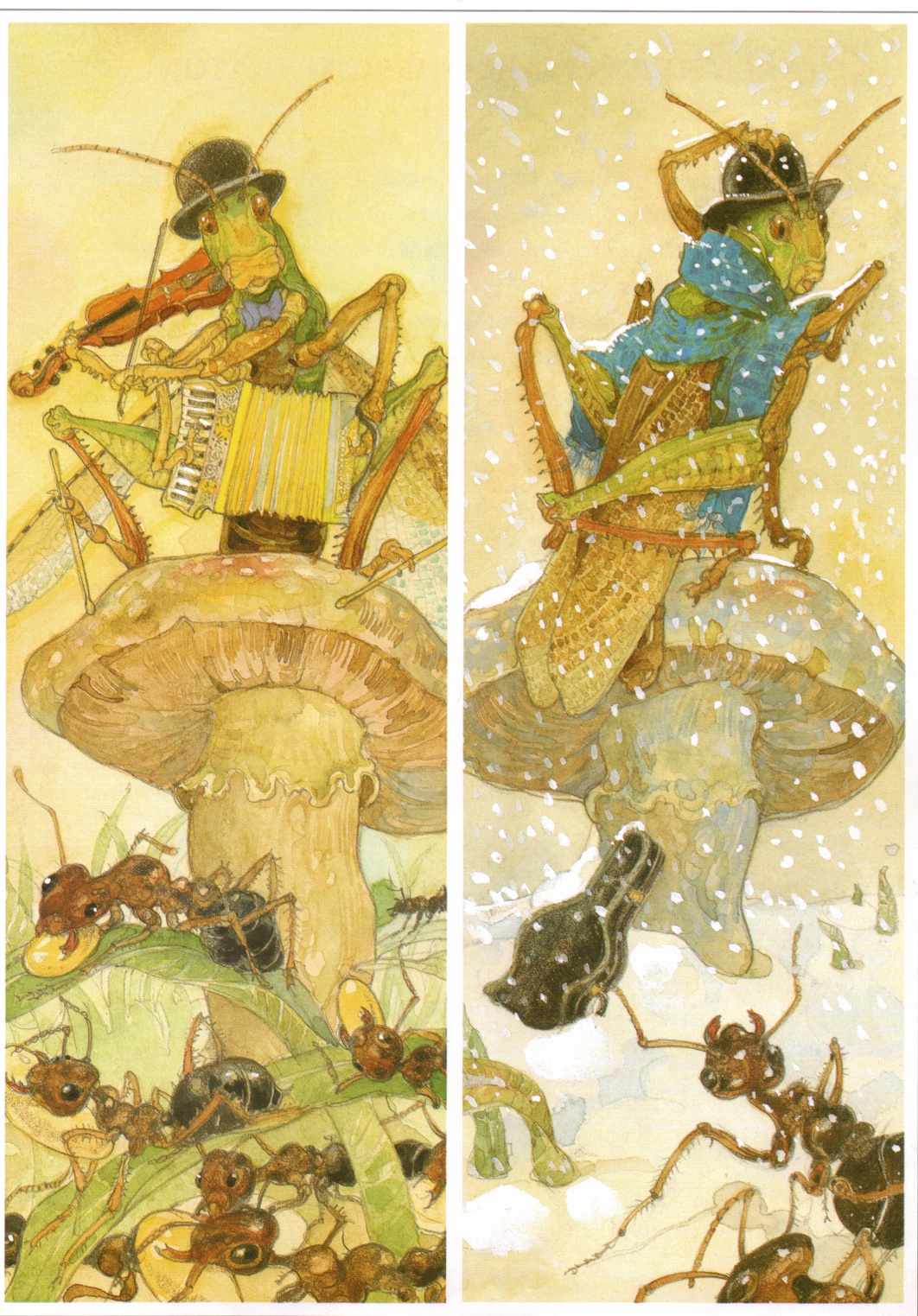
Jerry Pinkney, “The Grasshopper and the Ants” from Aesop’s Fables.
When Toni Morrison and her son Slade set out to interpret “The Grasshopper and the Ants,” they were interested in the artist’s labor. Mother and son were interested in the fact that the grasshopper labors through his musicianship. His labor does not lead to him storing up provisions but it benefits the community who listens and dances to it. When winter comes and grasshopper lacks provisions, ant refuses him given the pressing needs of his own growing family. Their interpretation centers on our obligations to one another; what we owe to our friends and our community. Pinkney’s rendering holds the grasshopper accountable for putting off until tomorrow what he should have done today.
Now seems the perfect time to consider this story as we approach the start of the Summer season. “The Grasshopper and the Ants” suggests that the Summer must keep the Winter in mind. The seduction of slipping fully into the indulgences of summertime is no better represented than through Al Green’s interpretation of the George Gershwin composed tune for the 1935 opera Porgy and Bess.
The earth yields abundantly during summer. Green’s bluesy interpretation makes Aesop’s grasshopper appear less foolish to me and more convincing for his belief that the ants’s work was out of proportion to the season. This sentiment gets conveyed through D.J. Jazzy Jeff and the Fresh Prince’s classic joint “Summertime.”
“Summertime,” here again, is not at all about work but about romance between boys and girls; young men and young women; old folk play and young folk play; food and celebrations. Summertime appears to erase any hint of conflict as all know the role they are to perform. Maybe this is why in Aesop’s tale, grasshopper seems so put off by the ants; they won’t act out leisure like everyone else. The ants insist on seeing tomorrow coming and refuse to be seduced by a moment of seeming abundance.
Cautious indulgence is the moral that I’m taking from this story–at least this time around. Now that school is out and vacation season has started, this story reminds us that all play and no work will make Winter a hungry time.



 In Reverie Blog