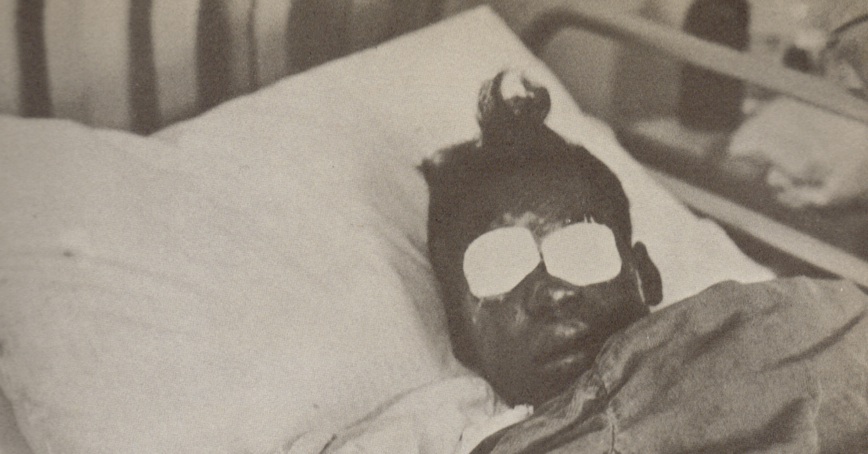
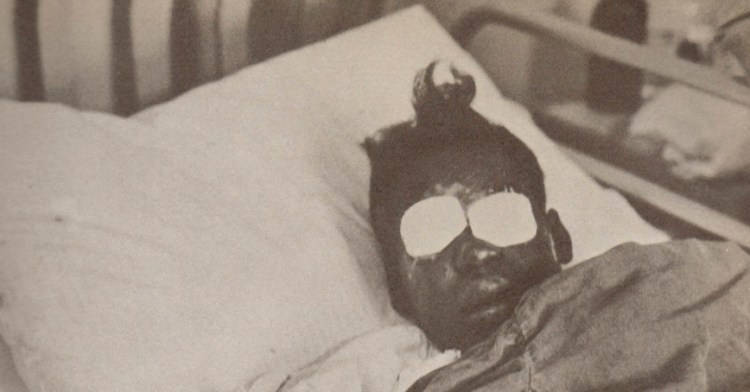
On December 17, 2012, I wrote a post that attempted to link the shooting at Sandy Hook Elementary School that occurred on December 14 in Newtown, Connecticut and the bombing of the 16th Street Baptist Church that occurred on September 15, 1963 in Birmingham, Alabama. In that post, I included a picture of Sarah Collins, one of the survivors who was in the ladies lounge with the four girls who were killed when the bomb exploded. Here is the photograph that I used in that earlier post [You can find this photograph in The Movement: Documentary of a Struggle for Equality (text by Lorraine Hansberry). I found the book at Amazon at a very low cost–though the copies available on Amazon’s site now are pretty pricey]:
Sarah Collins, Addie Mae Collins’s sister, the one survivor present in the ladies lounge when the bomb’s explosion ripped through the bathroom.
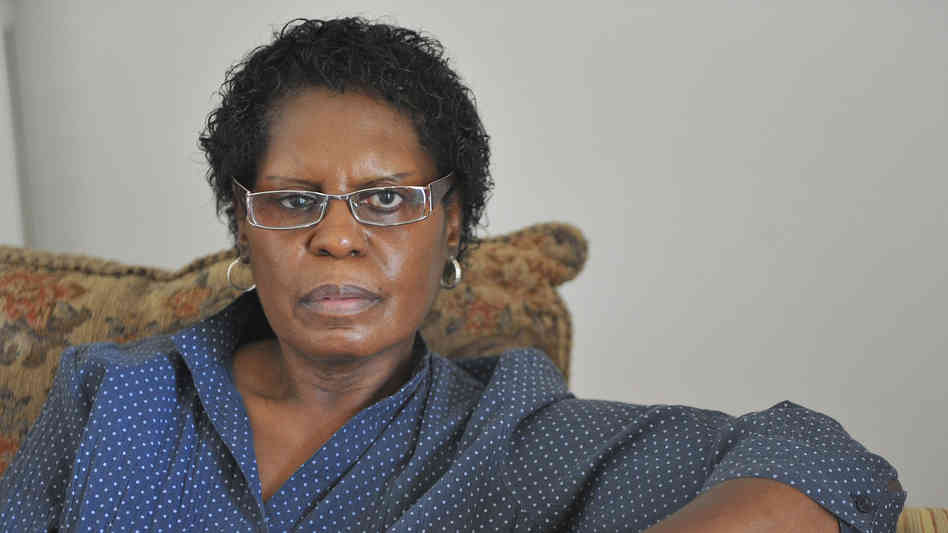
NPR has a short feature about Sarah Collins Rudolph on their website that is worth your time. The story chronicles her long hospital stay as well as the physical and psychological damages Collins suffered. The story also notes the financial costs of her survival: “Medical bills […] have mounted over the years as Collins worked in factories and cleaning houses–mostly without health insurance.”
Sarah Collins Rudolph today.
Collins sought financial assistance from the Birmingham City Council, but has not received any support. Though Birmingham Mayor William Bell claims that he is not heartless and recognizes her suffering, he contends that no legal obligation exists for the city to act…perhaps the Mayor has never heard of compassion, empathy, or simply morality as a motivating force.
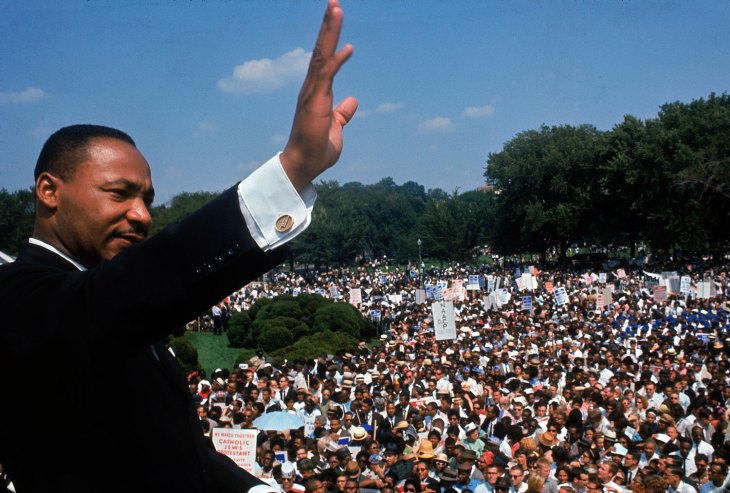
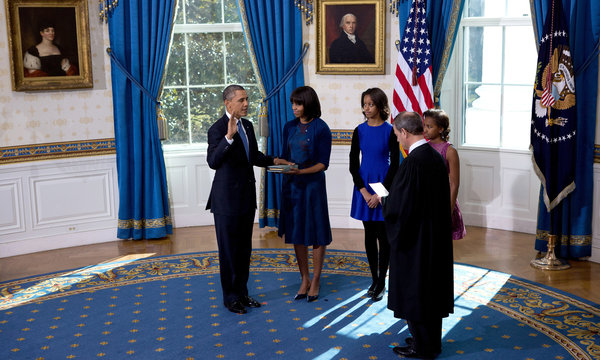
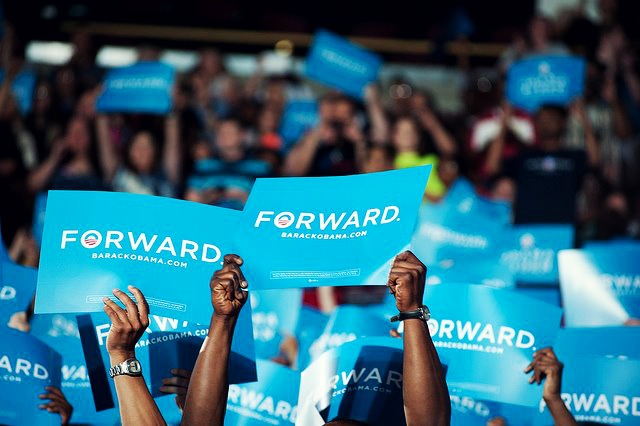
Martin Luther King, Jr. waves to the crowd at the March on Washington for Jobs and Freedom on August 28, 1963.President Obama takes the oath of office from Chief Justice John G. Roberts in the Blue Room of the White House on Sunday, January 20, 2013. Michelle Obama holds the family bible while daughters Malia and Sasha look on.
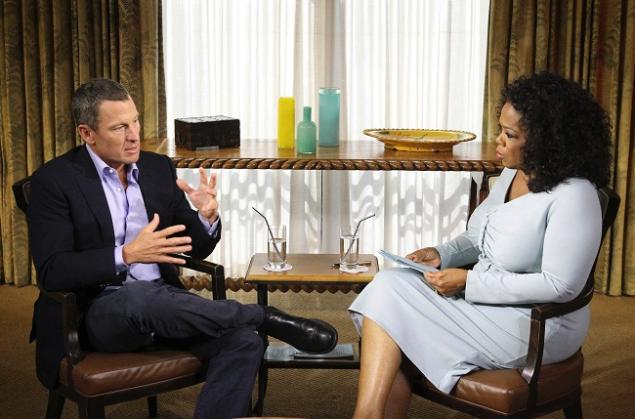
I watched disgraced cyclist Lance Armstrong in his much hyped interview with Oprah Winfrey on her OWN network Thursday evening with great interest. Like disgraced track star Marion Jones, he’s one of those athletes who has admitted his wrongdoing and who I find incredibly compelling. As with Jones, who also owned up to using performance enhancing drugs, Armstrong admits to his personal flaws and to his sporting transgressions. In the case of both athletes, I find myself watching the fallout and listening to the commentary wondering how long the master narrative of public contempt against them is supposed to last. While I understand the disappointment that many feel towards these once athletic heroes whose admitted cheating comes as a tremendous blow, I usually end up feeling great sympathy for the wrongdoer because of the seemingly relentless, untempered venom directed their way. Perhaps I see the public displaying of their flaws as a peek behind the curtain upon the ugliness that most of us get to hide from view and believe that the self-righteousness of the contemptuous ignores these all too human limitations reflected by our fallen heroes. Perhaps. What I know for sure is that as I watched Armstrong on Oprah’s Next Chapter, I recognized how hard it was for me to look at him as I thought about how embarrassing and shameful it must be to admit, in such a public fashion, that you lied and cheated. As I watched, I considered the meaningfulness of those feelings of sympathy in an environment that seems to make little room for any human sentiment beyond reality show like mean-spiritedness and treachery.
Watching Armstrong testify to his own flaws reminded me so much of what it was like talking to my father once he was ready to accept responsibility for something that he had done wrong. There was always something rather hollow about the admission. It was the revelation of a truth without the parting of the sea; the earth didn’t move either. But in admitting he was wrong and that he had flaws, it was like he had served an ace. He hit a ball that could not be returned and as the recipient of the serve, I was just left standing there. I remember feeling powerless at the same time as he won the point. Though I was the recipient of the admission and the apology, it never felt like I had ever won anything. At the same time, I never felt manipulated by my father’s apologies. I knew that my father never lived with a clear conscience. He suffered from terrible nightmares over how he had hurt people. But even if he hadn’t, I never thought that I should feel guilty for offering him my sympathy and compassion given his tremendous need for mercy. Typically, I just wanted to move on from the whole scene, I wanted to get past the ugliness of it all.
I ended up being the only one of my father’s four daughters who spent what was to be his last, full living day with him before he died. He had invited his other three daughters over to spend the day with us as we had never all shared space together. I can’t remember why his five-year-old didn’t come over but his two next oldest daughters had initially agreed to come; ultimately, they changed their plans because they said they had to attend church services. When my father told me this, I expressed to my mother what a mistake they seemed to be making. Though I didn’t know that it would be my father’s last full day, I knew that he was dying. “When your father is dying of cancer and asks you to stop by,” I said to my mother, “I think you should show up” as there might be deep regret for not doing so were he to die. Eventually, his two daughters did not come to his funeral. I thought this was more of the drama that I had seen from them and experienced through my father’s final stories about his previous meetings with them. Meaningful venom, it seemed to me, would have kept them estranged from him. Their repeated attempts to hold him hostage to the inadequacies of the reasons he tried to give them for why he stayed out of their lives for so long just seemed pointless. “If no answer will suffice,” I thought, “what is the point of repeatedly asking the same question?” They seemed to have drawn their own conclusions regarding the questions they posed to him so I wondered why those answers weren’t good enough. It all just seemed needlessly dramatic to me.
Though I certainly held an opinion about the decisions my father’s daughters had made, at the same time I believed that they had the right to whatever their relationship was with our father. I don’t know that I would have cared about their relationship one way or the other had it not impacted me; and it did. My father had expressed to me that he wanted to be cremated, but because he did not have a will, the three of us needed to authorize the process. One of his daughters was quite reluctant to consent. According to my stepmother, her oldest daughter’s faith did not support cremation. I was nearly furious when she told me this. Whatever her faith, this was a young woman who seemed to feel no deep sense of commitment to our father so why should she bring her faith into the decision regarding what would happen to him. In the end, she consented but I wonder now about the ways that an unwillingness to think through the consequences of bottomless contempt and endless rage as expressed in the public venom shown former heroes might be comparable to the personal drama that I experienced with my father’s daughters when he passed. My father’s daughters’ fury became my problem and it shouldn’t have. I had nothing to do with whatever harm he had caused them. My father’s daughters were too righteous about their fury to empathize with how I might have felt. I wonder if the public fury that we watch played out against cultural heroes has similar costs. As a culture, do innocent people suffer from the seemingly boundless rage of those who feel victimized?
As I watched Lance Armstrong repeatedly assert how sorry he was for his lies, I didn’t feel very optimistic about his apologies being well-received. People don’t like the powerless feeling that comes from being the recipient of the ace, the un-returnable serve that an apology oftentimes streaks right past you. The stories that seem to get told in popular culture regarding being a victim and then the recipient of an apology requires an intransigent commitment to holding on to anger and contempt as the victim’s duty. Over the course of the next several months, I expect to hear many, many stories of people’s attempts to sue Armstrong. They’ll talk about all of the pain and suffering he has caused them and their lawyers will explain their efforts to sue him as an attempt to receive justice. Justice, once again, will eclipse any hope of mercy.
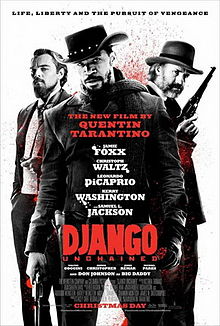
Every film that takes historical events as the core of the story it tells is not a documentary. To that end, Django Unchained does not claim to be a documentary about slavery and it is not a documentary about slavery. The film offers a fictive take on the antebellum period in United States history and captures the brutality, licentiousness, depravity, incestuousness, and ugliness of what black feminist scholar bell hooks calls “white supremacist capitalist patriarchy” very, very well. So if we do go to the movies to “learn stuff” as hooks asserts, Django Unchained enables a long look at the everyday humiliations of the dehumanization that slavery involved and the daily (sexual) perversions it maintained as it permeated every aspect of American life. In the film itself, Django represents the hope that the enslaved created for themselves through dissemblance, absconding, the establishment of fictive kinship networks, worship, marriage, storytelling, dancing, and music.
A very dear friend of mine aptly calls Django Unchained “Faulkneresque.” This description brilliantly captures what she terms the “Southern Gothic” very well represented in this film; it is macabre. The “Mandingo fights,” the “fancy girl” network, the hinting towards incestuousness in Quentin Tarantino’s film appear as direct references to William Faulkner’s Absalom, Absalom! One of the more powerful scenes in the film for me occurs when Dr. King Schultz recalls Calvin Candie’s dogs ripping an enslaved man apart; the memory haunts him. This representation of a traumatic memory underscores the powerful and peculiar impact of slavery’s violence to actively render the past a present catastrophe. Thus, time’s passage does not permit an easy escape from the horrors of this sadistic institution.
Unlike Margaret Mitchell’s Gone with the Wind, Django Unchained resists romanticizing slavery. The love story between Django and Broomhilda doesn’t romanticize slavery, as a nod towards historical understanding, their love story represents resistance of slavery. Despite slaveholders’ propaganda, slavery was not a system designed to benefit and enhance the lives of the enslaved. Narratives like Mitchell’s depicting kindly, benevolent slaveholders who take good care of their slaves misrepresents extreme paternalism and the violence of owning and commanding human chattel. If life became worthwhile for the enslaved, it was because they made it so. Marriage served as a site for just such a possibility. In Help Me to Find my People: The African American Search for Family Lost in Slavery, Heather Andrea Williams notes the role that marriage played in the interior lives of enslaved men. For some, she notes that “it could be an antidote for loneliness and emotional pain […] For some, marriage was what made the hard labor and abuse of slavery bearable. For others it was an act of soul preservation.” In recording the reflections of Francis Fredric, a man enslaved in Virginia and Kentucky, Williams reports his suggestion that “marriage and family served as the sole outlet for their emotions.” Continuing, Fredric believed that “some men focused all their affection on their wives and children because they had nothing else, no career or material possessions to compete for their attention or to give them a feeling of worth. Sometimes, too, marriage and fatherhood presented the only opportunity to exert a sense of power, ownership, or protectiveness, feelings not generally allowed to enslaved men.” This discussion of marriage and the suggestion of loving bonds suggests the active, use value of love. For the enslaved, love between them was about facilitating whatever semblance of life they could manage in the confines of their bondage. While Django Unchained used a romantic fairytale as a frame, ultimately, I think it showed an understanding that love between the enslaved had to be useful. In the film, usefulness is murderous but historically, usefulness wasn’t limited in this way, as Mr. Fredric’s testimony attests.
My friend Carmen has been hosting a series of wonderful posts about an “anti-princess campaign for young black women and girls” that will focus the writing courses she teaches. Her reflections on the limits of popular, fairy tale romance, especially for young black women and girls, have certainly impacted how I am processing Django Unchained. In one of Carmen’s posts, she uses the Williams book to discuss a fantastic assignment that she will require of her students. The kind of imaginative work that she is asking her students to do reminds me of the question my mother posed to me at the conclusion of Django Unchained: “So what’s going to happen to them after this? Do they even make it out of Mississippi?” What kind of life was possible for black people in such horrific circumstances? Coming to imagine the possibilities of how black Americans made lives for themselves requires doing the kind of work that Carmen has planned for her class. It is work that involves the archives and not simply going to the movies.
I greatly enjoyed this holiday season. I liked that we:
found a tree : and decorated it a little earlier this year:
I liked that my mother got to visit a while longer to help us enjoy the gingerbread people my son and I made:
I liked that we finally got to have that New Year’s Eve picnic like my Aunt Janet and Uncle Be Be:
This is a season that reminded me of the importance of turning to the real people in our lives for a model of how to live. Television, “reality” or otherwise, does not provide a good model for how real people create pleasure and meaning in their lives. I thought about this when I received so many kind messages about my New Year’s Eve picnic and the accompanying story I shared about my family’s tradition. Television makes all New Year’s traditions the same: every woman wears a sparkly dress; men wear suits and tuxedoes; they all don cardboard top hats and blow air thru cardboard horns; sometimes they have rattlers; they sip champagne and kiss at midnight…unless you’re in Times Square. If you’re in Times Square, you skip the sparkly dress and the suit but keep the other stuff. It’s just monotony packaged and sold as a good time.
I know real families who create wonderful rituals and traditions to enjoy that television does not portray. On my friend Carmen’s wonderful blog, she thoughtfully writes about preparing black-eyed peas for the New Year as a tradition that she and many of her friends ritualistically perform as an element of familial and community history. I actually first learned that black folk prepared black-eyed peas for New Year’s day after reading the Darden sisters’ cookbook, Spoonbread and Strawberry Wine (a cookbook I truly love as a book of good stories and photographs as much as for the recipes). My grandmother never cooked black-eyed peas. I suspect it was because they weren’t her favorite beans. She cooked pinto beans. Like her, I prepare pinto beans; they’re my favorite. When I first learned that African American families prepared black-eyed peas for good luck in the New Year, I improvised and made pinto instead. As my mother was visiting this year, I didn’t cook beans at all because she doesn’t eat them. In fact, she was most happy that she wasn’t in Cleveland so that she didn’t have to field numerous invitations from friends to enjoy a meal of black-eyed peas and collard greens as they are two foods she abhors. What my Mom’s friends did in preparation for the holiday season that she liked, as did I, was they ordered big ethnic meals for their families to enjoy before they prepared their big dinners. Thus, she had friends who ordered fanciful Italian dinners for their families. Other friends ordered Chinese food by the carton full so that they didn’t have to cook a thing themselves on Christmas Eve. One year, she told me that she had a friend who hosted a sandwich bar. In that vein, we had sub sandwiches on Christmas Eve.
We do ourselves such a service when we pay attention to the people in our lives; learn from them. T.V. people do not allow an assessment of the full scope and measure of their lives. Mostly what we see from television people is how they spend money. Thus, they might give us insight into how to shop–or better yet, how they shop, but not how to live.
Since my cousins were quite young, my Aunt Janet and Uncle Be Be had the wonderful idea to have a picnic in their basement to avoid the possibility of stray bullets from New Year’s Eve revelers. When they first started, they would go to Cleveland’s fabulous Westside Market for fruits, cheese and crackers that they enjoyed on their blanket. The next year they added a chicken nugget platter to the fruits, cheese and crackers. My cousin sent me pictures of their most recent feast and it featured barbecue ribs, chicken, fruits, cheese and crackers. This year, I’m following my family’s example.
Anytime I’ve ever told someone about my family’s picnic, they’ve thought it was a terrific idea. This is the first year that I think I’ll have the stamina to actually make it to midnight so that I can enjoy feasting. We’re planning on having barbecue ribs, chicken strips, cucumber, celery, carrots and vegetable dip, and a cheese plate. I’ll take pictures and share them with you.
I have continued to think about the relationship between our nation’s past and Adam Lanza’s murderous rampage at Sandy Hook Elementary School. On this particular morning, Christmas Eve, I thought about the touching scene in Spike Lee’s documentary film, 4 Little Girls, where Coretta Scott King reads the letter that her husband, Dr. Martin Luther King, Jr., addressed to the family of Denise McNair. Denise was one of four black girls killed when a bomb exploded in the basement of the 16th Street Baptist Church on September 15, 1963. Stanford University, which holds a substantial portion of the King papers, reveals the contents of the letter as it appears in Chapter 21 of King’s autobiography. The letter reads as follows:
CHRISTMAS LETTER TO THE FAMILY OF DENISE MCNAIR
Dear Mr. and Mrs. McNair:
Here in the midst of the Christmas season my thoughts have turned to you. This has been a difficult year for you. The coming Christmas, when the family bonds are normally more closely knit, makes the loss you have sustained even more painful. Yet, with the sad memories there are the memories of the good days when Denise was with you and your family.
As you know, many of us are giving up our Christmas as a memorial for the great sacrifices made this year in the Freedom Struggle. I know there is nothing that can compensate for the vacant place in your family circle, but we did want to share a part of our sacrifice this year with you. Perhaps there is some small thing dear to your heart in which this gift can play a part.
I’m sure at any historical moment such a material sacrifice during Christmas would have been seen as an extraordinary memorial, but as I am thinking about this in the context of our times, it appears radical, spectacular, thoughtful, and moving. Can you imagine how such a sacrifice would be perceived in our time of “Black Friday” and 24 hour last-minute shopping “opportunities” before Christmas? I can only imagine what it would mean for those families to know that Americans were making a memorial of sacrifice as a tribute to their loss. People have made beautiful and loving tributes, but what I find so compelling about King’s gesture is that it called for withholding goods as opposed to giving them; it’s a model that I have not seen in our own times.
It is hard to imagine any violent incident in American culture being without an historical antecedent as this is an extremely violent culture. As terrible as the recent massacre at Sandy Hook Elementary school is, the violence there is not without a horrific precedent. Its horror parallels the tragic bombing of the 16th Street Baptist Church nearly fifty years ago. On Sunday, September 15, 1963, a bomb exploded as the congregation prepared for its “Youth Day” service. Four of five girls downstairs in the lady’s lounge were killed instantly.
Sarah Collins, Addie Mae Collins’s sister, the one survivor present in the ladies lounge when the bomb’s explosion ripped through the bathroom.
The girls were all quite young, Denise McNair was eleven and Addie Mae Collins, Carole Robertson and Cynthia Wesley were all fourteen. In the immediate aftermath of the bombing, two black boys, thirteen-year-old Virgil Ware and sixteen-year-old Johnny Robinson were also killed. Ware was killed by a white teenager, Larry Joe Sims, an Eagle Scout who was driving home after attending a segregationist rally. A police officer, Jack Parker, shot Robinson in the back as he was a part of a group throwing rocks at a white segregationist’s car as rioting ensued in the streets. Historically, violence in America has known no sacred bounds.
In the documentary film 4 Little Girls that commemorates the bombing, director Spike Lee shows a photograph that I wish I could find that captures the devastation of the crime. The photo shows a relatively old man who you would think had seen it all but who has turned away from the church clearly weeping and distraught; he was clearly astonished by what he had observed. Families didn’t know quite how to handle the devastation. I learned from reading Carolyn McKinstry’s memoir, While the World Watched: A Birmingham Survivor Comes of Age during the Civil Rights Movementthat Birmingham schools were open the Monday immediately following the bombing and she was one of those who went to school. Johnny Robinson’s family offers the same story in the NPR segment that I link to above. They went to school the day following their brother’s death just as McKinstry went to school the day following a dear friend’s death. The impact of moving on so quickly without having psychological or emotional support took a toll on McKinstry’s mental health. Interestingly, Christopher Paul Curtis engages just this possibility in his commemoration of the bombing represented in his first children’s book, The Watson’s Go To Birmingham–1963. The young protagonist in that tale briefly descends into madness as a result of the bomb’s devastation. These stories suggest that rushing into “normal” may not be a good idea. Perhaps tragedies like these offer us an opportunity to redefine exactly what “normal” might be.
In thinking about this new normal, with an eye towards history, I have been quite interested in the gun control discussion. Attempts to nuance the discussion have turned towards an examination of new gun control laws and considerations of mental illness. Mental illness is not new to our world. I’m not convinced that adding mental illness into this discussion of gun control necessarily makes us safer. Perhaps a richer conversation about the quality of our cultural experience needs to frame these talks. In earlier times, like during the Civil Rights era, people could be shamed by their behavior. It was one of the reasons why the media was so important to the Movement. Photographs of police dogs attacking unarmed people and water hoses being turned against nonviolent protestors shamed the federal government. We seem to live in a shameless era. How does the permissiveness of our times inform recent gun violence? In his remarks at the memorial service in Newtown, President Obama asked the nation to reflect on how honest we have been in our efforts to make our communities safe for our children. In general, the concept of honesty is important for us to consider. We are not honest with ourselves about our efforts regarding safety or most other things. A dear friend and I couldn’t stop talking about descriptions of Adam Lanza and some of these other shooters as “brilliant.” Brilliant people, we surmised, do not enter movie theaters and shoot-up unarmed patrons. Brilliant people do not go to elementary schools and massacre defenseless children. Brilliant people compose “Sugar, Rum, Cherry;” brilliant people write Beloved; brilliant people paint the Migration Series. Brilliance is generative, not destructive. What is behind the media’s commitment to this description of Lanza? It seems dishonest.
Even if there were gun laws in place regarding the procurement of weapons and mental illness, from what we know of Nancy Lanza, who was tragically killed by her son, she was not mentally ill. She did however, think that her son suffered from Aspergers. Whether it was the Aspergers or something else, she apparently cautioned a baby sitter against diverting attention from Adam, “even to go to the bathroom.” So one wonders why she decided it was safe to have guns around him. Was she being honest with herself about what he was capable of? How would gun laws reasonably respond to such issues of judgement? How do we account for the delusions of those who are sane even as we consider restricting the rights of those who are not?
In going forward, I think we need to turn to the past. Our violent history should be instructive to us. Perhaps it could give us some clues about how we respond to our grief; how we move beyond fear; how we move on.
Parks and playgrounds are nice places for children to play.
My next door neighbor coaches his sons’ youth football team. A few weeks ago, he noticed that our three-year-old, who was born on the same day as his youngest child, was just as tall as his six-year-old so he asked my husband to let our son play for his team. My husband declined his offer and also explained that our son’s height didn’t automatically qualify him for sharing the field with children three years older than him. My neighbor argued that it would be safe and went on to tell my husband that only two kids from his team had to go to the emergency room this season. My husband found little comfort in those numbers and neither did I.
At my son’s play school, three-year-olds and six-year-olds don’t even share the same playground, nor should they. On all developmental levels, there is far too much difference between these sets of children. If the play school won’t even let these children share the same play space, there is no way to justify lining three-year-olds up against six-year-olds on a football field.
I’ve already been approached by basketball coaches asking me to bring my kid out for their teams. Most recently, I was approached as we were leaving the library after our weekly visit. That coach wasn’t pushy. He just recommended it because he noticed my son’s size but also his enthusiasm for “ready, set, go,” which he likes to play outside on the library’s walkway.
Other than size, I don’t quite understand why my son seems to be considered such a worthy candidate for organized sports. Just a few months ago, my son was frustrated by games that were appropriate for his age group. Thus, when I came to pick him up one afternoon he was crying because, as he explained it, he couldn’t sit in the chair of his choice. When I went into his classroom because he left his jacket behind, his tears made more sense to me. “Miles,” I explained, “your classmates are playing musical chairs. A chair is taken away each time the music stops. You can’t just have the seat you want. That’s not how the game is played.” He no longer cries about musical chairs but his frustration with the basic premise of that game does not lead me to believe that football or basketball would be the natural next step for him.
My husband and I both competed in big time, Division I sports; my husband even played football. We know very few former athletes who are eager to get their children involved in organized sports. If our son at some point becomes interested in sports, fine, but we’re certainly not going to push it; especially now. Neither of us sees the value in creating a commitment to daily practice and weekend competition for toddlers and pre-school age children. I must admit, I even find it ridiculous when the youth sports coaches we know discuss their win-loss records. “So what?” I want to ask them. No serious athletics program goes looking at pee-wee park leagues for recruits. And for good reason: anyone with the money to pay the dues can get their kid a spot on the team; and how good is your six-year-old when he’s teeing off on a three-year-old! Give me a break.
During football season, my neighbors didn’t make it home from practice until well after 8 p.m. most days. Their oldest son, who was on some kind of advanced academic track, got his first C ever as he found managing his first year of middle school and his practice schedule difficult. My neighbors seemed proud to tell us that their son has to stay up until midnight to complete his homework. We weren’t impressed. If you are going to involve your children in youth sports, their lives should be organized so that their school work gets done before practice, but midnight is far too late for a child in middle school to be awake.
It also troubles me that these children who play organized sports seem to do it year round. There is no time when they’re learning an instrument, practicing their lines for a play, sitting still. Sports don’t seem to contribute to the richness of their experiences; they constitute the whole of experience.
For now I say, “let them play tag!” Tag is a perfectly fine game that costs no money and requires no special uniform or equipment. If not tag, then something like it, but the point is, you do not have to sign your toddler up for youth sports because of their size.





 In Reverie Blog