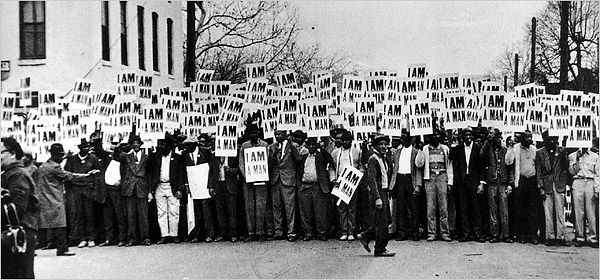
Today, the striking Memphis sanitation workers whose efforts King supported in 1968 are once again concerned about being diminished as workers, as persons, and as citizens as the city is considering privatizing sanitation work and thus effectively eliminating the Union. 45 years after King’s assassination on this day in Memphis, the fight for dignity continues.
There is a very short article and a 2:53 video at the Big Think site about the value of asking the right questions. According to the article, data from the U.S. School System reveals that “the average high school student asks one question of substance per month in a classroom.” This troubling find would make for interesting conversation. Why does American culture devalue the significance of asking questions?
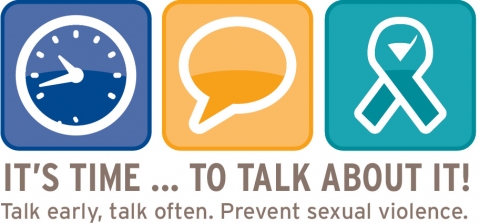
Today begins National Sexual Assault Awareness and Prevention Month. I was reading around on the National Sexual Violence Resource Center site thinking about the work that I try to do as a parent to keep my son safe and to keep him aware of his responsibility for ensuring the safety of others. Perhaps one of the most mundane things is in reminding him to keep his hands to himself. As I was helping him dress the other day, Miles said, “No one touches my bottom, right Mommy?”
“That’s right, Miles,” I told him. “And you don’t touch anyone else’s. NO TOUCHING BOTTOMS.”
“That’s right,” he confirmed.
That exchange reminded me of his four-year-old wellness visit when his pediatrician was examining him and told him that he’s not to let anyone touch him, examine him, in that way; and then she qualified herself, “except Mommy and Daddy.” And to that I said, “and if you said ‘no’ to any of us, we would have to respect that.” We all agreed.
When I was a young girl, I broke a total of three fingers under three different sports related circumstances. On one occasion, my basketball coach didn’t know that my finger was broken and assumed it was jammed. She kept trying to persuade me to allow her to pull my finger so that the joint would become properly aligned. I refused her every attempt. Finally, she asked my father who said to her, “that’s her finger! I can’t give you permission to pull her finger.” I was very grateful to him for that. It was an early lesson in the authority that I possessed in constructing my own bodily boundaries. It was very powerful for my father, who was partly responsible for giving me life, to declare in a very public way that when I set limits regarding my body, other people, including him, had to respect that; otherwise, a violation occurred.
I think it is quite wonderful when a parent or a pediatrician can give a child a message regarding bodily integrity, but I am also quite comfortable with it coming from a teacher. I don’t expect to receive a note in my son’s book bag about the lessons his Play School has prepared for National Sexual Assault Awareness and Prevention Month or a permission slip for me to authorize his participation in related educational programming, but I would definitely be cool with it; would you?
I recommend The Interrupters as worthwhile viewing. It is a deeply moving film about CeaseFire, an organization that works to interrupt urban street violence in Chicago. All of the members working with this organization have a record of violence that contributed to their former incarceration. Reflecting on their own lives influenced their decision to embrace peace and to interrupt violence as they see it in the Chicago communities where they grew-up.
There are moments in the film, especially the last scenes, where the camera lingers on the quiet, contemplative faces of three of the film’s featured Interrupters that reminds me of my father. Like my father, they all seemed haunted by the ghosts of their respective pasts. Every night that I spent with my father was one where I saw him through the glow of late night television and always ready with a story of some horror he could recall from his youth. He told me once that when “you did as much wrong as I did, you don’t sleep easy.” Like the rape victim whose apartment my father inspected every night before she entered from her late night shift, the community work that the Interrupters perform represents an attempt to absolve themselves of their guilt for their often unspeakable crimes. I found myself pulling for their salvation as much as I did for the community they were trying to save.
My husband recently shared with me the details of a motivational talk given to his track team by a former athlete and current business woman. The importance of building a brand served as the centerpiece of her talk to the athletes. We agreed that it was very different from the motivational talks we heard as young athletes. Instead of being encouraged to build our brand, we were encouraged to build our character.
I like the language of character far more than the language of brands. Corporate language negotiates human value through marketplace logic; for me that diminishes the possible expressions of human richness. Money and what it can buy defines wealth in market terms. Character allows for a fuller portrait of what constitutes richness.
When character defines wealth, Philane Lawson offers a portrait of human richness. The homemade bread that she awoke to make at 4 a.m. reflects the offering that she could make to her family despite having little money. When character defines wealth, Pearl Fryer offers a portrait of human richness through his garden:
I read an interview that a graduate student of religion conducted with American theologian James H. Cone and I was moved to remember the importance of love in my own life because of what Cone says about his parents and his community. When asked about receiving his calling, Cones says this in reply:
It started early for me. It happened before I knew it was happening. The model of my parents; they loved me. They deeply loved me. That gave me the strength to be able to speak with a kind of self-confidence. There was the Macedonia AME [African Methodist Episcopal] church which was an extension of the kind of love that I received at home, with the people expressing their confidence in me and in their belief that God had put me–and not just me, but all of us–on this earth to do something special. And then there was my segregated school, my teachers in the school who were a part of my church and the other churches – they also reinforced that. So by the time I was 16 years old and graduated from high school, I had been kept safe with the love of my parents, with Macedonia AME church, and at my school and in the community itself. When you are loved you are empowered.
Cone makes a marvelous tribute to his parents when he acknowledges how “deeply” they loved him. It seems to me a worthwhile goal to set for myself as a parent to one day have my son say that I loved him “deeply;” too, it seems worthwhile to have as my goal to have my friends and family say the same.
Pi (π) is the ratio of a circle’s circumference to its diameter, which is approximately 3.14159 and thus the reason for designating March 14, 3/14, Pi Day.
Here’s a link to folk discussing all the things they plan on doing to mark Pi Day. I recommended that my husband, a math teacher, screen The Life of Pi for his students.
Last year I made a fruit tart to mark the occasion, but this year, I didn’t have the energy to cut up the fruit so I made a simple no-bake cheesecake and bought frozen strawberries:
Ingredients:
8 oz Philadelphia Cream Cheese (softened)
1 (14 oz) can Borden’s Sweetened Condensed Milk
1/3 cup lemon juice
1 teaspoon vanilla
1 prepared graham cracker or shortbread crust.
Combine all ingredients with a mixer or a food processor until well-blended. Pour mixture into 1 prepared graham cracker or shortbread crust. Refrigerate overnight. Top with fruit or candy of your choice. Enjoy!
We experienced beautiful weather here in Atlanta this weekend. The sun was shining and the temperature climbed to almost 70 degrees. These beautiful conditions pushed many of us outdoors and into community with people who you can reach out and touch but whose company you rarely get to enjoy. I sometimes encounter my neighbors in the morning as we’re preparing to take our children to school but we don’t get to talk like we did yesterday. While our children played together, we stood around discussing young people, particularly the young college students working in my neighbor’s office. She works as a Social Worker and her division was recently assigned several interns. My neighbor usually enjoys mentoring these young people but she often marvels at the assumptions that even they make as people committing themselves to helping those who live in communities they would describe as being very much their own. “It’s like t.v. tells them who their own grandmother’s are,” my neighbor mused. “They talk about people who look like stereotypes of who I know them to be,” she continued. “I guess I’ve been doing this work for so long, I know that people are more complicated than their storylines on television,” she said.
I sympathized with my neighbor’s story. I told her about being in the public library last week overhearing what appeared to be a student group discussing a community service project they were planning. The project involved going door-to-door in “the community” informing people about energy efficiency in their homes. “What people don’t know” was the repeated refrain in their conversation. The only people I could imagine not knowing about home energy conservation in my community growing-up, which was very much like the West End community they were describing, were children. Children were the intended recipients of a wealth of knowledge from older people about how to conserve just about everything: “What you running fresh water for? Put that baby in that same water you just washed that other child in; it ain’t hurtin’ nothin’. That baby wouldn’t that dirty,” I would hear as advice given to young parents who clearly knew little about how to best use their resources; or this, “Close that refrigerator door , girl! You need to know what you want before you pull that door open,” was the instruction I was given when I lingered too long in the refrigerator; or, “Can Mary fit this? Sarah outgrew it.” Hand-me-downs was a way that the life of garments was extended so that money wouldn’t have to be wasted on new clothes. Perhaps my personal favorite was, “Stop burnin’ all these lights! Why you got all these lights on with all this light coming from outside? It ain’t dark in here.” My grandfather spoke of electric lights as though they were candles.
The language that I heard while growing-up was more colorful than the language of the green movement and so, more interesting. The students that I overheard mistook the colorful language for ignorance because, perhaps, it lacked the scientific terms they were using to describe their world. I didn’t know a single scientist when I was a child, but I knew people who practically worshipped the natural world. I knew people who took pride in their lawns and flower beds, their gardens and the birds they fed. I saw people pick-up trash they didn’t throw on the ground themselves; who shared abundance and didn’t just boast of it. So I wanted to say to those young people I overheard talking, “Imagine if the people you’re planning on helping do know something, then what are you going to do? What will your project amount to?” I think it’s clear that they wouldn’t have had much of a project, but if they thought about collaborating with people in the community they wanted to work in, they might have been on to something interesting.
Marvin Gaye’s phenomenal track “Mercy, Mercy Me (The Ecology)” always sounded like a collaborative work to me. The “mercy, mercy me” part always sounded like an old person’s voice; something my grandparents would say. In my mind, this song draws on an ancestral presence to voice urgent ecological concerns. The result brings the young and the old together to reclaim a cherished ecological past that was once a reality that the old knew very well, not some fantasy or sentimental delusion.
I certainly understood my neighbors frustration with her interns. Theirs was a model of service that diminishes the collaborative possibilities of community work; reducing a colorful world to one predictable tone.
The Alvin Ailey website describes Revelations as a work that “explores the places of deepest grief and holiest joy in the soul.” Memories of Ailey’s southern roots in Texas greatly inform the work’s themes, movements, and sound. Ailey’s singular recollections of black spiritual life intersects with musical expressions that testify to despair, redemption, and joy heard in the “African American spirituals, song-sermons, gospel songs and holy blues.”
Judith Jameson, the featured dancer in Revelations for 15 years, conveys the triumph of the work when she asserts that “it set a tone for what is human in all of us, no matter where you come from.”


 In Reverie Blog