This is the season for wishing, so I’d like to offer a few of mine. I wish that history meant more to young people, growing up saturated with instant facts and data, to see history as being more than social media timelines. Technological “advancement” has elevated the significance of media and diminished the value of history. So many titles I read suggest that we’re living during a time when being an avatar in the media outweighs the ambition to be a subject in history.
Locating one’s self in history beyond a social media timeline asks that we value an engagement with our culture, the various stories comprising the legacy of this culture, and it means recognizing the significance of records left behind that assist efforts to understand where we currently stand in culture. Those records, letters, photographs, songs, and scrapbooks, for example, provide us with more than information, they offer sites of process. Such sites challenge the expected immediacy that social media encourages and elevates the value of contemplation and reflection; requirements needed for making meaning and knowledge.
This blog and my email are the only virtual sites where I offer personal reflections out loud. I don’t trust Twitter, FaceBook, Instagram and other profiling sources. If you value history, then you recognize the dangers and hazards of profiling for people of color; It’s terribly lethal.
When I was growing up in Cleveland, Ohio, I don’t ever remember being raised to put much effort into creating an image of who I wanted to be; instead, I was encouraged to figure out who I actually was: What did I like? How did I like to spend my time? What unnerved me and what made me comfortable? Authentic living asked that you listen to stories about World War II, get lost in old photographs, learn the names and faces of people whose music did not, to my mind, in any way compare to the masterful music Michael Jackson put out.
As someone who’s very aware of raising a child in an era when virtual living seems to have diminished the value of tangible experience, I will make sure that my son listens to stories, examines photographs, discusses music. These activities helped me to value myself as a subject in history and shun efforts to build and to value my personal avatar. These activities also helped me better understand that public scripts of black life are far too limited, and that working on the substance of my identity taught me to craft my own meaning of a rich life.
Ultimately, I wish that everyone could experience the significance of these sites of process. Not only might they enhance your life, they might just extend it.
Flossie & the Fox is a children’s story that I love and probably value even more because it came as a recommendation from my dear friend Carmen. I’ve written about Flossie on this blog several times because of the admiral traits that allow Flossie to complete the task her grandmother assigned her. I find it admiral that this story revises the story of Little Red Riding Hood through the depiction of a little black girl who finds meaning in her grandmother’s words and uses them to create a way of addressing a predator on the loose. This strategy demands that she not concede to the predator’s presumed authority to tell her who she is (afraid girl) and by what name she will be called (easy target). Given all that I love about Flossie, there is something that I also love about the Fox. At one point in the story, in response to Flossie’s refusal to accept that he is actually a fox, he asks, “Whatever are they teaching children these days? A child your age should be simply terrified of me” (I may be slightly paraphrasing the declarative sentence because I don’t have the book before me). As much as I want Flossie to prevail, in this moment, I stand beside Fox in asking this very relevant question: Whatever are they teaching children these days?
My friends who work as college professors tell the most bizarre stories about how their students, who graduated from high schools with honors and accolades despite serious writing challenges and their lack of intellectual commitment to rigorously engaging subjects that presumably interest them. One of my friends told me that coherence is a concept that her students struggle with the most. In an effort to tackle this problem, she writes in class with them on a topic they determine on the spot. The entire class contributes ideas, language, and examples to support their topic as it develops towards a claim. After composing this introduction, my friend said that she asks the students what was different about how they compose individually in relationship to what the group offered under her direction. As if singing a verse in rounds, her students said, “well, you actually think about what you write.” She then asked them what could they possibly be doing if in writing, they were not thinking; their response was to giggle. Whatever are they teaching children these days?
I have another friend who works as a college professor who struggles to understand how students who are granted the opportunity to draft an essay multiple times, only to submit final essays with egregious, flagrant errors. Here are a few real life examples of (un)polished final revisions:
1. Violence in America has continued ever since they hung Emit Till from a tree.
2. This group put a president on allowing anyone to come to their school.
3. These beliefs crept into ignorant, poor blacks who didn’t know any better than to lust after money.
4. Her character showed that she preferred to abet in the betterment of the black race.
5. The 1960 Sanitation Workers Protest was about the health and safety of workers in factories.
Whatever are they teaching children these days?
Young people could learn a lot about the art of reading by viewing examples of animated poetry as a source. Some of my favorite animations provide examples of what reading might look like in someone’s head:
Maybe watching an interpretation of text, of poetry, can offer a model of reading that restores the value of historical accuracy, meaningful word choice, and empathetic renderings of humanity in one’s writing. Maybe. Who knows? Why not give it a try ’cause whatever they teaching children these days ain’t helping ’em learn to honor the dead or to show gratitude for those “ignorant, poor blacks” who sacrificed their lives to make life a little bit better for the sake of a future they could not predict. Whatever they’re teaching children these days sho don’t seem like it could possibly help them carry out their grandmothers’ instructions or to outwit any foxes.
I know a black woman who describes herself as having come from the ghetto but eschews an identification with what it means to be ghetto. To be ghetto, for her, means having little respect for decorum and failing to have an appreciation for reading and literacy. Interestingly, she also assumes that “being ghetto” means being black and articulating this identity through words and gestures associated with black folk. For example, she once told me about her five-year-old grandson’s first visit to the barbershop. Upon introducing himself to this child, the barber held out his fist and asked the boy to give him a pound. In recounting this story, the boy’s grandmother seemed so proud of the fact that her “grand baby” did not know what it meant to give someone a pound. According to her, he’s not raised “to be ghetto like these other kids running around here who don’t know how you’re supposed to greet somebody.” I thought, but did not say, giving someone a pound ain’t ghetto. Giving someone a pound represents a form of black cultural expression that signifies your membership in a community that recognizes this gesture as a form of communication. I don’t typically use “ghetto” as a way of describing a person’s identity, but let’s say we allow traits this woman associates with “being ghetto” to describe someone’s understanding of the meaning of “giving someone a pound,” then President and Mrs. Obama are ghetto.
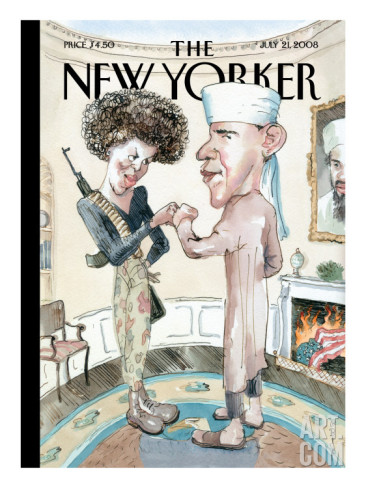
The “fist-bump” happened at a June 3, 2008 campaign rally in St. Paul, Minnesota.
What mainstream media called a “fist bump,” lacks creativity. It is a flat, mechanical description that one might expect to find in an instruction manual. This unimaginative phrase lacks the richness of what I grew-up, as a black person, calling “a pound.” This description conjures an image of boxers pummeling one another in the ring, but instead of being adversarial, the pound, as a greeting, suggests membership in a community that has historically revised and reformed the terms of unrelenting brutality. Failing to respect this creative re-articulation of violence reflected in a punch or a jab influences the lumbering, inarticulate misrepresentation of eloquence as brutishness. The July 21, 2008 cover of The New Yorker offers an example of the flat, mechanical description of a “fist bump” in visual terms:
This visual depiction of a “fist bump” casts the “pound” as a violent gesture signifying extremism and treason. While the illustrator, Barry Blitt, calls his work satire, I read it as a lazy caricature of racist constructions of the Obamas as reflected in right-wing criticism of them. The cover, which Blitt titled “The Politics of Fear,” might have revealed a more nuanced critique had he read the “fist bump” as “a pound.” Read as “a pound,” the Obamas were situating themselves within a historical context that uses this gesture to convey welcome, community, and inclusion. Had Blitt offered such an interpretation, he might have demonstrated a greater understanding of a politics of fear as it has been historically articulated and revealed through the destruction of black communities. From the destruction of the thriving black community in Tulsa, Oklahoma in 1921, the Rosewood massacre in 1923, the bombing of black homes and black institutions in Birmingham, Alabama in the 1960s, and the 1985 bombing of the MOVE house on Osage Avenue in Philadelphia, “the politics of fear” derives from the lethal aggression that is fueled by racism and aimed at annihilating black Americans’ efforts towards making community or seeking self-sufficiency. Thus, what Blitt doesn’t do is read “a pound” as an expression of love; instead, he reads a “fist bump” as a phrase epitomizing fear and hate that exemplifies a shared understanding of “the politics of fear.”
Along these same lines regarding the denigration of black American forms of cultural expression, much was made of the moment when then Presidential candidate Obama offered a black vernacular response to a cashier when paying for his meal at D.C.’s famed eatery, Ben’s Chili Bowl. When the cashier presumably asked Obama if he needed change, Obama responded, “nah, we straight.” This moment, that rhetoricians call “code switching,” inspired me to consider the verbal agility that once represented one’s ability to actively participate in a community that showed deep appreciation for creative, verbal expression. I’m sure that the woman who I spoke of earlier would view her grandson’s similar ignorance regarding what black folk at one time called “the dozens,” an example of him not being “ghetto,” I view this inability to demonstrate verbal dexterity as a profound example of incompetence. What I appreciate about playing the dozens is that it expands one’s options for reading themselves in terms of the broader culture. In other words, playing the dozens helps to facilitate one’s development of a creative, oppositional stance towards an obviously provocative claim or statement masquerading as a truth and demanding your participation. I have been thinking more and more about this with respect to cross-cultural dialogue that plays itself out between young people.
While I missed the two days when the film American Promisewas screened in Atlanta, I’m planning to view the film when it debuts on PBS in February. The trailer draws attention to the hazards of disregarding the value of learning to play the dozens. The film follows two African American boys who attend the purportedly “prestigious” Dalton School located in Manhattan’s Upper East Side. Both boys begin their tenure at the school for their primary years, but they part ways at the secondary level. The child who remains, Idris, enrolled through 12th grade, and is the filmmakers’ son.
The trailer offers descriptions of Dalton as “extraordinary” and voices the notion that Dalton is an “ivy league school in a brownstone.” The Dalton School website lists tuition as $40,220 for grades K-12 and I’m assuming that means per year and not the cost of one’s overall enrollment from kindergarten through senior year. Now, for all this money, Idris is obviously wounded when his black peers who do not attend Dalton contend that he “talks like a white boy.” I can only shake my head in pure annoyance with this child and his parents. I don’t understand how you can pay $40,000 in order to attend this “extraordinary” school and your kid gets hung up on “you talk like a white boy?” $40,000 doesn’t prepare you to have the verbal dexterity to respond to this tired association between erudition and whiteness? So I guess that $40,000 ostensibly prepares you to respond in formal academic terms to a presumably neutral, objective challenge but fails to teach you how to apply those skills to an everyday, vernacular challenge? So for $40,000 you are speechless when public school kids make assertions in the form of the dozens? I don’t get it. In the trailer, Idris’s father asserts that after attending Dalton, his son wanted to change what I guess is a name that estranges him from whiteness. The trailer shows no indication that these folk recognize Idris’s desire to change his name as the detritus left in the wake of the surreptitious version of scorn and derision that bears witness to the ugliness of his Dalton School classmates. Thus, unlike the playground kids who were clear and explicit when they challenged Idris’s sense of legitimate belonging in stating that he “talked like a white boy,” and whose guilt is associated with the visual portrayal of black boys on the basketball court at the moment Idris cites their brutality, the same meanness occurs less blatantly at Dalton. The veiled derision of his cinematically invisible classmates at Dalton should find a visual parallel to the basketball scene. This lack of exposure hides the challenge Idris needs to address on the playground and in the classroom. Instead of his “exceptional” school supporting and encouraging him to develop a response that indicates his awareness of the meanness directed towards him, the attainment of such skills is devalued in the way that Dalton defines what constitutes an “exceptional” education. The fact that Idris consistently capitulates to meanness undermines the claim that his education prepares him to compete in the world; rather, from the little that I observed, this child knows how to concede but has no sense of what it means for him to fight and to win on his terms. Idris remains silent on the playground and at school, he consistently allows someone else to determine how he views his own name in both places. Without this ability to claim the integrity of his own worldview and the value of his own name, what will it mean for Idris to one day call himself a man?
One parent confesses that she sends her son to Dalton because she “wants him to learn to be comfortable around white folks” and admits that she lacks such comfort. It’s not clear to me why whiteness serves as her point of reference for determining meaningful exchange, civic inclusion, and one’s sense of belonging. The $40,000 price tag on enrollment at the Dalton School seems too steep if your child fails to learn the value of being comfortable with himself (or herself), which ultimately determines how that child interacts with others.
So, if you can afford to pay $40,000 for compulsory education, be sure to read the fine print regarding what that fee includes. If it doesn’t include “a pound” and “a dozen,” then you’re being ripped off.
Given the hour, and my commitment to always posting on Monday, I wanted to make a post–even if it has to be quite brief. Thus, my recommendation for living in opposition to mainstream assumptions regarding what it means to live a good life is that you READ over the Thanksgiving break. Here are some of my suggestions:
Fiction
Ravi Howard, Like Trees, Walking. This narrative elegantly commemorates the crude lynching of Michael Donald in Mobile, Alabama on March 21, 1981. Usually, I don’t read fiction before history but in this case, I was interested in Howard’s experience of this event as an Alabama native and how he used fiction to represent what history cannot. After listening to an interesting NPR interview with Howard, I was convinced that I wanted to read his debut novel before reading B.J. Hollars’s creative non-fiction account of the Donald lynching in Thirteen Loops: Race, Violence, and the Last Lynching in America.
Poetry
In talking to a dear friend and thoughtful, engaging, and very accomplished poet, I shared my recent discovery of Marilyn Nelson’s brilliance. Though I started with her award winning book, A Wreath for Emmett Tillbefore moving on to the award winning, Carver: A Life in Poems, I recommend starting with another award winning work, Fortune’s Bones: The Manumission Requiem. I suggest this as a starting point because it was only this year that Mr. Fortune was finally given a proper burial. Until now, his cadaver has been used by Dr. Porter, the slave holder who once held Fortune captive in life, to use in medical training and study. Mr. Fortune’s skeleton remained in the Porter family for four generations before being donated to the Mattatuck Museum and placed on exhibit there in 1940 and remained on display until the 1970s. Thus far, I haven’t read any work that makes a connection between Mr. Fortune and Sara Baartman, his death in 1798 pre-dates her birth by nine years. They share the story of being used for “scientific advancement” and their remains being subject to public exhibition. Baartman was finally returned to her birthplace in South Africa and buried in 2002, thus pre-dating Fortune’s 2013 burial in a formal ceremony at the church where he was baptized (I’ve read the Crais and Scully book on Baartman that extends the essay hyperlinked above and I highly recommend it).
What I find truly provocative with respect to Nelson’s poetry is that it’s directed towards a pre-adolescent- young adult audience! The sophistication, complexity, and beauty suggests great respect for the intellectual ability of young readers. In addition to her rich poetry, a reader comes away with a profound sense of how much contemporary education insults the capacity of young people to read, reflect, and think in complex, sophisticated ways.
Non-Fiction
Given my keen interest in 1963 as an interesting and significant year in American history, most of my non-fiction reading has been about John F. Kennedy. If you have an e-reader, I recommend the Kindle single, The Kennedy Baby: The Loss that Transformed JFK (cost: $2.99). The work centers on the death of Patrick Bouvier Kennedy who died August 9, 1963. What I find most interesting about much of what is written about the Kennedy’s is how this work ignores aspects of JFK’s experience of the triumphs and tragedies of the human condition alongside the catastrophic losses black American families faced during the same year. To that end, rarely do mainstream accounts of JFK’s life, loss, and assassination engage facets of his experiences alongside the June 12, 1963 assassination of Medgar Evers and its impact on his widow, and their anguished son, for example. Life magazine used a moving photograph of Myrlie Evers comforting her grieving son, Darrell Kenyatta Evers, at his father’s June 15th funeral. In addition, there’s no mention of how JFK’s loss impacted his experience of the horrific loss that six black American families faced in the aftermath of the Klan bombing of the 16th Street Baptist church in Birmingham, Alabama on September 15, 1963.
I also recommend Vanity Fair’s commemorative issue of the 50th anniversary of JFK’s assassination. While the articles, which are mostly excerpts from previously published books, are clearly invested in glamour of JFK, his wife, and their heirs I found the unremarked ugliness informing these articles striking. From Jacqueline Kennedy telling William Manchester that she would “ruin” him because he would not agree to accommodate her firm attempt to halt the publication of his book (which she had not initially read, and shifted this task to her personal secretary; upon reading the work years later, she called it “Fascinating”) to Caroline Bassett Kennedy referring to Sean “Puffy” Combs as a “thug,” no one appears to acknowledge their behavior and their characterizations as ugly, elitist, and racist though it seems obvious to me.
Viewing
Continuing with this Kennedy theme, I recommend watching Letters to Jackie, the TLC work based on historian Ellen Fitzpatrick’s book of the same title. I have this book, and I’ve read most of it, but from what I’ve read so far, there’s not a moment in it where Fitzpatrick acknowledges the ugliness informing some expressions of grief in our violent culture. For example, Diane McWhorter admits that when someone came into her class at Brooke Hill School for Girls with the grim news that JFK had been shot, some “people cheered.” One of the articles in the Vanity Fair commemorative issue on JFK also offers an example of the gleeful response of some people in Dallas who opposed Kennedy. To that end, one of William Manchester’s discoveries for his book, The Death of a President, “[revealed] that in a wealthy Dallas suburb, when told that President Kennedy had been murdered in their city, the students in a fourth-grade class burst into applause.”
O.K., that’s all I’ve got. What are you reading or planning to read during this time of thanksgiving? I know one thing I won’t be doing: shopping for “Black Friday” sales 🙂
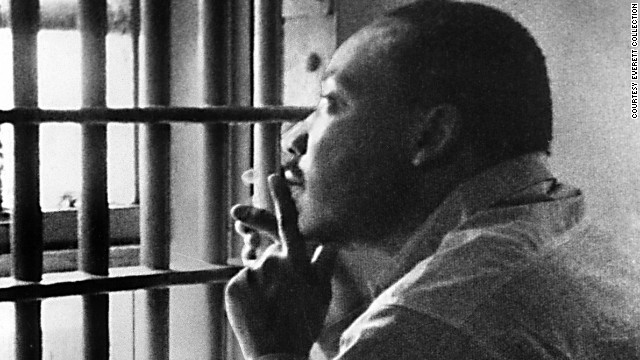
1963 photograph of King in a Birmingham jail cell.
On April 12, 1963, eight, white clergymen published the second of two letters penned in 1963 responding to the changing political climate regarding race and desegregation in Alabama. The April letter, printed in local newspapers challenged the timeliness of civil rights demonstrations:
[…] we are now confronted by a series of demonstrations by some of our negro citizens, directed and led in part by outsiders. We recognize the natural impatience of people who feel that their hopes are slow in being realized. But we are convinced that these demonstrations are unwise and untimely.
King’s response to these clergymen, “The Letter from Birmingham Jail,” first appeared in May 1963 and a later, edited version appeared in his book, Why We Can’t Wait, in 1964. Responding to the clergymen’s critique of the timeliness of the demonstrations, King contends that:
we have waited for more than 340 years for our constitutional and God-given rights. […] Perhaps it is easy for those who have never felt the stinging darts of segregation to say, “Wait.”
Ultimately King concludes that an act of empathy is required to understand the difficulty of waiting. As he writes, “[t]here comes a time when the cup of endurance runs over, and men are no longer willing to be plunged into the abyss of despair.” For me, King’s letter clearly emerges as having greater moral authority than the clergymen’s letters.
The arrogance of these eight men with respect to King’s response to their open letter is apparent in their claims of being wounded by its contents. Jonathan Rieder, who articulates a common yet unchallenged assertion that King, “never bothered to reply personally to his critics, a failure they found wounding and even exploitive” is problematic. Only through an embrace of racial paternalism and racial superiority does one find it reasonable to claim that King wounded and exploited these men when they published two open letters without consulting him even one time. Those clergymen did not seek King out as they made their public statements and did not have them approved by King, so why would they expect that of him? Again, the moral authority they claim is illegitimate in light of its reliance on white supremacist logic.
Rapper, Nelly, was recently featured in a discussion regarding his dying sister’s need for bone marrow and the “timeliness” of a conversation about representations of women in the media.
I have been thinking about these letters in light of a recent interview rapper, Nelly, gave to HuffingtonPost Live in response to Marc Lamont Hill’s questions about the national attention a bone marrow drive received that Nelly planned to host at Spelman College in 2004. This drive became a site of protest for some students who questioned the use of their campus, one belonging to black women, in uncritically accepting the rapper’s project in light of his portrayal of black women in his videos; particularly, “Tip Drill.” Now, if you have not seen this video, let me warn you, it is beyond Triple-X rated; it’s just straight up nasty! One can clearly understand why young black feminists would take issue with this video. When the student group learned that their Student Government Association (SGA) agreed to host Nelly’s bone marrow drive for his then dying sister, these students required that he engage them in a conversation concerning his video, “Tip Drill,” and the representation of black women in the media in general. He decided that Spelman would not be the venue for him to host the drive. Despite this, Spelman students along with the help of a local D.J. held the bone marrow drive at a local mall and registered over 300 donors. According to Nelly, their request for a conversation was ill-timed.
In the interview with Hill, Nelly challenges the urgency of this conversation given his sister’s mortality. Today, those former students who were responsible for requesting the conversation as well as one of the professors whose class served as a foundation for grounding their activism (along with another women’s studies course), appeared on HuffingtonPost Live to share their perspective on the events that transpired in 2004. Even as a feminist, I don’t find the lines of moral authority here as clearly defined as I did when considering the Birmingham letters of ’63.
First, it’s not clear to me that a man who would make such a nasty video would have much to offer by way of critical interrogation that would make having a conversation with him worthwhile. To that end, the letter the white clergymen composed and King’s written response offer a model of protest that actually offers criticism of “conversation.” As King notes in the “Letter,” “[t]oo long has our beloved Southland been bogged down in a tragic effort to live in monologue rather than dialogue.” In American culture at least, the presumed “conversation,” often boils down to a lecture given from the ideological standpoint of the interlocutors. To King’s point, though he wishes this weren’t the case, there is no dialogue; just two clearly staked positions. I am curious to know what the Spelman students actually thought would come from a “conversation” with Nelly. What did they actually think he would say? What words might be satisfactory? Too, I also wonder about the content of the “conversation” these students had with members of their own SGA. Were they in agreement over the need for “conversation?” Were they seen as having an equal voice in the decision to add a requirement to Nelly’s bone marrow drive at the College?
Moya Bailey, the past president of the feminist organization that sought to hold Nelly accountable for the depiction of black women in his videos, addressed many of the issues Nelly put forward in his interview with Hill through an open letter. Two things that the letter doesn’t address are most interesting to me in light of the history of “timeliness” identified in the exchange between the white clergymen and King in 1963. For Bailey, “timeliness” gets associated with Lilly Allen’s video in its heavy citation of “Tip Drill,” but what about “timeliness” in the way that Nelly raises the issue? Did the request for a “conversation” with him have the same urgency as his sister’s mortality? Given that there was no timeline given to Nelly concerning when he would have this conversation, why not ask at a later time? To that point, even King had to accept a more nuanced view of “timeliness” and morality after the bombing of the Sixteenth Street Baptist Church on September 15, 1963. Though King wanted to return to Birmingham, prominent black leaders in Birmingham, with far more conservative views, ended his hopes for reviving demonstrations there. “Timeliness,” then, can be greatly informed by the fact of human loss. One wonders how this understanding framed how the Spelman activists reflected upon Nelly’s sister.
Though Jelani Cobb addressed the open declaration of physical violence against women that Nelly asserted in his expressed desire to “kick somebody’s ass” over the protest, Bailey’s letter supports the maintenance of such violence. Her claim that she’s “ready” once Nelly names the time and place for a throw down misses an opportunity to not only address physical violence against women but also the ecology of violence that normalizes the rape culture Nelly glamorizes in “Tip Drill.”
Marc Lamont Hill made it clear in his conversation with the former Spelman protesters that he invited Nelly to enter into conversation with them, to offer his response to their stated position, and other such configurations allowing him to share his views. Honestly, if I were Nelly, I wouldn’t take any of them up on such an opportunity. As the conversation is being framed, a meaningful engagement over appearance and reality doesn’t seem possible in that forum. What can he possibly say to assuage the obvious fact that his raunchy video does not support a feminist point of view? Let’s say he gets that–understands it, now what? What kind of “love” is Bailey suggesting as she closes her letter when only a sentence before, she’s talking about being ready to fight this man?
The moral complexities of this case are quite compelling. There is no easy resolution; no clear winners…and it just be’s like that sometimes.
The coverage of the violence Miami Dolphins guard Richie Incognito directed towards his teammate, offensive tackle, Jonathan Martin has been problematic in the way that it questions Martin’s masculinity. Martin left the team due to the emotional stress of having received voicemails, such as this one, from Incognito:
“Hey, wassup, you half n—– piece of [expletive] . . . I saw you on Twitter, you been training ten weeks. [I want to] [expletive] in your [expletive] mouth. [I’m going to] slap your [expletive] mouth. [I’m going to] slap your real mother across the face (laughter). [Expletive] you, you’re still a rookie. I’ll kill you.”
Reportedly, another teammate threatened Martin’s sister:
‘We are going to run train on your sister. . . . She loves me. I am going to f–k her without a condom and c– in her c—,’
In addition, Martin surrendered $15,000 to Incognito for an unofficial team trip to Las Vegas that did not include him. Given this history, when Martin sat down for lunch and all of his teammates left the table, Martin decided that that would be his final day with the Dolphins.
Bullying provides the general frame for this vile story, but that term does not seem appropriate here. Bullying conjures the actions of school children and adolescents viciously accosting one of their peers. Using this term to describe Incognito’s behavior makes his actions appear childish and thus Martin’s response becomes overly dramatic; like a woman’s response. Even though I find Lawrence Taylor to be disreputable, his place in the Football Hall of Fame makes his opinions credible for some sports journalists, commentators, and fans. Taylor’s public comments questioned Martin’s toughness for a sport like football when he remarked, “if you’re that sensitive and weak-minded, then find another profession.” The conversation on NPR’s Tell Me More explicitly questions Martin’s masculinity through a segment of the show called “The Barbershop” that features Michel Martin discussing current issues with a pretty consistent group of male journalists. “Should Jonathan Martin ‘Man Up’ Or ‘Leave it on the Field” identifies the title of their discussion on the offensive tackle’s departure.
I will accept the term harassment to describe the violence Martin experienced in the locker room, on Twitter, and through voicemail but I think terrorism is an even better term. The ferocity of the racist and sexist violence that characterizes Martin’s experience with his teammates doesn’t recall a scene on the playground where you have a chance of coming out alive, but instead recalls the spectacle of a lynching. This notion that Martin could “man up” and defeat a mob of people determined to harm him is unreasonable (unless the expectation is that Martin should unleash the black beast within). Martin did exactly what a free man can and should do: he got away from the mob.
In his first public comments to Fox Sports after being suspended from the Dolphins for “actions detrimental to the team,” Incognito claims to be Martin’s best friend on the team. He further contends that his messages to Martin did not emerge from spite, he claims:
I can just sit here and be accountable for my actions. And my actions were coming from a place of love. No matter how bad and how vulgar it sounds, that’s how we communicate, that’s how our friendship was, and those are the facts, and that’s what I’m accountable for.
Terrorism is not an act of love. I never did understand the title of Eric Lott’s book Love and Theft: Blackface Minstrelsy and the American Working Class. Defining racism as love reflects its pathology. Blackface Minstrelsy mocked black humanity and suffering. I can’t find the love in that spectacle. Neither can I find the love in Incognito calling Martin “a half nigga piece of shit.” According to Incognito, “nigga” and other derogatory terms get thrown around the locker room constantly. Apparently, Incognito’s African American teammates support his claim that he is not racist and that his use of the term was cool with them. No one ever seems to question the authority white people seek from black people in asking if it is acceptable to degrade blackness. Over the years, I’ve read stories where coaches and teachers defend the decision to use the term “nigga” because they got sanction from their players or their students. Players do not have the authority to determine practice or game schedules and students do not have the authority to design and grade their own tests but when it comes to whether or not a white person can use the term “nigga,” all of sudden that authority rests in the hands of black people? It bothers me that those foolish Dolphins’ players don’t understand the problem with a white person asking them if it is acceptable to degrade them. It also bothers me that black culture gets very little acknowledgement for what it has offered American culture in terms of culture, morals, and values but when it comes to using the word “nigga,” because black people use that term, it is somehow a model that everyone should follow; it’s just absurd.
Lawrence Taylor was partly right when he said that Martin was “sensitive.” I see Martin as someone “sensitive” to history; as someone who then understands that “the only good nigga, is a dead nigga,” so he got the hell up outta there and good for him.
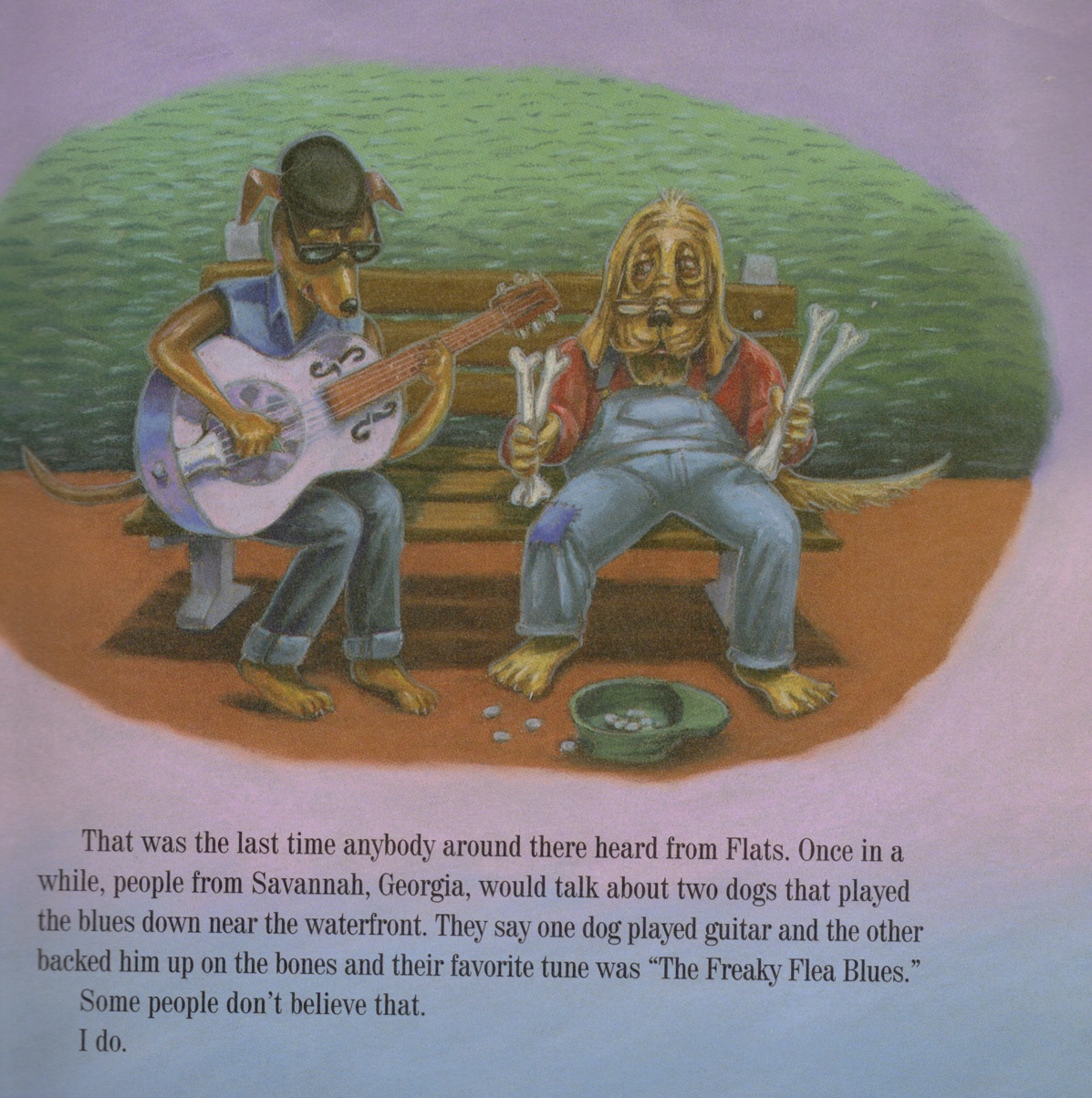
When my friend Carmen first told me about Walter Dean Myers’s book The Blues of Flats Brown, I knew that I had to get it for my son. The story is about these two dogs, Flats and Caleb, who are the unfortunate wards of a junkyard proprietor named A.J. Grubbs. Flats and Caleb flee the junkyard after a terrible fight between Caleb and a dog Grubbs has recruited for the task. After he vows to have Flats fight the next day, the two dogs make haste before the fight can take place.
Flats and Caleb survive, with Grubbs hot on their trail, by singing and playing the blues. Eventually, Grubbs grants Flats his freedom when he hears Flats sing a song that reflects his understanding of Grubbs’s character. At that point, Myers writes one of my favorite lines in the story. Everyone thinks that Flats will stay in New York and make lots of money but Myers writes that what “they didn’t know was that Flats was a blues playing kind of dog, not a filthy rich kind of dog.” Flats has “another model by which to live.”
The Blues of Flats Brown by Walter Dean Myers and illustrated by Nina Laden
The idea that he’s not eager to dedicate himself to making money reminds me of an essay on representations of the poor where feminist critic bell hooks decides that representations of poor people in American popular culture show them spending all their time longing for money and the material things it can buy (reality t.v. now does the same thing). She contests this vision with memories of her poor and working class family members who valued creativity and integrity over money.
In The Blues of Flats Brown, Flats and Caleb’s friendship and their ability to sing the music they love means more than living in a big city and making lots of money. Myers notes that some people don’t believe it when they hear the story of two dogs playing the blues down on the waterfront in Savannah, Georgia and I’m sure in part, they don’t believe it because they cannot believe that Flats would choose to give up the chance to be rich. For Flats, wealth was an indulgence of a different order. It involved the time to be creative and to enjoy camaraderie through creation. The way I see it, then, Flats didn’t give up being rich. He exchanged one idea of it for another. Thus, Flats was rich.
Recently, Walter Dean Myers was named the National Ambassador for Young People’s Literature. I read a wonderful interview conducted with Myers in light of this award and he offered thoughtful words on the role reading plays in contributing to the kind of wealth that Flats enjoys. “It’s the people who read well,” Myers tells the interviewer, “who are going to live a good life.” I especially like the way he qualifies reading. It’s not just reading itself that will lead to a good life, but Myers stresses the importance of reading well. Reading well demands time, attention, discipline, and focus. It requires deliberateness. These are all qualities that the skill itself does not demand but this additional effort makes the experience worthwhile because, as Myers also notes, this sort of reading “will give you clues to how to live your life.”
Myers chose the banner “reading is not optional” to serve his campaign to encourage youth literacy. I have not won a single award for children’s literature so the Library of Congress (loc) won’t be calling me to ask about my banner choice but in the spirit of reading and imagining, if the loc were to call, I would tell them that my banner to encourage reading should say “reading is seductive.” I first thought about the seductiveness of reading after thinking through a passage in Toni Morrison’s novel Paradise. Consolata asks Mavis to help her in shelling pecans. As Mavis sets to work, Morrison writes:
Later, watching her suddenly beautiful hands moving at the task, Mavis was reminded of her sixth-grade teacher opening a book: lifting the corner of the binding, stroking the edge to touch the bookmark, caressing the page, letting the tips of her fingers trail down the lines of print. The melty-thigh feeling she got watching her. Now, working pecans, she tried to economize her gestures without sacrificing their grace. (42)
If I were asked, I would play up how enticing reading can be. Of course the challenge would be trying to ensure that my message wouldn’t become vulgar, which seems to be the penchant in American culture. But for those of us who find reading seductive, the challenge of convincing others to be similarly enticed remains constant; so perhaps it would be a worthy campaign banner if the loc ever comes calling.
I think I might have seen an advertisement on television promoting the new season of The Real Housewives of Atlanta. In advance of the new season’s launch in early November, I thought to re-post my thoughts on the show because they’re sure to be relevant because nothing on the show ever seems to change.
Natasha Trethewey’s poem “Tableau” from her book Domestic Workfeatures a man and a woman pretty much in repose:
At breakfast, the scent of lemons,
just-picked, yellowing on the sill.
At the table, a man and woman.
Between them, a still life:
shallow bowl, damask plums
in one square of morning light.
The woman sips tea
from a chipped blue cup, turning it,
avoiding the rough white edge.
The man, his thumb pushing deep
toward the pit, peels taut skin
clean from plum flesh.
The woman watches his hands,
the pale fruit darkening
wherever he’s pushed too hard.
She is thinking seed, the hardness
she’ll roll on her tongue,
a beginning. One by one,
the man fills the bowl with globes
that glisten. Translucent, he thinks.
The woman, now, her cup tilting
empty, sees, for the first time,
the hairline crack
that has begun to split the bowl in half.
I’ve thought about this work a great deal since the very first time I read it. I love its elegant simplicity.
I imagine the man and woman as a married African American couple. I admire their ability to be still together, quiet, and comfortable enough with one another to take leave of their partnership to think their own thoughts and to have their own ideas about everyday things. Their peace enables them to see mundane things anew. While the “hairline crack” in the bowl might suggest something ominous about their relationship, I choose not to interpret the ending in this way. I see that “hairline crack” much like the “chipped blue cup” that the woman sips tea from: a mark of character as well as a feature of the cup. Flaws do not make items disposable for this woman. The cup has not lost its value as a conveyor of her morning drink. Despite being chipped, the cup still works.
The representation of an African American married couple who can be still together and quiet counters the representation offered on The Real Housewives of Atlanta. The tableau of African American married life on this show stands in direct opposition to Trethewey’s beautiful still life. The characters presented on this show do not seem committed to preserving anything despite functionality. They constantly shop for new things whose meaning seemingly derives from its brand name rather than its use. This show interprets the meaning of African American married couples spending time together, at least the significant part of it, as mostly scheming to make more money. I see very little beauty here. Why are we supposed to want lives like these women have?
I was really moved to see the cast showing a common understanding towards Kandi’s heartbreak over her daughter’s poor relationship with her father. What troubled me though was that you don’t ever see any of the women most concerned for their children’s relationships with their fathers doing anything that would improve them. In one episode, Sheree takes her son tennis shoe shopping and she makes some disjointed claims about the relationship she wants him to have with his father. I don’t actually remember what she said but I remember thinking that she would swear up and down that she talked to her son about his father but how little talking actually occurred. I thought the same thing when I saw a clip from an episode featuring NeNe talking to her son. Their descriptions of themselves as party starters, however, does not support their ambition to offer meaningful talk; that requires quiet. Meaningful talk requires thinking through what to say and how. The Real Housewives makes no effort to depict people who spend any time strategizing how to talk. What they offer is a process involved in being mean spirited: Step 1: Make a lot of noise. Step 2: Read nothing. Step 3: Busy yourself with a series of mindless tasks. Step 4: Meet a friend for dinner. Step 5: Talk to your friend over dinner. Once you get to Step 4, you begin to see how following these steps put you on a road to destruction because they gave you nothing to discuss once you reached the fifth step. The only thing these steps prepare you for is being mean spirited; a disaster.
I think that the cast of The Real Housewives of Atlanta were sincere when they claimed to want their children to have better relationships with their fathers. I also think they were being sincere when they talked to their children about this. However, really being of service to one’s children would require making use of a different series of steps: Step 1: Be quiet; don’t make any noise. Step 2: Read something. Step 3: Focus on what you read; think about it. Step 4: Discuss what you read with someone who spends more time being quiet and reading than you do. Steps 1-4 prepare you to offer advice, but before saying anything, it is extremely important to repeat Step 1.
Step 1 is where Natasha Trethewey’s poem centers all of its action. Those two people aren’t gettin’ the party started; they aren’t spending any money. What they are doing–together–is giving life careful attention. They are catching their perceptions up with the world going on around them. They are making careful observations and adjusting themselves to meet them (i.e. the woman turning the cup so as not to sip from the “rough edge”). They are executing a model of living that I find most attractive. It’s a life that we can all have without spending a dime–so don’t expect to see this life on television; it wouldn’t be attractive to sponsors.
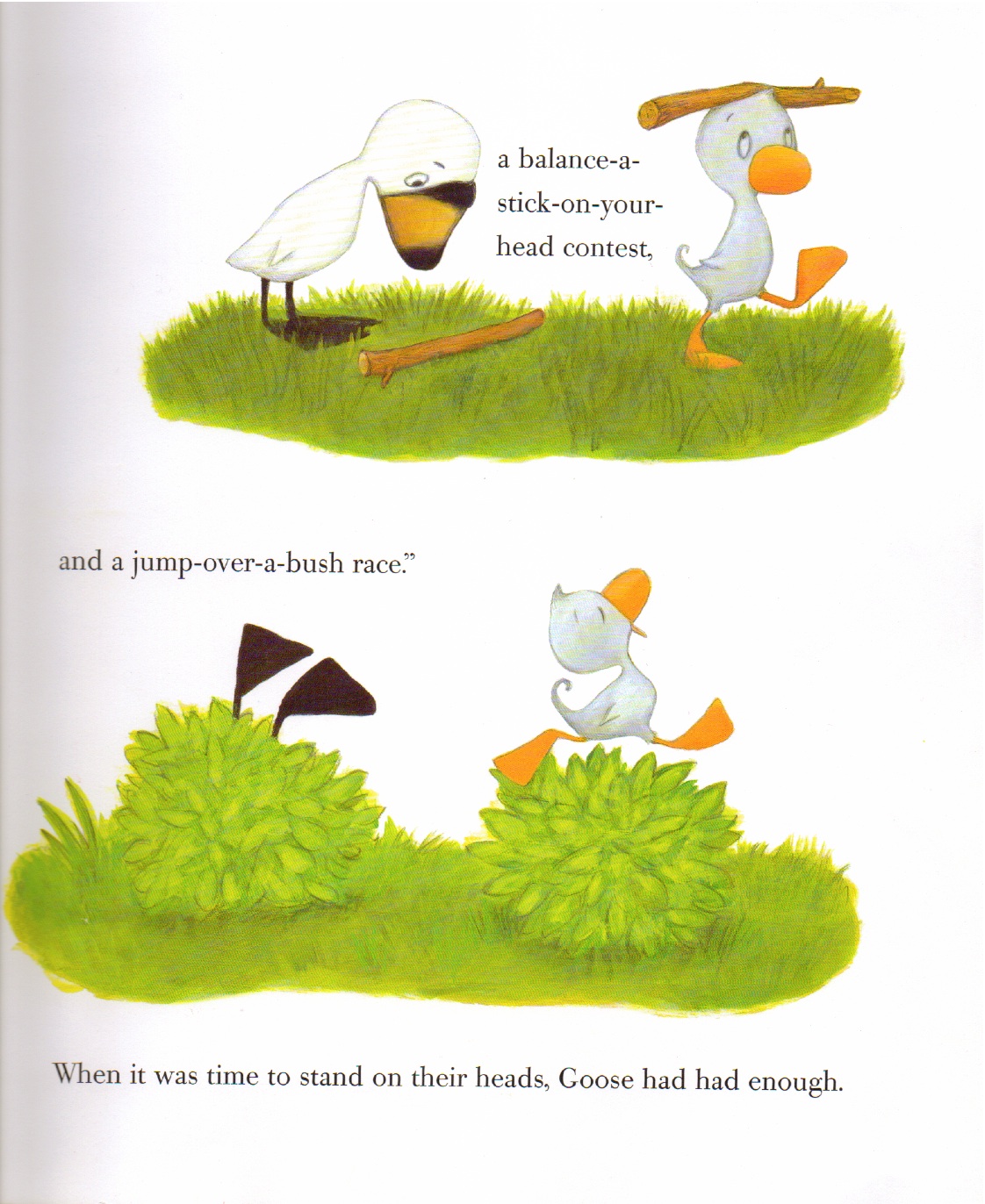
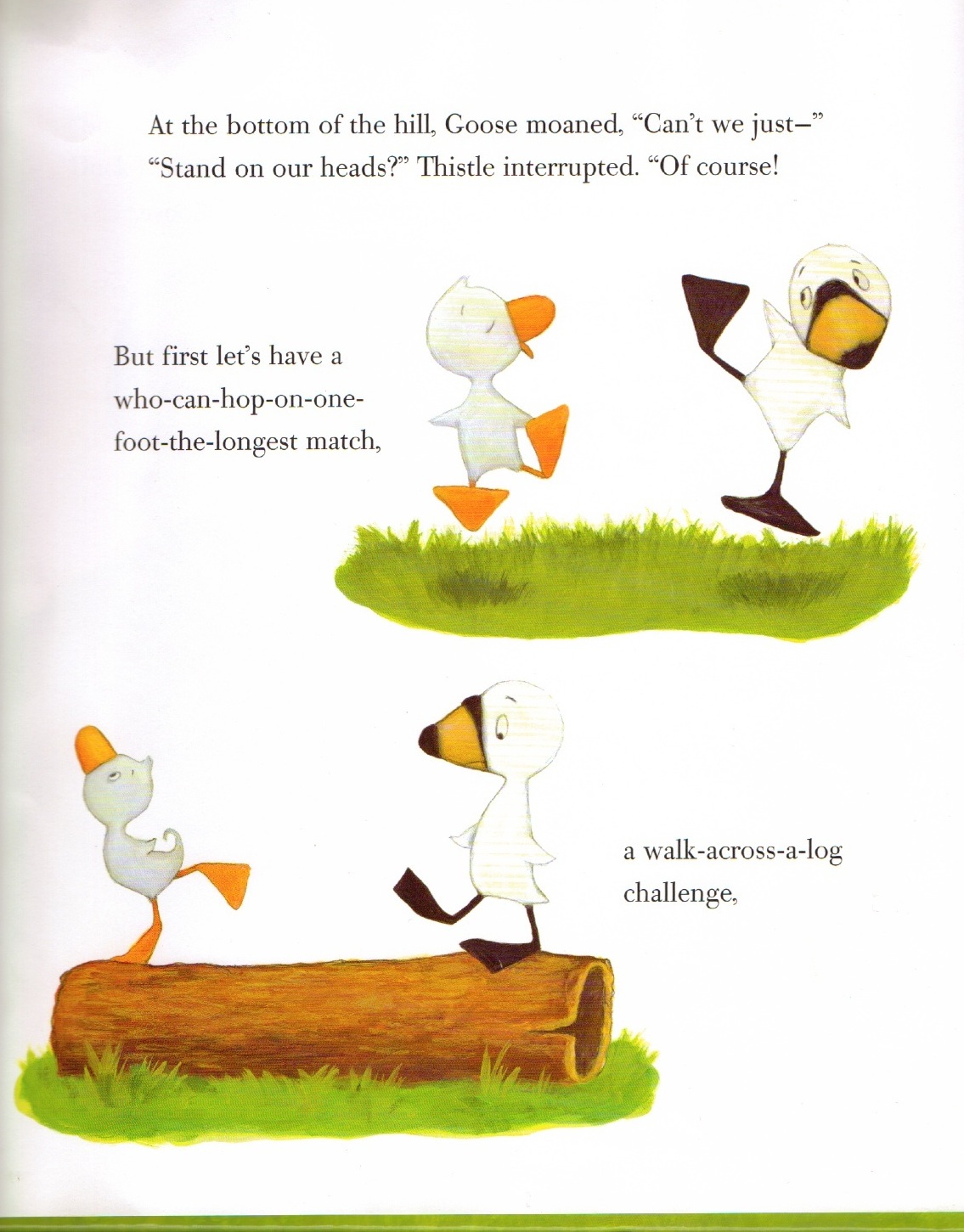
Usually, I end the evening with my son reading first, Duck and Goose followed by Duck, Duck, Goose both by Tad Hills. In the first book, Duck and Goose discover a ball that they mistake for an egg. In responding to what they take to be the egg’s needs, they develop an appreciation for one another that blossoms into a friendship. In Duck, Duck, Goose a new duck, Thistle, introduces competition into what had been a mostly cooperative relationship. My favorite part of the book occurs when Goose decides that he has had enough of Thistle’s contests.
Tad Hills. Duck, Duck, Goose. Schwartz and Wade, 2007.Tad Hills. Duck, Duck, Goose. Schwartz and Wade, 2007.
I love that Goose has boundaries. Though he acts as a good sport and participates as much as he can in Thistle’s games, he ultimately decides to move on to something else. “I’d rather look for butterflies,” he decides.
I thought about this recently as I’ve been reading Vanity Fair’s special commemorative issue on John F. Kennedy. I haven’t gotten to the essays devoted to the fatal crash that ended his son’s life, but I recalled another Vanity Fair article about John F. Kennedy, Jr. based on an excerpt from Christina Haag’s memoir, Come to the Edge. Unlike VF’s description, I found nothing “magical” about the trip Haag and John F. Kennedy Jr. took to Jamaica. I judged his “fearlessness” to be reckless and their “romance” to be patriarchal. The example that proves the case is the story Haag relates of the time he took her kayaking in Jamaica after she had broken her foot. Before they encounter the reef that could have killed them or the “enormous swell” that might have, she describes her reluctance and offers his response:
” ‘It’s a reef–turn back, King,’ I heard myself saying in a voice much higher-pitched than my own. We paddled back out and convened. ‘You’re first mate and I’m captain, but we’re a team and I need you behind me,’ he said. ‘If we pull in and you say no for any reason–any reason at all–I’ll turn back.’ He kept his eyes on me and waited. There were bits of dried salt on his large brown shoulders. I wanted that desert-island fantasy, sand and all. I also wanted to feel powerful, as afraid as I was. And somewhere in the mix, I wanted to please him. ‘O.K. But you promise?’ ‘Don’t worry, I promise.’ ”
I had to read this several times before I felt certain I understood what happened. I was confused by the conversation following Haag telling Kennedy, who she affectionately called King, to “turn back.” She told him to “turn in” and he didn’t so how could they even be having the conversation they presumably had where Kennedy tells Haag that if she tells him to turn in for any reason, he will? Though I completely sympathize with Haag’s desire to want to please and found it admirable that she admits this, I did not regard this scenario as attractive. Kennedy seemed insensitive and self-absorbed. There is nothing magical or romantic about someone ignoring you and asking that you forsake your concerns for theirs; that’s just manipulative.
I haven’t seen this “magic” in any of the articles that I’ve read in the commemorative magazine either. There is so much infidelity in the relationships being described that I can’t keep up with it. Too, the friendships all seemed so fragile and dependent on status and wealth. What the magazine presents as glamourous looks quite ugly to me; it appears to me to be a world without boundaries. I guess that’s what I like about Goose, he knew when he had enough. Knowing when to stop, yeah, that’s attractive.
I finally had a chance to sit down and watch Free Angela and All Political Prisoners. I found it absorbing. Shola Lynch’s beautifully organized, thoughtful film offers an intriguing portrait of Angela Davis that sharply contrasts with the iconic Davis that all Americans presumably know. Knowledge based on her halo-like afro and her leather jacket have come to represent Davis’s total being through terms completely divorced from their political significance. Lynch’s documentary unpacks what Davis herself has critiqued as the reductionist symbolism of her appearance as a “politics of fashion,” through an engagement with how her self-presentation communicated a revolutionary “politics of liberation.” Davis’s embrace of anti-establishment ideas that critiqued capitalism, racism, and sexism infuriated those committed to the flourishing of a system of domination as an order that secured their wealth, power, and authority.
One of the reasons Lynch’s film succeeds is because Free Angela and All Political Prisoners manages to reveal a relationship between radical politics and oppositional consciousness to a profound sensitivity towards human suffering. The documentary casts Davis as deeply committed to a politics that could expose the humanity of those whose suffering derived from deliberately manipulated injustices. For Davis, prisons function as a site for highlighting gross efforts to dehumanize and then to exploit the vulnerability of people of color through a teleology that presumes their criminality. In contemporary terms, the brilliant writer Kiese Laymon describes this telos through one’s birth assignment, “being born a black boy on parole” is how he terms it. The achievements found in both Lynch’s documentary and Laymon’s writing stem from their ability to depict the emergence of an incisive, strident , radical critique through the efforts of quiet, reflective practices requiring deliberate and focused reading, patience, and attention.
In interviews that I’ve read with Davis regarding the film, she has been asked to comment on the similarities and differences between the 1960s and ’70s and contemporary culture. True to form, Davis is very generous in her evaluation of present youth activism. To my mind, Davis is an honest and brilliant woman so when she makes this claim, I can only assume that she’s thinking in global terms. Because if she’s speaking about American youth, I just don’t see it…but maybe I’m not looking in the right places.
Popular culture and social media are certainly not the places one should look for an oppositional consciousness. I thought about this recently as I watched Rihanna’s video for “Pour It Up.”
If you have not seen this video, I should caution you, before you decide to hit play, to hide your children first. Distract them with something, ANYTHING, for about 30 minutes so that you can view this 3:17 video in private and devote the remaining time to praying, crying, or shouting because you will need to do something to prepare yourself to answer the question, “what has become of freedom?”
While I identify myself as a feminist, and have done so for a very long time, I don’t see anything liberatory in glamorizing the lives and the choices of desperate women. When I have made this claim in discussions with young women, they are quick to denounce my views as being aligned with conservatives and elitists bent on “slut shaming” women for using their bodies however they please. Admittedly, I don’t understand how one can reasonably assert that someone might be “pleased” to perform such labor? Doesn’t a system of domination limit the choices of some women so that what they think of as available options contrasts sharply with women privileged enough to recognize, to claim, and to expect other options for supporting themselves? In a culture where great emphasis is placed on human worth being linked to expensive clothes, how would it be possible that this same culture extolls those whose work requires nudity? Routine, public nudity can’t possibly signify haute couture; though “Pour it Up” tries to make a strong case for it.
In recognizing the value of a feminist viewpoint, I understand that the music industry is the engine shielded by Rihanna’s explicit performance. And while I recognize its culpability, I don’t understand what it means for her to be rich. How does all this money, that her lyrics extoll, enable her freedom? It seems to me that if you have a lot of money, then your work wouldn’t require nudity; you could afford to be clothed in all that expensive shit that money can buy. What the fuck is money for if it doesn’t free you from the choices that desperate women sometimes make? Rihanna, and this nasty ass video, represent, at least for me, the implausibility of American youth facilitating revolution: they’ve got a fucked up view of freedom. [Isn’t it interesting how we can see the ugliness in words and language but not in the cultural inscriptions on (black women’s) flesh?]
Young Americans appear to have no investment in freedom and its role in facilitating a person’s ability to lead lives of dignity and integrity. It’s as though those words have no currency anymore; no value. In Free Angela and All Political Prisoners, freedom, dignity, and integrity were used repeatedly to articulate the meaning of injustice; indecency had meaning. How might activism proceed in a culture wherein indecency may be substituted for glamour? It’s an intensification of the problem Angela Davis identifies in substituting a “politics of liberation for a politics of fashion.” Our current enchantment with indecency not only obscures, but strangles the possibility for the emergence of “other models by which to live,” which interestingly enough, essentially constitutes a review of the ambitions of generations of activists who fought for the righteousness of decency. Angela Davis is still with us and she is still advocating for a world where every person can live with what Martin Luther King, Jr envisioned as one where every [person] respects “the dignity and worth of human personality.” I just don’t see how the ostensible razzle-dazzle of stripping gets us to a better place.
More and more, I’m beginning to see the political significance of beauty; the weight of beauty that Ben Arogundade understands as a “human rights issue.” In order for freedom, dignity, and integrity to matter, for Davis and King to be intelligible, you’ve got to be able to see the ugliness of “Pour it Up.” In order for that to happen, the social critique facilitated by the quiet, diligence, patience, and literacy that Davis values would have to triumph over the speed with which one can upload a new “selfie;” do more than view provocative discussion through the lens of “hot topics;” and value clear, concrete, expression over allowing the claim of “feeling some type of way” about an issue to hold meaning. I wish I could see what Angela Davis sees in young people, but the fact that I don’t helps me see and truly understand what it means to be visionary.
Postscript: Gloria Steinem on Miley Cyrus
According to on article on the Huffington Post, Gloria Steinem has no criticism that would “shame” Miley Cyrus given her infamous 2013 VMA performance and acknowledges “the complex context of Cyrus’s manufactured sexuality.” In response to a question about whether or not Cyrus’s performance negatively impacted feminism, Steinhem reportedly made these remarks:
I wish we didn’t have to be nude to be noticed … But given the game as it exists, women make decisions. For instance, the Miss America contest is in all of its states … the single greatest source of scholarship money for women in the United States. If a contest based only on appearance was the single greatest source of scholarship money for men, we would be saying, “This is why China wins.” You know? It’s ridiculous. But that’s the way the culture is. I think that we need to change the culture, not blame the people that are playing the only game that exists.
It’s not clear to me how we’re supposed to change a culture through complicity. And what kind of feminism uses men as a standard for how we imagine liberation? Also problematic is Steinem’s claim that women “have to be nude to be noticed.” What kind of attention is she describing? I’ve never seen Miley Cyrus in a single episode of Hanna Montana but one of the reasons why her VMA performance was so scandalous is because she achieved contemporary stardom playing the role of a wholesome, all-American girl through the character on that television show. Cyrus wasn’t nude on that show and she was “noticed.” In fact, she’s still “noticed.” People are actually discussing this girl’s performance, but what about the “choices” of poor, black, anonymous girls? Does refusing to “shame” Cyrus mean that we create an acceptable space for the ostensible virtue of stripping? Cyrus’s “decision” to participate in the mainstreaming of stripping is shameful precisely because it mocks the violent ecology informing the “decisions” that desperate women make. Miley Cyrus isn’t a good example to use in attempting to critique a culture for subjugating women; unless the point is to underscore women’s complicity in patriarchy. Steinhem doesn’t appear to be making such a critique. Instead, Steinhem wants to emphasize the culture’s role in influencing Cyrus’s choice so as not to focus on an evaluation of her “decision.” Miley Cyrus’s “decision” to sexually objectify herself, like Rihanna’s, is a poor decision…and just a hot ass mess.
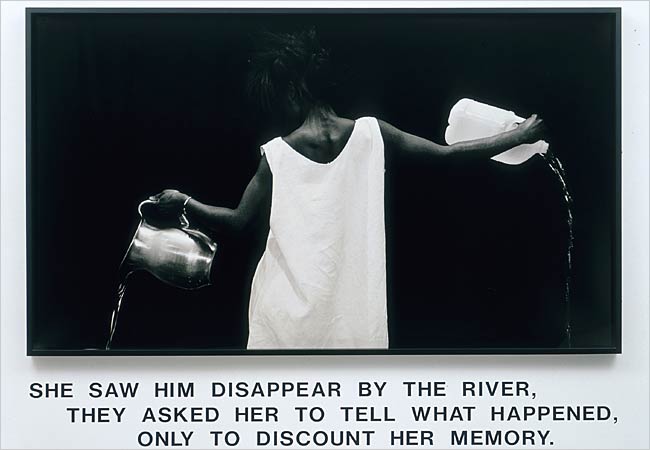
Lorna Simpson offers an alternative response to cultural dismissal that is far more compelling and potentially transformative than anything suggested in the parodies of desperation exhibited in the videos and stage performances of contemporary pop stars. In “Waterbearer,” Simpson constructs the portrait of a woman who claims the integrity of her own witness despite her dismissal:
Like a vernacular Lady Justice, Simpson’s Waterbearer exposes the prejudices of the law. Rather than beg for attention and acknowledgement of her authority, she continues on with her work of weighing and measuring injustice.




 In Reverie Blog