Now that Barack Obama is President of the United States, he symbolizes the possibility of maximizing one’s potential in a way that earlier generations of Americans thought a mere fantasy. For me, Obama represents even broader possibilities regarding how to live in this world beyond where you work. Here are several examples of what President Obama symbolizes as an alternative model of living fully in the world:
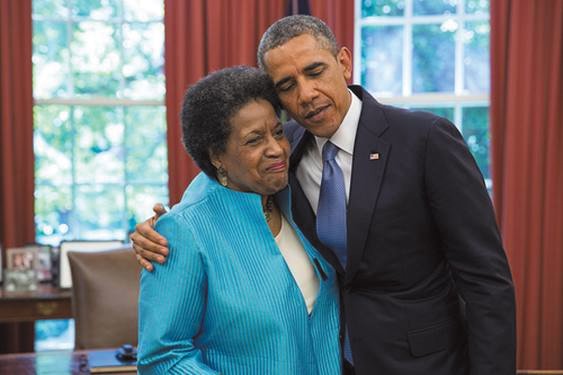
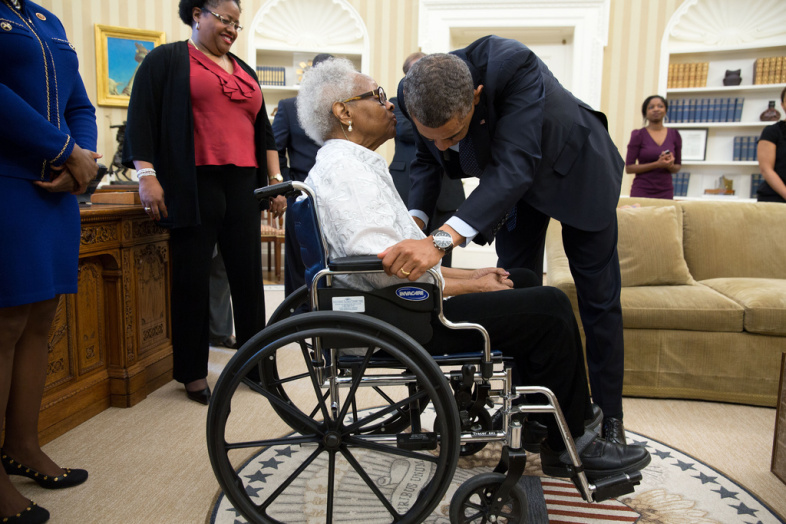
He calls us to honor the past:
President Obama consoles Myrlie Evers-Williams during a ceremony at the Oval Office. WHITE HOUSEPresident Obama listening to Maxine McNair, mother of Denise McNair who at 11 years-old was killed in the bombing of the Sixteenth Street Baptist Church on September 15, 1963.
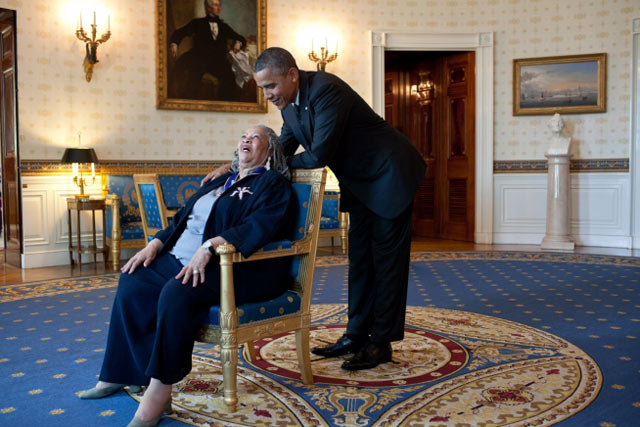
He demonstrates the seductive glory of reflection:
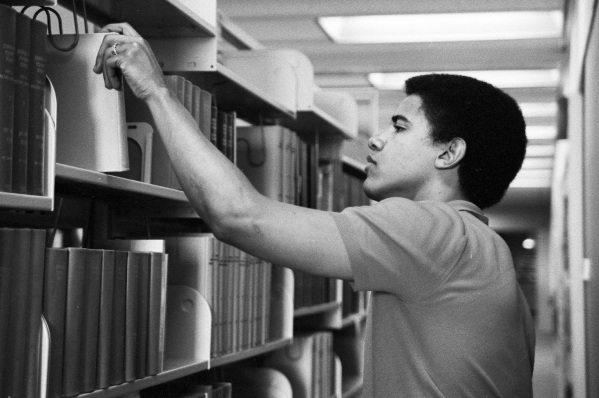
He makes a habit of reading:
He invests in the reading habits of his children:
He cries upon the loss of his grandmother and for the generosity of those young people who worked for his campaign:
Once upon a time, I was in a study group with several very nice, competent, and helpful people. We always began our sessions with a meal and a discussion about what we were reading, watching, and listening to. We all tended to lean towards enjoying the same stories about mountain climbing tragedies and documentary films covering a wide range of topics. Music is where we parted ways. I was the odd person out when it came time to discuss our plans for an evening devoted to our favorite musicians. My group members were all Bob Dylan fans and I was not. Although I understand Dylan’s significance as a songwriter, I am completely mystified by the scores of people captivated by the quality of his voice or even his stage presence. I have a hard time even looking at the man because he seems so uncomfortable when he’s singing.
When I don’t like a singer’s voice, I have a very difficult time getting past that sound. If the sound doesn’t move me, I can’t even hear the lyrics. With Dylan, I came to an understanding of his significance first through reading history and then through listening to other artists cover his songs. The first time I realized the power of Dylan’s songwriting was when I heard Stevie Wonder’s 1966 cover of “Blowin’ in the Wind.”
“Blowin’ in the Wind” became a tune that I wanted to contemplate; imagine the lives connected to the questioning; reflect on injustice. Sam Cooke covered “Blowin’ in the Wind” at least two years before Stevie Wonder and his version is compelling in a different way and conjures the lives of people most likely to laugh at life’s mysteries.
Even though other artists have given me great respect for Bob Dylan, I still can’t manage to make it to the end of any of his songs that he actually sings; can’t do it.
Again, I think the man can write a song; I do. What I don’t understand is what made him ever think he could sing them? I’m far too distracted by Dylan’s voice to pay attention to the lyrics when he’s singing. Developing an appreciation for Dylan’s songwriting skills required rotating someone else’s vocals into his music so that I could actually hear the lyrics. I accept that this may simply be my limitation or a matter of personal taste, but I’m no less stunned. Dylan’s success, however, as a singer/songwriter helps clarify how some Americans come to believe that their goals are within reach if they work hard and commit to realizing them.
My study group members never actually discussed Dylan’s voice. They talked more about their love for him and noted what they read about him. At the time, some filmmaker was in the process of making a film about Dylan wherein various famous people would stand in for Dylan. I have no idea if this film was ever made, but I was sure to tell my group not to invite me to the screening or any of the events they were staging in celebration of all things Bob Dylan. I’m down with protest, consciousness raising, social commentary, but even with that sincere interest, I couldn’t even see myself at a Bob Dylan party. Despite my expressed wish to be excluded from the party, I fully recognize that Bob Dylan has made a significant contribution to the freedom struggle; so I’m cool with his Medal of Freedom…
but notice, when remarks were offered at the award’s ceremony, not a word was uttered about how that brother could sang. Bob Dylan is one confident brother! I don’t know if confidence in myself would get me that far, but the belief he has in himself is worth admiring.
In reading this Huffington post article, I learned about how Lance Underwood, the father of two sons, had the brilliant idea to photoshop his sons into classic album covers. You should check out his Tumblr. My favorite visual remix has to be the one of Underwood’s son as Miles Davis on the cover of Birth of the Cool (I might have to bite this idea and photoshop my Miles into the cover of Kind of Blue).
Mr. Underwood’s notion of teaching his sons the classics is DOPE. His Tumblr provides a very compelling visual example of how our testing culture limits how children are being trained to limit their articulation of “the classics,” or what counts as an important, relevant, or worthy text to know and to engage. It’s lazy and foolish to limit an assessment of what the Underwood boys know about art, history, culture, economics, race, gender, pleasure, philosophy, and marketing to a bubble…the “common” core ain’t ready for them Underwood boys.
As I’ve continued to reflect on standardized tests, I’ve come to another conclusion about their limits. There’s nothing seductive about the thinking they prompt. Conclusions, right or wrong, don’t even hint at the pleasures of puzzling over meaning.
Sometimes I wonder if it’s this teaching to the test stuff that makes young people so bland. Despite all the technological savvy that ostensibly signals the imaginative powers of young folk, I’m not convinced of their sophistication. Recently, I attended a luncheon with a friend who often raves about these high school students in her AP classes. The luncheon was held to honor these students for the excellent papers and projects they submitted for an annual school event highlighting academic achievement. Listening to these children discuss their work, both at our table and on stage was painful. It was like listening to cardboard cut-outs of thinking people. My family wouldn’t have allowed me to be so flat and I think I know how they did it: they imposed an entire cultural world on me and didn’t care one bit if I didn’t like it.
Over the next few weeks, maybe longer, I’m going to provide sources and suggestions for how these texts might look in practice, with the goal of enhancing how we think about what children should be doing with ideas, history, and questions. To do that, we’re going to start with music.
First, if your kid is one who would have probably been at that underwhelming luncheon highlighting bland academic achievement, then said child must have grown up with some familiarity with the likes of Jay Z and Kanye West. Your kid might even be a fan of both rappers, but know this: that kid’s familiarity with the catalogues of these artists does not make that child an expert in music. So, you need to make sure that you do not stand for this child having the temerity to declare that “Otis” is a great song without also being able to sing every line of Otis Redding’s rendition of “Try a Little Tenderness.” The original Otis put his foot in this song! Check out Mr. Redding:
Now, I like Frank Sinatra. He could sing; no doubt about it…but Frank couldn’t do what Otis did (at least he didn’t do it). Redding’s version is so cold you can’t even wait for Sinatra to finish (at least I couldn’t).
So after I would have uttered some foolishness about Jay Z and Kanye’s new song “Otis,” my grandfather would have stopped whatever he was doing and given me all of his attention. “What did you say?” he would have asked. I would’ve repeated my claim, maybe even offered a few lines of the song before my grandfather went back to reading his paper. Not too long after making my declaration, I can just imagine how my grandfather would have called me away from whatever I was doing so that he could get me to tell the people gathered on our porch what I said about Jay Z and Kanye West’s song “Otis.” Everyone would have doubled over from laughing at my foolishness. “This child think she discovered good music,” my grandfather might have said to his tickled audience. On these occasions, I usually silently stood and wondered why what I said was so funny to them. I would have left, in silence, thinking about what everyone was laughing about. Given that these spontaneous schooling moments weren’t followed up with quizzes, tests, or papers I could just think. Typically, what I thought about was what it was I had missed. Why was it so important to know Otis Redding, for example. Why couldn’t I be entitled to my opinion without people laughing at me?
Those episodes of long term contemplation where I was permitted to raise my own questions and to pursue my own line of reasoning influenced my desire for quiet as well as space for reflection. I learned to find satisfaction with provisional answers and to be open to having those ideas evolve. I also would have learned to do some self-directed research concerning a question whose answer would speak to my own desire to know.
I think it’s a very good thing to make your child be quiet; it’s the noise of contemplation. If you provide really good material to aid their reflection, the possibilities for how they handle this material are endless. Otis Redding might have helped to make those cardboard children I had lunch with far more interesting than they thought they were.
To sum up, don’t allow the children in your care to exclusively listen to the music they want to hear. They won’t have enough sources to drawn on in order to talk about music with any depth if you do that. Make children listen to the music you grew up loving, the music your parents imposed on you, and the music their parents imposed on them. Imposing a sonic genealogy on your children will provide them with a foundation and a familiarity with family and cultural history. As your children mature, supplement these primary sources with books, articles, photographs, and films. Here’s a link to a really interesting documentary about Otis Redding (Soul Ambassador) you might consider:
Now, if a “high achieving” student could write about Plato’s theory of the soul and the way memory relates to love, as he proffers in The Phaedrus, and the way Otis Redding defines or articulates a theory of the soul through his catalogue, that kid would supersede the “common” core. That kid would actually be interesting to talk to over lunch.
Though I wasn’t feeling well last week, there were a few commitments that I needed to keep…and those few things took all the strength I could muster. One of the most grueling commitments was to my son’s school where I had agreed to proctor a standardized test for the first grade class. Admittedly, it seemed ridiculous to me that standardized tests would be administered to six-year-olds–still does, in fact–but I agreed to help nonetheless.
Assisting with this test exposed me to even more uncontrolled variables that heavily weigh against the integrity of the assessment. Instead of measuring aptitude, these tests clearly assess student behavior more than what students comprehend. Students’ ability to follow a story, identify shapes, and figure simple arithmetic was evident during the 45 minutes, or so, of the test. As I walked between the students, it was clear that most all of them filled in the correct bubbles for those portions of the test. After that first slice of time, however, there was barely a child in the room with the self-control, discipline, or focus to consistently do their part to show what they knew; they were more invested in escaping time. Several students expressed urgent need to use the restroom or to blow their nose. Administering the test continued despite the various, unscheduled breaks that occurred throughout the day and most students were unconcerned about what they missed. As far as they were concerned, they were able to escape the boring, predictable rhythms of the exam.
On one hand, the teacher might bear some responsibility for failing to prepare her students through daily classroom structure and practices that would have aligned with the behavior needed to control for this variable in corrupting the desired outcomes. On the other hand, there are factors outside of any teacher’s control that influenced some of what I witnessed. Several children, for example, were clearly too sleepy to concentrate on the exam. In their case, going to the restroom may have been one strategy for staying awake. In one particular case, a student’s long stay in the restroom resulted from the meal he had eaten the previous night. The children’s teacher shared with me that many of her students have such busy lives with sports, dance, and visiting friends and family, in-town and out, that whatever means of discipline, focus, and self-control instilled in school are undermined outside of it. Though I see her point, there are other factors working to incite the frenzy beyond the activities adults select for their children. These factors include the instability caused by homelessness, the inability to focus that results from hunger, and the incapacity to enact self-control when one’s caretakers are given to violence.
Much of what I have read lately with respect to standardized tests highlights the cultural bias of the tests and the economic bias that enables middle-class families to pay for tutoring services for their children. My own experience in proctoring a standardized test laid bare the impact of (in)stability as a factor in a child’s life that greatly influences how equipped a student is to consistently demonstrate their understanding of course content through this measure. The conversation that the first grade teacher at my son’s school is prepared to have with her students’ parents about their child’s test results will most likely result in a lecture concerning the social choices parents are making for their children; essentially, she’s prepared to blame the parents for weak scores. What might be more useful, however, is to involve parents in discussions that teachers and administrators should have regarding testing practices and the needs of their demographic. Instead of calling out parents to “sin no more,” schools would be better off addressing what they can control–the way tests are administered–and the reality of their students lives. To that end, students who were typically tardy before the week of testing, were also tardy the week of testing. Given the reality that students in general will be tardy, it might better serve them to schedule exams in the afternoon. National data concerning student outcomes may not have used the conditions of your school’s population in considering what might be best for them. Those kids who didn’t get enough rest the night before testing or who were late to school would have been better served had their test been administered in the afternoon.
Standardized testing makes too many presumptions about the norms comprising students’ lives. The presumptive norms taken for granted here provide fodder for maligning parents while at the same time evading an examination of the biases created through the standardization of ideals.
I watched the ESPN 30 for 30 documentary, Benji, for the twentieth time this weekend. This very moving film tells the tragic story of the shooting death of Chicago basketball sensation Benjamin Wilson. At the time of his death, the 17-year-old was ranked the number one high school player in the nation and so was a highly sought after recruit. As Michael Wilbon attests in the film, stories of promises unfulfilled are often compelling and this one is no less so.
The film features many of Benji’s friends–some of whom had known him since he was just 3-years-old. Every person who chronicles his life and his promise is male, except one person. Though Benji’s mother appears in the film through television footage, she does not author her own words directly for this film, which was made after her death in 2000. The one woman who appears was a friend to both Benji and Billy Moore, the sixteen-year-old shooter. The first ten times I saw the film, I don’t think I paid much attention to the nearly totalizing male voice and perspective, but once I did, I began to think a great deal about how the “bro-mance” works to create a mythical, heroic tale of Benji as an unchallenged truth. While the tragedy is no less affecting given this limitation, other perspectives would have certainly challenged the narrative of good versus bad and innocence versus guilt as the most prominent themes in the film.
The male chroniclers limit their evaluation of Benji’s faults. Despite these limits, Benji’s faults still surface. While the men, for example, extoll the love that Benji had for his girlfriend Jetun Rush, they overlook his aggressiveness towards her as nothing more than the two having challenges in their relationship after the birth of their son, Brandon. What they construct as a lover’s spat is better described as violence over her refusal to give him the attention he wanted. On one occasion, he grabs her and becomes so rough with her that when a teacher intervenes, Benji reacts by hitting the man and knocking him to the ground. According to his friends and family, Benji was incredibly apologetic to his teacher and regretted his actions–as did his mother who was frustrated that her son, the number one player in the country, struck a teacher. No one, however, link his imperfections–as one friend muses–to his aggression towards Jetun. His friends and family seemed to overlook his aggression towards Jetun at school and on their fateful walk to the bus stop where he meets his shooter. To them, Benji looooooved Jetun and this was evidenced by him crying over her, according to his brother, and apparently through what he expressed to his friends. Jetun’s story might have challenged this romantic narrative and highlighted an ego that his friends insisted was totally justified confidence.
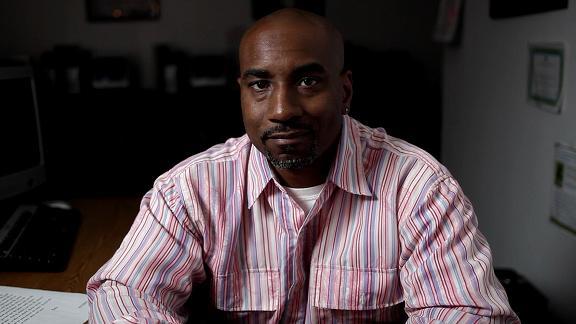
Billy Moore
Rather than romantic love, the more interesting love story that I think the film tells is about forgiveness. Unfortunately, most of this narrative gets displaced in the film and is told mainly through the bonus features. The bonus features grant more attention to Billy Moore, the person who shot and killed Benji. Moore tells of how he accepted responsibility for the tragic act that cost Wilson his life; how he asked Benji’s parents for their forgiveness; how he asked Benji’s friends for forgiveness; and how he continues to work to make a positive contribution to his community. Unlike the romance/bro-mance of the central narrative, the tale of Moore’s quest for forgiveness does not seduce the viewer into a familiar tale of good guys and bad guys. It’s a shame that the love story of seeking redemption doesn’t provide the allure of (b)romance, because, to cite Don Henley, forgiveness really is “the heart of the matter” complicating the fairytales and myths mistakenly taken for history.
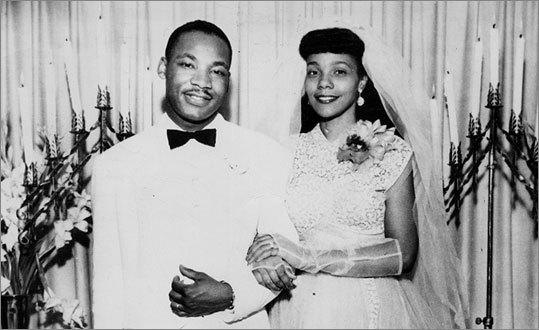
In much of the scholarship one reads about the tragically brief life of Martin Luther King, Jr., one can observe the great efforts scholars make to engage King’s struggles to resolve the tension between a ministry centering on his role in advocating and living a life consistent with the gospels and the private man who was habitually unfaithful to his wife Coretta. The numerous male scholars writing about King overlook the possibility of considering King’s chronic infidelity through his promulgation of nonviolence; instead, they read the fact of his chronic infidelity solely through the lens of King’s religious vocation and the pressures, tensions, and anxieties related to the stress of his besieged life as a public figure. For example, in I May Not Get There With You: The True Martin Luther King, Jr., Michael Dyson asserts this:
“In King’s case, the varied functions of black privacy were even more highly charged. During much of his career, King’s private time was spent where he and his colleagues shaped strategies for social change. King’s time at home was severely curtailed by the inhuman demands of the movement. He spent nearly twenty-seven days of most months in pursuit of the prize of black liberation. Inevitably, this separation weakened King’s sexual bonds with his wife and eroded the quality of time and affection he could devote to her and to their children. To be fair, King’s habits of sexual adventure had been well established by the time he was married. His personal and public circumstances only amplified his sexual indiscretions” (161).
Dyson follows his analysis of King’s serial infidelity to a very thoughtful reading of patriarchy and King’s full embrace of it. No one disputes that King was a male chauvinist who believed that women were not equal to men and thus unqualified to lead. Married women, like Mrs. King, were expected to raise children and keep house.
Others offer similar readings of King’s habitual infidelity. In Jonathan Rieder’s book, The Word of the Lord is Upon Me: The Righteous Performance of Dr. Martin Luther King, Jr.,he recounts a brief conversation that nearly matches the connection Dyson makes between the activism that pulled King away from his family as well as a response to stress. Rieder writes:
“A friend once raised ‘the subject of [King’s] compulsive sexual athleticism…after being prompted by a worried mutual acquaintance. ‘I’m away from home twenty-five to twenty-seven days a month,’ King Answered. ‘Fucking’s a form of anxiety reduction.'” (78)
Rieder’s portrait of King follows his interest in the various rhetorical situations and communities that King addressed, held membership in, and engaged personally. Thus, the ribald language King ostensibly put forward in this exchange reflects his position in a close-knit community that recognized his humanity, respected the fact of his private life and private needs, and accepted him–faults and all.
I can go on and on with the examples of scholars writing about King’s private sexual escapades in relationship to patriarchy, male chauvinism, and the anxieties of being a besieged man, but so far, I haven’t read where any of these very interesting and thoughtful King scholars have associated King’s adultery with his fierce commitment to nonviolence as not just a tool but a philosophy. To that end, while activists marvel at King’s keen understanding of the relationship between adequate wages and human dignity as well as the significance of living with integrity, there is an arresting silence about the limits of King’s vision as it pertains to the relationship between adultery and violence. Perhaps those who discuss the matter assume that in describing patriarchy, they’ve said all that needs to be said about violence, but if that’s the case, there needs to be more interrogation of the limits of nonviolence as a life philosophy when it accepts the violence of adultery. In describing adultery as violence, I aim to place it within the scope of King’s vision and commitment to human dignity and integrity. While King’s infidelity was not made public knowledge until his best bud, Ralph Abernathy exposed it in his autobiography, And the Walls Came Tumbling Down, it was a very open secret to those in the movement–and of course the U.S. Government. So what is intriguing to me is how often these oral narratives offered by King’s friends convey an awareness of King’s infidelity, and not a single Christian one of them ever seems offended that King’s actions could have shamed, embarrassed, and diminished his wife’s efforts to live with dignity and integrity.
I recently finished reading Ben Kamin’s book, Room 306: The National Story of the Lorraine Motel, and despite its great reviews, I found it underwhelming. The interviews are very short and the conversations lack, what I consider to be, rich engagement. One of the more egregious instances of such an occurrence is featured in chapter three, which Kamin titles, “Lover at the Lorraine: Georgia Davis Powers.” Most King scholars cite Powers as one of the three mistresses he had genuinely strong feelings for. In citing her presence at the Lorraine Motel on April 3, when he gives his famous “Mountaintop” speech, and on April 4 when James Earl Ray kills King, there is no further attempt to bear greater scrutiny regarding her witness. Understanding Powers as a party to the violence of King’s infidelity challenges the consistency of Kamin’s presumption that “witness” merely refers to the lethal violence of King’s assassination and not the routine, everyday violence committed against Mrs. King and their children. Failing to recognize the leniency granted King’s routine infidelity implicates many “witnesses” to the persistent aggression King’s entire circle maintained against Mrs. King. The documentary short, “The Witness: From the Balcony of Room 306,” offers an example of what appears to be the easy embrace of such aggression.
The film centers on the witness of Reverend Samuel “Billy” Kyles who was the only person who actually stood beside King when he was hit by the lethal bullet. Kyles and his wife were hosting King and his guests for dinner at their home. While dinner was scheduled for six, Kyles told King the meal would be served at 5 because he knew how casually King regarded time. Though Georgia Powers does not appear in the film, Kamin’s book, and numerous others, report that she and one of her girlfriends were extended an invitation to this dinner party. So far, I have yet to read anyone rigorously engage the fact of Powers’s acceptance into the home of a minister and his wife as the guest of a married man as an affront to Mrs. King. As long as their coupling remained ostensibly discreet, King and Powers were free to disrespect, disregard, and dishonor Mrs. King at will. The one time Powers was prevented by someone in King’s circle from accompanying King was when Powers attempted to ride in the ambulance as King was taken to the hospital after being shot; Andrew Young is credited with interceding at this moment. Powers contends that she spent the rest of that tragic evening at Rev. Kyles’s house surrounded by the dinner prepared in King’s honor. The last time she would see King’s body was when she flew to Atlanta for the funeral where she offered her condolences to Mrs. King.
Overlooking the violence of adultery as an accepted component of a philosophy of nonviolence is an egregious omission. Though Mrs. King was not assassinated, she was routinely assaulted by most of the people who shared her world. It seems to me that the dynamics of nonviolence are inadequately engaged when the violence maintained against Mrs. King is so thoroughly dismissed; it’s amazing that she lived as long as she did given that so many people populating her world were trying to kill her. Nonviolence as both a tactic and a philosophy may have been an effective strategy for building a movement against white supremacy and disenfranchisement, but it certainly doesn’t seem to be an effective practice for black women who try to claim and maintain dignity and integrity for themselves within a marriage. This story, the story of the assault against Mrs. King, makes you question the possibilities of nonviolence as a model for building intimate relationships; it seems to work just fine for citizens and lovers, but nonviolence doesn’t appear to support a wife’s desire to experience the longevity that King longed for. Instead, as nonviolence may serve as an effective strategy for systemic change, at the same time, it expands the ways we can conceptualize domestic violence.











 In Reverie Blog