Models Monday: Keeping Up

I’m not totally averse to an expanded understanding of what it means to keep up with the Jones’s. Though this used to be a caution against competing with our peers over material possessions, it might have some under-acknowledged benefits. I have been easily swayed by arguments like the one I first read by Juliet B. Schor in her work The Overspent American: Why We Want What We Don’t Need. Schor contends that when we were at pains to try to match our neighbors in material gains, we were at least better off financially than when we started trying to keep up with the Hiltons and the Diddys. Our neighbors typically share our financial portfolio, unlike the people we try to emulate who are on television because of their multi-million dollar lifestyles, and so it becomes less costly for us when we try to keep up with the folk next door.

I also think keeping up with the Jones’s might have gotten a bad rap because of our attenuated focus on its association with material possessions. But trying to keep up with people who plan healthy meals for their family, who are organized, or who have beautiful gardens is not a bad idea. The documentary film A Man Named Pearl offers a wonderful example of this. The film focuses on the beautiful topiary gardens of Pearl Fryar. Fryar’s own yard offers a visual feast for visitors from his home state of South Carolina as well as for interested observers around the globe. Interestingly, he has inspired his neighbors to create their own topiary gardens. Their work is also on display in the film and they offer testimony concerning Fryar’s influence on them and their efforts to keep up with him. Fryar enjoys helping his neighbors to develop their topiary and they in turn welcome his support. In this instance, keeping up is cooperative rather than competitive.

If you’ve got a neighbor who conducts themselves with integrity, try to keep up. If you’ve got a neighbor who is thoughtful and creative, try to keep up. If you’ve got a neighbor who is generous, try to keep up. Keeping up with the laudable virtues and talents of our neighbors is much more worthwhile than keeping up with the Kardashians.

Reading with my Father: Slim’s Table (Part IV cont.)

I remember watching one of those bloopers and practical jokes programs with my father, must’ve been during the late 1980s, when he made an observation that was characteristic of him. We must have been watching a segment featuring a common citizen made the butt of a practical joke when my father said, “You know, it’s all fun and games when they get us laughing about these crazy jobs they want these people to do, but once the joke’s over, these people ain’t got no job.” “That’s true,” I said. “Yeah man, that part ain’t funny–at all.” I never forgot that aspect of reality as it became masked by the joke. Did the television producers who created the joke find work for the person who got us to laugh? My father’s remark made me think about how much time someone might’ve put into looking for a job and the relief they must have found once they secured one. How did they react when the joke was over? Did they simply head back to the drawing board cheerfully optimistic about their chances for landing an actual job the next time around? 

My father’s engagement with the television program was a mode of viewing that I routinely experienced as the common practice of those around me. People talked back to what they saw. I guess that’s why I was surprised later to learn that people passively observed television programs. Too, I understood my father’s way of viewing television as an act of reading. Reading at its best was performed very much like how my father viewed television (and how he read the newspaper, books, magazines, and people): poetically, actively; thoughtfully, fully. Consistently done, artful, active reading enhances noble aspects and expressions of humanity: laughter, empathy, remembrance.

Reading was an important theme in my reading of Mitchell Duneier’s chapter entitled “The Stereotype of Blacks in Sociology and Journalism.” As a reader of this work, I finished this chapter greatly impressed by Duneier’s skill as a reader. He astutely reads the classics of his field; discerning the consequences of sociological jokes masked as truths. I think that my father would have appreciated his skills as a reader.

Cinderella Sharp

I was listening to Michel Martin’s radio show Tell Me More yesterday (January 3) and I caught the tail end of a panel discussion about young people and designer clothing. The event that provided the anchor for this conversation was the killing of a young Washington D.C. man over the Christmas holiday for his North Face coat. Prior to that fatal event, he had been accosted over another designer item. Thus, this young man’s experiences underscored the violent character and lethal consequences of materialism in American culture. It also became the grounds for discussing parenting and identity. At one point, Martin described the role of designer brands in the lives of professionals. Lucky for me that I have chosen a profession where designer clothes don’t matter…or better yet, if they do matter, I haven’t noticed…or maybe I have just chosen another model.

I don’t think that I know the threshold for being well-dressed and being out of fashion but I know for a fact that even on the days when the culture at large would agree that I was sharp, I have been insulted. Typically, I dress counter to the “Cinderella Sharp”

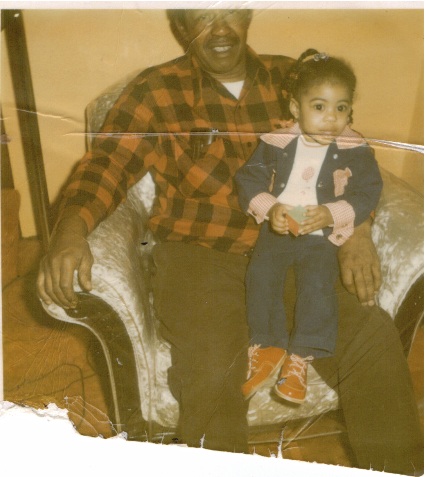
Grandpa and Me at Betty and Thomas's house.

style that my father said described people who went to church in their best clothes only to come home to ask my lumberjack shirt wearing grandfather for some cash. While I appreciate the feel of a well-made shirt and the fit of a perfectly tailored pair of pants, style never manifested for me the life that I imagined it would. Somehow, I imagined that style would contribute to an elegantly lived life but what I’ve discovered is that if you leave your house, you can be subjected to all manner of insult despite your attire.

Take this Christmas season as an example. My husband and I took our son to his three-year-old well visit and we were both smartly dressed. Instead of the football fan gear we’re both given to wearing, we were doing our best Michelle and Barak Obama impressions, sporting professional style clothing that mature, adult audiences would appreciate. Such attire means that we wore nothing flashy or glaringly branded though I did carry a designer bag, wore pearl earrings, and we both wore smart leather shoes. The doctor had not been in that room for five minutes before she insulted both of us. And while this is the first time that I’ve experienced a lack of courtesy from my son’s soon to be former Pediatrician, it certainly isn’t the first time my pearls failed to protect me from rude doctors or their staff. Once while I was wearing them, the scheduler at my former Pulmonologist’s office shushed me when I tried to tell her the days when I could best accommodate a procedure. My purse hasn’t helped much either. It didn’t come through for me at the grocery store when I was kept waiting while some things were sorted out with a woman purchasing groceries using an Electronic Benefit Transfer (EBT) card that allows for the dispersal of funds provided by state governments to needy recipients. After the woman completed her purchase, the cashier turned to me and apologized for the long wait. To which I replied, “no problem; it’s fine.” Instead of scanning my items without further comment, the cashier then says, “well good because it might be you someday.” I was thrown: So as a return for my courtesy, I receive a lecture on manners and turns of fortune from the cashier at my local grocery store? Huh? Maybe she didn’t hear me say “NO PROBLEM.” Or, more to the point of this post, maybe she didn’t see the Coach wallet that I retrieved from my Coach purse. Perhaps she failed to notice the electronic key for the Lexus that I placed on the counter next to the card scanner. (Disclosure: The Lexus is actually my husband’s car. I have only ever bought Fords and plan to only ever buy Fords though I’ll drive whatever is available.)

So my friends, fashion has never come to my rescue. Here’s my take on that stuff (with a little help from Morrison’s Beloved, specifically Baby Suggs’s speech in the Clearing): “You better love it. You.” Don’t expect fashion to make people respect you. Don’t expect it to save you from insult. If you do, you’ll only be disappointed.

Models Monday: Reflections On Marriage

With my first Models Monday post of the new year, I thought I would address some of the issues that I raised in previous posts. As the year was coming to a close, in one post I bemoaned the lists chronicled in magazines and on television of the year in review. Here I suggested that I would offer questions as a way of reviewing the year. Instead of a list of questions, I decided to embed these questions into my established series. To that end, my first question involves marriage and getting there involves an engagement with two books. The first of which appeared on a number of the year’s lists.

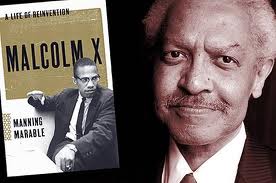
Manning Marable’s final work Malcolm X: A Life of Reinvention frequently appeared on lists of the year’s best non-fiction books. It certainly deserves such recognition for the compelling narrative that it creates with the facts of Malcolm’s life.

Much was made of Marable’s engagement with a story that Malcolm tells in his famous autobiography of a hustle that he ran involving a man who was sexually stimulated when another nude man covered him with talcum powder. According to Marable, though Malcolm’s autobiography removes him directly from that scene, this was probably not the case. Malcolm was most likely the nude man offering the stimulation of talcum powder to Paul Lennon. Marable’s research shows that Malcolm continued to keep in touch with Lennon while Malcolm was incarcerated because he thought Lennon was sufficiently wealthy enough and powerful enough to gain him an early release from prison. In addition to the impact this hustle has had on representations of Malcolm’s sexuality, Marable’s well-substantiated claims that Malcolm was a terrible husband, further undermined his standing as a model of nobel reform. Malcolm seldom spent time with his wife and children. Typically, he would be present when a child was born and then he left town shortly after the birth.

One of the striking assertions that Marable makes involving Malcolm’s marriage, at least for me, was a passing remark that he made about Betty Shabazz, Malcolm’s wife. “Years after Malcolm’s assassination,” Marable writes, “Betty would describe her marriage as ‘hectic, beautiful, and unforgettable–the greatest thing in my life.” Then, Marable makes what I take to be a really interesting remark. “In reality,” he asserts, “the twenty-three-year-old was poorly prepared for married life.” Explaining his assertion, Marable notes:

She had never learned to cook. Even after she joined the Nation, she knew how to make little more than bean dishes and a few beef and chicken recipes. Malcolm never cooked, so it was up to her to plan nutritious and varied meals on a limited budget. Any romantic fantasies she may have had about her future life were largely extinguished by the end of their first year together. Malcolm rarely, if ever, displayed affection toward her. They almost never spent the night out in each other’s company–throughout their seven years of marriage, he took her to a movie only once, in 1963. (147)

For me, it was interesting to think about what it meant to be “prepared for married life.” For earlier generations of women, it seemed like Marable had painted a very clear picture of what that meant. A married woman should know how to cook. She should know how to cook nutritious meals; offering variety with limited means.

The suggestion of Betty’s missed romance reminded me of another book. In a previous post I noted that I had been reading Ann Weisgarber’s debut novel The Personal History of Rachel DuPress. Weisgarber sensitively imagines the life of an African American women homesteader who she had observed in a photograph. In wondering about her life, she invents Rachel, an African American woman born in Louisiana who migrates to Chicago with her family. Rachel works as the cook for an African American woman who runs a boarding house that caters to black men working at a nearby slaughterhouse. The men fancy Rachel’s cooking and offer to take her out on dates but she sweetly shuns their advances. Rachel shows an interest in Mrs. Du Pree’s son Isaac who has come to Chicago after serving thirteen years in the Army. Isaac has come to spread the word about the Homestead Act of 1862 that enabled men and unmarried women to claim one hundred and sixty acres of public land. For Isaac, this far Western land stood as a beacon of opportunity for him to live independently and to assert himself as a man in a way that race prohibited him from doing in other parts of the country. Rachel offers Isaac a claim for land in her name if he agrees to marry her.

Having been a farmer’s daughter as well as a cook, Rachel serves her husband well as a helpmate in the Badlands. As a romantic partner, Isaac proved to be the fictional double of the historical Malcolm that Marable offers us in the biography. Isaac’s life was about usefulness and he seemed to dabble with romance if it offered him some practical use; otherwise, he wasn’t interested in sentiment.

In reading both of these works I wondered what it would mean to say of a young woman today that she was (un)prepared to be a wife. Do we still think that for a woman to be prepared for marriage that she know how to cook nutritious meals with variety? Do we still judge men by their response to romance?

Any thoughts? 

Reading with my Father: Slim’s Table (Part IV.)

In chapter 8 of Slim’s Table, Mitchell Duneier engages the class myth that accords the black middle class moral superiority and authority and devalues the moral authority of the black working class. Interestingly he points out that even though the men at Slim’s table disrupt this hasty, inaccurate assumption, they also use these terms to describe their world.

My father would have appreciated Duneier’s efforts to see these men outside of limited paradigms–even the one’s that the men themselves used. My father wanted to be appreciated for being in the process of becoming a better man. He told me once that he might have been down but to check him in the fourth quarter “’cause like Denis Rodman, I rebound.” My Dad was a pretty good rebounder in most respects. By the time he died, his masculinity didn’t seem as fragile as it had once been. He no longer needed to physically fight every person who gave him offense. He could walk away and still call himself a man. So in that respect, he stepped outside of his previous interpretation of how the broader culture defined masculinity.

Chapter 8 raised questions for me about the process of coming to define one’s self against the culture. I admire people who learn to name their experiences for themselves. It’s an ability that shouldn’t be taken for granted. It requires taking a risk that you won’t be understood. My father seemed aware of the risks and was always aware of being observed. He thought a lot about how he was being perceived and tried to construct a persona that people would like or, interestingly, dislike. I wrote about my father’s efforts to incur the disdain of his neighbors in a previous post. What I liked very much about my father though was that he wasn’t afraid to be disliked. We don’t talk about this a lot in American culture but there are people who don’t care whether or not they are liked and I think that it’s important to know that this option exists. There are times when this was an admirable trait of my father’s and other times when it wasn’t…but I find that it wasn’t when it mirrored cultural axioms–not when it was an authentic statement. For example, my father once told me about a man he knew who was in love with a classic car. He took my father to see it. Later that same day, my father went back and bought the car for himself. When he told me the story, he recalled how angry the man was with my father for buying “his” car. The notion that it was “his” was the part of the story that my father wanted to contest. The car wasn’t “his.” It belonged to the person who bought it. My father used a ruthless, business model to justify betraying an acquaintance who trusted him with the object of his longing. I thought it interesting that my father not only told me that story but he also told another acquaintance that same day who seemed as appalled by it as I was. My father didn’t care that he hurt his acquaintance’s feelings or that he betrayed his trust but it did seem that he wanted confirmation regarding his logic; he didn’t get it.

Models Monday: This Christmas

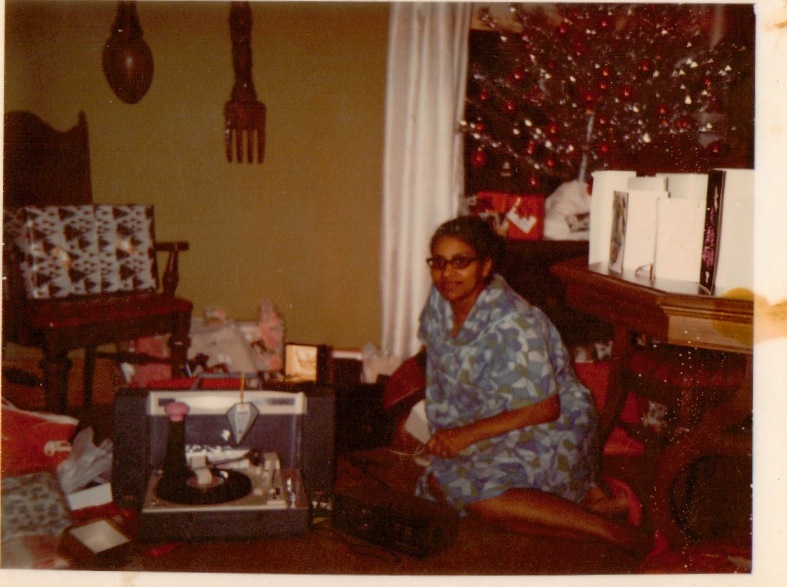
I think about my grandmothers a lot. What must it have been like for them to have raised children while managing their dreams for themselves? My mother’s siblings describe wonderful times
eating fruits, candies, and nuts. They recall being thrilled by receiving all the presents they had asked for. Once they stopped believing in Santa Claus, they wondered how it had all been possible. When my grandmother did work she worked as a domestic and my grandfather worked for the Water Department. While his would have been considered a “good” job, seven children would have meant spending a good portion of those “good” wages.

We managed to do a good job budgeting money this season but I didn’t do a good enough job preparing my body for the tolls of joy. Children may not realize this, I know I certainly didn’t when I was one, but parents work hard staging the home for Santa. We actually thought about how we were going to wake my son up and how we were going to introduce him to his various gifts. I also made a big dinner. By the end of the day I was exhausted; I’m still exhausted!

I wonder how long it took my grandmother to learn to manage the tolls of joy? I wonder what models she would suggest for me?

Models Monday: Sustaining Fictions

I don’t know how these things are connected, but I’ve been holding them together in my mind for some time now. For some reason, I’ve been thinking about these lists we chronicle in popular culture at this time of year at the same time that I have been thinking about the stories that we need confirmed despite their veracity. So for example, I was thinking about or better yet, dreading, the television shows and magazines dedicated to which celebrities divorced or filed bankruptcy or were engaged in some scandal alongside my thoughts about the documentary film 51 Birch Street. Have you ever seen this film? If not, go directly to Netflix and add it to your que. The film is about a man who learns that the relationship that he believed that his parents had was an illusion after his father marries a woman who had been his secretary soon after his wife of 54 years dies. Doug Block, the filmmaker and son, had been close to his mother but found his father difficult to get close to. The viewer expects to like and respect the mother but one of the great surprises of the film is how much you like and respect the father. Doug learns that his parents’ marriage was rather loveless when he discovers the almost daily journals that his mother kept chronicling their marriage. I’m not going to give it all away, but one of Doug’s pressing concerns involves his father’s swift marriage. Were they having an affair, he wonders.  In one very poignant moment between Doug and his father, Doug asks his father this very question. It reminded me of an episode of Kimora: Life in the Fab Lane that I happened to catch when one of her daughters asked her if she was actually nude in a PETA advertising campaign she had seen printed somewhere.

Kimora Lee Simmons for PETA

The audience had been privy to the behind the scenes footage of the photography shoot and knew that Lee Simmons was actually in the nude so I was curious to see how she would respond to her daughter’s inquiry. She looked directly at her daughter and said, “No, Mommy was not naked.” The little girl let out a sigh of relief and moved on. I remember thinking it was a sweet moment because Lee Simmons knew that her little girl wanted her to say exactly what she did. That if she could have accepted the possibility of her mother’s public nudity, she wouldn’t have needed to ask the question. So when I heard Doug Block ask his father if he had had an affair, I thought his father must have heard a little boy asking the question.

Maybe I’m curious about my own need for sustaining fictions and whether or not I would recognize them if I asked them out loud. I wonder if there is something fundamental about the parent/child relationship with respect to these sustaining fictions. If, for example, we find the need for our husbands or our wives to support these fictions for us, are we asking our marriage to perform paternalistically. If we need our friends to perform this function, then are we asking our friends to perform paternalistically. 

I still don’t know why I’ve been thinking about the year in review alongside sustaining fictions but in thinking about the two ideas now I am more intrigued by what a year’s end list of questions might look like. Maybe I don’t like the fiction of facts that we chronicle. I don’t like the suggestion that because we know the quantity of something or the state of something, that we also know the quality of it. Maybe I would more greatly appreciate a list of the mysteries of life that we have encountered and the ways we encountered them. Perhaps I’ll work on this list as a model for a more interesting chronicle of our times. 

Models Monday: Making Room for Listening (Part I)

One of my favorite things to do on Sunday mornings, sometimes Saturday evenings, is to read the “Sunday Routine” in The New York Times. Though I grew up in a household where people worked on Sunday, if any day can be imagined as one where people are released from the requirement to work, it would easily be Sunday. In “Domestic Work, 1937” in Natasha Trethewey’s collection entitled Domestic work she writes that “Sunday mornings are hers,” acknowledging the one day off for the subject of the poem whose counterparts were historically afforded this one day of reprieve from working in someone else’s house. Trethewey’s subject finds calm where I imagine anxiety if I had only one day to cover all the things I would want to do with my time. Fretful over my choices, I imagine myself paralyzed. It happens to me now and I have a month of Sundays available to me when compared to the women in my grandmother’s generation: Should I read this or that? Should I think about this or that? Should I watch this or listen to that? Should I clean this or that? 

Sunday might be attractive because it can be the one day where people get to be decisive about their time. The details chronicled in the “Sunday Routine” of prominent New Yorkers reveal all manner of decisions about the day. A few Sunday’s ago (Dec. 4), I read about how Choirmaster Kent Tritle spent his Sunday (I provided the link to this article above) and his day was interesting because he works on Sunday as a music director, an organist, and a radio host. What became of interest to me was how he ended the day. Instead of watching television, like so many other folk featured, he and his partner “listened to music.”

Like so many other Times readers (about 8,670 of them) I watch football on Sunday, but I like the notion of dedicating the day, at least part of it, to listening. I would like to spend more time listening. When I was growing up, my family talked a lot about the time they spent listening to music. My grandfather had a music room in the basement. There were turntables, a reel-to-reel player, and what seemed to me to be hundreds of records, 8 track tapes, and reels. I used to go into this room and look at the album covers while sitting on my grandfather’s black stool but I didn’t know how any of the equipment worked. I sat there thinking about how the music might have sounded but I never actually heard any of it.

I was an adult before I ever heard James Moody though I heard talk of Moody’s Mood all the time–I actually really dig collecting covers of classic songs and for this one, I highly recommend George Benson’s (ft. Patti Austin) from the Give Me the Night album. The Brian McKnight cover with Take 6 (on Quincy Jones’s cd Q’s Jook Joint) also makes a strong case for itself.

My son was listening to a cd that came with a book we bought him entitled Duck Ellington Swings through the Zoo. At first my attention was elsewhere but the music was so alluring that I stopped bopping around and tried to give it more of my attention. It was nice hearing the music of Duke Ellington, Thelonious Monk, and John Coltrane playing while my son and I played with his wooden trains.

I find it difficult making room to concentrate through my ears with a two year old around. I wonder how this worked with the radio generation? When the primary form of entertainment involved listening, were children more inclined to offer silence so that they could hear what was going on?

Interestingly, Henning Mankell had a featured opinion in the NYT yesterday entitled “The Art of Listening.” In it, Mankell suggests that our ability to listen distinguishes human beings from animals, he writes:

It struck me as I listened to those two men that a truer nomination for our species than Homo sapiens might be Homo narrans, the storytelling person. What differentiates us from animals is the fact that we can listen to other people’s dreams, fears, joys, sorrows, desires, and defeats–and they can in turn listen to ours.

I worry over my inability to consistently make room for listening, or more accurately, to make room for enhancing my ability to listen. Hearing plays an important role in an animal’s ability to survive in the wild and I think that listening might serve a similar role for us too.

I listen to books when I make long trips by car but my efforts to do this consistently are undermined because the cd player in my car is broken. I have friends who always listen to books as they drive and I think this a lovely habit. Since my cd player doesn’t work in my car, I am given to indulging my other acoustic craving: silence.

I’m going to try dedicating a part of my Sundays to making room for listening. As I do, I’ll be sure to tell you what I hear. Wouldn’t it be nice to develop a podcast series around this idea? I could call it: Sunday Mornings Are Hers.

Reading with my Father: Slim’s Table (Part III cont.)

I’ve been reading Ann Weisgarber’s novel The Personal History of Rachel DuPree (more on that in a separate post). At one point, Rachel notes that her husband Isaac has built the family a wooden house and describes the sod house they lived in before:

Its walls were nothing but squares of sod. The ceilings sagged. The floors were dirt. Summers, grass grew on the inside walls and I’d take a match and burn the shoots to keep the prairie from staking a claim on the inside of our home. (6)

Though I knew no one who lived life on the prairie, I recognize the gesture of burning the shoots to keep the wilderness from taking over. Though my family and many of my friends lived in the kind of community that Mitchell Duneier may have termed a ghetto, I saw people actively working to keep those elements from coming inside.

Duneier concludes that the black men at Valois come to the diner because there they can fashion a world that reflects the moral life and character they envision themselves having since the ghettos around them did not. People that I knew and admired made a Valois of their home lives by metaphorically doing as Rachel did. My grandfather used to chastise people who would wash out glasses in the kitchen sink that they had just taken from the cabinet to get a drink. “We ain’t got no roaches here,” he would say. “You ain’t got to wash out no glasses ’round here.” It would be a remark I remember having to think about: Do people who do have roaches in their homes wash out glasses because of the bugs or the spray? Whatever the answer, my grandfather wanted it to be clear that he lived in a clean environment. He was proud of this cleanliness.

That there were never any dirty dishes in our kitchen sink was something my father mentioned to me. He noted this when he would reminisce about the things that were attractive to him about my mother and her family: the house was always clean.

Outside we always had a well-maintained lawn, a flower bed that grew hydrangea, a trellis where the most beautiful african violets climbed, and a garden in the backyard where we grew tomatoes, cucumber, peppers, and collard greens; so did our neighbors.

I’m not clear on where these people are in the lives of the black men who frequent Valois or what accounts for the difference between people who make their home environments what they want and those who find environments like the one’s they want at home. Duneier suggests that for some of the men, they lived in depressed buildings that would have conspired against personal attempts to control them. For example, in Chapter 2, he writes about Jackson’s problems with the landlord of the building he and Duneier shared:

Our studios were in a terrible state of disrepair. The first time I went over to Jackson’s place was when, knowing I had a camera, he asked if I would take photographs of his apartment so that he could use them as evidence if he ever decided to sue. Paint was chipping and peeling on all four walls and flaking down from the ceiling. The stove didn’t work. The wall beneath his window hadn’t been properly insulated. The bathroom light socket had come out of its fixture and dangled on a wire a few feet above the bathtub. (27)

Jackson’s apartment bears witness to the disregard shown to the poor.

I’ve been thinking a lot about this lately as I’ve considered why people find ambition so attractive. While I value being motivated toward becoming a better person, I don’t include having power and status among those meaningful ambitions. Interestingly, a young woman recently asked me to help her with a school project about this subject. Though this is not the exact prompt, I was asked to provide her with commentary on what I admired about women who held power and status. Here’s my response:

Well, I don’t admire “status,” if by that you mean authority. If anything, I admire women who have a strong sense of their value without having public, sanctioned, or recognized authority. As you have indicated, there are multiple, compelling, and nuanced ways of having an impact on others. I tend to admire those women who do not try to enforce their impact and assume another’s need for their guidance and vision; in other words, those who do not attempt to make children of others. Take my friend Tanya as an example. It never occurs to Tanya to assume rank in someone else’s life. She enters into relationships with an understanding that she is entering into community with another and not that her job is to assume that she will guide and influence their behavior. Now of course there are situations where someone has authority or is in authority but that role has boundaries.

Since I have been re-reading A’Leila Bundles‘ wonderful biography of her great-great-grandmother Madam C.J. Walker entitled On Her Own Ground: The Life and Times of Madam C.J. Walker, I’ve considered my own ambivalence about money and career ambitions. It makes sense for a woman who had worked very hard as a farm laborer and a laundress to desire greater control over her own labor and her life. It would also make sense that someone who had experienced the indignities of segregation and who had witnessed the grisly spectacle of the aftermath of lynching to have wanted a commanding voice. In one astounding passage from the biography, Bundles cites a black Mississippian who commented on the conditions black folk left behind when they quit the South:

“After the summer crops were all in, any of the white people could send for a Negro woman to come and do the family washing at 75 cents to $1.00 a day […] If she sent word she could not come she had to send an excuse why…They were never allowed to stay at home as long as they were able to go.”

The expectation that black women would provide an excuse for not satisfying a request to work speaks to my rejection of “power” and “status” that turns others into children. Walker’s historical significance has a great deal to do with the opportunities she created for those black women to work under their own power.

What gets me, though, is the way that materialism creeps into stories like Walker’s in ways that raise questions regarding uniqueness of vision and voice. For example, when Bundles writes about Fairy Mae, Walker’s adopted grand-daughter being seduced by the environment surrounding her new family, she notes this:

Fairy Mae understandably was seduced by the opulence of Madam Walker’s Indianapolis home with its twelve lavishly furnished rooms. For a child accustomed to living with several siblings in less than half the space, the calm and quiet of the rose-and-gold drawing room–with its brilliantly patterned Oriental rugs, gold-leaf curious cabinet and Tiffany chandelier–was like paradise. In the library, Fairy Mae could hold soft leather-bound books, run her fingers across the gleaming keys of the Chickering baby grand piano and admire the lovely oil paintings of young William Edouard Scott, the local colored artist who had studied in Paris. On a table covered with Battenberg lace, she watched Madam Walker’s guests being served dinner on Havilland china with monogrammed silverware with sparking crystal goblets. (143)

Certainly, I see this moment as serving a few purposes for the writer: 1.) explaining Fairy Mae’s desire to remain in this environment, 2.) documenting Walker’s furnishings and appointments. But what I am most interested in is the kind of work such documentation performs relating to cultural presumptions. That is to say, even without being told, the reader is supposed to think that these trappings mean that Walker lived in a very nice home. We’re supposed to think that the rational thing to do with money is to spend it on the best things that it can buy. I don’t know.

I’m not sure that I’m convinced of what makes some material object best. I know what some might say but I’m not sure I agree. For example, it doesn’t matter what kind of china Kris Kardashian served Thanksgiving dinner on, I prefer my Food Network collection plates to it and the dinner conversation I was able to manage over the food. And though the lamp in my son’s room isn’t made by Tiffany, I don’t think he notices when we read to him at night. Again, I understand Bundles’ point, especially at the juncture in the text at which she made it. I just wonder about having “the best” things that money can buy and the presumptions about the lives that go along with them. (I also question the notion that this performs some kind of important historical work.)

Duneier ends his chapter “A Higher Self” noting the importance of claiming a present self that reflects notions of a prior self. He contends that the black men at Valois have a memory of themselves living out the values that their present environment makes nearly impossible for them to execute. Valois gives them a place to live out these remembrances. If this is their motivation for coming to Valois, it offers a wonderful model by which to live. Pursuing a “higher self” has nothing to do with designer labels, but everything to do with conversation, listening, and sharing; it involves compassion and reflection. Burning the shoots serves as an attempt to keep the present from taking over the past or of maintaining the good of the past recreated in the present.

It makes sense that people would want to materialize all of the good they see in themselves. The articulation of this desire dominating our current moment involves the representation of this desire through materialism alone. What the men at Slim’s table reveal is that it is possible to see one’s higher self through camaraderie and fellowship if not through one’s address.

Models Monday: Forgiving Yourself

Venus Williams is in the news today for a “wardrobe malfunction,” and her prominence suits me today because my reflections are about her–or at least comments about her. I once heard Pam Shriver say about Venus Williams that one of the things that she liked about her was that “she forgives herself quickly and moves on.” I wish I could provide you with evidence of Shriver’s remarks but I don’t remember the tournament or the match or Williams’s opponent, but I know what I heard. Shriver made me think about the unending penance I seemed to think I owed for my failings, mistakes, or shortcomings. Until I heard Shriver’s remarks, I thought that long suffering was best; perhaps this was a lesson I learned from being raised in a Catholic family or years of Catholic schooling. Shriver’s comments though made me think that long suffering was something that women are taught to do.

Shriver seemed to recognize Williams’s ability to commit an error and then follow-up with an ace as something out of the ordinary. I don’t think she would have said that had Nadal been playing Federer. I say that because I never hear sports analysts say about a man that he forgave himself quickly and moved on and I watch a lot of football–I mean A LOT. As many times as quarterbacks throw interceptions, receivers fumble passes, and linebackers jump offsides I have never heard Al Michaels say “gotta love that Eli Manning, he may have thrown an interception but he’s not going to let that get him down.”  I can’t say that I’ve even heard that said of individual collegiate men athletes. Certainly there is an analysis of how they handle adversity but the presumption is that they handle it by fighting through it. Penance doesn’t even seem to be an option for sportsmen. (Though of course this isn’t true of the fans–men or women. I’m a Cleveland Browns fan so I know all about penance! The best stories of the price we have paid is chronicled in Terry Pluto’s wonderful book Things I’ve Learned from Watching the Browns. The poignant video of fans reading some of their stories that Pluto chronicles in the book almost makes me want to weep…but I digress.)

If the lessons that men and women learn play out like my gendered reading of Shriver’s remarks about Venus Williams, then they are instructive: Teach your girls to forgive themselves quickly and move on.