Reading with the Times: Death of a Salesman (March 1)

On March 1, The New York Times theater critic Charles Isherwood invited columnist Joe Nocera to discuss the relevance of Arthur Miller’s Pulitzer Prize winning play Death of a Salesman in light of the contemporary dynamics and culture of American business. I did not add my ideas or questions to their active digital discussion but I decided to consider the theme of their discussion on my own blog, a plan I noted in my February 26 post.

The Times featured a striking image from the original playbill for the play. The

Detail of the original playbill for Death of a Salesman from The New York Times.

poignant image captures the heavy burdens of the play’s protagonist whose dream of becoming a salesman stemmed from seeing eighty-four year old Dave Singleman at work. Singleman’s working life was one of ease and repose as he could make his sales calls by merely picking up his home phone. The playbill image captures the weight of working on your feet and moving about away from home at an advanced age. Such an existence curves a man’s shoulders and pulls his head down. The Times nicely sets this image against the topic of the “fresh urgency” of the play’s critique of American Dreams of success in modern times.

Nocera reads the relevance of Miller’s work through a portrayal of Americans who “strive endlessly” and who are “fueled by ambition,” and who “often measure ourselves by how much money we have.” To me, the relevance of Death of a Salesman for our times, as it relates to business culture, has much to do with how well it captures the sadness and emptiness that comes from constant striving, boundless ambition, and the lust for money. As I read Miller’s stage directions I could hear the music he intended for the play and much of it echoes the sorrow I associate with Willy’s life. The music was so striking to me because of how the acoustic representation of Wall Street resounds for me today. Currently, Wall Street appears unaware of knowing critiques of greed to the extent that a clear eyed and incisive treatment of the corrupting influence of money can serve as fuel. The use of The O’Jays classic soul and funk hit “For the Love of Money” as the theme song for the NBC television show The Apprentice proves this point.

For the love of money is the root of all evil: which while some coveted after, they have erred from the faith, and pierced themselves through with many sorrows. 1 Timothy 6:10

So how does a song that has this biblical caution as its inspiration become the theme song for Donald Trump’s show The Apprentice? I don’t actually know historically how that came to pass but I know that it doesn’t quite make sense. I can’t honestly say that I have watched an entire episode of this show but I know the premise. People compete for a chance to get a job working at one of Trump’s enterprises. They are organized as teams who compete against one another with the losing team having to face Trump’s boardroom appraisal. At the end of his review, he makes the decisive pronouncement, “you’re fired,” and sends someone home. Even when celebrities compete for charity dollars, Trump doesn’t deviate from his bold declaration.

The Apprentice shows people being awful to one another. From the little that I’ve seen, they yell at one another, they conspire against one another, and they justify this poor treatment through an appeal to their winning ambition. On one level, then, The Apprentice appears to be a televisual re-enactment of The O’Jays’ lyrics since the show depicts how money corrupts. The O’Jays song, however, is an explicit critique and The Apprentice appears shameless about its embrace and pursuit of “money, money, money, money, money, money.” Nocera contends that contemporary businessmen absolve themselves from any guilt associated with the seemingly harsh realities of job loss and firings through their foundations and charities. Perhaps The Apprentice does the same through its seasons of celebrity charity giving but what the show fails to appreciate is the poisonous atmosphere it maintains in having people mistreat one another in the name of winning money.

The Apprentice. NBC.

The Apprentice logo significantly differs in its portrayal of a businessman from the one featured on the original playbill for Death of a Salesman. The businessman on the playbill looks tired and rundown. The play itself constantly suggests and even references Willy’s fatigue and exhaustion. The Apprentice makes an ideal of frenzy. For all of Willy’s faults, he never wanted to be like the man running with a briefcase. He wanted his slightest gestures to open doors and to move men. From the little that I’ve seen of The Apprentice this is the impression that Trump likes to make of himself: when he enters the room, “attention must be paid.” And of course, Linda wanted someone to pay attention to her husband’s humanity despite his anonymity. The goal of The Apprentice, or any reality show for that matter, is not to be human, but rich.


Models Monday: Repeat Step 1

In advance of considering Arthur Miller’s Pulitzer Prize winning play Death of a Salesman, I decided to re-post the following piece. As I considered the play’s critique of the “hollowness of some cherished American ideals,” I wondered how this critique would play out in the age of reality television. Though I’ve taken my copy of the play off my shelf, I haven’t started re-reading it but when I do, I’ll be doing so while thinking about the state of certain critiques in this “look at me, look at me, look at me now” era of reality shows. 

Natasha Trethewey’s poem “Tableau” from her book Domestic Work features a man and a woman pretty much in repose:

At breakfast, the scent of lemons,
just-picked, yellowing on the sill.
At the table, a man and woman.

Between them, a still life:
shallow bowl, damask plums
in one square of morning light.

The woman sips tea
from a chipped blue cup, turning it,
avoiding the rough white edge.

The man, his thumb pushing deep
toward the pit, peels taut skin
clean from plum flesh.

The woman watches his hands,
the pale fruit darkening
wherever he’s pushed too hard.

She is thinking seed, the hardness
she’ll roll on her tongue,
a beginning. One by one,

the man fills the bowl with globes
that glisten. Translucent, he thinks.
The woman, now, her cup tilting

empty, sees, for the first time,
the hairline crack
that has begun to split the bowl in half.

I’ve thought about this work a great deal since the very first time I read it. I love its elegant simplicity.

I imagine the man and woman as a married African American couple. I admire their ability to be still together, quiet, and comfortable enough with one another to take leave of their partnership to think their own thoughts and have their own ideas about everyday things. Their peace enables them to see mundane things anew. While the “hairline crack” in the bowl might suggest something ominous about their relationship, I choose not to interpret the ending in this way. I see that “hairline crack” much like the “chipped blue cup” that the woman sips tea from: a mark of character as well as a feature of the cup. Flaws do not make items disposable for this woman. The cup has not lost its value as a conveyor of her morning drink. Despite being chipped, the cup still works.

The representation of an African American married couple who can be still together and quiet counters the representation offered on The Real Housewives of Atlanta. The tableau of African American married life on this show stands in direct opposition to Trethewey’s beautiful still life. The characters presented on this show do not seem committed to preserving anything despite functionality. They constantly shop for new things whose meaning seemingly derives from its brand name rather than its use. This show interprets the meaning of African American married couples spending time together, at least the significant part of it, as mostly scheming to make more money. I see very little beauty here. Why are we supposed to want lives like these women have? 

I was really moved to see the cast showing a common understanding towards Kandi’s heartbreak over her daughter’s poor relationship with her father. What troubled me though was that you don’t ever see any of the women most concerned for their children’s relationships with their fathers doing anything that would improve them. In one episode, Sheree takes her son tennis shoe shopping and she makes some disjointed claims about the relationship she wants him to have with his father. I don’t actually remember what she said but I remember thinking that she would swear up and down that she talked to her son about his father but how little talking actually occurred. I thought the same thing when I saw a clip from an episode featuring NeNe talking to her son. Their descriptions of themselves as party starters, however, does not support their ambition to offer meaningful talk; that requires quiet. Meaningful talk requires thinking through what to say and how. The Real Housewives makes no effort to depict people who spend any time strategizing how to talk. What they offer is a process involved in being mean spirited: Step 1: Make a lot of noise. Step 2: Read nothing. Step 3: Busy yourself with a series of mindless tasks. Step 4: Meet a friend for dinner. Step 5: Talk to your friend over dinner. Once you get to Step 4, you begin to see how following these steps put you on a road to destruction because they gave you nothing to discuss once you reached the fifth step. The only thing these steps prepare you for is being mean spirited; a disaster.

I think that the cast of The Real Housewives of Atlanta were sincere when they claimed to want their children to have better relationships with their fathers. I also think they were being sincere when they talked to their children about this. However, really being of service to one’s children would require making use of a different series of steps: Step 1: Be quiet; don’t make any noise. Step 2: Read something. Step 3: Focus on what you read; think about it. Step 4: Discuss what you read with someone who spends more time being quiet and reading than you do. Steps 1-4 prepare you to offer advice, but before saying anything, it is extremely important to repeat Step 1.

Step 1 is where Natasha Trethewey’s poem centers all of its action. Those two people aren’t gettin’ the party started; they aren’t spending any money. What they are doing–together–is giving life careful attention. They are catching their perceptions up with the world going on around them. They are making careful observations and adjusting themselves to meet them (i.e. the woman turning the cup so as not to sip from the “rough edge”). They are executing a model of living that I find most attractive. It’s a life that we can all have without spending a dime–so don’t expect to see this life on television; it wouldn’t be attractive to sponsors.

Reading with the Times

I am going to join The New York Times in their reading of Arthur Miller’s Pulitzer Prize winning play Death of a Salesman. It’s a play that has always moved me and I agree with the Times about the importance of considering Death of a Salesman and its critique of “the hollowness of some cherished American ideals.”

I invite you to come along with me as I read the play and consider the interviews and discussions featured in The New York Times. So dust off your copy, or borrow one from the library, so that we can be ready for their discussion beginning March 1.

Models Monday: More than a Textbook (Washington’s Birthday edition)

I recently watched Shukree Tilghman’s documentary film More than a Month about his plan to see black history month abolished (you can watch the entire film at this address until March 1: http://video.pbs.org/video/2197967045/). Through the course of the film he learns that it’s an ill-conceived project, at least in part, because he did not give enough consideration to the political significance of such a project and the constituencies he might be colluding with in light of such an agenda. An interesting turning point in the film occurs when Tilghman, who self-identifies as African American, spends time with a group in Virginia that has been advocating for a Confederate history month. This experience aids Tilghman’s understanding of the importance of having a platform upon which to offer counter-narratives of historical master scripts. Thus, he begins to understand the relationship between history and power. As a viewer, the moment becomes important because I began noticing that the unrecognized model for narrating history was the textbook.

Tilghman and many of the film’s featured speakers referred to “what was written in history books” as they negotiated the importance of preserving Black history month and it was clear they meant textbooks. These books were never given titles and no one ever cited authors. The irony here is that when Tilghman begins to explore Carter G. Woodson’s founding ideas in creating black history week, a major impetus for creating the occasion was the desire to build legitimacy through scholarly documentation around stories existing as folk memory about African American contributions to American history. What is clear to me in light of the focus of More than a Month and its accompanying shadow narrative of the textbook is that textbooks undermine a recognition of multiple sources, the importance of documentation, as well as  competing historical narratives.

The textbook represents one source for learning history but there are others. In honor of these additional sources, I am going to use today, the celebration of Washington’s Birthday, as an occasion and a case for making suggestions for how one might engage history beyond a textbook approach.

With an Eye towards History

My son watches the new The Electric Company series on PBS. One of the featured artists is Lin-Manuel Miranda, the Tony award winning composer and lyricist. Miranda’s new work The Hamilton Mixtape reflects his deep investment in American history. In a New York Times interview about this project, Miranda tells how his interest in Alexander Hamilton, our nation’s first Secretary of the Treasury (1789-95), grew from a high school writing assignment. In later years, Miranda read Ron Chernow’s biography of Hamilton and it fueled his interest in a rap concept album about the dynamics of Hamilton’s life that reflect story lines in hip hop culture. Miranda earns a standing ovation from President Obama for his thoughtful, rhythmic, and engaging lyrical depiction of Hamilton in a 2009 performance at the White House: 

Miranda’s performance and Chernow’s book are just two sources that could be used in contemplating representations of Alexander Hamilton in textbooks. Hamilton Grange National Memorial serves as an additional source for considering Hamilton’s life and legacy. School trips might be one way to integrate the experience of a home tour or of a memorial site but these venues are available even without a school organizing the trip. Sites maintained by the National Park Service are often free and when they are not routinely without cost, there are free entrance days posted for participating locations. Thus far, every house tour that I have been on that was a part of the National Park Service was free. Other house tours that I have experienced, like the tour of Joel Chandler Harris’s house (the Wren’s Nest) and the Mary Todd Lincoln House, were less than $10. Thus, the cost of these historical experiences rival the expense of a movie ticket. There are more ways to have fun and find enjoyment than going to see a Hollywood movie. Moving beyond the textbook as our only source for learning history can also expand the way we imagine worthwhile ways of using our resources.

More than a Textbook

Shukree Tilghman must have appreciated the issue that I am raising regarding textbooks because the website for the film also shows an advertisement for a free app designed to be used to highlight African American history on the landscape. The film certainly engages the many ways one might approach teaching and learning history as Tilghman visits museums, sites for historical re-enactments, and archives. The pre-eminance accorded the history textbook, however, remains under-examined. Indeed, there is a sequence in the film where someone acknowledges that the textbook has authority but it remains unquestioned in many ways. The goal of telling American history becomes the goal of re-writing a history textbook. I kept wondering why schoolchildren couldn’t read multiple sources. Of course, I was also reminded of the Texas textbook controversy involving the claim by Conservatives of a Liberal bias in the teaching of history in the state, so I don’t want to dismiss the importance of having a discussion about the role of the textbook. Tilghman’s film, however, doesn’t present the role of the textbook as its central issue but it clearly could be one of them. There is more than one way to teach and learn history. The textbook approach may be easy but it may not be the best model.

Models Monday: Fifty-nine and Twelve

A few years ago, I was trying to figure out what I thought it meant for black women to be considered icons. This was a consideration that had been lingering from some years prior when I saw Congresswoman Maxine Waters in some setting with black male politicians who all referred to her as an icon and acknowledged her iconic presence before they spoke. Most striking was that as attention was drawn to Waters’s iconic status, she was never given space to say a word. It was as if her status as an icon spoke for her. So being an icon, I thought, means your frozen, trapped, or captured in what others make of your identity. You don’t get to make a new sound; And she didn’t. Waters did not utter a word. Is this what happens to all black women who get turned into icons, I wondered. If it is, is this a worthwhile pursuit? Is it in any way tied to a pursuit of full humanity and dignity? What about when the designation has been imposed and not pursued? How has this designation impacted those black women? Are there other avenues for recovery? So I began thinking about those iconic black women. What was the narrative of their iconic representation and what was the historical subjectivity that might be buried underneath it.

It became a fascinating project for me to consider what I thought about this. One of the first women I thought about was Sojourner Truth because I had read historian Nell Irvin Painter’s wonderful biography of Truth that counters so much of what we take to be her life. For instance, Truth had not been enslaved in the South but in the North thus she did not speak with a southern accent. In fact, she spoke Dutch and the accent of this heritage that she acquired while enslaved then as a domestic servant in New York lingered throughout her life. Most revelatory was the fact that the famous “Ar’n’t I A Woman,” speech that gets attributed to her was the creation of feminist and abolitionist Frances Dana Gage. According to Painter, Gage revised an impromptu speech Truth had given to include the famous line and this led to the creation of an image of Truth we still live with. Not only do children perform this speech during Black History month in February, but famous actresses and noted authors have dramatized the speech as it appears attributed to Truth in Howard Zinn and Anthony Arnove’s book Voices of a People’s History. Here’s an example of Kerry Washington performing the voice of Truth:

There’s an entire series of these Zinn presentations. One of the more recent public performances of the dramatization of the famous speech attributed to Truth occurred in 2009 when a bust of her was installed in the Capitol building. Cicely Tyson dramatized Truth on this occasion:

Ultimately, Painter decides that

“We need an heroic ‘Sojourner Truth’ in our public life to function as the authentic black woman, as a symbol who compensates for the imperfections of individual black women…”

But what about those Black women who, I was surprised to learn, young folk don’t remember or recognize as icons, how do they function? The young black women who were in attendance for a semi-public presentation of some of these ideas provided me with an opportunity to connect past and present because one of the icons I chose to discuss did not register as important though there was some general familiarity with her. The woman was Billie Holiday.

“Do you even know the movie Lady Sings the Blues?” I asked. Crickets. Diana Ross? Billy Dee Williams? Crickets. Ah, I know, how about this song:

Billie Holiday first recorded “Good Morning Heartache” in 1946. Diana Ross revived the song when she played Holiday in the biopic Lady Sings the Blues in 1972. Scott’s contemporary stardom enabled me to generate greater interest in Holiday’s life. Of course these young women recognized photographs of Holiday but they had not thought much about her legacy, her music, or her impact on them. Because so many folk have covered Holiday’s catalogue, it enabled me to introduce them to other women or merely contemplate other black women I would have considered icons (i.e. Natalie Cole). Whitney Houston was the most consistently cited black woman we discussed alongside Holiday.

Unlike those who consider the final years of Holiday’s career her worst, scholar Robert G. O’Meally contends that these years amplify her artistic understanding. As drugs had ravaged her instrument, Holiday did not surrender it completely; instead, O’Meally contends, she learned how to command her voice in the state it was in to tremendous emotional effect. In other words, despite an inability to wield her voice as she had before drug abuse took its toll, Holiday recognized the difference and asserted the change meaningfully in terms of how she sang. So how would Whitney Houston respond to the impact of an altered voice?

On Saturday night when I learned that Whitney Houston had died, I quietly thought about Billie Holiday. They were both relatively young women when they passed. Holiday was 44 when she died in 1959. At least as O’Meally hears Holiday, one can think that she had defined herself anew by the time of her demise. I wonder if there will be a way of thinking of Whitney Houston along those same lines. I heard a news reporter say that it was clear that Houston was trying to sing in a lower register. Perhaps time will enable listeners to appreciate the difference.

Although we do not know yet what killed Houston, we do know that she had a history of drug abuse. Unfortunately for her, she had to suffer her addiction publicly. I spent much of my early years surrounded by drug addicts of all kinds and it was always a very sad tableau. I knew some who were strung out on heroine because everyone else around them was doing it and they weren’t strong enough to define their own experiences; I knew some who were alcoholics because of a past pain that they could never properly or adequately address; I knew some who snorted cocaine because people had deeply disappointed them. I considered myself fortunate because my mother never had any chemical dependencies and could always provide me with relief from the sadness that overwhelmed my father. As a child, I remember the tremendous relief I felt when I did not have to suffer his sadness alone and there were other adults around. Interestingly, I preferred his occasional bouts of anger to his sadness. So I wonder about the life of Whitney’s daughter Bobbi Kristina. I wonder how she made sense of her mother’s sorrows in the face of such abundance. I imagine sorrow making sense in a context of deprivation. I can only imagine how confused she was growing up in the presence of her mother’s obvious talent and the luxuries that that talent afforded and having to make sense of the great sorrow that characterizes an addict’s life.

I think when my father died, he had made peace with many of his demons. So I thought he was able to end his life well. I wonder what will bring Bobbi Kristina peace. I feel such sympathy for that child. Her’s appears to be a life constituted by so much of the stuff this culture highly prizes. She was introduced to fame, fortune, and glamour. I’m sure she was surrounded by many of the markers of her mother’s achievements: platinum records and countless statuettes; iconic photographs taken by esteemed photographers; expensive clothes designed by designers who are themselves iconic; stays in some of the world’s most famous hotels; rides in some of the costliest cars. But since this culture celebrates such stuff, they can’t really tell you how empty it all is. I’m sure that little in her experience would have prepared her to question the  meaningfulness of designer clothes, expensive cars, and grammy awards–except her mother’s sorrow. Her mother’s sorrow should tell us all about the insignificance of what consumer society tells us is the stuff of life.

Models Monday: Borrowing, Renting, and the Library

I.

Trinity College Library, Dublin, Ireland.

My friend Raina routinely goes to the library with her daughter. It’s their place for getting books, videos, and CDs. I thought about this recently when my mother decided to use her local library to borrow a movie because her local Blockbusters has gone out of business. My Mom was shocked that she hadn’t thought about going to the library sooner. My Mother is a fan of Hollywood and she subscribes to People magazine and watches Entertainment Tonight during the week. In thinking about her decision to use her local library, I was reminded of my ambition to record the questions that I ended the year thinking about as a part of my year-in-review. To that end, I wondered if these celebrities who have captured my mother’s interest ever go to the library? They certainly get all gussied up to go to a movie premier and some go to Gallery openings. I’ve heard celebrities discussing the importance of the Arts and generating support for them through concerts. But do celebrities go to the library?

George Peabody Library, Johns Hopkins University, Baltimore, Maryland.

Where are the paparazzi photographs of celebrities ducking out of the library wearing aviator shades? They are not dogged by stories of what books they borrowed or guesses about the titles they try to conceal while running to their waiting cars. The new Duchess across the pond does her own grocery shopping from time to time and Jennifer Garner takes her children to the park, but I don’t think I’ve seen anyone famous coming from the library.

Perhaps borrowing suggests poverty. I actually know College students who don’t use the library. A friend asked one of these students why not and this young woman responded that she didn’t like “renting” books. “Renting?” my friend asked. “Yeah,” the student told her, “I’d rather buy.” That language goes a long way toward explaining why celebrities wouldn’t go to the library. Owning reflects a person’s power through credit history and long standing ties to money (think about people who look down on those who rent property on Martha’s Vineyard versus owning property there), and in some cases, freedom. From this perspective, renting, I suppose, means being marginal to wealth. Of course, celebrities find nothing wrong with wearing jewelry on loan from expensive jewelers when they’re on the red carpet going to the movies (I always wonder if they really get all dressed up to literally go into a movie theater and watch a movie–there’s got to be something else going on inside much more suited to their attire). So they’re not opposed to borrowing in general, they’re just not into “renting” books I suppose.

When I used to buy items from the American Library Association website, they used to sell posters and bookmarks featuring celebrities. Serena Williams, Shaquille O’Neal, Justin Timberlake, that young man from Harry Potter–you name the celebrity and they were on a bookmark or poster celebrating reading while holding up their favorite book. But I can’t say that I’ve ever seen a candid shot of a single one of them coming out of an actual library…but they are forever being photographed coming out of nightclubs, restaurants, hotels, stadiums, clothiers, bakeries, airports–but never libraries.

II.

I’ve continued thinking about Walter Dean Myers’s appointment as the National Ambassador for Young People’s Literature. Even more, I’ve thought about his campaign slogan, “Reading is Not Optional.” I understand what Myers wants to communicate with this slogan but I’m not taken by its clarity. In American culture, I am more frequently experiencing the negative possibilities of what he intends. For example, I was using a newly designed website for a site that I frequently visit. As I was trying to figure out how to navigate it, I grew frustrated that I had to watch videos about navigation and was never given an option to read about the navigation. Why couldn’t they provide photographs and words (or just words)? Why did I have to watch a video and suffer through information that didn’t pertain to me? If I were given the option to read, I wouldn’t have wasted two good minutes of my time. It also happens with news stories on the internet. You’ll read a headline that attracts your attention but when you click it, you find that you have to see a video as opposed to being taken to an article to read. This is not what Myers means by reading not being optional but it’s true that we are not always given the option to read content, we must suffer through video.

III.

Maybe the current status of our housing market will change the way Americans view “renting” and we will begin seeing photographs of celebrities borrowing books. As it stands, having money seems to mean spending money and borrowing marks a person’s lack. This isn’t the way I see it. Libraries are wonderful community resources and borrowing books represents an undervalued method of exchange between citizens. Sharing resources between citizens offers a model by which to live that counters the consumer transactions that have come to define us. Libraries reinforce membership and belonging to a community and this makes them worthwhile places to visit. 

Models Monday: Women and Leadership

I heard a woman at a conference that I recently attended offer a view on leadership that I disagree with. The woman, who was the moderator for a panel on women and leadership, responded to a question that put forth a concern about the dynamism of the category woman and the simplification of its meaning in discussing the topic of leadership. Her central concern was this: Why can’t women, dynamically defined, have multiple notions of leadership? The moderator said in response that she held a very strong bias concerning how that question should be answered but would let others speak. Audience members asked the moderator to share her views and in doing so, she revealed a point of view that I reject. “Women,” she said, “don’t get to make up a new definition of what leadership means.” Even as I write this, I can’t quite believe what it says. Did I actually remember her words correctly? Why can’t women define leadership anew? 

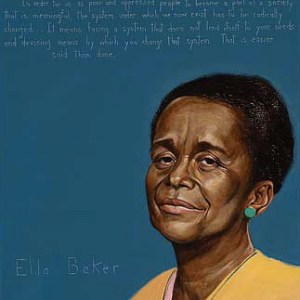
Ella Baker. Image taken from the Ella Baker Center for Human Rights.

I can’t remember the moderator’s argument against multiple notions of leadership but I’ll try to construct what I think would be her best defense. If you make terms mean what you want and there’s no system of meaning, how would communication occur? How would people understand you? To that point, who could you lead if you couldn’t communicate with people?

Even with clear terms, however, I find communication over the meaning of leadership difficult. For instance, I don’t always respond to the call to stand in awe of those in leadership positions. I don’t agree with the presumptions regarding the value, intellect, and overall worth of those who occupy such positions over those without recognized authority.

Ultimately, there was a strange, unexamined tension between those women on the panel who were calling for recognition of the challenges women face when pursuing leadership positions and those wanting to claim a single definition of the term. The former group was actually pointing to other constructions of leadership women held but instead of examining these constructions, they sought to remove barriers that prevented women from eventually using power in masculinist defined ways. At one point in the larger discussion of the issue, audience members were asked to come to the mic and provide their name and where they were from. I found this quite interesting because if someone neglected those details, someone would yell at them to provide them. I bet if someone said, “well, I don’t want to,” the audience would have been at a loss for how to respond because they had been engaged in bully behavior. Bullies expect compliance. Grace was neglected. Anyway, one woman identified herself and said that when she initially received her registration packet, she did not want to wear her name badge with the speaker flag because she didn’t want to draw attention to herself. After listening to the panel, she confessed to being a shrinking violet and decided that “a man wouldn’t have a problem with people seeing him as an authority,” so she decided to wear her speaker badge. The audience roared with laughter and applause. “Since when did enacting masculinist practices become the goal of feminism?” I mused. Recognizing the ways that the practices and the performances associated with male behavior are overvalued constitutes  the substance of my critique, not the end game of my feminist engagement. In other words, I don’t want to act like a man and I don’t want men to either. I’m interested in adults being able to behave like adults and having that behavior accorded equal value.

To the moderator’s point, women cannot define leadership however they want if they expect to be recognized for commanding patriarchal authority. If women have an alternative idea for operationalizing the authority they want to wield, then of course you can define leadership anew.

I included a photograph of Ella Baker in this post because as I listened to those women discuss leadership, I thought about Baker and Septima Clark. Baker and Clark were both Civil Rights activists with a deep sense of commitment to the power and the capacity of everyday people to bring about change in their own lives. Evidence of Baker’s philosophy in practice occurred dramatically through the freedom rides; for Clark it was the Citizenship Schools.  The notion of a participatory democracy was meaningful for Baker and Clark. Ella Baker’s pronouncement that “strong people don’t need strong leaders” offers eloquent testimony to the possibility of having another model of leadership despite what the moderator of the panel on women in leadership thought.

Models Monday: The Seduction of Reading

When my friend Carmen first told me about Walter Dean Myers’s book The Blues of Flats Brown, I knew that I had to get it for my son. The story is about these two dogs, Flats and Caleb, who are the unfortunate wards of a junkyard proprietor named A.J. Grubbs. Flats and Caleb flee the junkyard after a terrible fight between Caleb and a dog Grubbs has recruited for the task. After he vows to have Flats fight the next day, the two dogs make haste before the fight can take place.

Flats and Caleb survive, with Grubbs hot on their trail, by singing and playing the blues. Eventually, Grubbs grants Flats his freedom when he hears Flats sing a song that reflects his understanding of Grubbs’s character. At that point, Myers writes one of my favorite lines in the story. Everyone thinks that Flats will stay in New York and make lots of money but Myers writes that what “they didn’t know was that Flats was a blues playing kind of dog, not a filthy rich kind of dog.” Flats has “another model by which to live.”

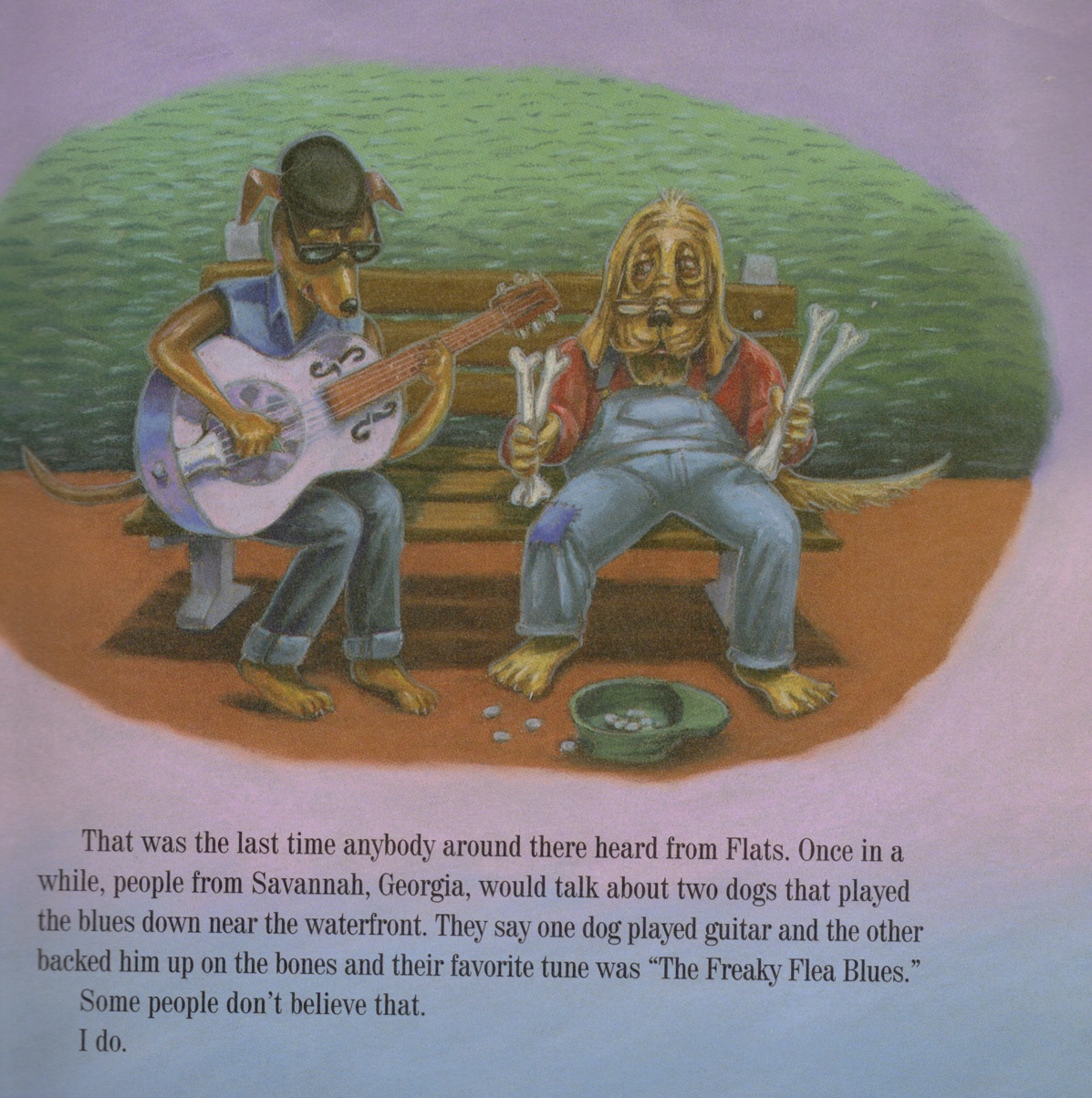
The Blues of Flats Brown by Walter Dean Myers and illustrated by Nina Laden

The idea that he’s not eager to dedicate himself to making money reminds me of an essay on representations of the poor where feminist critic bell hooks decides that representations of poor people in American popular culture show them spending all their time longing for money and the material things it can buy (reality t.v. now does the same thing). She contests this vision with memories of her poor and working class family members who valued creativity and integrity over money.

In The Blues of Flats Brown, Flats and Caleb’s friendship and their ability to sing the music they love means more than living in a big city and making lots of money. Myers notes that some people don’t believe it when they hear the story of two dogs playing the blues down on the waterfront in Savannah, Georgia and I’m sure in part, they don’t believe it because they cannot believe that Flats would choose to give up the chance to be rich. For Flats, wealth was an indulgence of a different order. It involved the time to be creative and to enjoy camaraderie through creation. The way I see it, then, Flats didn’t give up being rich. He exchanged one idea of it for another. Thus, Flats was rich.

Recently, Walter Dean Myers was named the National Ambassador for Young People’s Literature. I read a wonderful interview conducted with Myers in light of this award and he offered thoughtful words on the role reading plays in contributing to the kind of wealth that Flats enjoys. “It’s the people who read well,” Myers tells the interviewer, “who are going to live a good life.” I especially like the way he qualifies reading. It’s not just reading itself that will lead to a good life, but Myers stresses the importance of reading well. Reading well demands time, attention, discipline, and focus. It requires deliberateness. These are all qualities that the skill itself does not demand but this additional effort makes the experience worthwhile because, as Myers also notes, this sort of reading “will give you clues to how to live your life.”

Myers chose the banner “reading is not optional” to serve his campaign to encourage youth literacy. I have not won a single award for children’s literature so the Library of Congress (loc) won’t be calling me to ask about my banner choice but in the spirit of reading and imagining, if the loc were to call, I would tell them that my banner to encourage reading should say “reading is seductive.” I first thought about the seductiveness of reading after thinking through a passage in Toni Morrison’s novel Paradise. Consolata asks Mavis to help her in shelling pecans. As Mavis sets to work, Morrison writes:

Later, watching her suddenly beautiful hands moving at the task, Mavis was reminded of her sixth-grade teacher opening a book: lifting  the corner of the binding, stroking the edge to touch the bookmark, caressing the page, letting the tips of her fingers trail down the lines of print. The melty-thigh feeling she got watching her. Now, working pecans, she tried to economize her gestures without sacrificing their grace. (42)

If I were asked, I would play up how enticing reading can be. Of course the challenge would be trying to ensure that my message wouldn’t become vulgar, which seems to be the penchant in American culture. But for those of us who find reading seductive, the challenge of convincing others to be similarly enticed remains constant; so perhaps it would be a worthy campaign banner if the loc ever comes calling.


Models Monday: Taking King as a Model

One of my favorite Martin Luther King, Jr. stories was one I heard several King aides

Model of the King birth home as its construction was being completed in the Cosby parking lot at Spelman College. (Taken with my iPhone.)

telling through a montage in a documentary about his life. Maybe this was the place where I first heard about how difficult it was to fly with King because of the bomb threats that were phoned in and the precautions taken requiring numerous evacuations for flight crews and passengers. On one of these flights, the men recalled experiencing turbulence that deeply frightened them. They each described the various, colorful fits they went through while also observing how calm King remained; perhaps they recalled him reading a bible through it all. Afterwards, Jesse Jackson, or either Andrew Young, asked King how he could remain so calm. To which he responded, “Well, maybe it’s because I made my peace with turbulence a long time ago.” 

As King was a seeker of peace, certainly he had not decided that peace was impossible. Instead, I understand his remark to mean that he had accepted that his pursuit of peace would be filled with disturbances. Rather than confront this reality with surprise or annoyance, King had decided to live in full awareness of these conditions and of this reality. To that end, bumps and ruptures become a part of peace and a peaceful life and not alien to it or some kind of obnoxious intrusion. It is possible, then, to perceive the possibility of what it means to live in peace. You can live it, as King did on his bumpy flight, when you accept turbulence as a part of it. Fighting this truth would be the absence of peace.

Reading with my Father: Slim’s Table (Conclusion)

My father seemed deeply marked by the depravations he experienced as a child. He remained wounded, it seems to me, his entire life by his father’s absence. He talked about him and thought about him with a deep sense of regret. By paying close attention to my father, I glimpsed a fragility of manhood that resulted from its sheltering a little boy seeking his father’s attention, investment, and concern.

My father would have described himself as a ghetto resident. His residency, as he understood it, was directly related to his mother raising him and his brother without his father on a single income. In addition to lacking his father’s presence, inadequate housing, an inability to dress stylishly, his few and flimsy material possessions marked his experience as an impoverished child. My father never told me that he had a good Christmas as a child. He resented that.

Despite all that he perceived himself lacking–and in fact did lack–my father would have acknowledged the good men, indeed, the good models of masculinity in his community. In his final chapter, Mitchell Duneier writes that “sociologists and psychologists need to explore with greater care the hypothesis that the adaptations of some black men have produced at least some variants of a ghetto-specific masculinity with positive characteristics that might serve as a model to men in the wider society” (164). My father knew admirable men who lived in close proximity to his life and experience. Certainly my grandfather, my mother’s father, was one of these men…and there were others.