Morrisonian Hope: T. Lang Dance Company Premiers Mother/Mutha

On Thursday, I went to The Goat Farm, a visually sumptuous arts center in Atlanta, to take in the premier of my friend T. Lang’s latest work Mother/Mutha. I had the great privilege of seeing her dance company working through some of the movements during an early rehearsal of the show and I was eager to see the realization of her vision. I had never been to The Goat Farm but I imagined it would be a rather intimate, urban spot in some part of the city where I had never been. So I was taken aback when I saw that The Goat Farm was an explicit reference. I sent my husband the above picture with a message that said: “There are real, live goats here!” Instead of the cold, dead, industrial space that I imagined being lit up by this performance, I started considering the fact of black women dancers in this bucolic scene and it immediately put me in mind of Toni Morrison’s Beloved (I know, everything does), particularly the Clearing, where “Baby Suggs had danced in sunlight.” Morrison describes Baby Suggs’s Clearing as “a wide-open place cut deep in the woods nobody knew for what at the end of a party known only to deer and whoever cleared the land in the first place.” The Goat Farm has an industrial past. It was first a site that manufactured cotton gins before making artillery during World War II. During the 1970s, it was used by an industrial engineer who also leased space to artists; apparently, the goats were brought in to eat the kudzu. The interplay of the industrial and the pastoral suited a performance that engaged black women’s violent, bodily interactions with history and their narratives of recovery.

Goodson Yard about 20 minutes before the show. The house was packed by showtime.

Unpaved roads lead to Goodson Yard, the warehouse seen in the above photograph. It was a beautiful evening to take in an event in the semi-outdoors. My phone told me that it was 79 degrees just before the start of the show. There was a wonderful breeze that would occasion past that added to the insistence to remain present to this experience. As I waited for the show to begin, I thought about Baby Suggs’s speech in the Clearing, her message of recovering, of laying it down, resounding in this setting. Through Baby Suggs, Morrison offers what has got to be the greatest speech written in the last fifty years. It is worth quoting at length:

“Here,” she said, “in this here place, we flesh; flesh that weeps, laughs; flesh that dances on bare feet in grass. Love it. Love it hard. Yonder they do not love your flesh. They despise it. They don’t love your eyes; they just as soon pick em out. No more do they love the skin on your back. Yonder they flay it. And O my people they do not love your hands. Those they only use, tie, bind, chop off and leave empty. Love your hands! Love them. Raise them up and kiss them. Touch others with them, pat them together, stroke them on your face ’cause they don’t love that either. You got to love it, you! And no, they ain’t in love with your mouth. Yonder, out there, they will see it broken and break it again. What you say out of it they will not heed. What you scream from it they do not hear. What you put into it to nourish your body they will snatch away and give you leavens instead. No, they don’t love your mouth. You got to love it. This is flesh I’m talking about here. Flesh that needs to be loved. Feet that need to rest and to dance; backs that need support; shoulders that need arms, strong arms I’m telling you. And O my people, out yonder, hear me, they do not love your neck unnoosed and straight. So love your neck; put a hand on it, grace it, stroke it and hold it up. And all your inside parts that they’d just as soon slop for hogs, you got to love them. The dark, dark liver–love it, love it, and the beat and beating heart, love that too. More than eyes or feet. More than lungs that have yet to draw free air. More than your life holding womb and you life-giving private parts, hear me now, love your heart. For this is the prize.”

And then she dances.

The five part composition that T. Lang choreographed was deeply rooted in sound: the sound of an auction barker; of a whip; of Bessie Smith; of Louis Armstrong; of crying; of wailing; of panting; of words; of silence. The visual range was stunning. The dancers were of varying shades of brown and carried that off through bodies of varying, refreshing frames. The masterful blending of the visual and the acoustic oftentimes through new technologies excited time. Every moment of the show felt urgent.

It must be an artist’s challenge to render ugliness beautifully. T. Lang’s choreography renders some of this through citing other artists, like Kara Walker, who have captured the crudity that black women have met in American life. As Lang’s work shows, for black women, crudity resounds like an anthem. But it was striking to me how hopeful the work felt. There was one narrative sequence where one dancer was moved like the stone that Sisyphus rolls. Each time she would be set in place, she would move and have to be reset. The dancer doing Sisyphus’s work kept an impassive face and I was reminded of Camus:

“The struggle (…) itself is enough to fill a man’s heart. One must imagine Sisyphus happy.”

I saw Mother/Mutha as an incredibly hopeful work. I saw the dancers always searching, questing for beauty despite the crudity that loops and repeats interminably. In the work of dancing, through art, the show seems to suggest, black women reflect the “flesh” work that Baby Suggs describes wherein a “you” recovers its own worth–finds its own “model by which to live” –and can be happy.

Milk, Biscuit, and Applesauce

The three items announced in the title of this post are actually listed as “Breakfast” on the menu of the Play School where we recently enrolled our son. Needless to say, I am horrified that this institution considers “milk, biscuit, and applesauce” a meal. You could read this menu and think that we sent our son to a scene from The Little Princess (1939) or better yet, Great Expectations. The austerity of this “meal” makes no sense. Why wouldn’t they try to enliven this choice with color? We live in Georgia and they make no effort to include the peach?! In fact, the fruit listed as an accompaniment to all of the meals on the menu is either processed or suspended in syrup of some kind, which is completely unnecessary. When I want to sweeten my fruit, I usually add honey. I recently watched a beautiful film about honey through a link on Simply Breakfast, one of my favorite food blogs to visit. In watching that video, you get the sense that those people know how to eat.

Breakfast is a deeply aromatic experience; it should smell rustic, earthy, and savory. There should be the scent of sweet or slightly tart berries mixing with the thick, heavy scent of percolating coffee, and complimented by a background of milk pooled in a mug, waiting in a creamer, and curdled in a dish.

The proposed breakfast menu at my son’s Play School fails to engage his sense of smell and this can cut him off from an intense set of experiences. In an article from The New York Times several years back on a conference on olfaction, the description of the power of the sense of smell was as poetic as my own memories stirred by the oatmeal my grandmother made with a touch of maple syrup and a pat of butter:

“Olfaction is an ancient sense, the key by which our earliest forebears learned to approach or slink off. Yet the right aroma can evoke such vivid, whole body sensations that we feel life’s permanent newness, the grounding of now.”

Our sense of smell can awaken us to the urgency of our existence and our uniqueness in the world. I love time’s presence in our sense of smell and recognize its potency. According to Jay A. Gottfried, as quoted in the Times,

“Olfaction is our slow sense, for it depends on messages carried not at the speed of light or of sound, but at the far statelier pace of a bypassing breeze, a pocket of air enriched with the sort of small, volatile molecules that our nasal-based odor receptors can read. Yet olfaction is our quickest sense. Whereas new signals detected by our eyes and our ears must first be assimilated by a structural way station called the thalamus before reaching the brain’s interpretive regions, odiferous messages barrel along dedicated pathways straight from the nose and right into the brain’s olfactory cortex, for instant processing.”

My perception of the coffee that I do not drink but whose scent I strongly remember percolating on Ma Mildred’s stove has the sense of pace that Gottfried describes. I experience it both as a whiff that creeps up out of my past and that is as available as it is gone. I can hear Ma Mildred’s husband Robert slurping his coffee from the saucer he took it from and I can see myself forming an impression. I seemed to be aware of myself creating memories at breakfast time; that’s what it seemed to be for.

My son and I make pancakes together in the mornings. He’s gotten pretty good at following instructions. He can dump and stir all of the ingredients “without making a mess.” This practice has become

something that we do together on the weekends. I’ve been trying out different biscuit recipes on Sunday mornings and he helps with that too.

My mother tried to make me feel better about the “meals” he would be served at Play School by telling me that he would get used to them. I explained to her that that is precisely what I don’t want to happen! I don’t want him to get used to that menu. So I’ve decided not to routinize that meal for him. When our schedule requires that we have to surrender him to that spartan, Play School fare, then he will encounter such austerity as an irregularity; otherwise, the evocative, aesthetic experience of an aromatic breakfast will be his measure. We take him to Play School after he’s had breakfast at home. We decided that his sense of smell was far too important to neglect.

Father’s Day Suite: John Edwards and Impoverished Children

It’s been about a week since John Edwards accepted responsibility for his “sins” in his press conference following the not-guilty verdict in his federal finance charges case. Making the distinction between his personal failings and his commission of crimes was a key strategy in mounting his defense. It is an important distinction. What worries me now is the work he plans to do for “impoverished children.” The New York Times reports that,

“Mr. Edwards closed his statement by saying that he believed that God was not finished with him yet and that he would spend the rest of his life trying to be the best father he could and work at how he could serve impoverished children in the United States and around the world.”

I hope that Edwards rethinks his photo op of impoverishment. This one takes place on December 26, 2006 when he became the first major presidential candidate to enter the race. Credit: CHARLES DHARAPAK/AP Photo.

I can’t help but to consider the limited way that Edwards might be conceptualizing what it means to be “impoverished.” For him, it seems to refer exclusively to money. In the Nightline segment that I watched, Edwards spoke of seeing children in the most poverty stricken places and believes that the Lord might have him serve those children. Poor children could certainly benefit from whatever money John Edwards can give them; they should take his money. Edwards, however, might want to spend some time considering how an expanded definition of “impoverishment” might be serviceable here. In his case, moral impoverishment best captures the “sins” that he accepts responsibility for and surely impacted his own children. The fact that they have money does not mean that they are not suffering as a result of their father’s moral impoverishment, despite his material wealth.

The public humiliation that Edwards has brought upon his own children would seem to create a strong need for him to consider the wreckage of moral impoverishment. Working through the salacious details of his own recklessness towards the feelings of his children is worth his investment. His actions put them under considerable public scrutiny. It pains me to think about how they were forced to enter into their public world and then come to terms with how they were being perceived; wondering how they would respond. I strongly identify with how his children might have suffered. Having to suffer through my own father’s worst times when I was a young girl made me sympathetic to my peers who were suffering the sins of their fathers.

My father came to my high school once to taunt me. I can’t even say that the taunting contained a plot, he just seemed to want to make me feel uncomfortable. I knew when I saw him that he had been plotting this bully session obsessively for at least that entire day. He could get that way when he was in one of his dark moods and when I saw him, I knew that I was in for something mean-spirited and largely incoherent. So on that day, he made me answer questions with language that good manners forced me to respond to in a way he could anticipate and thus controlled. All of my track teammates were around and they let me have my moment of glassy eyes after he left without question. And in turn, I defended them when they showed up to practice with startlingly jet black hair that covered their natural blond locks and stared off into space until their fathers came to practice; I watched them cry.

I thought about those Edwards children who might have had money but may not have had a mature enough relationship to language to respond to the sadness or to the curiosity of their peers and their peers’ parents and their teachers who wondered about them. How they all might have struggled with trying to show concern for those children who had to suffer their mother, Elizabeth Edwards’s pain, heartbreak, and sorrow as she was herself dying from cancer and losing her world. Though she isn’t old enough to have peers who worry about her yet in this way, I thought about the fact that Edwards’s affair has informed his youngest child’s public identity.

My father would spend the rest of his life “trying to be the best father he could be” and I think it was time well-spent. He did charitable work in El Salvador in 1999 and he worked with homeless families consistently until he passed in 2010. As he did it, he never overlooked his own impoverishment. In an interview that I conducted with my father during the summer of 2006, you get a real strong sense of the kind of thinking that my father did over his limitations as a father. Here’s a portion of the transcript where he reflects on his parenting when compared to his brother, my Uncle B.B.:

Dad: As a father? I’ve been envious of my brother’s relationship with his children. As a father-

Me: Really?

Dad: Oh hell yeah.

Me: O.K., because as I kid I remembered you’d talk about the pressure that he put on his kids that you weren’t happy with.

Dad: There’s a staying power-

Me: Mmm.

Dad: That in spite of the unhappiness, in spite of the fact that I disagreed with what he was doing, he didn’t go nowhere.

Me: Mmm.

Dad: You know. I can’t say that with you. See, but like I say, as an athlete, I’m not concerned about the game and the score of the game in the first quarter. You know. When it’s over, look at the scoreboard now. I feel like I’m a blessed individual that God put your mother into my life producing you. Oprah Winfrey? You ain’t seen greatness yet. I don’t care how much money Oprah got that if you gave me [a substance], my daughter versus Oprah, I’m picking my daughter. Not because she’s my daughter, it’s because I think she’s a great person. It was always real important to me…In the case of my brother, in spite of the fact–I made some youth adjustments, some peer pressure adjustments that affected my relationship with my daughter that all the things I said I’d never do, happened. And are there some regrets? Sure there are. You know. What do you do? Check me in the fourth quarter.

Me: Mm hmm. And as you say, rebound.

Dad: Oh I’m Dennis Rodman, I can rebound.

Me: But you think your brother is a cool father?

Dad: Oh God yeah. God yeah. How can you not be a cool father when you had health care for your kids and I didn’t have health care for mine? How can you not be a cool father when you were working everyday for your kid to not to have a scholarship but you could pay for them to go to school? How can you not be a cool father when you took your kid out of this environment and put them in a different one with a higher degree of education? When you always made sure that there was food on the table? That you were always there with some Kleenex? That you were always there at that baseball game that I was talking about?

Me: Mm hmm.

Dad: Oh it’s different things about him Bean(voice starts to break) that I respect the shit out of him for (trails off)…

Even if my father had not done a day’s work with “impoverished” children in El Salvador, I think his honesty about his limitations and his recognition of my Uncle’s good example redeemed him in many, many ways. I think he offers a good model for John Edwards to use for his own pursuit of being a better father to his children. My father would smile at the suggestion.

See also:

Reading with my Father

The Elegance of Cooperation

Junior distance runner Meghan Vogel won the open mile at the Ohio State championship this past weekend but was on her way to finishing last in the two mile. As she was approaching the finish line, the runner in front of her, Arden McMath, began to collapse–and then something extraordinary happens: Vogel lifts McMath and supports her weight across the finish line, advancing McMath ahead of her in the final push! Instead of taking her shot at not finishing dead last, Vogel exhibits an incredible sense of integrity by advancing McMath ahead of her thereby reflecting McMath’s front runner status before her urgent decline. As someone who competed on that same Ohio track when I was in high school and thus knowing the drama attached to success on the state’s biggest stage for runners, I find Vogel’s compassion and generosity inspiring. Ultimately, she maintained a clear perspective concerning what was at stake. Neither of the runners could win first place. Instead of giving in to the terms of competition that would make finishing last the goal to fight against, Vogel redefined the meaningfulness of the event so that the goal became maintaining one’s humanity in the face of an alleged indignity. From the way that Vogel casts these terms, losing would have been passing by a fading opponent; ignoring someone’s clear need for assistance.

I admire McMath’s response as well. I have seen runners completely pass out in a race. Instead of conceding to the burning in her lungs and the lactic acid weighing down her legs, McMath allowed herself to be helped and in doing so made Vogel’s load an easier one to carry. As cooperative competitors, they redefined the most basic terms of athletic competition. Together they turned the simple grammar of competition’s starkest expression into an elegant, lyrical statement of human achievement.

See Also: 

“Track and Transformation”

Models Monday: On Dignity’s Power

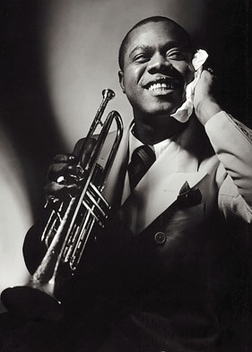
The great trumpet player and soloist Louis Armstrong (1901-1971).

I’ve been thinking about and listening to a lot of Louis Armstrong lately. It all started with me thinking of my grandfather and Armstrong’s “Black and Blue.” I’m almost surprised at how well Armstrong’s music translates across time. It resists whatever elements of its own time that would have held it there. I watched an exceptional conversation on youtube that Robert O’Meally facilitated between Wynton Marsalis and Stanley Crouch about Armstrong and his legacy. At one point, Marsalis linked Armstrong to a conversation about dignity that I found intriguing. Marsalis contends that Armstrong’s favorite trumpet player was Joe Oliver because “he played with a lot of dignity.” So what’s striking to me is that minstrel images still cling to Louis Armstrong’s presentation at the same time that you encounter the dignity of his music. There is no question that Armstrong played himself up as a clown before white audiences and was legitimately accused of “Uncle Tomming” by scores of black folk. However, his artistry and excellence of craftsmanship overcomes the social limitations that informed his self-presentation. His seeming collusion with a will to emasculate him gets overridden by the grandeur of his sound. Thus, his music, the quality of it, its sophistication, its dignity, mounts a strong challenge to the sole triumph of the denigrating potential of his exaggerated grinning and bucked eyes. His command of the notes restores his humanity. So what of the dignity and integrity of contemporary music?

I know this question may seem kind of stale to you but let me try to reinvigorate it through a discussion of how I am thinking of it anew. I was in a meeting recently where the goal was to try and help an organization to develop a mission statement. Our discussion leader wanted to prompt our thinking around a series of words. One of the participants responded to the list of terms that included “integrity,” “excellence,” and “discipline” by saying that she wanted “‘integrity’ off the list because like “love” it was so overused as to be meaningless.” I found her remarks deeply affecting. How can one say anything meaningful, I wondered, without “integrity” and “love?” While I certainly appreciated the point about the diminished value of overused terms, I thought it equally damaging to respond through the concession of such important words. “What might it require to make “integrity” a resonant term?” I wondered.  “How do you reposition “love” so that it resounds in useful ways?” Rather than toss “integrity” and “love” aside, I wondered how they might be salvaged so that they would be available for our employment. I thought about this as I watched about six minutes of “Niggas In Paris.” What do we do with this legacy of dignity and integrity of performance as it contends with contemporary musical expression?

Maybe it’s a moralizing question, but it came up for me when I saw a clip from the “Watch the Throne” tour from Paris where Jay-Z and Kanye West performed for three hours at the Palais Omnisports de Paris-Bersy. The pair reportedly performed their wildly successful single “Niggas in Paris” eleven times for over 50 minutes.

The song begins by focusing on the improbability of being a black man with freedom and wealth. It further engages the rappers’ sense of disorientation surrounding the improbability of their freedom and wealth and how that gets negotiated in their relationships with others. For the many of us outside of this notion of good fortune, they document their wealth in concrete terms. And so we get a chronicle of the many exceedingly expensive goods they can purchase without fretting the expense. Since I don’t spend very much time dreaming of consumer goods beyond what I can afford, I was unfamiliar with the Audemars brand. When I looked it up, I saw watches that cost over one million dollars. The least expensive ones cost over two hundred thousand dollars. I love watches. Even as a child I enjoyed them. My first one was a Mickey Mouse watch with a black leather band. I enjoy the craftsmanship of a well made timepiece, but I can’t imagine spending one million dollars on one. I just can’t imagine that my experience of time would be worth the expense of the watch. I don’t accept that a million dollar watch makes one’s experience of time more meaningful. So even if I had the money, I can’t see that I would own an Audemars watch. Now, I do like having a clean environment so I think finding clean, well-maintained, and safe lodging is important. But since $965 a night is out of my price range, my own trip to Paris did not involve plans for a stay at Le Meurice. When I looked up Jay’s reference to the Le Meurice, I thought its citing a good example of his noted thoughtfulness. Given the royal suggestion in the title of he and Kanye’s CD as well as their tour, the hotel’s description as “the hotel of royals” and the pied a tier of “celebrity royalty,” Jay’s reference fits. The hotel’s history was also of interest to me as 1771 gets cited. The Atlantic Ocean was filled with the traffic in slaves at this time. All of the people coming and going into the hotel that Jay cites did so with slavery as its backdrop, as a part of the business that afforded and defined the luxuriousness and opulence of it. That Jay can be one who enters the hotel as a guest and not an item of exchange or a unit of capital in the Atlantic world economy stands out. But what also stands out is how disconnected from the visual economy of this legacy his references were.

Though there are many images of the transatlantic world economy that could have been used to reinforce the point of Jay’s reference, none of them were. “NIGGAS IN PARIS” stands in for all of these other more compelling images. It lights up in white letters against a black screen and flickers on and off for over 50 minutes. There are examples of how “niggas in Paris” have experienced discrimination that could have also resonated with a French audience. Nearly two years ago now, the French police were shown on video dragging pregnant black women on the ground, sometimes with their barebacked infant children on the cement in order to stop them from protesting their eviction from apartments in the Seine-Saint-Denis suburb of Paris. Why not loop this very disturbing video? The ethnic tension between North African French and European French as well as the religious intolerance confronting the Muslim population in a secular state since September 11 could have given Jay and Kanye plenty of material to draw from. Perhaps fusing his song “Glory” about his daughter Blue Ivy and those related images might have been set against the girls in French schools who were prohibited from wearing veils. It seems to me that the nearly one hour looping of this song could have been more meaningful had it worked better with the conditions on the ground. There are marginalized folk in Paris now who are feeling the kind of estrangement that Jay and Kanye have moved beyond. So what is the relationship between the world they came from, the place where they are performing this song, and the people who are rockin’ with him over it? In general, how does the sense of disorientation of those who would expect to be marginalized in the States relate to the disillusionment of those ethnic and religious minorities living on the edges, the suburbs, the banlieues, in France? What was the crowd actually responding to? Were they rejoicing in Jay’s unlikely ascendency? Energized over extending a similar unlikeliness to the minorities in their midst?

What Louis Armstrong’s example shows us is that dignity humanizes. I don’t want to dismiss the possibility of there being dignity in Jay and Kanye’s performance but I found it hard to find. Even as someone who believes that words can be recuperated and put to novel uses, I found their use of “Nigga” merely excessive; it just feels like waste. I understand that a part of the song’s goal is to provoke but I wonder if the provocation itself contains some dignity. In other words, what about their performance can meaningfully endure beyond their time in the way that Armstrong’s music did for him? Given that they spent over 53 minutes on that song, what was the point? Some websites that I looked at that discussed “Niggas in Paris” as it was performed this weekend seemed to revel in the fact that the duo made history in backing up this track eleven times; but so what? Even though their goal is to entertain, the will to entertain does not negate a consideration of the place and role of dignity. Armstrong’s example highlights this point. His musical performance was always in conversation with his self-presentation. The contemporary example, I think, allows us to engage the way that dignity still matters at the party. A party that makes dignity irrelevant is a dangerous affair, I don’t care how rich its hosts. (I think the new Great Gatsby film makes this point.)

It is not a good idea for us to enter into any space and to imagine that “dignity” has no place; that it should be taken “off the list.” The force of dignity to recover the force of our humanity makes it a worthy aim for our ambitions.

Father’s Day Suite: Quiet Acts of Love

Since this is the month where we in the United States celebrate Father’s Day, I want to begin June thinking about fathers. Reading with My Father chronicles some of my engagements with my father’s memory through books, sometimes songs, fashion, and films. Throughout this month, I want to think generally about the idea of fatherhood in U.S. culture. Robert Hayden’s poem “Those Winter Sundays” offers an eloquent way to begin.

The poem is told through the voice of a man coming to terms with himself over what he couldn’t or didn’t understand about a father’s love when he was merely a boy. His father never experienced relief from working, as on Sundays he “too” continued his labors. What made Sundays different, despite that he remained unprotected from the elements, especially the cold, is that he worked through it to make warmth for his own family to enjoy. The father’s habits are similar to Troy Maxson’s, the complicated father that August Wilson crafts in Fences, whose deeply held principle that he owed “a responsibility” to his son at least drives him to work through the humiliations of his work for the sanitation department. In Hayden’s poem, the father endures the cold until the warmth set in, protecting his son from having to tolerate its bitterness. The father’s sacrifice reveals his thoughtfulness and his sense of compassion. Looking back on his father’s efforts, the son realized the gifts of sacrifice and kindness that he once overlooked. Chastising himself so as to forgive himself, the son realizes that he had not recognized love as a series of seemingly plain and spartan acts. “Austere,” with its suggestion of cold, solemn, sternness does not usually cling to our expectations of how love behaves or performs.The poem makes you wonder how much unrecognized love we’ve known. What does it actually mean to know a thing that you do not recognize?

It’s interesting to think about what work needs to occur to make this kind of love–plain, austere love– visible; to imagine what it has to cut through. I remember feeling struck by the recognition of mis-seeing love when I first saw Jean-Marc Bouju’s 2003 World Press Award winning photograph of a hooded Iraqi prisoner comforting his son:

World Press Photo provides a nice interview with Bouju detailing the events surrounding his award winning photo.

The text accompanying the photograph described the soldier’s compassion towards the man and his son; I had missed that. I was too overwhelmed by the father’s grim, black hood and the spiky wire to notice anything more. Eventually, love came into focus. I saw that despite how frightening I found the father’s appearance, the child was clearly comforted by him. He gives in to his father’s body and allows himself to be held. I imagine the same American soldier who cut the plastic handcuffs also neatly placed the boy’s shoes beyond him. Thus, instead of seeing the photograph as a chronicle of what was not done to make the scenario more palatable, I began to see and appreciate the traces of humanity that were to be found.

Whether fighting through Hayden’s cold or through the barbed fences surrounding the arid desert that Bouju forces us to peer through, there is work involved in coming to recognize love, which is unexpected. I think we expect to easily recognize love because we think of it as a noun and not a verb. Erich Fromm writes about this in at least two places, To Have or To Be as well as in The Art of Loving. In brief, love conceived as a noun considers it as a possession, something that you have. Love, Fromm insists, is not a thing, but an activity:

“a process, is a verb: for instance I am, I love, I desire, I hate, etc. Yet ever more frequently an activity is expressed in terms of having; that is, a noun is used instead of a verb. But to express an activity by to have in connection with a noun is an erroneous use of language, because processes and activities cannot be possessed; they can only be experienced. (To Have or To Be, 19)

Hayden’s self-questioning and self-admonishing narrator raises the question of how we come to learn to recognize “love’s austere and lonely offices” by coming to perceive an experience. It is what the narrator does when he sees his father’s efforts to warm the house, polish the shoes, and wait for the cold to dissipate as love. His father gave him the experience of warmth but the child was too distracted by his father’s sternness and solemnity to appreciate these expressions of love. Thus, there is a caution raised in the poem against overlooking the value of pared-down, quiet expressions of profound feeling. The work suggests that raising children with a greater sense of the scope and the magnitude of love in their lives might just involve teaching them to see love through both the eloquence and the mechanics of austerity.

See also:

Models Monday: The Certainty of Love

Natural Hair: A NYT Op-Doc

Zina Saro-Wiwa’s short documentary film, Transitions, for The New York Times captures an interesting mood surrounding black women’s natural hairstyling practices in the contemporary U.S. The film is about six minutes long and you can view it by following this hyperlink and viewing the film on the Times’s site.

Bizarro World and Immigration Reform

Kansas Secretary of State. His website describes him as a “Defender of Cities and States that Fight Illegal Immigration.” Newsweek calls him the “America’s Deporter in Chief.”

I read this today in The New York Times and it gave me pause:

“Without question, Alabama’s H.B. 56 is the most comprehensive anti-illegal immigration state law ever drafted,” said Kris Kobach, the Kansas secretary of state and intellectual author of both the Arizona and Alabama laws, who has consulted with 10 other states on immigration legislation. “It includes just about everything a state can do to discourage illegal immigration.”

Kobach, an informal adviser to presumed Republican presidential candidate Mitt Romney, is a proponent of “self-deportation,” creating conditions so unwelcome that undocumented immigrants leave voluntarily.

The idea that people are working towards the goal of being uninviting and inhospitable is an ugly goal. Americans ostensibly love the practice of creating home. Martha Stewart’s financial success comes from her ability to tap into this desire of creating a beautiful environment and extending that place to friends and family. Creating unwelcome conditions for guests is like experiencing the Martha Stewart ideal in Bizarro World. The Bizarro Code states: “Us do opposite of all Earthly things! Us hate beauty! Us love ugliness! Is big crime to make anything perfect on Bizarro World!” It looks like we’re well on our way towards having our immigration laws exemplify this code.

I don’t understand why our national conversations around bullying aren’t connected to our conversations about immigration–or to our conversations about the environment. From the Times discussion of Kris Kobach’s role as the author of both the Arizona and Alabama “comprehensive anti-illegal immigration state law” he seems to be a professional bully. His notion of “self-deportation” attempts to divert attention away from those who actually create “conditions so unwelcome that undocumented immigrants leave voluntarily” and make it appear to be about the immigrant’s choice. Well, how much choice does incivility leave? Policies promoting inhospitality force departure.

While the Bizarro reference might be dismissed because of its relationship to the comic book world, Kobach casts himself as a superhero through the articles on his website. He’s the “Defender of cities and states that fight illegal immigration.” Newsweek calls him the “Defender in Chief.” Kobach is certainly no vigilante. He definitely wants to work within the law, but I don’t feel safe because of the work he’s doing. Instead, I think the work he’s doing poisons the environment. When I think about the environment, I think about the reservoirs that we’re able to draw sustenance from in physical, psychic, and spiritual terms. Promoting hostility towards guests and strangers pollutes the environment because it creates fertile conditions for planting and then reaping harvests of contempt. Making a world unwelcome for immigrants is the same as making it unwelcome for children who are targets of bullies. Making our world more inhospitable is an ecological crime.

Leaning In to History

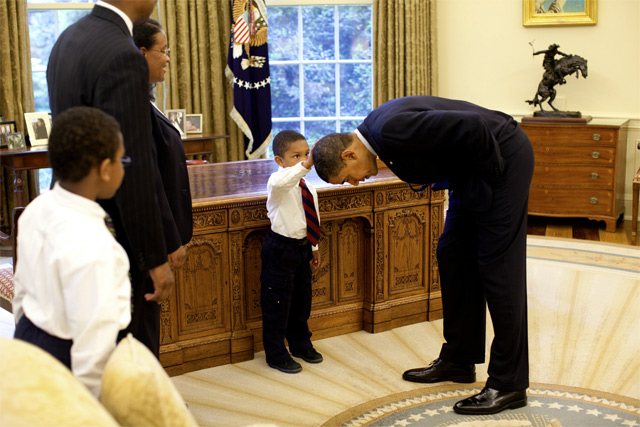
This Pete Souza photograph of President Obama and 5-year-old Jacob Philadelphia has been making its rounds in the news lately. Philadelphia’s father, Carlton, a former Marine, was visiting the Oval Office with his family after being granted a courtesy common to departing staff members. Interceding for his family, Mr. Philadelphia told the President that his sons each had a question for him. Jacob goes first and softly asks the president if his hair is like his. The president leans in and says to Jacob, “Why don’t you touch it and see for yourself?” It’s an affecting story.

I wonder what Jacob thought about his own hair. I wonder why he questioned the feel of the president’s hair. I know my own three-year-old son doesn’t enjoy getting his hair cut–at all–but he hasn’t yet formed an identity involving his hair. So I wonder what happens in the space of those two years for little black boys to begin contemplating their hair texture. President Obama followed-up with Jacob and Jacob confirmed that “Yes, it does feel the same.” I wonder what that did for him.

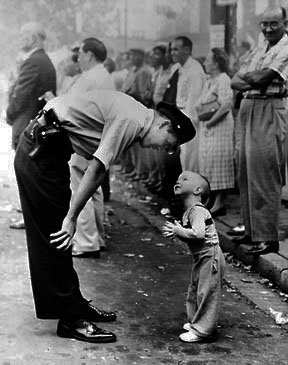
When I saw the Souza photograph most recently, I was reminded of the 1958 Pulitzer Prize-winning photograph by William C. Beall entitled “Faith and Confidence.” Beall was on assignment for the

Beall’s photograph from September 10, 1957 won a Pulitzer Prize for photography in 1958.

Washington Daily News (September 10, 1957) when he captured police officer Maurice Cullinane cautioning a two-year-old boy, Allen Weaver, who had stepped into the street where the Chinese Merchants Association parade was occurring. Much of what I read about the photograph suggests that its power comes from its suggestion of “childhood innocence.”

1957 is a lyric year in American history that saw black artists boldly respond to violence meeting black children in the South, particularly in Little Rock, Arkansas. In 1957, Louis Armstrong canceled his tour of the Soviet Union to protest Governor Faubus’s racist intransigence over school desegregation and the general humiliations and routine indignities of white supremacist hatred in the Jim Crow South. And though it was recorded two years after the Little Rock Nine’s desegregation efforts, jazz bassist Charles Mingus also penned “Fables of Faubus” as an explicit protest song against Arkansas Governor Orval E. Faubus who called upon the National Guard to block the integration of Little Rock High School. Its original release did not include the scathing lyrics that would accompany the song as it was recorded in 1960. Indeed, the governmental response to black children in 1957 was far more martial than innocent.

The Beall photograph has charm. Weaver looks enchanted by this big, authoritative man who makes himself small for the child. It is certainly a persistent wish of the nation that it looked this charming in the 1950s. But the claim to happy days ignores this image from September 1957:

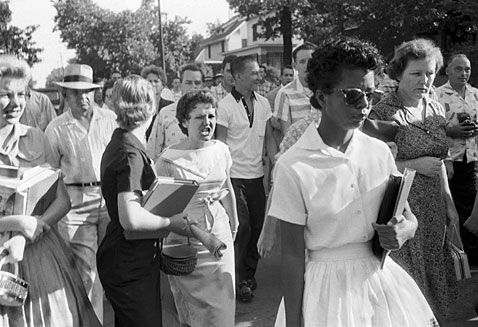
Elizabeth Eckford surrounded by a hostile crowd that includes the jeering Hazel Bryan on September 4, 1957.

Will Counts, the photographer for the Arkansas Democrat, captures Elizabeth Eckford within a broad expanse of charm’s opposite. Black children from 1955 thru at least 1968 with the killing of Pine Bluff, Arkansas native Bobby Hutton, were not the recipients of congenial acts of public authority.

In part, the potency of the Obama/Philadelphia photograph lies in the suggestion that legal authority may lean in close so as to address an imbalance of power that has routinely harmed black children. While holding the highest office in the land, President Obama leans into a child; it’s a portrait of servant leadership that holds promise for young black boys.

I think it’s interesting that young Jacob asked the president “if your hair felt like mine” and not simply what his hair felt like. Jacob appears to wonder about himself in relationship to the President’s body. In feeling the president’s hair, his touch confirmed his nearness to power rather than his distance from it. The president himself didn’t seem to think that he was a specimen or an object of racial curiosity. I am reminded of a very different scene between legendary tennis champion Arthur Ashe and the spectacle of him attempting to have his hair cut while on the professional tennis circuit. In his memoir, Off the Court, Ashe writes this about his experience in Australia:

Aboriginals all have straight hair and the closest thing to me was a Fijian, whom the Aussies would call a ‘wooly.’ Several times I had to try to explain to an Australian barber how to cut my kinky hair. And each time the shaving became ‘theater.’ People would literally stop and watch; chances are they would never again see a kinky-haired black man get his hair cut. I know that for a long time several players–especially the Russians–wanted to touch my hair but they never asked. Alex Metreveli, the Russian player, had a coach named Serge. One day, at Albert Hall in London, I came out of the shower, semi-dried my hair, put on my clothes, and then proceeded to ‘pick’ my hair. Serge watched with amazement as my ‘pick’ disappeared into my head and with a flick of my wrist I pulled, teased, and shaped my ‘fro.’

‘Vat is dat–dust?’ he asked.

‘No, is not dust. Come here Serge; you can touch it.’

He walked over and felt the top of my head while the locker room roared.

‘Is soft, not hard. I think long time is hard. Feels nice.’

‘What does it feel like, Serge?’

He broke out into a big grin and walked out, amid howls of laughter. (136-137)

One wonders whether the estrangement of hair texture animating the “theatre” described here motivated young Jacob’s inquiry of Obama; and whether the president’s recognition of the feeling moved him to invite the boy to confirm their similarity. Certainly what passes between Obama and young Jacob differs dramatically from Ashe’s description of his encounter with Serge; especially the final silence. What exactly did Serge’s grin mean? How did it answer Ashe’s question about what his hair felt like? Young Jacob answered the president’s question directly, telling him that their hair felt the same. It was a confirmation of sameness, a sense of shared humanity. The grin and the laughter that passes after Ashe’s question to Serge makes no sense. What it doesn’t do, it seems to me, is bring them closer together through shared sameness. The empathy that passes between Obama and Philadelphia does not appear to occur between Ashe and Serge.

The direction of the touch anchors the power of the Obama/Philadelphia photograph. As the photograph suggests that the child has the power to ennoble an apparent supplicant, it moves beyond charm and enters a more substantive realm given that the crown young Jacob touches actually belongs to the one who holds the highest office in the land.

Models Monday: Memorial Day 2012

Norah Jones’s rendition of the Gene Scheer song “American Anthem” hits all the right notes and it frames my thoughts about this Memorial Day.

My grandfather, Charles Albert Hite, served in World War II and by all accounts, he was none too happy about it. My Uncle Eric wrote about my grandfather’s views on serving in some of our correspondence. According to Uncle E’s memory, my grandfather “listened to FDR’s speech promising all them mamas that their boys would be safe from the draft, but if I can remember correctly,” notes my uncle, “he and Uncle Frank received their draft notices the next week.” What isn’t apparent from the Honorable Discharge report itself and my grandfather’s frustration with FDR involved his enlistment date on February 19, 1943: my grandparents were married only six days before he was drafted on February 13, 1943.

The Honorable Discharge report shows that my grandfather mastered the rifle, but according to my Uncle E, my grandfather had no interest in using his skills. “I can remember the Ole Man being angry at the Blacks back home who constantly went to the press about wanting the Blacks to have a bigger participation in the War effort,” he writes. According to my uncle, my grandfather “didn’t like that shit at all.” In fact, my uncle continues, “he was real cool with ‘digging ditches,’ and didn’t want nothing to do with the fighting.”

Today, as it is Memorial Day, I think about my grandfather’s service now through the lyrics of Jones’s resonant voice–even though those lyrics don’t quite fit his story. When I think of my grandfather, I wonder how he must have processed going into war with a new wife and and a baby on the way. I wonder how flimsy hope must have felt to him as he thought about making it back for them. My grandfather was fortunate since he did return to his wife and son. Today, I’m wondering about the soldiers he met who didn’t make it back. Did they have young wives and children who inspired their dreams of making it through the war? For my grandfather, Norah Jones’s bluesy, plaintive voice doesn’t quite strike at the core of what he might have been feeling–Louis Armstrong’s (What Did I Do to Be So) Black and Blue best captures the frustrations of a Black man from the Jim Crow South sent off to fight for a country that did not even protect him from Kentucky. When I imagine the friends that he might have lost, though, Norah Jones’s tender, raspy voice moves in deeply when I think of their mothers. I think of the soldiers telling what they might have believed but when Jones sings “America, America, I gave my best to you,” I imagine their mothers singing that part and I am deeply moved.

I know a lot of folk who celebrate Memorial Day with barbecues and picnics on Sunday. When I look around my neighborhood, there aren’t too many folks partying today, which seems appropriate. Today should really be a day for thinking about those mothers who gave us their “very best.”