My mother and one of her friends recommended PortableNorthPole.com to me. It’s a site that allows you to work with Santa in composing a personalized video message for a special recipient. I highly recommend this site. My son watched his special message for over an hour last night and woke up asking for it this morning. What was really neat was that the message was slightly different this morning…and this was the free service! I was so impressed that I bought the App for my iPhone for $2.99 and I’ll probably be upgrading the video options as well.
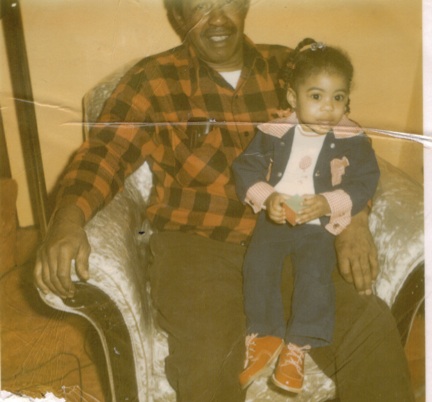
Here’s a picture of me as a toddler with my grandfather at our neighbor’s house. He loved me dearly, and loving me involved telling me what to do.
I never lived a single day of my life in or near 1929 but because my grandmother was a child of the depression, it touched every aspect of my home life growing-up. I think about this all the time when I consider our current beliefs about how children should be raised so that they should never know hard times. This was not how people thought about child rearing when I came of age. They may not have believed in showing their vulnerabilities but the adults I knew certainly believed that children should know of their sacrifices. How much something cost or how long it took to acquire was not a secret. Do you know how much water costs? was asked of me anytime I left the water running in the sink for too long. Do you know how much electricity costs? was the question put to me if I left lights turned on or kept the refrigerator door open while I searched for something to eat. It seemed like I was always being asked to think about how much money it cost to live.
I wonder why people don’t make their children think about expenses anymore? A friend recently shared with me that a year before she was planning to apply for college, her parents sat her down and explained how much money they had to spend on her education. That total included transportation costs, books, and incidentals. My friend teaches at a private college now and was reflecting on her own experiences upon encountering current students who seem surprised that their parents are struggling to afford their tuition. One student confessed that her parents asked her to transfer to a less expensive school but the student refused because “she was enjoying her experience.” I never would have been given that kind of choice when I needed my mother’s money. My mother, like my friend’s parents, would have simply told me what I was going to do.
I liked those days of parenting better than the ones we’re living through now. I don’t think that children should tell adults what to do. The things my husband reports students saying to him just appall me. In thinking about his experiences in the classroom alongside other stories that I have heard about the things young people say and do who have not been made to respect the work and sacrifices of adults, I have come up with a list of things adults should considering telling children to either establish or reinforce the hierarchy:
1. No (you do not have to say yes to your children).
2. Hush (you can make your children stop talking).
3. Put that X away (your children are not entitled to video games, toys, etc).
4. Read this.
5. Do X (your children need to do as they are told).
6. Answer me.
7. Come here.
8. Go there.
So what do you think of my list? What would you add?
I read Sara Mosle’s article, “What Should Children Read,” in The New York Times with interest. In the article, Mosle shares her disappointment with the content specified by the Common Core State Standards. The national benchmarks set to go into effect in 2014 require that nonfiction comprise 70% of the curriculum. According to Mosle, David Coleman, the College Board President who helped “design and promote the Common Core,” offered this as the rationale for his vision:
“It is rare in a working environment that someone says, ‘Johnson, I need a market analysis by Friday but before that I need a compelling account of your childhood.'”
In response, Mosle offers education researcher Diane Ravitch’s perspective. She asks, “Why does David Coleman dislike fiction?” In support of English literature, Ravitch offers her own view of the value of fiction:
“I can’t imagine a well-developed mind that has not read novels, poems and short stories.”
Ravitch’s got the right idea. Her view of reading as an aspect of education emphasizes thinking whereas Coleman’s view of reading seems to be limited to a single context. Sure, work constitutes an aspect of life, but not all of it. Little of what I did over this Thanksgiving holiday could be described as work; that was the point. I enjoyed myself cooking, eating, talking, reflecting, listening, writing, reading. I enjoyed my time with my family. Working represents only one aspect of life, not the entirety of it.
It was interesting to read Ginia Bellafante’s article in the Times about the city’s lack of compassion for the hardships confronting people in housing projects in the wake of Hurricane Sandy in light of Mosle’s article: The lack of consideration for the diabetic who could not properly store insulin in the refrigerator without power; the lack of recognition for the danger facing young people moving about thru unlit hallways. As people have been forced to spend what little income they have in response to Sandy’s wreckage, some have not been able to afford their rent; others have not paid in protest against the city’s failure to provide adequate services. Bellafante points out that the city gave residents free tickets to Carnegie Hall. That would have been a fine gesture if it were offered in tandem with basic services. While the city’s leaders suggest through their gesture that they value art, their failure to show empathy and compassion suggests little of art’s influence.
Good students of the arts are moved by it–if not changed altogether. The arts create a sense of intimacy around the human condition. They have the power to bring you in touch with the interior lives of those we are normally cut off from; it’s a soulful experience. According to Toni Morrison, reading, specifically, is also a seductive experience.
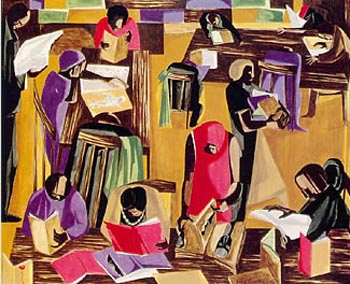
In Paradise, for example,the seduction of reading-understood as the beckoning, siren like pull of literacy-emerges prominently in the history of rejection and dissention within Haven and Ruby; limited literacy contributes to the violence directed at the Convent women. Women are not simply victims of male illiteracy however, but have their own responses to the lure of literacy. Thus, when Mavis saw Connie shelling pecans she, “was reminded of her sixth-grade teacher opening a book: lifting the corner of the binding, stroking the edge to touch the bookmark, caressing the page, letting the tips of her fingers trail down the lines of print. The melty-thigh feeling she got watching her” (42). Mavis’s seduction occurred as a result of observing the thorough, tactile attention her teacher gave every aspect of the printed page. She was moved to feel the erotic sensation she witnessed through the teacher’s lingering, attentive fingers lift, stroke, and caress the book.
Responses to literacy are revealing. When I watched Steve James’s 30 for 30 documentary, No Crossover: The Trial of Allen Iverson, there was a moment in that film that offered a telling story of Iverson’s relationship to literacy. Though Iverson was in prison, college basketball coaches still sought after his prodigious talent. In his recruitment bid, Coach Mike Jarvis, then basketball coach at George Washington University, went to visit Iverson in prison and brought him The Autobiography of Malcolm X. Jim Ellenson, one of the attorney’s involved with the defense, claimed that when he saw Iverson in prison, Iverson’s comment with respect to the book was “what the fuck am I supposed to do with this?” Ellenson suggests that Iverson was merely commenting on how impractical the gift was for someone who just wanted to get out of prison, but I thought it a tragically revealing admission of his shortsightedness. The Autobiography should have been received as a relevant text for a young black man imprisoned in the prime of his life. It might have suggested hope for a meaningful life beyond soul crushing circumstances.
Young people need to be taught what to do with books and how to establish a relationship to literacy. If schools are not doing this, you can have your own literacy requirements for your children. Thus, in considering Sara Mosle’s well-founded critique, your child’s reading list does not have to be limited by the school’s curriculum. Be forewarned though: your child may not like your assignments. But as I say to my own son when he shares his feelings concerning what he wants to do, “wanting to is not a requirement (think about it, instructions rarely if ever require liking what follows)–you don’t have to like it, you just have to do as you’re told.” Children must be good at following instructions–yours and the schools.
I was invited to moderate a film discussion earlier this week for a film that has received rave reviews. My role was minimal. I was only required to ask two questions before turning it over to the audience. It was an interesting experience. I learned how seriously people take film actors and actresses as well as how highly they regard themselves. The audience was falling all over themselves trying to convey to these folk how wonderful they thought they were. Later, the Director, who I was sitting next to, was the only person on the panel who even acknowledged my presence. While she didn’t thank me, she at least turned to me and smiled. I then thanked her for participating in the discussion and wished her well on the film.
I thought the remaining panelists should have at least said “thank you” given how much it cost me to be there. I’m not much of a shopper so I’ve only been to this venue three times so I actually had to use my GPS to get there. Once there, I had no idea how to get out of the parking lot. I found some nice young people who helped me navigate from the parking lot to the theatre. When I arrived, it wasn’t clear how to even enter the theatre. Since I hadn’t eaten much, I bought a small punch and a box of Sweet Tarts, which totalled $10.67! It wound up costing me $8 to park and I had to walk in the rain to get back to the parking lot. By the time I got home to my family it was almost 11 p.m. and I was soaking wet.
In thinking about gratitude-especially as the Thanksgiving holiday is right around the corner-it was clear to me that the actors and perhaps the audience members overlooked what it cost me because of the presumed benefit that I received of having a reserved seat, sitting next to the Director, and being one of the first people in Atlanta to see this film. No one was ever directed to acknowledge anyone else’s contribution to the evening. It never occurred to them, for example, that someone would have another idea about the value of spending time away from their family after a long day of work; about spending time with Hollywood actors; about spending money at the concession stand.
When Michael Jackson died, I called my father. When he answered, he said, “Yeah, I heard. That’s too bad. I feel bad for his family and I loved his music but when my mother died, I don’t remember Mike calling me to offer his condolences.” We both laughed. I thought about this as I reflected on the presumption that I would want to spend time with these Hollywood strangers. The fact that my encounter with celebrity, no matter how marginal, occured the same week that Justin Timberlake and Mila Kunis attended Marine Corp balls (Timberlake’s reflections on his experience were thoughtful) didn’t help to illuminate another view of the meaningfulness of celebrity. Like my father’s remarks suggest, I can appreciate someone’s talent and still understand the place they have as a very important person in my life. As much pleasure as Michael Jackson’s music still brings me, if I had only one opportunity to select someone to spend my last day with, it wouldn’t be him or any other Hollywood stranger. I would certainly choose from among the people who I have actually known and loved. This is also true of living celebrities and my living family and friends. My family and friends are very important people even if people don’t have to pay money to see them; they matter to me.
I was sent an alert mid-week that my name was being placed on a VIP list for another film screening and was told that confirmation concerning the details of the screening would follow. Do you know that they did not email those details until 10:21 p.m. Friday evening for a film being shown Saturday? A friend sent a text asking if I was still going, to which I replied “NOPE.” My prior experience with these Hollywood folk taught me everything I needed to know about their presumptions regarding what it means to be a very important person. So instead of heading down to the Fox theatre, I spent time with my husband and my son, I talked on the phone with my mom, my friends, and my aunt. It was a good day spent with VIPs. I’ll catch the film on DVD.
I have been truly amazed by news reports of how shellshocked Mitt Romney and his supporters were by his loss. Claims that Romney had the “sincere belief” he would win despite the fact that he apparently ignored data to the contrary appear extraordinarily generous. I read this “sincere belief” as delusional. If Romney’s failings have anything to offer us here at E.M. Monroe it’s this: If you want to avoid being shellshocked, then you can’t ignore the conditions on the ground. You can’t dismiss what you don’t want to hear and imagine your own reality. You need to pay attention to the truth–even if you don’t like it.
In my work as an anthropologist studying consumer issues, I have found it useful to think of the environment as more than air, land, and natural resources. Thinking about the consumer environment, from my perspective, requires also thinking about access to important resources: transportation, education, food, shelter, and increasingly, technology. The consumer environment also includes accessibility of businesses and services, whether social, medical, artistic, or electronic. This approach does not utterly ignore more traditionally defined environmental issues, but my aim is to contextualize choices and options in ways that can account for poverty as well as abundance–and to explore how those two extremes are connected.
I’ve thought about Elizabeth Chin’s essay from time to time since I first read it back in 2006, but her thoughts couldn’t be more relevant now in light of the devastation wrought by Hurricane Sandy. While this Hurricane didn’t leave us with nasty images of people trapped on rooftops screaming for help, it has claimed lives, destroyed homes, re-routed bodies, and stolen power. Certainly, having access to the kinds of resources that Chin identifies would have had a significant impact on how people experienced this Hurricane.
I read an article in The New York Times this weekend about people stranded in public housing without power and water. Their friends and family members were frequently in the same position so endurance was their greatest option. I know someone with a daughter in Connecticut. She was so worried about her daughter that she could hardly speak of anything else, but when I reminded her that her daughter had resources, she settled. Resources directly figure into how you can weather a storm.
I don’t have any great insight into how to make this happen but I do know that it is very important to improve your supply of resources; wherever you are, you need to make this one of your goals.
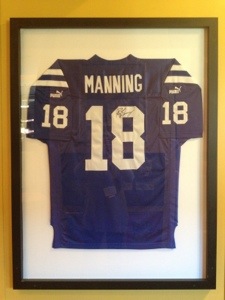
I am in Indianapolis. I got here yesterday. As I thought about the autographed Peyton Manning jersey in the restaurant where I ate dinner last night,I couldn’t help but to reflect on my life with the Cleveland Browns. I was raised on the Browns. As a child, I slept in a Brian Sipe jersey. Every Sunday from September thru February, my family turned against one of my cousins because he cheered for the Washington Redskins. My cousin seemed like such a fool to the rest of us. How could you not cheer for our hometown team? I never grew to admire my cousin’s disloyalty, but I thought about it over the years. I don’t want my son to be like my cousin in this way, but I also don’t want him to have the Sunday heartbreak that is the weight of the Cleveland Browns fan’s legacy.
The way I look at, I didn’t have much of a choice in being a Brown’s fan. I was a third generation Clevelander with a longstanding history of my family supporting the team. My son has a little bit more room in deciding what his relationship to his hometown team will be without being the Sunday fool my cousin was because my husband and I are new to the region. As new migrants we have history in other places and commitments to other teams. I think it would be acceptable for our son to choose to follow the Miami Dolphins and the Cleveland Browns because of us. After all, my husband became a Dolphins fan in order to establish a tie to his father.
I would like to say that I was so forward thinking that I planned to have my son in a city that boasts hosting an undefeated professional football team right at a time when my son began recognizing himself in terms of the team we told him was his. I can’t claim this power. I am no Pat Summit. I read that the esteemed Tennessee Lady Vols coach was on a recruiting trip out of state when she went into labor. As the story goes, the coach refused to deliver that baby until her plane had crossed state lines into Tennessee. If this story holds true, then in addition to the Presidential Medal of Freedom that she has already earned, she deserves for every parent to pause at least once every year in order to pay homage to Pat Summit for her dedication and commitment to home place such that she suffered prolonged labor for it! Again, I am no Pat Summit. Family planning and the role of the state takes on new meaning when seen through the lens of Summit’s decision to prolong her labor. I did not plan to have my son in a city with a winning team, but my history with a team that consistently battles for a top pick in the draft informs how I will teach my son to be a fan.
Being a Cleveland Browns fan has taught me what loyalty looks like and what it requires. 1.) Loyal fans wear fan gear and decorate using their team’s paraphernalia even when the team isn’t playing well. 2.) Real fans always look for the bright side. When your team has won only two games, you need to see the upside it provides for the rebuild. The bright side exists in the future. 3.) Real fans learn to work through their emotions. You will need to craft a healthy way of handling loss. Turning off ESPN until your team wins again is one strategy but it only provides a temporary fix. 4.) Ultimately, real fans never move on from their team. Thus, you can wish Peyton well, but if you’re a Colts fan, you’ve got to stay with your team.
I have to admit my ignorance. When I first encountered the ESPN 30 for 30 documentary title Benji, I thought it was a reference to the dog of that same name and so I imagined that it would be a film that focused on the dog’s intense training. Only after reading The New York Timesarticle and viewing the trailer for the documentary did I learn that Benji referred to Chicago basketball sensation Benjamin Wilson. Wilson was ranked the number one basketball player in the nation when he was gunned down on the streets of Chicago in the fall of 1984.
You need to figure out a way to watch this film if you didn’t see it last night. Mike Hale of the Times calls it “absorbing” and I completely agree. Coodie Simmons and Chike Ozah, the film’s directors, tell a remarkable and tragic tale of a young black man coming of age during a time when drugs and gangs are ravaging his hometown. Basketball offers hope for a life far beyond violence, but not necessarily beyond Chicago; after all, Chicago became the home of Michael Jordan after the Bulls selected him with their third overall pick in the 1984 draft, merely months before Benji gets gunned down. The story isn’t so much a love letter to Chicago as it is to Benji. He clearly meant so much to the men who were his teammates, family, and friends. I was moved by the players who paid tribute to Benji by wearing the number 25 throughout their careers. It was a great lesson in Chicago sports history.
I couldn’t help but to wonder about Benji’s story alongside Emmett Till’s story, especially given the prominence of their mothers after their deaths. Like Mrs. Till-Mobley, Mrs. Wilson allows her son’s death to become instructive. She even has an open casket funeral like Mrs. Till-Mobley hosted. Ultimately, Mrs. Wilson decided to move her family back to Mississippi some years after Benji was murdered, reversing Mrs. Till-Mobley’s move. What circumstances led her to view the South as a safer place for black boys in the ’80s? Mrs. Wilson’s actions place her son’s story in a historical context beyond the scope of basketball.
Follow this link to the ESPN page about Benji. I hope you get a chance to watch this extraordinary film.
The article in The New York Timesthis weekend about Dalton, the Calhoun School, and Trinity, all on the Upper West Side in Manhattan, suggests that minority students’ experiences don’t help make the case that these “elite” schools are good ones. While these schools were apparently interested in recruiting minority students, they weren’t heavily invested in the students’ welfare once they arrived. No one considered how difficult it would be to afford a $1,300 class trip to the Bahamas for some of the schools’ new recruits from low incomes families. No one considered how effective stereotypes of blackness and otherness can be in marginalizing students of color from routine experiences. For example, students of color at these “elite” schools were often imagined as occupants of “bad” neighborhoods and were refused visits by classmates when they extended them invitations to their homes. In addition, one student told a heartbreaking story of feeling estranged from beauty as markers of racial otherness set her outside of the dictates of beauty that saw being “white, skinny, and tall” as its ideal.
I went to a very small, private, all-girls school. I loved it but I recognize its limitations. One of the reasons I was able to thrive there was because there was enough diversity at the school to enable me to find the support that I needed. My needs, though, weren’t very great. One of my classmates, Cheryl, did have significant emotional needs and the school failed her because they relied on stereotypes of blackness to drive their understanding of her behavior. Cheryl’s parents were going through a divorce and it was a devastating experience for her. Teachers and administrators alike read Cheryl’s sadness as hostility and they pulled her aside several times and told her that she needed to “get it together” because they weren’t “going to put up with her attitude.” Cheryl’s mother intervened and explained the difficulty of the divorce on her daughter but administrators were unmoved so Cheryl eventually transferred.
Cheryl’s mother provides me with a model for what I plan to do if a school fails my son in any way similar to how my beloved alma mater failed Cheryl: I will withdraw him. Cheryl’s mother’s move was a radical one in light of my own schooling experiences because I had never known anyone to support their child in that way. I disliked my elementary school, but I was made to endure it from kindergarten through eighth grade because I only seemed to register routine gripes about it. Admittedly, my elementary school experience wasn’t soul crushing so remaining there didn’t cause me great harm. The children who were featured in the Times article seemed crushed, so it’s not very clear to me why they stayed. The article takes for granted that these “elite” schools were “good” schools and so maybe this viewpoint was also taken-up by the parents and the students alike. I’ve certainly known people who described devastating experiences in schools that they went on to describe as “good.” One such student was one of two black people in her school; the other black student was her brother. When she was entering the bus to go on a field trip with her class, her teacher said to her, ” we saved you a seat at the back of the bus where you belong.” Her classmates all laughed, which only added to this girl’s humiliation. This same girl was also humiliated when her teacher called her “Kizzy” when she entered the classroom wearing braids and her class had been reading Alex Haley’s Roots. If I were this girl’s mother, I would have definitely talked to the teacher but I also would have removed my daughter from this school. From what I knew of this child, she was far too fragile to withstand this school’s personality. As far as I was concerned, this girl’s “good” school seemed far too brutal.
In her memoir Project Girl, Janet McDonald describes the consequences of taking for granted a young person’s emotional, psychic, and spiritual needs in failing to size-up schools and the choices students have in making decisions about them:
What I gained in possibilities was nearly outweighed by my loss of grounding. The message I received as a child equated home with failure; fortune could only be found elsewhere, with people unlike me. The contrast between my actual background and the world where I was sent to find role models was brutal.
It was in coming to recognize the constructions of the home that I prized devalued that I came to see the limitations of my high school and thus to recognize its racism in viewing my friend as a black girl with an attitude instead of a wounded, hurt, and sad young girl mourning the loss of her parent’s marriage.
I’m not necessarily thrilled by the way my son’s school seems to imagine him, but he doesn’t seem impacted by it; he enjoys himself at playschool. Going forward, my son’s soul will be the measure of whether or not a school is a “good” one. No school that diminishes a child’s soul seems worthy of the title “elite.”





 In Reverie Blog