Models Monday: “This House I’m in Right Now”

After the fourth time my house was broken into, I put my house on the market. Looking at properties I could barely afford made me think about friends and family who never moved. I can think of at least three families who have had the same address and telephone number for at least my entire lifetime. Though they all could have afforded bigger houses at some point in their lives, they chose to stay in those smaller ones. This choice meant that they could save money and could easily afford to travel or enjoy themselves in other meaningful ways.

I thought about this recently after watching the making of the documentary film I am A Man. 

I had read a newspaper account of Mr. Nickelberry’s participation in the sanitation workers strike  and took pause over the fact that he still works for the city. The behind the scenes footage of the film offers a glimpse into his home and it is the same one that he lived in and was working to afford at the time of the strike in ’68. Michael Honey’s book Black Workers Remember: An Oral History of Segregation, Unionism, and the Freedom Struggle records Taylor Rogers’ reflections on the strike and he reveals that he also lives in the same home he was buying when the strike began. As he tells Honey, “I was just beginning to buy a home, this house I’m in right now […]” The fact of Mr. Nickelberry and Mr. Rogers residing in the same homes since at least 1968 may not have been striking to me when I was younger and still living among my grandparents’ generation because these folk never seemed to move. My mother observes that “old people don’t move, they die” and in many cases, she’s correct. Even with the neighborhood changing and often declining around them, I know old folk who wouldn’t have dreamed of selling their homes. In fact, my former neighbors, Betty and Thomas, recently passed away but when I returned for visits, they lived out their lives in 2009 as they had in 1989. They continued to garden in their backyard; they shopped at Sav-Mor on Harvard; they turned on the sprinkler in their front yard for their granddaughters to run thru. I worried about them though because their neighbors no longer mirrored these habits. They were younger; meaner. Many of them openly peddled drugs in the street.

I wonder if my generation of elderly folk will think about home in the same way as Thomas and Betty’s generation. It seems like my generation is encouraged to feel restless and unsettled–with satisfaction only coming with the next move. I’ve read simple living blogs that recommend throwing out catalogues that come in the mail not only so that you won’t be tempted to buy but so that you won’t be tempted to long for the lives of the folk in them. I have taken this advice but I do sometimes flip through these catalogues but I do so with a more critical eye than I once did. I used to simply think about what might look nice in my house. Now I think about how little room I have in my house for those things. Instead of feeling bad because I don’t have the space, I wonder about an ethics of marketing that requires people to disparage the spaces people have created for themselves.

As a child growing up without these catalogues as a part of my reading, I never judged the spaces and homes I now realize are small. I enjoyed bountiful meals of fresh food grown in the backyard or shared between neighbors. I looked forward to snowy, cold Christmas mornings before brunch with my family. I savored the photographs in albums and taped to walls in the basement. In fact, I never even realized how frightening my inner-city neighborhood was supposed to be because my neighbors never locked their doors; never preyed on one another; shared resources.

Given the market, I couldn’t sell my house. But to be honest I didn’t try very hard. I had convinced myself that I would find safety in a higher price point but this fragile illusion was completely shattered when I heard a new homeowner discussing a break-in with an agent at the property. Realizing that I couldn’t price myself out of danger, I began thinking about people in my life who lived lives they could easily afford, which in itself offers a measure of security.

Models Monday: Bitter Reminiscence

MOVE
1985 Philadelphia police bombing destroyed over 60 homes, displaced at least 250 people, killed 6 adults and 5 children.

Michael Ward, one of two survivors of the 1985 Philadelphia police bombing of the MOVE residence recently passed away. His is such a sad story. The extremist philosophy that shaped his life for at least eleven years and his bearing witness to the mass murder of MOVE members would make for difficult, troubled memories. In light of the recent events commemorating the bombing of the 16th Street Baptist Church on September 15, 1963, the deadly bomb dropped on the MOVE residence underscores the vulnerability of black American children in sacred spaces across time.

MOVE was founded as a black liberation group that had taken up residence in a working-class neighborhood in West Philadelphia. Black residents of Osage avenue complained to city officials about the reluctance of MOVE members to maintain their property. Law enforcement was well-aware of the organization. MOVE firmly and publicly critiqued the American criminal justice system as well as the influence of major U.S. corporations operating in the culture. After several attempts to evict MOVE from their home, law enforcement violently forced them out by dropping a C-4 bomb on the house. Failing to contain the fire destroyed at least 60 homes in the community. Tragically, 11 people were killed. Michael Africa was only 13 when the bomb dropped.

Michael Africa, who became Michael Ward after his father, who had spent years searching for his son, reclaimed him in the aftermath of the bombing. Sadly, Michael Ward accidentally drowned while in a hot tub on the cruise ship Carnival Dream. He was 41.

The obituary about Ward featured in The New York Times notes that a new documentary film, Let the Fire Burn, recounting the May 13, 1985 tragedy superbly makes use of video footage from young Ward’s public testimony to city officials regarding his experiences as a member of MOVE and as a victim of the bombing. The film’s been getting great reviews. What I find interesting, however, is that many of these reviews ignore Louis Massiah’s masterful documentary, The Bombing of Osage Avenue (1987).

Massiah, who won an MacArthur “Genius” Grant, deserves to have his work in conversation with this latest documentary film focusing on MOVE. Discounting the work of this master documentarian raises interesting questions about the consequences of marginalizing violence against black Americans. To that end, how might the devastation in Waco, Texas between law enforcement and a pariah group read in light of the 1985 MOVE tragedy? How do those fires compare?

Whenever you get a chance, I highly recommend Massiah’s film. Toni Cade Bambara narrates the film, and the story that folk tell of their community and of their experiences with MOVE are absorbing; definitely worthwhile viewing.

Models Monday: The Value of Being Discreet in the YouTube Era

Ellen Shub Photography.
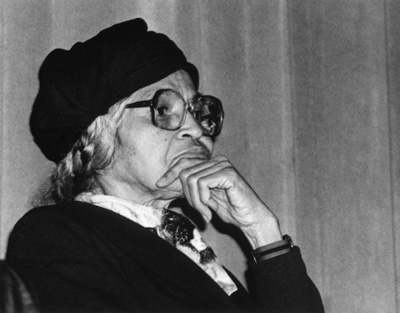
A contemplative Rosa Parks, 1983. Ellen Shub Photography.

In Jean Theoharris’s wonderful biography,The Rebellious Life of Mrs. Rosa Parks, she teases readers with details about Parks’s inner life through her discussion of how quiet she and her husband Raymond were. In one story, Theoharris provides Edward Vaughn’s impression of Mr. and Mrs. Parks. Vaughn was the proprietor of the only black bookstore in Detroit when it opened in 1959. He describes  Mrs. Parks as one of his best customers. Reflecting on the Parks’s as a couple, Vaughn asserts that they were “two of the quietest people you ever see” (192). Theoharris doesn’t speculate on what Mr. and Mrs. Parks’s quiet love looked like, but I am certainly curious about it. What did a day in their quiet lives look like when they were alone together?

One of the ways that the Parks’s communicated the importance of their privacy in public was through the way Mrs. Parks wore her hair. On two separate occasions,  Theoharris reports that two writers encountered Mrs. Parks in the restroom as she was freshening “up before meeting with reporters” when Parks revealed an intimate detail from her private life. According to Cynthia Stokes Brown, when Parks removed her hat and hairpin:

her braids fell below her waist in a cascade of thick wavy hair that Rapunzel would have envied. When Mrs. Parks saw the astonishment on my face, she chuckled softly, “Well, many of my ancestors were Indians. I never cut my hair because my husband liked it this way. It’s a lot of trouble, and he’s been dead a number of years, but I still can’t bring myself to cut it.” (13)

Alice Walker offers a comparable story of her encounter with Mrs. Parks when they were both attending an event in Mississippi. According to Theoharris:

They went into the bathroom and Parks took down her hair. Walker was “stunned.” As she put back her bun, Parks explained “my hair was something that my husband dearly, dearly loved about me…I never wear it down in public.” (14)

Theoharris ventures that politics also played a role in Mrs. Parks’s decision to shield her long hair from public view. She writes, “[a]ware of the racial politics of hair and appearance, Parks kept her hair long in an act of love and affection (even after Raymond died) but tucked away in a series of braids and buns–maintaining a clear division between her public presentation and her private person” (14).

When Mrs. Parks first met Mr. Parks, he was involved with the Scottsboro case that she would also devote her energy towards. Of her involvement, Theoharris contends that, “[b]eginning with the Scottsboro case, Rosa Parks had learned to be discreet about her political activities.” Theoharris’s use of the word “discreet” greatly interested me because of what I take to be its current devaluation. Being discreet seems to have no place in contemporary American life. The fact that Mrs. Parks “learned to be discreet” makes you wonder what taught her such caution.

At the moment, it doesn’t seem to me that any lesson plan for being discreet is being offered–especially to young people–in American culture. Indiscretion rules the day. There are numerous accounts of young girls and young women being shamed by the circulation of nude pictures of themselves posted on-line or maliciously sent as mass text messages. Then there are the tragic efforts towards shaming people through social media that, in Tyler Clementi’s case, drove him to commit suicide. Most recently, I learned that Chicago gangs are using social media to kill their adversaries. Ben Austen’s fascinating article, “Public Enemies: Social Media is Fueling Gang Wars in Chicago,”offers the story of two young men from rival gangs whose YouTube diss videos led to the death of one of them. Lil JoJo, whose funeral is posted on YouTube, announced his location on Twitter. This tweet led to the teen being gunned down as he rode on the back pegs of a friend’s bike.

The YouTube video above shows friends outside the funeral parlor having what looks to be a party. In order to redeem this and not dismiss the value of a systemic critique that highlights the drive for profits that fuels companies like Interscope records, whose deal with Chief Keef reportedly led to a contract somewhere between $3 million and $6 million dollars, to represent a young man who brandishes guns on film, brags about his gang affiliation, and whose music is implicated in someone’s murder, it’s hard to overlook the tragedy of this spectacle. Is this hip hop’s version of a second line jazz funeral typical of New Orleans?

The young people “honoring” Lil JoJo’s life fail to offer any recognizable sense of reverence for the life that was violently and unnecessarily taken. Are we to read their respect through the mere fact of someone uploading video footage? Is this hip hop’s version of commemoration? What does this commemorative gesture tell us about the cultural moment we’re living through?

One thing it tells us is that being discreet has very little value in the YouTube, Instagram, Twitter era. Life and death seemingly involve heedless postings and updates. I agree with Ben Austin when he writes:

We naturally associate criminal activity with secrecy, with conspiracies hatched in alleyways or back rooms. Today, though, foolish as it may be in practice, street gangs have adopted a level of transparency that might impress even the most fervent Silicon Valley futurist.

Austen contends that:

Everyday on Facebook and Twitter, on Instagram and YouTube, you can find unabashed teens flashing hand signs, brandishing guns, splaying out drugs and wads of cash. If we live in an era of openness, no segment of the population is more surprisingly open than 21st-century gang members, as they simultaneously document and roil the streets of America’s toughest neighborhoods.

I would add married politicians like Anthony Weiner, Eliot Spitzer, and Vito J. Lopez (and let’s not forget Mark Foley) to the “surprisingly open” segment of the population that Austen limits to gang members. Elected officials appear to value discretion about as much as neglected children…and let’s not forget teachers. News stories about teachers can be found all across the internet describing the inappropriate messages and photos they send their young students…oh, and we can’t forget ministers like Eddie Long who struck a sexy pose for the young men he was accused of exploiting and violating. Thus, the YouTube, Instagram, Twitter generation actually spans all ages and professions, races and genders, classes and religions–American culture reflects an equality of explicitness regarding every nook and cranny of cultural experience.

It’s hard to imagine anyone in this contemporary moment who would pay private tribute to someone they deeply loved as Mrs. Parks did in pinning up her long hair. The few people who are keeping some aspects of their lives private are throwbacks to a time when being discreet could speak to a person’s character. But I guess character doesn’t much matter when you can become an internet sensation based on your YouTube views and your number of Twitter followers; privacy doesn’t pay like explicitness. I still believe that there are other ways of thinking about having a rich life and Mrs. Parks exemplifies this alternative in a way that is recklessly overlooked in this seemingly shameless time in history.

Models Monday: Commemorating the Lives of Addie Mae Collins, Denise McNair, Carole Robertson, Cynthia Wesley, Virgil Ware, and Johnny Robinson

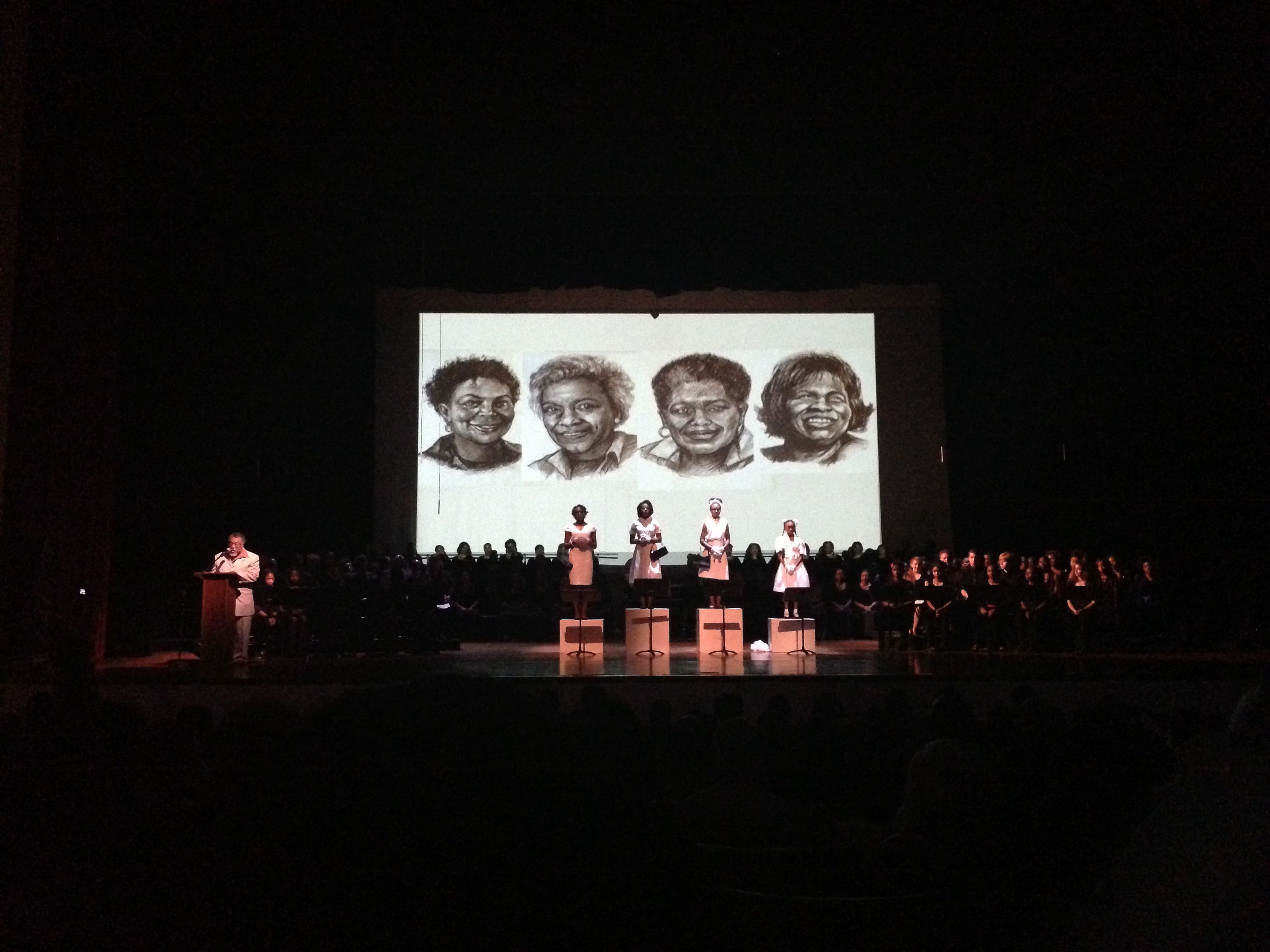
Actresses playing the role of the four little girls who have been killed. The image behind them represents how they might have looked 50 years later.

Yesterday, September 15, I attended the Atlanta production of Christina Ham’s play, Four Little Girls, at the Martin Luther King, Jr. International Chapel located on the Morehouse campus. The Spelman College Glee Club, two local choirs, and local actors and actresses performed Ham’s work to commemorate the grim, 50th anniversary of the decimation of the 16th Street Baptist Church, which led to the death of six children. Addie Mae Collins, Denise McNair, Carole Robertson, and Cynthia Wesley were torn apart by the 19 sticks of dynamite planted near the ladies lounge were they were readying themselves for the church’s annual Youth Day service that featured children in the roles customarily/ritually performed by adults. 13-year-old Virgil Ware was a victim of the bomb’s aftermath. Six hours after the blast, Eagle Scouts, Larry Joe Simms and Michael Lee Farley left a segregationist rally and shot at the Ware brothers as Virgil was riding on the handle bars of his 16-year-old brother’s bike; Virgil was hit twice. Simms and Farley received two-years of probation as their punishment. Police officer Jack Parker shot 16-year-old Johnny Robinson in the back. Robinson was a participant in the demonstrations that occurred in the wake of the blast. Parker accused Robinson of throwing a rock. As Robinson and other children fled, Parker shot Robinson in the back. Parker was never charged for this crime.

Performing the play was a national event featuring theater groups from around the country offering this work through Project1 Voice. By conveying the girls’ dreams, the play sought to recover their humanity through a depiction of the vibrancy destroyed as a result of the “brutal imagination” that defined the Jim Crow south. As a national event, the play’s power, at least for me, stemmed from the imaginative way it confronts the country’s seeming inability to mourn the lives of black children. In this way, the play reminded me of a wonderful scene in Beloved between Denver and Beloved. The black body of the novel is everywhere in pieces. The black enslaved have been through an experience that literally made bits of their lives. Unlike the slave traders who packaged these bits for sale, the novel examines how black people interpreted the bits and pieces of their lives and the responsibility it involved. A moment between Denver and Beloved offers an example of how black people helped one another make meaning of the bits and pieces of their lives. In the scene, Beloved reaches into her mouth and extracts a tooth:

Beloved looked at the tooth and thought, This is it. Next would be her arm, her hand, a toe. Pieces of her would drop maybe one at a time, maybe all at once. Or on one of those mornings before Denver woke and after Sethe left she would flyapart. It is difficult keeping her head on her neck, her legs attached to her hips when she is by herself. Among the things she could not remember was when she first knew she could wake up any day and find herself in pieces. (133)

Denver teaches Beloved how to mourn. When she observes her pulling out her own tooth, she asks Beloved if it hurts. When she confirms that it does, Denver asks her, “If it hurts, why don’t you cry?” (133) Her answer came in the form of tears. Beloved then pays tribute to other moments in her life when “it hurt.” Denver also assists Beloved by keeping her arm around Beloved’s shoulder thereby giving her hope that she would not fall apart (134). Staging Four Little Girls opened up a space to reflect on the violence that has historically characterized the lives of black children whose horrible fate leaves no teared stained streaks on the nation’s face.

Recently, I’ve been doing some thinking about a detail regarding the life of Robert “Yummy” Sandifer who at age 11 was the victim of gang warfare in Chicago during the summer of 1994. That child was so unloved that the family could only find a mugshot of him to use for the funeral program. He also died a September death. Very few mourned that child’s death. To that end, there’s not a single marker in Atlanta to commemorate the lives of the scores of black children murdered during that brutal period in the city from 1979-1981. This country acts as if black children are supposed to die violently and black people are accustomed to this reality; it’s a terrible, troubling fiction.

Although I understand Ham’s decision to craft the dreams of Addie Mae Collins, Denise McNair, Carole Robertson, and Cynthia Wesley through the everyday longings of an average young, American girl, I think there are other possibilities for representing their interior lives beyond casting them as black Gidgets. Angela Davis grew up in Birmingham and her autobiography reveals her to have been a critical thinker even as a child; she recognized poverty, rejection, racial hierarchy. The penultimate scene in the play features the actresses as the dead girls standing before

Four little girls 2
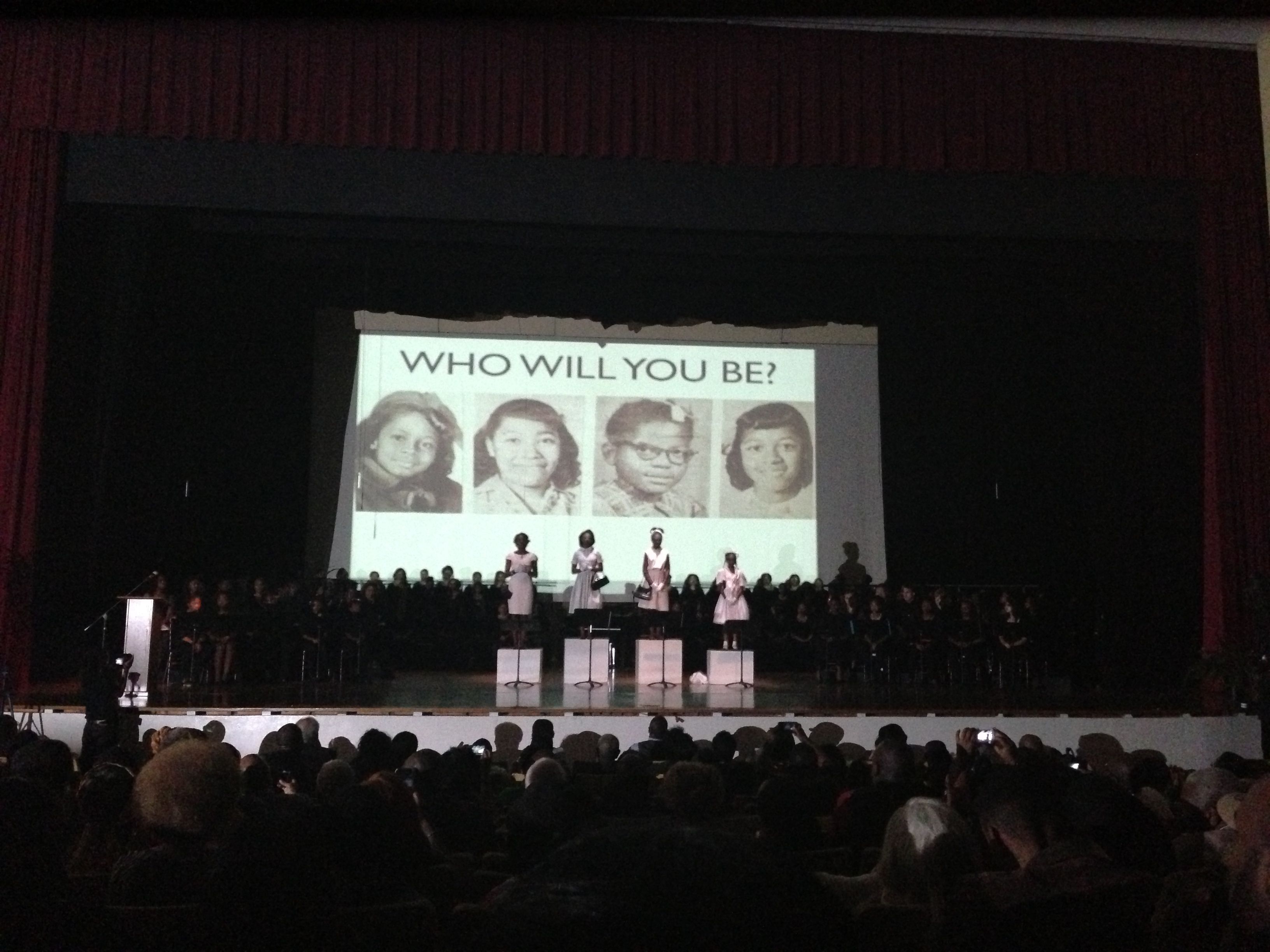
The final image from the play Four Little Girls.

a screen featuring photographs of McNair, Robertson, Collins, and Wesley. The photograph features a caption that reads, “WHO WILL YOU BE?” yet the play really only prepares you to answer the question, “Where will you work?” or “How do you wish to earn money?” In 1963, Black Americans did not accept segregation as a norm. They disagreed with white supremacist claims regarding their inferiority. Giving such a critique, “WHO WILL YOU BE?” would not have been read as a question about professionalization. They most likely would have answered the question for what it seems to interrogate, namely, ontology and value theory. Thus, they might have answered, “I WANT TO BE FREE?” and “I WANT DIGNITY AND INTEGRITY TO QUALIFY MY LIFE.” Imagining this response is certainly worthwhile and relevant as the nation still casts the death of black children as a norm and not a catastrophe. The United States should spend at least two minutes everyday feeling ashamed of itself.

Black Women and the Politics of Beauty

I just finished reading my friend Dr. Carmen Kynard’s brilliant post about seven-year-old Tiana Parker being sent home from the Oklahoma Charter school where she was enrolled because of her hairstyle. The school’s dress code does not allow “hairstyles such as dreadlocks, afros, mohawks and other faddish styles.”  Kynard highlights the political nature of beauty–especially as it gets articulated through black women’s bodies. Filmmaker Zina Saro-Wiwa presents an op-doc for The New York Times that video-opdoc-naturalhairSUB-thumbWidefeatures black women discussing why they have chosen to embrace their natural hair while at the same time contending that their choice was not political. As Kynard contends, these women claim their decision to go natural is “politically neutral.”

Kynard writes about Dr. Yaba Blay’s beautiful response to Tiana’s tears. Its beauty lies in the witness she offers to Tiana’s pain and the loving, tender address she offers in response. The Care Package for Tiana results from the aftermath of the violence Tiana experienced. As soon as you get a chance, check out the “care package” by following the link above so that you can view the “digital book of photos and messages from 111 woman and girls from all over the country and all over the world, all of whom wear their hair in locs, all of whom want Tiana to know that she and her hair are PERFECT.”

Models Monday: Sovereignty

I recently finished reading Kevin Quashie’s wonderful, engaging, and provocative book, The Sovereignty of Quiet: Beyond Resistance in Black Culture. The work challenges the presumption that publicness and resistance are the sole categories for conceptualizing black life. Quashie offers “quiet” as a concept for expanding the terms of how black humanity is lived. Resistance, according to Quashie, requires that black people live in response to the gaze and the concerns of the public world. He writes:

So much of the discourse of racial blackness imagines black people as public subjects with identities formed and articulated and resisted in public. Such blackness is dramatic, symbolic, never for its own vagary, always representative and engaged with how it is imagined publicly. These characterizations are the legacy of racism and they become the common way we understand and represent blackness; literally they become a lingua franca. (Location 92 in Kindle)

Quiet, however, enlivens black humanity:

The idea of quiet, then, can shift attention to what is interior. This shift can feel like a kind of heresy if the interior is thought of as apolitical or inexpressive, which it is not: one’s inner life is raucous and full of expression, especially if we distinguish the term “expressive” from the notion of the public. Indeed the interior could be understood as the source of human action–that anything we do is shaped by the range of desires and capacities of our inner life. (Location 97 in Kindle)

Quashie does not minimize the value of resistance and the important work that has emerged from this concept and the work still to come, but he contends that there is more to life than this. As he notes:

After all, all living is political–every human action means something–but all living is not in protest; to assume such is to disregard the richness of life. (Emphasis mine; Location 107 in Kindle)

The Sovereignty of Quiet is a wonderful read. Quashie’s close reading of texts illustrates the possibility for “the richness of life” to reference nonmaterial aspects and dimensions of being. As an example, Quashie cites this very compelling moment in Gwendolyn Brooks’s Maud Martha where the title character reflects on participants in public life who prize such recognition over their interiority. Brooks writes:

How people could parade themselves on a stage like that, exhibit their precious private identities; shake themselves about; be very foolish for a thousand eyes.

She was going to keep herself to herself. She did not want fame. She did not want to be a “star.”

To create–a role, a poem, picture, music, a rapture in stone: great. But not for her.

What she wanted was to donate to the world a good Maud Martha. That was the offering, the bit of art, that could not come from any other.

She would polish and hone that. (Quoted in Quashie Location 660 in Kindle)

Brooks’s insight and presentation of someone who has another idea about what counts as a worthwhile way of being in the world is dazzling in its ostensible simplicity. She offers a set of goals that are widely achievable. As Toni Morrison says about “in sight” in Paradise, achieving what Maud Martha wants from life and what she wants to give “is free and available to anyone who wants to develop it.” Quashie contends that Maud Martha’s work of polishing and honing herself reflects a valuable sense of self-regard. In commenting on Maud Martha, Quashie offers an insightful way of regarding the significance of her desire to “donate” a “good” version of herself:

For sure, donate implies simplicity and inferiority, especially when one considers that Maud Martha only wants to be “good,” and not “great.” But donate also implies a gift, as in a gesture of good will that Maud Martha chooses to make. For her to donate her goodness is a profound act; it suggests that she has something to give to the world, a gift so unique and needed that it cannot be purchased–it has to be granted by an act of generosity. (Location 664 in Kindle)

Maud Martha is a very interesting woman. You wonder how she came to be that way; how she came to regard her way of being in the world as meaningful; how she became sovereign. From what Quashie posits about quiet and the cultivation of a private world, these components are essential for being human and being free.

Models Monday: Work Worthwhile

My Cousin Shay worked as a chauffeur until he became too frail. It wasn’t until Cousin Shay died that I learned that he earned his money by driving for one of Cleveland’s “prominent” white residents. What’s so striking about films like Driving Miss Daisy and The Help is the presumption these films make regarding how black people viewed themselves in relationship to the white people they worked for. In Driving Miss Daisy, you have no sense of what Hoke’s life looked like when he wasn’t working. Hoke’s entire life occurs at work. When Cousin Shay came to visit, he never talked about work. Cousin Shay didn’t seem to find his employer nearly as interesting or as important as Hollywood films suggest he would. For Hollywood, black workers are never complicated or interesting; there’s no inner life that exists in opposition to the public face.

I remember listening to ABC News anchor, Peter Jennings, report on the end of South African apartheid that gestured towards this complicated inner world. Toward the conclusion of his report he told a story that served to reflect white anxiety regarding the possibility of black violence against them. In this account, a white, South African woman who for years employed a black, South African man as a servant peers through her window at the commotion taking place in the street. The woman turns to her employee and says, “they say there’s going to be violence when this is all over,” and he replies, “mm hmm.” “I’ve been good to you all these years, so you would never do anything to harm me; would you?” she asks. “Madame,” the black man replies, “you would be the first person I’d kill.” With that, Jennings signs off.

I was a young person when I heard Jennings tell this story, and it confused me. I didn’t understand then that in declaring her right to determine what her employee deserved offered some indication of the ways she had tormented him. Very seldom would you find in popular American culture a presentation of black folk in service to white folk that would make the servant in Jenning’s tale intelligible. I haven’t yet seen The Butler, but I don’t have much hope for a complicated representation of working class black folk with Lee Daniels, the film’s director, controlling this narrative. White supremacist ideology greatly informs Daniels’s vision of black life. He sees black people as nothing more than the stereotypes offered in American culture. This problematic point-of-view is blatantly expressed in Daniels’s claim that when he entered a health crisis center to learn more about AIDS and he saw “black women with kids—[he] thought [he] had walked into the welfare office.”

When I was growing-up, I just didn’t hear working-class people discussing how good they wanted to be at their jobs. Gwendolyn Brooks’s Maud Martha pretty much sums up the ambitions of the working-class folk I knew:

She was going to keep herself to herself. She did not want fame. She did not want to be a “star.”

To create–a role, a poem, picture, music, a rapture in stone: great. But not for her.

What she wanted was to donate to the world a good Maud Martha. That was the offering, the bit of art, that could not come from any other.

She would polish and hone that.

Maud Martha’s job is one worth having.

Models Monday: The Importance of Names

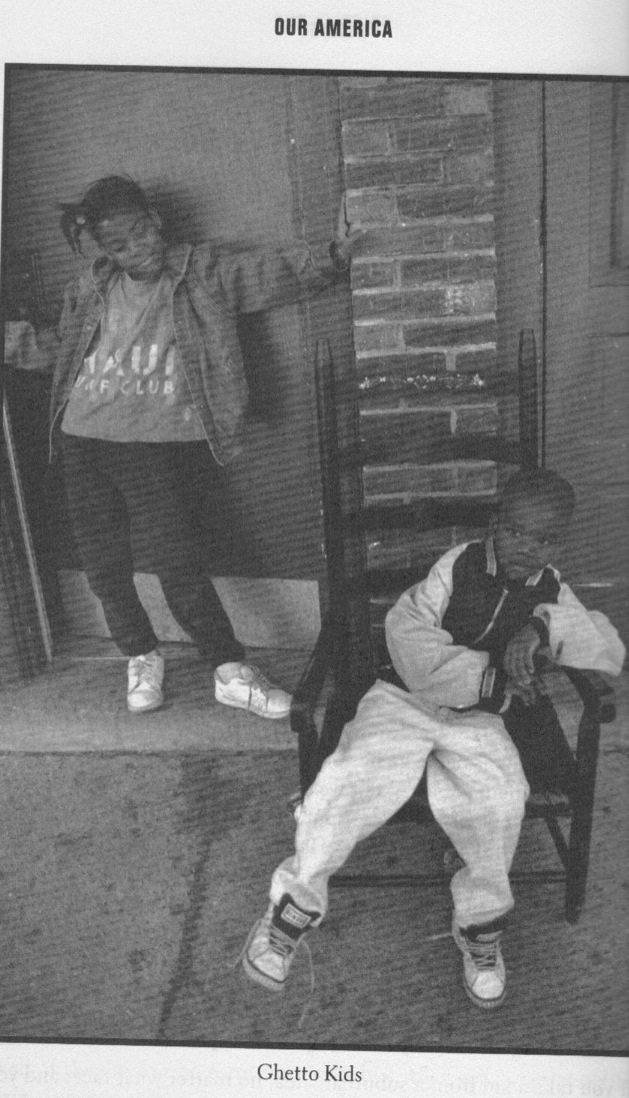
John Brooks, photo featured in the book Our America: Life and Death on the South Side of Chicago
John Brooks photo featured in the book Our America: Life and Death on the South Side of Chicago

In October 1994, two boys, ten and eleven-years-old, dropped five-year-old Eric Morse from the 14th floor of the Ida B. Wells housing project in Chicago. LeAlan Jones and Lloyd Newman, residents of the notorious complex, documented their witness of the tragedy in a radio documentary they named Remorse: The 14 Stories of Eric MorseThese very young teens, fifteen and sixteen-years-old, were thought ideal ethnographers of “ghetto life” as a result of the previous NPR documentary they recorded in March 1993 that Jones titled Ghetto Life 101. David Isay, the author originally considered to deliver content for a public radio station airing stories concerning race and ethnicity in Chicago, served as the producer and editor of their work. Our America: Life and Death on the South Side of Chicagoblends the two award winning radio documentaries into a cohesive story documenting the lives of the occupants of Chicago’s oldest African-American public housing development.

In the book’s Introduction, Isay writes that after Eric Morse’s lethal fall, “LeAlan and Lloyd spent about a year recording the story (through most of 1995). Over the course of their investigations, they became the nation’s experts on a tragedy which made headlines across the country when the two boys convicted of the crime became the youngest kids ever sentenced to prison in this country” [emphasis mine] (20). Since when did residing in a place make someone an “expert”? Are they, then, responsible for naming the two children in the photograph above “Ghetto Kids?” Are they responsible for the “Ghetto Glossary” proceeding the content? Were these young men attempting to cite their estrangement from citizenship in creating this Glossary? Do they see themselves as foreigners? Why is it so oddly compelling to witness how people resist, survive, and live in the terrible places they are forced to occupy and it not be equally compelling to scrutinize the people who put them there? Are these young men “experts” regarding the system that has ghettoized poverty? How would they caption  photographs of the children born to the people who maintain such systems? “Privileged Children,” or “Luck of the Draw Kids,” perhaps? ” What kind of “privilege” is this? Seems more like a “flaw” to me.

Did anyone awarding these children prizes for their portrayals of the ravages of urban poverty ever tell them to refuse to accept “Ghetto Kid” as a proper name? If they didn’t, then those decision makers should be called “Shameless.”

Models Monday: The Great Depression, Parenting, and Us

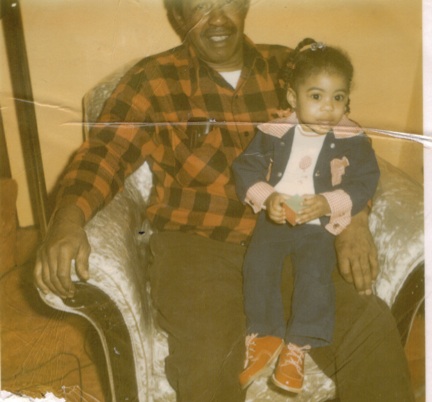
Me and grandpa copy
Here’s a picture of me as a toddler with my grandfather at our neighbor’s house. He loved me dearly, and loving me involved telling me what to do.

I never lived a single day of my life in or near 1929 but because my grandmother was a child of the depression, it touched every aspect of my home life growing-up. I think about this all the time when I consider our current beliefs about how children should be raised so that they should never know hard times. This was not how people thought about child rearing when I came of age. They may not have believed in showing their vulnerabilities but the adults I knew certainly believed that children should know of their sacrifices. How much something cost or how long it took to acquire was not a secret. Do you know how much water costs? was asked of me anytime I left the water running in the sink for too long. Do you know how much electricity costs? was the question put to me if I left lights turned on or kept the refrigerator door open while I searched for something to eat. It seemed like I was always being asked to think about how much money it cost to live.

I wonder why people don’t make their children think about expenses anymore? A friend recently shared with me that a year before she was planning to apply for college, her parents sat her down and explained how much money they had to spend on her education. That total included transportation costs, books, and incidentals. My friend teaches at a private college now and was reflecting on her own experiences upon encountering current students who seem surprised that their parents are struggling to afford their tuition. One student confessed that her parents asked her to transfer to a less expensive school but the student refused because “she was enjoying her experience.” I never would have been given that kind of choice when I needed my mother’s money. My mother, like my friend’s parents, would have simply told me what I was going to do.

I liked those days of parenting better than the ones we’re living through now. I don’t think that children should tell adults what to do. The things my husband reports students saying to him just appall me. In thinking about his experiences in the classroom alongside other stories that I have heard about the things young people say and do who have not been made to respect the work and sacrifices of adults, I have come up with a list of things adults should considering telling children to either establish or reinforce the hierarchy:

1. No (you do not have to say yes to your children).
2. Hush (you can make your children stop talking).
3. Put that X away (your children are not entitled to video games, toys, etc).
4. Read this.
5. Do X (your children need to do as they are told).
6. Answer me.
7. Come here.
8. Go there.

So what do you think of my list? What would you add?

Models Monday: Black Boys, Trayvon Martin, and the Politics of Comfort

Today was my son’s first day of Kindergarten! I was very deliberate in framing how I talked about Monday, August 12 with Miles because of some great advice I received last year around this time. One of my dearest friends shared the ritual she used in taking her daughter to school during those early years. “At first, children are very nervous about entering into a new environment because they don’t know what to expect,” she explained. “So in order to help them,” she continued, “we should detail for them what their day will look like so that you minimize the surprises. Ultimately, the most important thing to reassure them of is,” and this I thought was brilliant, “that you will always come back.” In giving me this language, my friend enabled me to have a clearer view of my son’s concerns. I realized that he was afraid of being abandoned and so the repetition of the phrase was important because it emphasized my returning to him and my reclaiming of him; it also addressed and therefore helped to diminish his fears of rejection and abandonment. When my son began Pre-K, he seemed soooo comforted by these words. So much so that he would say them to me as he visualized his day. “…and then,”  he would say, “you will always come back for me.”

We visited my son’s new school for Orientation last Friday. He met his new teacher and saw his new classroom, but he wanted reassurance that we weren’t going to leave him there on Friday, which we confirmed. So from Friday to Monday I stressed to him that he is not being abandoned or discounted in being sent into this new experience, but I also considered the possibility that he wouldn’t fully understand the significance of these words until he had to recall them in the face of his new reality. When we arrived to school he was clearly nervous, so I started going over his day with him, and as I was doing this, his teacher came over and put her arms around him and said, “I know you’re scared now, but we will have a good day together.” I thought she was pitch perfect. She honored my son’s humanity. She didn’t encourage him to abandon his assessment of the world as it was represented through her classroom; she didn’t tell him to get over it. Miss Malcolm suggested that she understood anxiety as a companion to one’s experience of a new place. She didn’t imagine that he was outside of any expectation for tenderness in his life; instead, she imagined that my son, a black boy, has had the experience of deep and abiding love…she did all of that with what seems to be such a simple gesture; it doesn’t have to cost you very much at all.

In the wake of the assassination of Trayvon Martin, it was incredibly meaningful to me that this sistah recognized the possibility that black children can be afraid and sad. With this witness, Miss Malcolm showed me that she understood that black boys are worthy of comfort, care, and concern.

I thought Charles Blow’s editorial in The New York Times on the George Zimmerman verdict was exceptional. When Miss Malcolm pulled Miles in close to her body for the purpose of responding to his immediate need for comfort, I thought about the heartless and brutal vision that Blow assigns to Zimmerman when he writes,

The system failed [Trayvon Martin] when the bullet ripped through his chest, and the man who shot him said he mounted him and stretched his arms out wide, preventing him from even clutching the spot that hurt.

The system failed him in those moments just after he was shot when he was surely aware that he was about to die, but before life’s light fully passed from his body–and no one came to comfort him or try to save him.

In holding my son’s body close to hers, Miss Malcolm let me know that she just might believe that black boys deserve compassionate witness; that black boys need people who see their fears instead of overlooking them in favor of a racist manufacturing of their monstrosity. Miss Malcolm’s gesture suggested to me that she firmly disagrees with George Zimmerman. Zimmerman has such contempt for black boys that he dreams up stories where he makes their dead bodies resemble a crucifixion. I agree with the implications of Jonathan Capehart’s point of view on this one, since there is no evidence, no documentation that Martin’s body was found in the position Zimmerman describes, why doesn’t he have to account for this fantasy? This delusion? Doesn’t this fabrication suggest something meaningful about Zimmerman’s state of mind?

Unlike Zimmerman, Miss Malcolm looked at my black son and saw someone who felt estranged from belonging in this new place. Rejecting the view that black boys who appear out of place should be killed, Miss Malcolm thinks they should be reassured of their right to hospitable arrivals.  She appears to think that black boys should have an opportunity to clutch “the spot that hurt” and help in tending to these often fatal presumptions that they don’t belong–anywhere. Miss Malcolm affirmed that she understood that “Miles’s mother will come back, but in the meantime, I will take care to demonstrate to all concerned that he will live in peace until she gets here.” I tell you, it was a damn good surprise to have someone who sees your black child as having a life worth preserving temporarily responsible for their keeping. She’s a model for how a person might demonstrate their liberal views: You want to prove to me that you aren’t racist, well then how about you showing me that you Always choose to be an Aide and not an Assassin.