Models Monday: Learning from the ID Network

warning-yellow-tape-featured

When I do watch television, I only watch sports and the shows on Investigation Discovery (ID). The ID network hosts true crime shows. Sometimes they highlight the same stories only repackaged in a different show format.  I’ve learned a few things about securing your life from these shows that I’d like to share with you:

1. Be clear about who your friends are and distinguish them from your partner’s friends. Even though we like to imagine that our partnerships require an entanglement of our entire lives, it’s not true. You partner’s friends know things about that person in a way that you don’t. They share secrets and loyalties that your presence does not change. Accepting this view means that when your partner is away and a friend of theirs rings your doorbell, DO NOT answer it. I’ve learned that some friendships are possessive ones and it may not be obvious to you at first. Thus, in dating you, moving you in, or marrying you the friend who was once perceived as your partner’s number one resents you for their lower ranking. This one woman found this out when she opened her door for her husband’s lifelong friend and best man at their wedding. That man raped and then killed her. I’ve taken the lesson I learned from this woman’s story and extended it to include goods my husband tells me his friends are coming over to collect in his absence. I tell him that those items should be placed in the mailbox or outside our front door. If that doesn’t work for them, they will need to make different arrangements.

2. If a room exists in the house you share with your partner and your children that you cannot enter, go in and look around for what you’re not supposed to see when your partner is away. Once you get the evidence you need, DO NOT TELL YOUR PARTNER what you know! Sharing the information with the person you just learned is committing a crime or that you know things that could shame someone for whom appearance is everything is like turning over your team’s playbook to the team you’re competing against. The woman at the center of the story I watched recently told the man all the secrets she knew about him and he had her killed in front of their children.
suspicion

3. If you are so afraid of your partner that you need to tell friends and family members that you think your spouse is trying to kill you, don’t go back to your house. In the show I watched last night, the woman told her mother that she was afraid of her husband. Her mother told her to plan her escape and not let him know. The woman’s husband killed her. So, if anyone tells to get out, stay right where you are because going home is far too risky. If you have the means, hire a private investigator. I’ve seen PI’s save lives!

4. If your partner admits to an extramarital affair and you decide to forgive that person because of your faith and your children, fine. However, if the mistress starts stalking you, confronts you, and attacks you then you need to divorce your partner. You can still forgive your partner but his choices have put you in danger and knowing this information should impact your decisions. LEAVE! The woman I recently saw on this show had a forgiving heart, but her husband’s mistress wasn’t done with her anger and hatred for the woman she saw as the obstacle to her getting her man. After church one evening, a man the mistress paid walked up behind the family and shot the wife in the head.

5. Every story I’ve seen on the ID Network about people who find love on the internet end up dead. I know a few people who have found mates on the internet and they’re still alive. One woman I know who found her mate this way has a wonderful relationship. I just think it’s really important that you realize that there are people in the world who are mean, deranged, and hateful people. Getting to know a person’s avatar is not like knowing them in the flesh. So you need to take special precautions when seeking out a partner online. The video above gives some useful tips.

6. If you have been in perfectly good health and as soon as your partner starts making your meals you fall ill, more likely than not, your partner is poisoning you; don’t eat another bite. Call a very good friend who can take you to the hospital. Once you arrive at the hospital, tell them you’ve been poisoned.

7. STAY AWAY from anyone who conveys an interest in you and two weeks after marrying you wants you to purchase a life insurance policy. People who ask their new spouses to purchase life insurance or to increase their existing policies are trying to KILL YOU! Really.

8. Just because a house always looks beautiful on the outside and the family inside seems wonderful and happy, you should keep in mind that YOU DON’T KNOW WTF IS GOING ON INSIDE that house. From what I’ve seen on these true crime shows, going inside could mean your life.

 

Models Monday: Being Like My Mother

image1

This is the church that hides the school that I attended and hated from kindergarten through eighth grade. Although my mother would later claim that she had no idea how much I despised the school, what she doesn’t acknowledge is how little it would’ve mattered. My family worshipped there, the congregation often came to my house for mass in the backyard, and I did well in school and in sports so I knew she would not know, care, or understand my displeasure; boy, those were different times.

My mother’s philosophy of sending me off to school was very different than what my son experiences. My mother dropped me off in the parking lot and assumed I made it inside; my mother never asked me how my day went; she never ever asked me about what I learned; and she never attended any meeting unless it was to collect my report card. My mother paid tuition, bought uniforms, provided lunch, and took me to school so as far as she was concerned, the rest was left to me. Though unstated, it was very clear that I could never ever make her late for work; that I would never do anything in school that would require she leave her job to deal with or talk to any teacher or administrator about me; that if I forgot a book, paper, or project that was just too bad and I would have to suffer the consequences. Despite doing everything within her power to avoid doing anything at the school besides pay tuition and conference with my teachers twice a year for report cards, she would be heartless mad when I brought home something for her to read or sign. Typically, she would snatch the paper from me and then complain that the notice she received was second-hand, mimeographed paper, “can’t they at least give this to me on a clean sheet of paper?” she would fume.

It wasn’t uncommon for most kids I knew to have parents who treated them and their experience in school the same way. Even still, I thought I would have a different attitude about being engaged in my son’s education. When it comes to showing him how to learn, helping him with homework, and actually talking to him, I’m very different from my mother. At the same time, I now fully support her venom towards anything having to do with that school other than paying his tuition, ensuring that he has adequate supplies, and that he is more than prepared for the work. I hate all this 24 hour surveillance you have to deal with in schools these days. My son’s teacher and his principal send so many emails that I wish I could electronically snatch them and turn up my face like my mother did. The emails are rarely substantive. For example, last week, we received four emails from our son’s teacher telling us what was coming-up, how she was going to be doing X, what was no longer going to occur, and that she wanted us to purchase more Kleenex. What’s worse is that everything she puts in these emails is already posted on the electronic software they use to post assignments, grades, and homework. Why send me an email telling me you’re going to be sending textbooks home? When he brings the books home, won’t I know? When I check the software program, it will indicate the assignments you have made so why does this information have to invade every device I own? When I’m not checking that homework software, then I have to check the math practice website, if not that then I’m checking text messages from his principal; it’s annoying.

I don’t know if this is true at most schools, but I feel as though I’m being encouraged to surveil my kid all day. You can actually download apps to your phone for this silly software. For what? Who has time for that? My kid is FIVE, what could he possibly be doing that all the adults around him can’t manage? I also don’t like that my son has come to expect for someone else to tell him how his day went.  I think children should be encouraged to determine for themselves how things went. Although his teacher may have thought Miles had a good day, maybe he didn’t like the encounter he had with another teacher or student? When does he get to learn how to determine his own measure of what’s good? And toss in those stupid notes about “book day” being on Friday, I don’t know if I trust her measure of what counts as a “great day” anyway.

I don’t know if my own mother felt this way, but I also think that schools–at least those housing mostly black children–presume that you need parenting lessons. Thus, ANYTHING the school requires that may be new to this phase of the curriculum, for example, you have to come to a meeting to get the information. Now this isn’t stated, but clearly it’s taking place. After the two hour meeting that I had to sit through during that first meeting, I swore I would never go to another one. My husband felt differently; fine, you go. He comes home one day and said that “we” had missed a meeting, to which I replied, “no, you missed a meeting. I never planned on attending.” Later we learn that at the meeting, parents were “trained” to use this silly surveillance software. Instead of sending the instructions home with the child whose parents did not show, you were supposed to come in and schedule a tutorial session before they would give you the information on how the program works. I understand that some people are not as computer savvy as others, but I don’t fall into that category. I don’t need a lesson on how to type in a web address and create a username and password. So of course, I called and said that I never signed any contract stating that I had to do what my son’s principal tells me to do in order for him to receive full access to the curriculum. The person on the phone at first tried to justify that nonsense but I understood that I was supposed to be chastised for not coming to that meeting and having to admit that was intended to  shame me. I told that man that they would be giving me that information on my terms as I do not work for his boss; moreover, a formal meeting requires a formal agenda. Needless to say, I got the paper the next day. Just today, parents received a text message from the principal telling us when we could come to collect class pictures: Tuesday, Wednesday, and Thursday from 3:00-5:00. Why can’t they just put the damn pictures in the child’s folder? Why do I have to come in, on their time, and collect something that isn’t so precious my son can’t handle it himself?

I fully appreciate my mother’s approach to dealing with teachers and administrators: I didn’t sign-up for Parenting University and I have a life. Whatever Miles’s teacher is being paid it’s certainly not enough. That woman is always at work, logging in to her email account and then telling all recipients that we can “contact her anytime” if we have issues, concerns, or questions. My son is in the first grade! Why would I need to contact this woman with “questions, issues, or concerns?” It’s FIRST GRADE! If I have any concerns regarding my son being mistreated in any way, I’m certainly not going to send an email. This morning, my husband said that we’ll probably be receiving a text message soon telling us that it’s Monday and we should bring our children to school…it really is that ludicrous.

Models Monday: E-Depravity

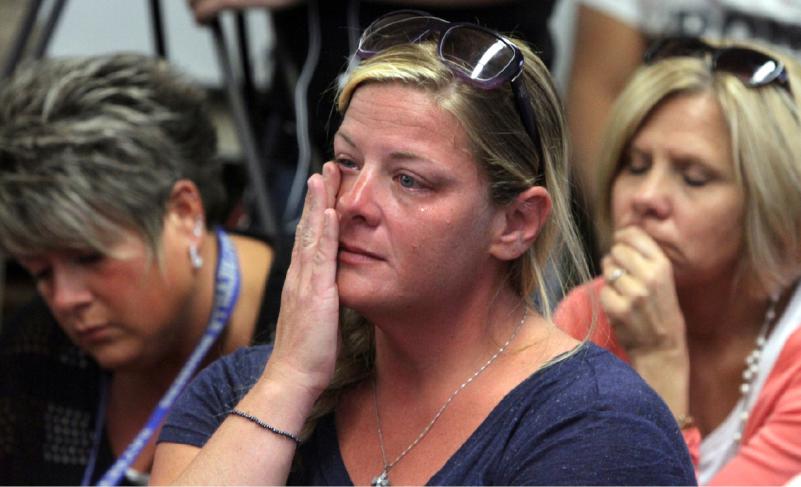
In this Friday, Oct. 3, 2014 photograph, audience members react as members of the Sayreville Board of Education hold a press conference at the Selover School in South Amboy, N.J., to address a hazing incident that "went too far" and is at the center of the investigation into the Sayreville War Memorial High School football team. On Monday, Oct. 6, 2014 school superintendent Richard Labbe said the Sayreville War Memorial High School football season has been canceled amid allegations of harassment, intimidation and bullying among players. (APPhoto/ Home News Tribune, Mark R. Sullivan) On Friday October 3,,2014 Photo: Mark R. Sullivan/Home News Tribune/AP
In this Friday, Oct. 3, 2014 photograph, audience members react as members of the Sayreville Board of Education hold a press conference at the Selover School in South Amboy, N.J., to address a hazing incident that “went too far” and is at the center of the investigation into the Sayreville War Memorial High School football team. On Monday, Oct. 6, 2014 school superintendent Richard Labbe said the Sayreville War Memorial High School football season has been canceled amid allegations of harassment, intimidation and bullying among players. (APPhoto/ Home News Tribune, Mark R. Sullivan) On Friday October 3,,2014 Photo: Mark R. Sullivan/Home News Tribune/AP

This caption says it all: The people pictured are crying and clearly disturbed because the football season was canceled, not because some players sexually violated others. Sayreville students are equally disturbed. According to The New York TimesSayreville High School students are tweeting their virulent rejection of the decision to cancel the football season. One 16-year-old female student wrote that venom against first-year students had increased: “If freshmen thought we hated them before we sure as hell hate them now.” In this same article, the Times reports that “[a]nother girl posted a picture of two trash bins, saying it was a real picture of the freshman football team.” Such electronic depravity or “e-depravity” reminds me so much of the angry mobs that attacked black children in the 1950s:

This venom has significant consequences for the psyche, the soul, and the bodies of those who have come under attack. In the aftermath of the backlash at Sayreville, one freshman on the football team told the Times that he “wanted to shoot [himself].” I hope the town, the adults, and the students believe this child because he wouldn’t be the first child to kill himself after having e-rocks hurled at him in cyberspace.

R.I.P. Tyler Clementi and all the others who took their own lives because an ugly, mean spirited, mob using the internet and new technology were persistent in their efforts to kill them.

Dream Defenders

2014-10-14-DreamDefendersTheDreamVest_edit-thumb

The Dream Defenders describes their mission on their website in this way:

“The Dream Defenders develop the next generation of radical leaders to realize and exercise our independent collective power; building alternative systems and organizing to disrupt the structures that oppress our communities.”
 

These young people are impressive! Have you seen their latest video “Vest or Vote?” If not, check it out:

The Dream Defenders have tapped into new ways of using social media to identify, frame, and present old problems in thoughtful and moving ways. They’ve turned the tables on “It’s Morning Again in America” and “Willie Horton” for the purpose of social justice and not domination.

Models Monday: Precision

keep_calm_and_focus_on_being_imprecise_case-re5495bc9482b40ed9510dfbb4598d074_wsdzo_8byvr_324
http://www.zazzle.co.uk/guess+iphone+cases

Definite, specific, and concrete language has gone out of favor these days. Many young people I know use the expression, “I feel some type-a way about that,” to convey something but it’s never clear to me what way they’re feeling. “What ‘type-a way” do you mean? Feel? Think? The vagueness currently embraced often acts in complicity with this country’s obsession with sanitizing the violence it perpetuates. “Bullying” has become one of the chief terms used as a substitute for tormenting, intimidating, taunting, and threatening the lives of those perceived as vulnerable. “Bullying” connotes the actions and behavior of children and possibly teenagers who intimidate and physically, mentally, and abuse those in their peer group. When the NFL investigator Ted Wells concluded evidence of “bullying” in the Miami Dolphins locker room, I thought it absurd. Richie Incognito tormented and terrorized Jonathan Martin with racial epithets and following through on such racist logic, Incognito insisted that he and Martin were friends; like one of the family–his good and faithful servant.

When I first read about the heinous acts of seven players on the Sayersville War Memorial High School football team in New Jersey, the term initially used to describe upperclassmen groping, holding down at least one boy and penetrating him with their fingers and then into the victim’s mouth “bullying,” I found it insulting to the victims. Those boys weren’t merely bullied or hazed–the other term of choice–they were RAPED! Perhaps understanding these crimes as “bullying” explains the frustration of parents who strongly oppose the Superintendent’s decision to cancel the Bombers football season. Some parents claimed that punishing the team because of the actions of seven players was unfair to the innocent ones. Apparently, such violence had become a part of the culture of that locker room so I think it is reasonable that this entire culture needs to bear the weight of or at least come to terms with their role in maintaining this perverse ecosystem–this Hobbesian state of nature. Maybe those “innocent” team members need to spend time working to create a civil, ethical, and empathetic environment supportive of all those children and parents who must be greatly suffering as a result of a cultural ethos that supports rape culture at their school.

In addition to “bullying,” the term “incident,” also has me reeling. Thus, when Darren Wilson shot and killed Michael Brown, “incident” was the term often used to describe the slaying of this unarmed child. George Zimmerman’s lethal shooting of Trayvon Martin also falls under the title of “incident.” The deadly force police officers used against Aiyana Stanley-Jones, Oscar Grant, Jordan Davis, Vonderictt Myers, Ervin Jefferson, Malissa Williams and Tim Russell (137 shots), Kendrec McDade, and Kimani Gray–just to name a few–have all been described as “incidents.” When it comes to precision these day, I’m beginning to trust cartoon artists more than journalists. These cartoons are very clear:

Cartoon artists appear to value precision far more than journalists. Instead of being vague and abstruse like journalists and politicians, these artists, cartoon artists, are clear, direct, and precise in their witness.

Models Monday: Good Advice


cc46a7ceb3ae838df6333e2be2098cfe
Elizabeth Catlett, Pensive, 1963

Asagai: (Charmed) All right, I shall leave you. No–don’t get up. (Touching her, gently, sweetly) Just sit awhile and think…Never be afraid to sit awhile and think.

A Raisin in the Sun: Act III, Scene 1

Lorraine Hansberry

Models Monday: Anita Hill

Anita Hill, Friday, 19 September 2014.

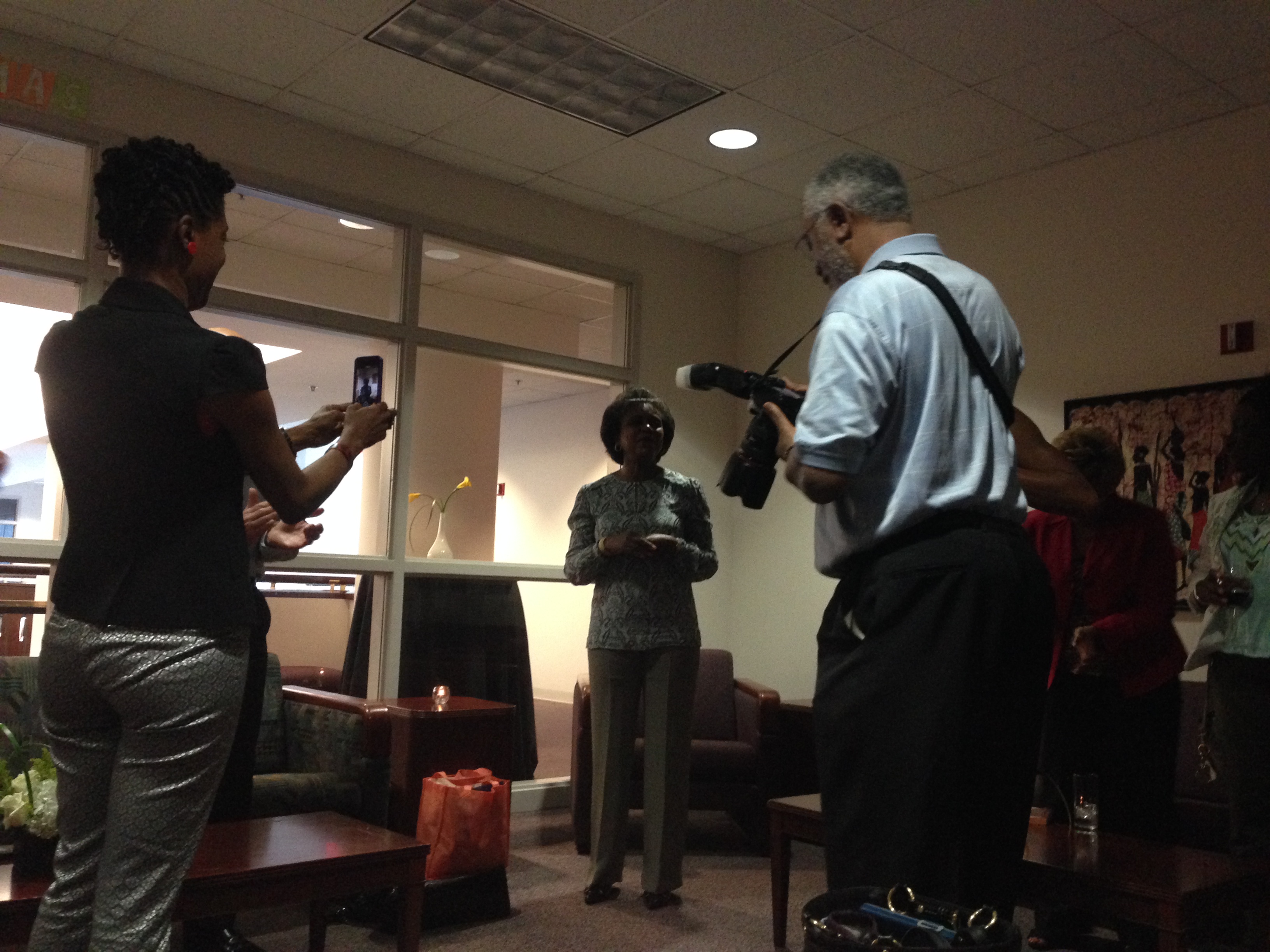
I had the privilege of being one among a small gathering of people who greeted Prof. Anita Hill before the screening of the Frieda Mock documentary about the impetus and the aftermath of Hill’s testimony before the Senate Judiciary Committee in October 1991 regarding the sexual harassment charges Hill leveled against Supreme Court Justice nominee Clarence Thomas.  Anita foregrounds the many women who rallied in support of Hill in ’91 and interestingly, most of the women who narrate this highly provocative media spectacle wherein 14 white men interrogate a black woman, forcing her to recount Thomas’s crimes in graphic detail, are white women. While these women address the significance of the strong narrative of racial betrayal leveled against Hill for her charges against a black man, someone of her own race, and thus disrupting his smooth path to judicial distinction, the narrators say nothing about the sanitized spectacle of this country’s long history of rape against black women dating from the antebellum period. Maybe they did not want to seem to be making a case for Hill as a victim of a “high-tech” raping akin to Thomas’s charge of a “high-tech” lynching having occurred. Charles Ogletree appeared to understand the significance of the intersection between race and gender in this case and decided that showing solidarity with Hill was both his moral and civic responsibility; he said the words, “black woman,” that others noted but were not called to think of in terms of U.S. history. To that end, instead of embracing her as an “icon,” Ogletree acted as someone who knew she needed cover.


Ogletree recognized that no black men were seen who publicly supported Hill and decided he would be among the first. He not only saw Hill’s vulnerability, but that of his daughters and grandchildren who have been born along the same sick, sordid trajectory that begins with antebellum U.S. history and extends well beyond it. Beyond Ogletree, Hill’s former law school classmates and friends offer testimony on her behalf. One of the most moving moments in the film occur when Hill’s family arrives. Despite the Senate’s attempt to make Hill appear ugly and unloveable, her mother and father held their daughter in a loving embrace the moment they arrived. Their gesture models a worthy rebuke to a history and culture of contempt.

Towards the end of Anita, the camera’s gaze lands on the staged 1956 Look magazine photograph of Rosa Parks hanging on the wall of Hill’s Brandeis office. The documentary makes it resoundingly clear that Anita Hill’s testimony helped disrupt the marginalization of sexual harassment as a public issue. What the film does not do is make the case that Hill and Parks are analogous figures. Hill very explicitly and consistently contend that her professional goal was not to testify before the Senate against Clarence Thomas but, as she states, “teach her classes.” Telling “the truth” was Hill’s motivation to ultimately go before the Senate Judiciary Committee regarding Thomas’s conduct. Rosa Parks challenged systems of domination on purpose. Parks was not caught up in an overwhelming situation. As a lifelong activist, she was well prepared that December day. It seems odd to link Hill and Parks together; one black woman who chose to resist and another black woman who fell into the role. While both women were modest dressers, careful speakers, and highly visible socio-political actors, Rosa Parks’s consciousness was a radical one. The association Mock makes between Hill and Parks only works as a sentimental tale, but not as history.

2014 “…and they’re still on the loose.” Beloved

Daniel Holtzclaw
Oklahoma City Police Officer, Daniel Holtzclaw

I’ve been doing a little bit of thinking about Icons and the dangers that come with worshipping them. Given that this era is reflecting on the past 50 years, I’ve been thinking about the civil rights commemorations that have occurred–as well as those to come–the names we honor and sometimes, the violence their names shield. Specifically, I’ve been thinking a great deal about adultery as the violence of “nonviolent” activism. Adultery has been attributed to most of the men’s names heralded from this era of history, black and white, but as with all human beings, these men have faults. This idea emerged for me most recently when viewing a documentary that notes James Bevel’s role as an activist. Bevel, while praised for his idea to train children in the methods of nonviolent direct action, the quirky, strident man that his old friends lovingly recall was not only an adulterer, he was a convicted child molester.

While reading about Aaralyn Mills’s decision to press charges against her father, I couldn’t help but consider how hollow the ring of Danielle McGuire’s claims regarding the primacy black women’s bodies held for generating, maintaining, and fortifying civil rights activism around black women’s vulnerability given Bevel’s crimes. Men who love the black women who live in these bodies don’t shame us, molest us, beat us, rape us. Today, when reading Sikivu Hutchinson’s precise and cogent analysis of the silence of white feminists as mostly poor and working class black women have been victims of the “New Jim Crow” police officers, like Daniel Holtzclaw, still employing antebellum, slave-holders’ practices of maintaining control over black women’s bodies, I decided that Alabama can issue as many apologies as it wants to: “Recy Taylor” remains unsafe (for more evidence, see the L.A.P.D.’s claim to racial blindness in handcuffing black actress, Daniele Watts, after mistaking her for a prostitute).

Models Monday: The Seduction of Reading

When my friend Carmen first told me about Walter Dean Myers’s book The Blues of Flats Brown, I knew that I had to get it for my son. The story is about these two dogs, Flats and Caleb, who are the unfortunate wards of a junkyard proprietor named A.J. Grubbs. Flats and Caleb flee the junkyard after a terrible fight between Caleb and a dog Grubbs has recruited for the task. After he vows to have Flats fight the next day, the two dogs make haste before the fight can take place.

Flats and Caleb survive, with Grubbs hot on their trail, by singing and playing the blues. Eventually, Grubbs grants Flats his freedom when he hears Flats sing a song that reflects his understanding of Grubbs’s character. At that point, Myers writes one of my favorite lines in the story. Everyone thinks that Flats will stay in New York and make lots of money but Myers writes that what “they didn’t know was that Flats was a blues playing kind of dog, not a filthy rich kind of dog.” Flats has “another model by which to live.”

The Blues of Flats Brown by Walter Dean Myers and illustrated by Nina Laden

The idea that he’s not eager to dedicate himself to making money reminds me of an essay on representations of the poor where feminist critic bell hooks decides that representations of poor people in American popular culture show them spending all their time longing for money and the material things it can buy (reality t.v. now does the same thing). She contests this vision with memories of her poor and working class family members who valued creativity and integrity over money.

In The Blues of Flats Brown, Flats and Caleb’s friendship and their ability to sing the music they love means more than living in a big city and making lots of money. Myers notes that some people don’t believe it when they hear the story of two dogs playing the blues down on the waterfront in Savannah, Georgia and I’m sure in part, they don’t believe it because they cannot believe that Flats would choose to give up the chance to be rich. For Flats, wealth was an indulgence of a different order. It involved the time to be creative and to enjoy camaraderie through creation. The way I see it, then, Flats didn’t give up being rich. He exchanged one idea of it for another. Thus, Flats was rich.

In 2012, Walter Dean Myers was named the National Ambassador for Young People’s Literature. I read a wonderful interview conducted with Myers in light of this award and he offered thoughtful words on the role reading plays in contributing to the kind of wealth that Flats enjoys. “It’s the people who read well,” Myers tells the interviewer, “who are going to live a good life.” I especially like the way he qualifies reading. It’s not just reading itself that will lead to a good life, but Myers stresses the importance of reading well. Reading well demands time, attention, discipline, and focus. It requires deliberateness. These are all qualities that the skill itself does not demand but this additional effort makes the experience worthwhile because, as Myers also notes, this sort of reading “will give you clues to how to live your life.”

Myers chose the banner “reading is not optional” to serve his campaign to encourage youth literacy. I have not won a single award for children’s literature so the Library of Congress (loc) won’t be calling me to ask about my banner choice but in the spirit of reading and imagining, if the loc were to call, I would tell them that my banner to encourage reading should say “reading is seductive.” I first thought about the seductiveness of reading after thinking through a passage in Toni Morrison’s novel Paradise. Consolata asks Mavis to help her in shelling pecans. As Mavis sets to work, Morrison writes:

Later, watching her suddenly beautiful hands moving at the task, Mavis was reminded of her sixth-grade teacher opening a book: lifting  the corner of the binding, stroking the edge to touch the bookmark, caressing the page, letting the tips of her fingers trail down the lines of print. The melty-thigh feeling she got watching her. Now, working pecans, she tried to economize her gestures without sacrificing their grace. (42)

If I were asked, I would play up how enticing reading can be. Of course the challenge would be trying to ensure that my message wouldn’t become vulgar, which seems to be the penchant in American culture. But for those of us who find reading seductive, the challenge of convincing others to be similarly enticed remains constant; so perhaps it would be a worthy campaign banner if the loc ever comes calling.